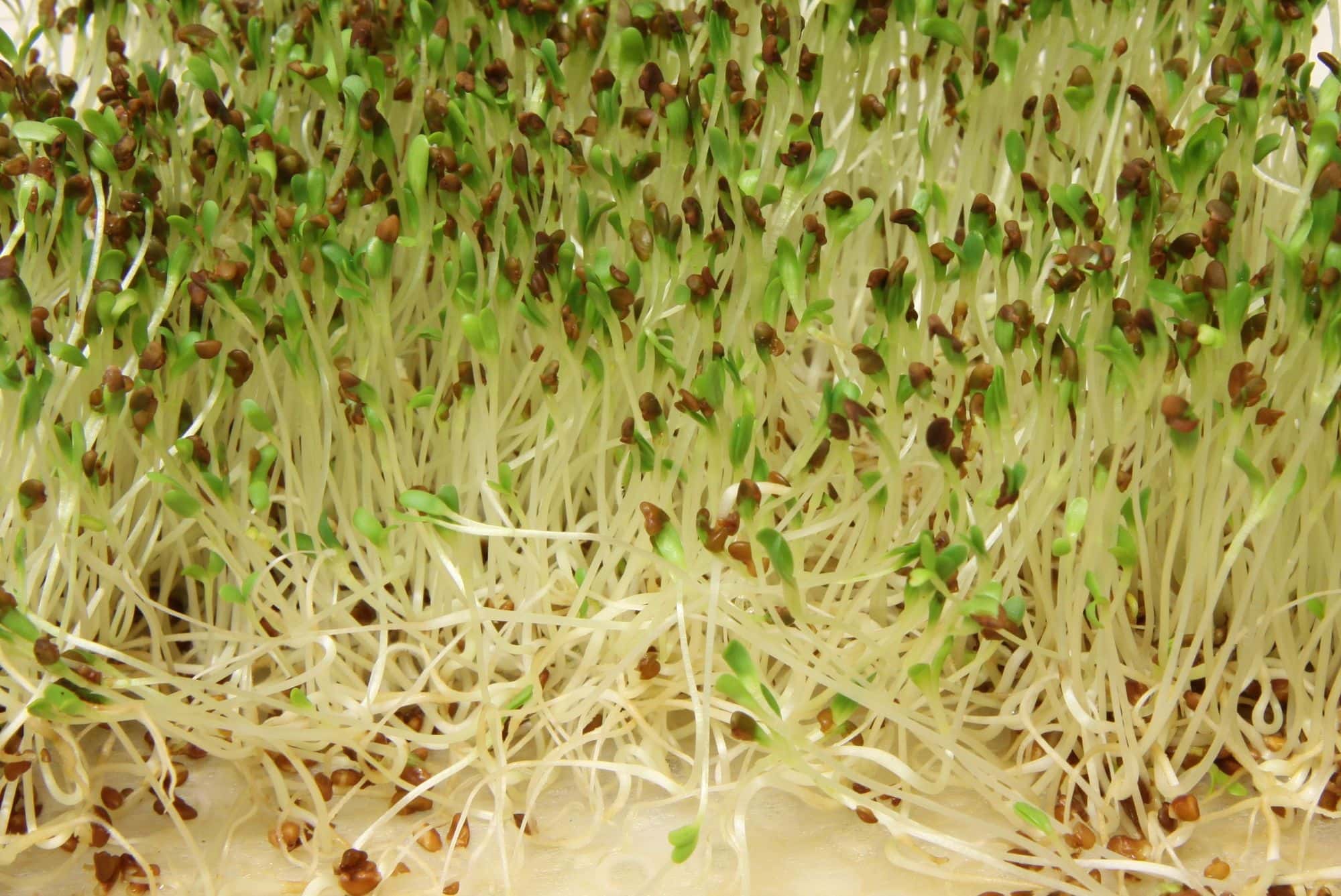
What alfalfa microgreens are
Alfalfa, called lucerne in much of the world and rijka or lasunghas in India, is best known as a fodder crop for cattle. Its seed is small, and it sprouts easily. Grown as a microgreen, it forms a dense tray of fine, pale stems with tiny round seed leaves. The flavour is mild, fresh and slightly sweet, closer to young peas than to the peppery brassicas. Because it has no heat, it is often used as a base in microgreen mixes and in sandwiches.
The Seth et al. 2025 review lists alfalfa with a light-green colour, alongside other legume microgreens such as pea, chickpea, lentil and mung bean. Its seed is far smaller than moong or pea seed, so a tray of alfalfa is a fine, even carpet of thin stems rather than a stand of thick shoots. It has been studied less than broccoli or radish, but several recent trials, summarised below, have measured its yield and pigments.
Alfalfa microgreens and alfalfa sprouts
Alfalfa sprouts and alfalfa microgreens come from the same seed but are grown and eaten differently. Sprouts are germinated in water or a jar for a few days and eaten whole, with seed, root and shoot. Microgreens are sown on a medium, grown in light until the seed leaves turn green, and cut above the roots. The US FDA explains that sprouts grow in warm, humid conditions that suit bacteria such as Salmonella, Listeria and E. coli, and it advises children, older adults, pregnant women and people with weakened immunity to avoid raw alfalfa sprouts.
Microgreens are not the same product. ICAR-IARI researchers note that microbial contamination is less common in microgreens than in sprouts. But microgreens are still eaten raw, and they are grown from the same seed. Buying clean seed, growing in fresh medium, cutting with clean scissors and keeping the harvest cold all matter. Vulnerable people should follow their doctor's advice on raw produce.
| Alfalfa sprouts | Alfalfa microgreens | |
|---|---|---|
| How grown | In water or a jar, usually in the dark | On a medium, in light |
| Part eaten | Seed, root and shoot | Stem and leaves, cut above the roots |
| FDA advice for vulnerable groups | Avoid raw or lightly cooked sprouts | No specific FDA advice; eaten raw, so hygiene matters |
What studies have measured
Fabek Uher and colleagues in Croatia grew alfalfa, red cabbage, yellow beet and fennel microgreens on perlite in floating hydroponics in 2023. Alfalfa had the highest content of every chlorophyll pigment measured: 0.536 mg of chlorophyll a, 0.248 mg of chlorophyll b and 0.785 mg of total chlorophyll per gram fresh weight. Fennel had the most phenols and vitamin C. Alfalfa yielded 0.85 kg per square metre, against 2.69 kg for red cabbage.
A 2021 study of five legume and seven cereal microgreens found that the Bilensoy alfalfa variety had the highest total antioxidant activity and flavonoid content among the legumes. In a 2025 study in the UAE comparing six microgreens in desert sand and rockwool, alfalfa and fenugreek gave the highest fresh and dry weights. These are measured contents and yields. They do not show a health effect in people.
How to grow alfalfa microgreens
In the Croatian trial, alfalfa was sown at 300 g per square metre on perlite, covered with a thin layer of perlite, and kept under black polyethylene film at about 20°C until it germinated, which took 3 days. The trays then went into a floating hydroponic bed with a leafy-vegetable nutrient solution, and the microgreens were cut 20 days after sowing. A 10×20-inch tray covers 0.129 m², so 300 × 0.129 = about 39 g of seed per tray.
- Rinse the seed and pick out any broken or discoloured seeds.
- Fill a tray with 2–3 cm of moist cocopeat, soil or perlite.
- Sow about 39 g per 10×20-inch tray and cover very lightly.
- Cover with black film or a second tray for about 3 days, until germination.
- Uncover and give bright light for 12–16 hours a day; water from below.
- Harvest when the seed leaves are green and fully open, cutting above the medium.
Tips specific to alfalfa
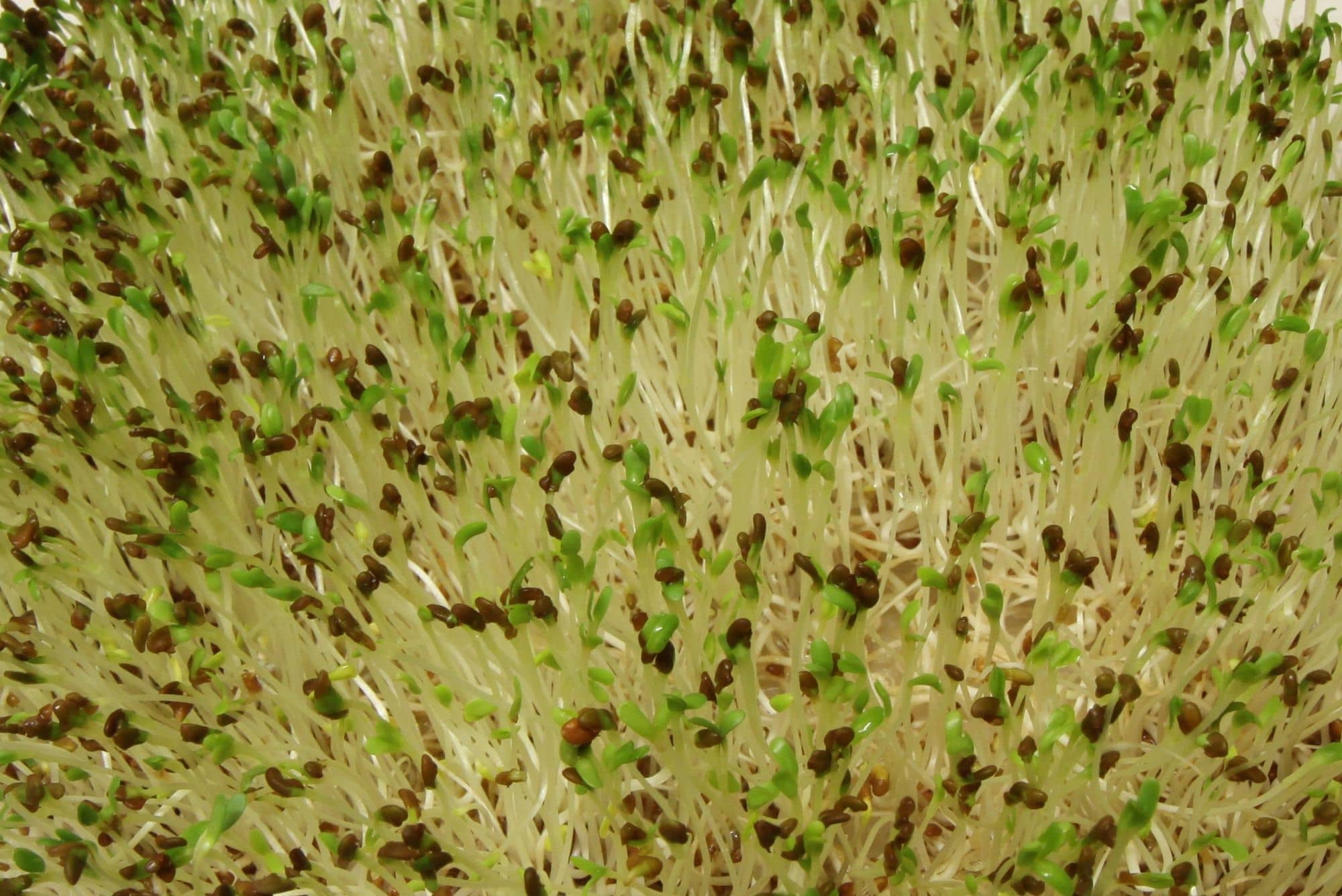
Yield depends heavily on the growing system. In the Croatian trial alfalfa's yield of 0.85 kg per m² was about a third of red cabbage's, yet in the UAE study it was one of the two heaviest of six microgreens. On a home tray, 0.85 kg per m² works out to 0.85 × 0.129 = about 110 g. The medium matters too: in the UAE study, microgreens grown in desert sand outperformed those in rockwool, which the authors linked to the calcium in the sand. Sub-irrigation, which Penn State recommends for microgreens generally, keeps the fine stems dry and upright.
Seed hulls often cling to alfalfa leaves. Rinsing the harvest in cold water floats most of them off, but Penn State notes that washing before storage shortens shelf life, so rinse just before eating, then spin or pat dry. Buy seed sold for sprouting or microgreens and check that it is untreated; Penn State advises against pesticide-treated seed for any microgreen.
Common problems
Alfalfa's fine, dense stand holds humidity, so rot is the main risk. Damping-off, a rot that collapses seedlings at the base, was the one disease Penn State Extension met when growing microgreens, and it is favoured by warm, humid conditions; Penn State suggests watering from below. In Pune's humid months, keep air moving over the trays and sow slightly thinner.
- Seedlings collapsing in patches: damping-off; discard the patch, reduce water and add airflow.
- Poor germination: old or poorly stored seed; buy fresh sprouting-grade seed.
- Hulls stuck to leaves: normal; rinse just before eating.
- Long, weak stems: too little light after uncovering.
Using alfalfa microgreens in food
Alfalfa microgreens are best raw, where their mild taste and soft texture show. Pile them into sandwiches, wraps and kathi rolls, fold them into a cucumber raita or koshimbir, and scatter them over poha, upma, bhel or avocado toast. They balance stronger microgreens such as radish, mustard and arugula in a mix. Add them after cooking, as heat wilts them almost at once. Keep them cold and dry, and rinse just before eating.
Alfalfa and other microgreens in Pune
Garden & Acre delivers fresh microgreens in Pune and Pimpri-Chinchwad, as a weekly subscription for homes and as regular supply for restaurants, cafés and hotels. The microgreens come from our own supply chain. Orders are placed on WhatsApp, and prices are given there. Ask which varieties are available that week, including whether alfalfa is on the list, and tell us the quantity and delivery day you need.
Questions
Are alfalfa microgreens the same as alfalfa sprouts?
No. Sprouts are germinated in water for a few days and eaten whole, root and seed included. Microgreens grow on a medium in light and are cut above the roots once the leaves turn green. The FDA advises vulnerable groups to avoid raw alfalfa sprouts; microgreens are a different product but are still eaten raw, so hygiene matters.
Are alfalfa microgreens safe to eat raw?
For most people, yes, when grown from clean seed and kept cold. Research at ICAR-IARI notes that microbial contamination is less common in microgreens than in sprouts. They are still raw produce, so children, older adults, pregnant women and people with weak immunity should follow medical advice.
How long do alfalfa microgreens take to grow?
In a 2023 Croatian trial, alfalfa germinated 3 days after sowing under black film and was harvested 20 days after sowing in floating hydroponics. Home growers often cut earlier, once the seed leaves are fully green and open. Warm weather speeds growth.
How much alfalfa seed do I need per tray?
The Croatian trial used 300 g per square metre. A 10×20-inch tray covers 0.129 m², so 300 × 0.129 = about 39 g per tray. Spread it evenly in one layer and cover it very lightly, since the seed is small.
What is alfalfa called in Hindi and Marathi?
Alfalfa is called rijka in Hindi and lasunghas in Marathi, and lucerne in much of the English-speaking world. In India it is grown mainly as green fodder for dairy cattle. The microgreens are young seedlings of the same plant, Medicago sativa.
Do alfalfa microgreens have a strong taste?
No. Alfalfa is one of the mildest microgreens, fresh and slightly sweet, with none of the pepperiness of radish, mustard or arugula. That makes it a good base for mixes and a good choice for people who find sharper greens too strong.
Sources
- Fabek Uher et al. 2023, Alfalfa, cabbage, beet and fennel microgreens in floating hydroponics (Plants)
- Nishanth et al. 2025, Harnessing desert resources: microgreens growth in desert sand and rockwool (Front Plant Sci)
- Altuner 2021, Determination of biochemical composition and pigment content in legume and cereal microgreens (Legume Research)
- US FDA: Selecting and Serving Produce Safely
- Priti et al. 2022, Yield optimization, microbial load analysis, and sensory evaluation of mungbean, lentil, and Indian mustard microgreens (PLoS One)
- Seth et al. 2025, Microgreens: functional food for nutrition and dietary diversification (Plants)
- Penn State Extension: Growing Microgreens