Microgreens price per kg: the short answer
Microgreens are sold in small packs, so the price per kg is worked out from the pack price: price ÷ pack weight in kg. A 50 g pack at ₹37 is ₹37 ÷ 0.05 = ₹740 per kg; a 20 g pack at ₹50 is ₹50 ÷ 0.02 = ₹2,500 per kg. The table gathers every listing we opened on 24 September 2026. Hyperpure sells to restaurants and caterers; BigBasket sells to households. No government body or mandi publishes a microgreens price, so dated marketplace listings are the most reliable public figures.
For comparison, the same Hyperpure listings showed coriander leaves at ₹13 for 300 g, which is about ₹43 per kg, and iceberg lettuce at ₹99 per kg. Microgreens cost many times more per kg than the mature leaves because a tray yields only a few hundred grams, the crop is cut within two weeks of sowing, and it keeps for only a few days.
| Seller | Product | Pack | Price | Per kg |
|---|---|---|---|---|
| Hyperpure (Pune) | Microgreen Leaf (Hydroponic) | 50 g | ₹37 | ₹740 |
| Hyperpure | Microgreen Mustard | 100 g | ₹121 | ₹1,210 |
| Hyperpure | Microgreen Radish | 50 g | ₹95 | ₹1,900 |
| Hyperpure | Microgreen Mix | 50 g | ₹118 | ₹2,360 |
| BigBasket | White Radish - Microgreen | 20 g | ₹40 | ₹2,000 |
| BigBasket | Mix (red amaranthus, sunflower, turnip, white radish) | 50 g | ₹104 | ₹2,080 |
| BigBasket | Mix (purple sango radish, spinach, mustard, beetroot) | 50 g | ₹115 | ₹2,300 |
| BigBasket | Sunflower - Microgreen | 20 g | ₹50 | ₹2,500 |
| BigBasket | Beetroot - Microgreen | 20 g | ₹50 | ₹2,500 |
| BigBasket | Purple Sango Radish - Microgreen | 20 g | ₹50 | ₹2,500 |
| BigBasket | Radish Microgreens | 50 g | ₹149 | ₹2,980 |
Wholesale prices on Hyperpure
Hyperpure is Zomato's supply platform for restaurants, and it lists microgreens under exotic vegetables. On 24 September 2026, its Pune page showed Microgreen Leaf (Hydroponic) at ₹37 for 50 g, or ₹740 per kg. Its national pages, with no delivery city chosen, showed radish at ₹95 for 50 g, a mix of radish, mustard, peas, amaranthus, beet and sunflower at ₹118 for 50 g, and mustard at ₹121 for 100 g. The ₹740 listing is the lowest per-kg microgreens price we found, and it is the figure used in the worked example on our business page.
Hyperpure also shows lower rates for larger orders. Radish fell from ₹95 to ₹94 a pack for 3 packs or more and ₹93 for 5 or more. The mix fell from ₹118 to ₹117 and ₹116. Mustard fell from ₹1,210 to ₹1,200 per kg for 0.3 kg or more, and ₹1,180 per kg for 0.5 kg or more. These are small steps, about 2 to 3 percent. A grower selling to a platform like this receives less than the listed price, because the platform adds its own margin, delivery and credit terms.
Retail pack prices on BigBasket
BigBasket's search for microgreens on 24 September 2026 returned 67 results, most of them seed kits. The fresh microgreens were single varieties in 20 g packs and mixes in 50 g packs, all marked 20 percent off and available for 10-minute delivery. White radish was ₹40 for 20 g, and sunflower, beetroot and purple sango radish were ₹50 each for 20 g. A 50 g radish pack was ₹149, and two 50 g mixes were ₹104 and ₹115. No delivery address was set, so prices in your city may differ.
Per kg, those packs work out at ₹2,000 to ₹2,980, which is about 2.7 to 4 times the ₹740 Hyperpure listing. Small retail packs carry the cost of a clamshell or box, a label, cold storage and last-mile delivery for every 20 g sold. They also carry the cost of stock that does not sell before it wilts. Buying larger packs, or a weekly supply, usually lowers the price per 100 g.
Why prices vary by variety: seed cost and yield
Two numbers set most of the difference between varieties: how much seed a tray needs and how much it yields. Johnny's Selected Seeds' 2017 trial sowed 24.5 g of Red Arrow radish per 10 × 20 inch tray and harvested about 283 g, but used 23 g of Bull's Blood beet seed for about 213 g. Seed prices differ too. The table uses seed pack prices listed on Amazon.in on 24 September 2026 to show the seed cost in each kg of harvested greens: seed per tray × seed price ÷ yield per tray.
Beet comes out at about five times the seed cost of radish per kg of greens, because it needs as much seed per tray, the seed costs about four times as much, and the tray yields less. It also takes longer: Johnny's recorded 17 days for beet against 8 days for Red Arrow radish, so each tray position produces fewer beet crops in a month. Amaranth has cheap seed per tray but also took 17 days in the trial. Slow growth and costly seed help explain why white radish was the cheapest single-variety pack in the BigBasket listings.
| Variety | Seed per tray | Seed price listed | Seed cost per tray | Yield per tray | Seed cost per kg of greens |
|---|---|---|---|---|---|
| Radish (Red Arrow) | 24.5 g | ₹385 for 450 g = ₹856/kg | 24.5 g × ₹856/kg = ₹21 | about 283 g | ₹21 ÷ 0.283 = ₹74 |
| Amaranth | 7.5 g | ₹129 for 100 g = ₹1,290/kg | 7.5 g × ₹1,290/kg = ₹9.7 | about 184 g | ₹9.7 ÷ 0.184 = ₹53 |
| Broccoli | 13 g | ₹549 for 100 g = ₹5,490/kg | 13 g × ₹5,490/kg = ₹71 | about 326 g | ₹71 ÷ 0.326 = ₹218 |
| Beet (Bull's Blood) | 23 g | ₹180 for 50 g = ₹3,600/kg | 23 g × ₹3,600/kg = ₹83 | about 213 g | ₹83 ÷ 0.213 = ₹390 |
Yield per square metre in Indian trials
Yield also varies within a variety. In ICAR-IARI trials published by Priti and colleagues in 2022, mungbean microgreens gave 1,854 to 2,168 g per m² at 2 seeds per cm² and 2,123 to 2,572 g per m² at 4 seeds per cm², depending on the genotype. Lentil gave 899 to 1,418 g per m², and Indian mustard 1,092 to 1,356 g per m². Mungbean was ready on day 7, mustard on day 8 and lentil on day 9 after sowing.
On paper, a heavy-yielding crop such as mungbean should sell for less per kg because each tray produces more. In practice the price also depends on demand. A 2025 review by Seth and colleagues, with ICAR authors, notes that mung and lentil microgreens were less accepted by consumers because of their beany flavour, while amaranth, beet and coriander microgreens were better accepted. A variety that chefs ask for can hold its price even if it yields less.
Shelf life, wastage and price
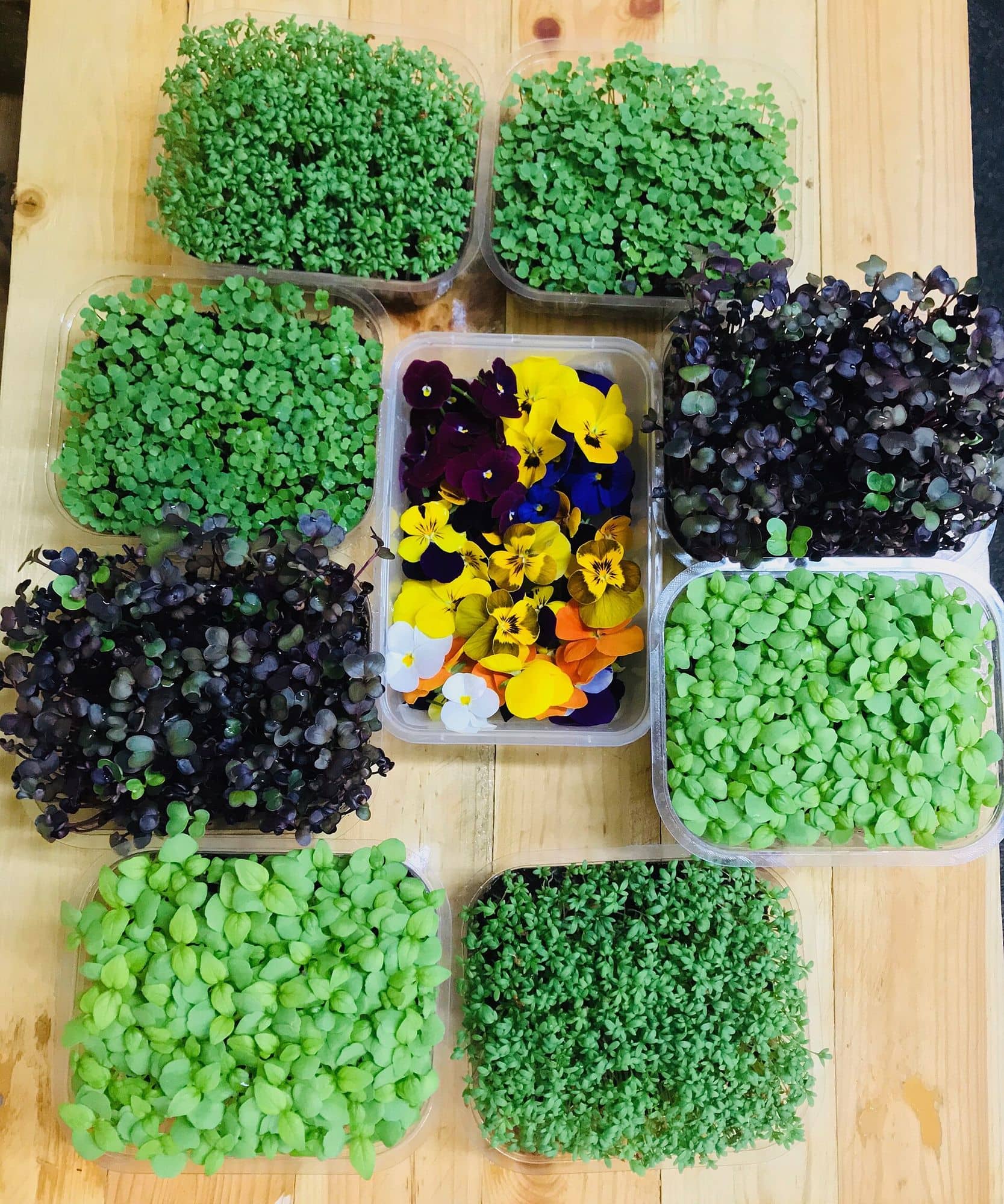
Microgreens lose quality fast, and the seller prices that risk in. The review by Singh and colleagues (2024) gives a shelf life of 2 to 3 days at room temperature, and up to 14 days when stored at about 4 °C straight after harvest. The Seth review gives 3 to 10 days at most under refrigeration. In the ICAR-IARI trial, mungbean and Indian mustard microgreens stayed saleable for about 4 days at 4 °C and lentil for about 6 days.
A seller who throws away one pack in five has to charge a quarter more on the four that sell to earn the same: 5 ÷ 4 = 1.25. That is part of why retail packs cost more per kg than wholesale orders, which are cut to a confirmed quantity. It is also why the harvest date matters more than the price when you compare two packs.
Micro herbs price
Micro herbs, such as basil, coriander and dill cut at the seedling stage, were not listed as separate products on Hyperpure or BigBasket when we checked on 24 September 2026, so there is no dated price to quote. What the trial data does show is why they tend to cost more. In Johnny's 2017 trial, Italian Large Leaf basil took 19 days and yielded about 213 g per tray, and Dark Opal basil took 25.5 days for about 170 g. A tray position that grows radish in 8 days can turn roughly three radish crops in the time one Dark Opal basil crop grows: 25.5 ÷ 8 = 3.2.
What it costs to grow a kg of microgreens
Listing prices make more sense next to the cost of growing. Our business page works through a room with 200 tray positions, using the ICAR-IARI yield of 1.35 kg per m² for Indian mustard and Maharashtra's 2026-27 electricity tariffs. It produces about 75 kg a month at a full cost, including labour, rent, power, seed, packing, delivery and depreciation, of ₹894 to ₹939 per kg. Every rate in that example is marked as sourced or assumed, so the result is a method rather than a quote.
Set against the listings, that cost sits above Hyperpure's ₹740 per kg hydroponic leaf and below its ₹1,210 per kg mustard and ₹1,900 per kg radish. It explains why growers who sell only at the lowest wholesale price struggle, and why many sell part of their harvest in retail packs or weekly subscriptions. Seed, media and packing are the costs that rise with every extra kg; rent, labour and most of the electricity are paid whether the trays sell or not.
What to check when you buy
A low price per pack does not always mean a low price per 100 g, and a fresh pack at a higher price can work out cheaper than a wilted one at a lower price, because less of it goes in the bin. Pack sizes also differ between sellers, from 20 g to 100 g. The points below help compare offers on equal terms, whether you buy for a restaurant kitchen or a household.
- Work out the price per 100 g: pack price ÷ pack weight in grams × 100.
- Ask for the harvest date, not only the packing or expiry date.
- Check the greens are cold on arrival and the leaves are upright and dry, with no slime or smell.
- Compare the same variety: radish and mustard cost less to grow than beet, amaranth or basil.
- For regular use, ask about a weekly order, which usually costs less per 100 g than single packs.
Fresh microgreens delivered in Pune
Garden & Acre delivers fresh microgreens in Pune and Pimpri-Chinchwad, from its own supply chain. Homes can take a weekly subscription, so a fresh pack arrives each week on a set day, and restaurants, cafés and hotels can arrange regular supply in the quantities their kitchens use. Orders are placed on WhatsApp, and current prices for each variety and pack size are given there.
Questions
What is the price of microgreens per kg in India?
On 24 September 2026, Hyperpure listed microgreens at ₹740 to ₹2,360 per kg for restaurant buyers, and BigBasket's retail packs worked out at ₹2,000 to ₹2,980 per kg. Prices change often and vary by city, variety and pack size, so check the listing date when you compare figures.
How much does a 100 g pack of microgreens cost?
Hyperpure listed a 100 g pack of mustard microgreens at ₹121 on 24 September 2026. Retail packs are usually 20 g or 50 g: BigBasket's 50 g packs cost ₹104 to ₹149, which is ₹208 to ₹298 per 100 g. Single-variety 20 g packs cost ₹40 to ₹50.
Why are microgreens so expensive?
A tray yields only a few hundred grams. Johnny's trial recorded about 283 g of radish and 213 g of beet per 10 × 20 inch tray. Seed is a large share of the cost, the crop needs light and cooling, and microgreens keep for only a few days, so sellers price in packing, cold delivery and unsold stock.
Which microgreens are the cheapest?
Radish and mustard are usually the cheapest to grow because the seed is inexpensive per tray and they are ready in 8 to 13 days. In the listings we checked, white radish was ₹40 for 20 g on BigBasket, while beetroot and sunflower were ₹50 for 20 g.
What is the wholesale price of microgreens for restaurants?
Hyperpure, which supplies restaurants, listed microgreens at ₹740 per kg (hydroponic leaf, Pune), ₹1,210 per kg (mustard), ₹1,900 per kg (radish) and ₹2,360 per kg (mix) on 24 September 2026, with small discounts for larger quantities. Direct supply prices from growers are agreed privately and are not published.
Are microgreen seeds expensive?
It depends on the variety. Amazon.in listings on 24 September 2026 worked out at about ₹856 per kg for a 450 g pack of radish seed, ₹3,600 per kg for a 50 g pack of beetroot seed and ₹5,490 per kg for a 100 g pack of broccoli seed. Seed per tray also varies, from about 7.5 g for amaranth to 24.5 g for radish.
Sources
- Hyperpure Pune, Microgreen Leaf (Hydroponic) 50 gm listing (read 24 September 2026)
- Hyperpure, Microgreen Mustard 100 gm listing (read 24 September 2026)
- Hyperpure, Microgreen Radish 50 gm listing (read 24 September 2026)
- Hyperpure, Microgreen Mix 50 gm listing (read 24 September 2026)
- Hyperpure, Lettuce Iceberg 1 kg listing (read 24 September 2026)
- BigBasket, search results for microgreens (read 24 September 2026)
- Amazon.in, search results for microgreens, seed listings (read 24 September 2026)
- Johnny's Selected Seeds, Micro Greens Yield Trial 2017
- Priti et al. (2022), Yield optimization, microbial load analysis, and sensory evaluation of mungbean, lentil, and Indian mustard microgreens, PLoS One (ICAR-IARI)
- Singh et al. (2024), Emergence of microgreens as a valuable food, current understanding of their market and consumer perception: A review, Food Chemistry: X
- Seth et al. (2025), Microgreens: Functional Food for Nutrition and Dietary Diversification, Plants