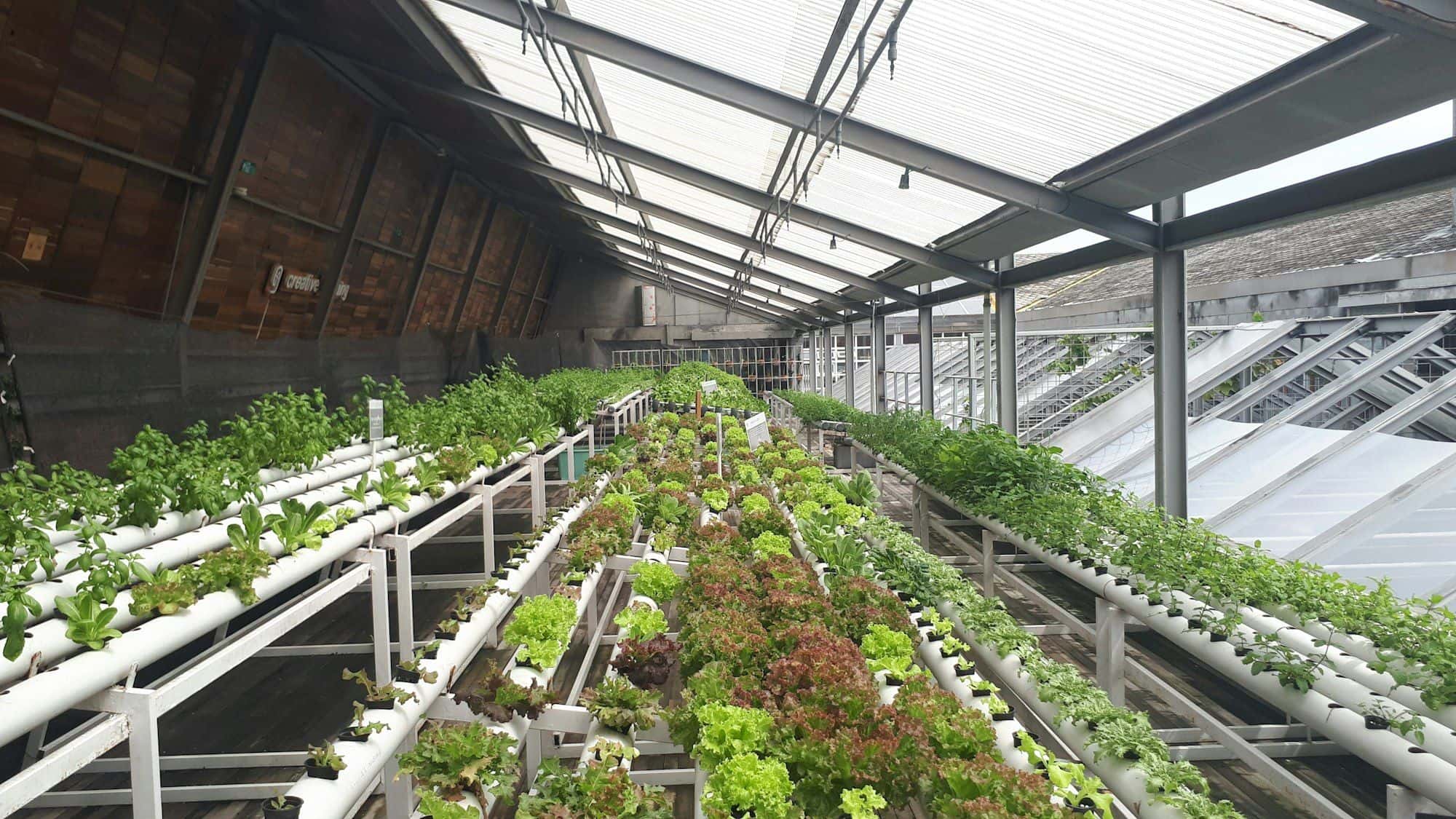
What hydroponic vertical farming means
Hydroponics is growing plants without soil. The roots get water, oxygen and dissolved mineral nutrients directly, from a solution made by dissolving fertiliser salts in water. University of Nevada, Reno Extension lists the practical gains as year-round growing, closer control of the root zone, no weeding, water savings of up to 90 percent, and the ability to space plants closely and stack them vertically. Its listed limits are higher start-up cost, the need for some skill, and the fact that disease, once present, can spread easily through shared water.
Vertical farming adds the second idea: several growing layers stacked on top of each other, usually indoors under LED lights, so that one square metre of floor carries several square metres of crop. Almost every indoor vertical farm in the world is hydroponic or aeroponic, because soil is too heavy to stack and too slow to manage at scale. A vertical hydroponic system is therefore two decisions: how the roots are fed (the hydroponic method) and how the layers are arranged (the rack, tower or A-frame layout).
The five hydroponic methods used in vertical farms
Extension services group hydroponic systems into water-culture systems, where roots sit in or under the solution with no growing medium, and medium-culture systems, where a substrate such as rockwool, coco coir, perlite or expanded clay holds the roots. Systems are also open, where solution flows past once and is discarded, or closed, where the surplus is collected, corrected and reused. Commercial vertical farms are almost always closed, because recirculating the solution is how they save water and fertiliser.
- Nutrient film technique (NFT): a thin film of solution runs down sloped channels past the roots and back to a tank. Oregon State University Extension recommends a minimum 2% slope in horizontal channels.
- Deep water culture (DWC), also called raft or floating culture: plants sit in net pots or foam rafts floating on an aerated tank of solution, with the roots hanging into it.
- Ebb and flow (flood and drain): trays of plants in a medium are flooded from a reservoir on a timer, then drain back by gravity, so the roots alternate between solution and air.
- Drip: solution is delivered to each plant or each tower through drip emitters and flows through a medium. Tower systems that feed from the top are a drip variant.
- Wick (sub-irrigation): solution rises to the roots through a wick or porous medium by capillary action, with no pump. It is passive and suits small home and classroom units.
Nutrient film technique (NFT) in vertical racks and A-frames
NFT is the workhorse of leafy-green vertical farms. Plants sit in holes along a closed channel. A pump lifts solution from a tank to the high end, it flows as a shallow film along the channel floor, and drains back to the tank. The upper roots stay in moist air, which is how NFT keeps roots oxygenated without air pumps. UF/IFAS Extension rates NFT as efficient on water and nutrients, compact and scalable, and suited to leafy greens and herbs.
Oregon State University lists the crops that suit NFT as lettuce, basil, coriander, mint, parsley, spinach, rocket, kale, Swiss chard, mustard greens and some strawberry varieties, all fast-growing and shallow-rooted. The same guide lists the risks: plants wilt quickly if power fails, the shallow film heats up fast, channels can clog, and upper levels shade lower ones when channels are stacked. Long channels warm the solution along their length, so shorter runs are advised where temperature is a concern.
For Indian conditions, the heat point matters most. A thin film in a plastic channel warms quickly in a warm room, and warm solution holds less dissolved oxygen. NFT in India works best in an insulated, air-conditioned room or with a chilled reservoir, and it needs a backup power supply for the pump because roots in an empty channel dry within a short time.
Deep water culture, ebb and flow, drip and wick
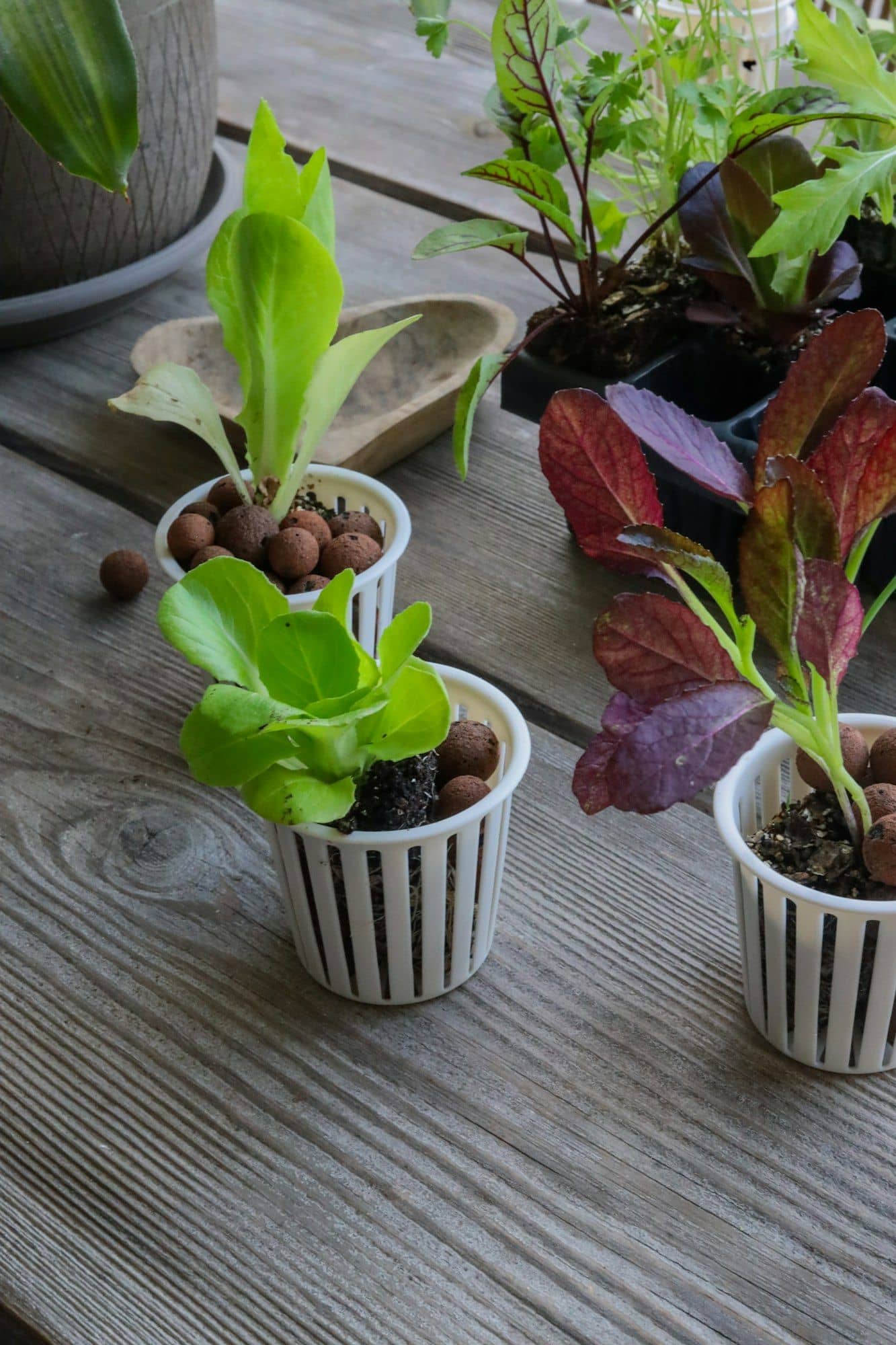
Deep water culture is the most forgiving method. Because the roots sit in a large volume of solution, pH, nutrient strength and temperature change slowly, and a pump failure does not dry the roots at once. UF/IFAS rates DWC as easy to set up, with few mechanical parts and low energy use, but warns that the solution temperature must be managed and that roots become prone to disease if the air supply fails. In vertical racks, DWC means shallow tanks on each shelf, which adds weight: every litre of solution weighs about a kilogram, so shelves and floors must be rated for it.
Ebb and flow suits larger plants and propagation. Oregon State advises flooding to about an inch below the top of the medium and draining once the medium is soaked, then flooding again before it starts to dry. Its limits are dependence on a reliable timer, salt build-up in the medium without flushing, and algae. Drip is the usual choice for fruiting crops in media and for top-fed towers. Wick systems have no pump, so they are silent and cheap, but they move water slowly and do not suit large, thirsty plants.
Comparison of hydroponic systems for vertical farming
The table compares the five methods on the points that decide a vertical farm design: how the roots are fed, how exposed they are to a pump or power failure, which crops fit, and which layout the method is normally used in. UF/IFAS Extension rates DWC as the cheapest of the pumped systems, with NFT and ebb and flow one step up and aeroponics the most expensive. For most leafy-green farms the real choice is between NFT and DWC; ebb and flow and drip come in for propagation, larger plants and towers.
| Method | How roots are fed | If the pump stops | Best crops | Usual vertical layout |
|---|---|---|---|---|
| NFT | Thin film of solution in sloped channels | Roots dry quickly; plants wilt | Lettuce, herbs, spinach, kale, some strawberries | Multi-tier racks, A-frames |
| Deep water culture | Roots hang in aerated tank | Slow decline; air pump is the weak point | Lettuce and other leafy greens | Shallow tanks on racks |
| Ebb and flow | Tray flooded and drained on a timer | Medium holds some water for a while | Seedlings, microgreens, herbs, larger plants | Rolling benches, racks |
| Drip | Emitters feed each plant or tower top | Medium holds some water for a while | Fruiting crops, strawberries, tower crops | Towers, gutters, vertical bags |
| Wick | Capillary rise through a wick or medium | Not affected (no pump) | Small herbs and leafy greens | Home and classroom units |
Rack vs tower vs A-frame layouts
A rack system stacks horizontal growing layers, usually NFT channels, DWC tanks or ebb-and-flow trays, on steel shelving with an LED fixture above each layer. This is the layout of most indoor commercial vertical farms, because it gives even light to every plant and allows automation such as moving trays. Its cost is mostly in lights and air conditioning, since every layer needs its own light and every watt of light ends up as heat.
A tower system stands plants on the outside of a vertical pipe or column. Solution is pumped to the top and trickles down past the roots, as drip or as a low-pressure spray. Towers take very little floor space and are the usual format for homes, cafés, schools and rooftops, where they can use sunlight. Under sunlight the side facing away from the sun gets less light, so towers are often rotated or spaced apart.
An A-frame sets NFT channels on two sloping sides of a triangular frame, like the letter A. It is a way to fit more channel length onto a small footprint in a greenhouse or open rooftop while letting sunlight reach both faces. A-frames are common in small commercial and hobby greenhouse setups. The trade-off is uneven light between upper and lower channels, and the lower channels shade each other if the frame is too steep.
| Layout | Light source | Typical hydroponic method | Strengths | Watch-outs |
|---|---|---|---|---|
| Multi-tier rack | LED on every layer | NFT, DWC, ebb and flow | Most plants per m² of floor; even light; easy to automate | High electricity and cooling load; floor loading |
| Tower | Sunlight or LED | Drip or low-pressure spray | Small footprint; suits homes, cafés, rooftops | Uneven light around the tower; clogging of top feed |
| A-frame | Mostly sunlight | NFT | More channel length per m² in greenhouses | Lower channels get less light; heat in channels |
Components of a vertical hydroponic system

Whatever the method and layout, a vertical hydroponic farm is built from the same parts. The list below is the working set for a closed, recirculating indoor system. A sunlit rooftop tower needs fewer of them, since it has no grow lights or air conditioning; a sealed indoor rack farm needs all of them. The items most often under-budgeted are the ones that protect the crop when something goes wrong: backup power, spare pumps, and a way to sterilise the solution before it goes back to the plants.
- Growing structure: racks, towers, A-frames, channels, trays or rafts, rated for the weight of wet plants and solution.
- Reservoir or nutrient tank, opaque to stop algae, with a lid.
- Pump sized for the head height of the tallest layer, plus a timer or controller.
- Air pump and air stones for deep water culture tanks.
- Plumbing: supply lines, drains, valves and a filter to catch roots and debris.
- Growing medium for seedlings and plugs: rockwool, coco coir, foam or expanded clay, with net pots.
- Nutrient concentrates, usually as two-part A and B stock solutions, plus pH up and pH down.
- Meters for pH and electrical conductivity (EC), or inline sensors with dosing pumps in larger farms.
- LED grow lights and drivers for indoor layers, with timers.
- Climate control: air conditioning or heat pumps, dehumidification, fans for air movement, and in sealed rooms CO₂ supply.
- Solution treatment: UV, ozone or heat sterilisation for recirculated water, which UNR Extension lists as the common methods.
- Backup power: an inverter or generator sized at least for pumps and air pumps.
- Propagation area for seeding and germination, and a clean harvest and packing area.
Energy and running costs of hydroponic vertical farms
In a sunlit tower or A-frame, electricity is mainly pumping, which is small. In an indoor rack farm, electricity is the largest running cost. A 2024 benchmarking study of vertical farms found lettuce needs about 10 to 18 kWh of electricity per kg in current farms, with lighting taking 65 to 85 percent of the total. Cooling to remove the heat from the lights takes most of the rest.
To put that in rupees, take a small farm in Maharashtra on the low-tension non-residential tariff for loads up to 20 kW. For 2026-27, MERC approved an energy charge of ₹8.51 per kWh plus a wheeling charge of ₹1.60, a variable charge of ₹10.11 per kWh, before fixed charges and duties. At 10 kWh per kg, 10 × ₹10.11 = ₹101 of electricity per kg of lettuce. At 18 kWh per kg, 18 × ₹10.11 = ₹182 per kg. That range is why indoor farms in India focus on crops that sell well above those numbers, such as premium lettuce, herbs and microgreens.
Labour is the other big line. A 2022 study of Japanese plant factories by Zhuang and colleagues put labour at the largest single cost per square metre of lettuce, ahead of electricity, with seeds, nutrients, packaging and logistics making up most of the rest. Automation of seeding, transplanting and harvesting is how large farms reduce it. Smaller farms reduce it with layouts that keep work at waist height, trays that move to the worker, and crop schedules that batch the same task on the same day.
Choosing a vertical hydroponic system in India
Start from the crop and the site, not the equipment. Leafy greens and herbs grown indoors point to NFT or DWC on racks under LEDs. Strawberries and fruiting crops point to drip-fed towers or gutters, often in a greenhouse. A home, café or school with a sunny balcony or terrace points to towers, which need no grow lights for most of the year in most of India.
Then plan for the two Indian constraints: heat and power. Summer room temperatures in much of the country warm nutrient solution above the range leafy greens like, so indoor rooms need insulation and cooling, and outdoor towers need shade in the hottest months. Power cuts and voltage dips are a direct crop risk for NFT and aeroponics, so budget for an inverter or generator from the start. Finally, check support: the National Horticulture Board has been reported (Krishi Jagran, 2022) to give a credit-linked, back-ended subsidy of 20 percent of project cost, capped at ₹25 lakh (₹30 lakh in the North East and hilly areas), for hydroponic projects over 1,000 m² under protected cultivation. Confirm the current terms against NHB and MIDH guidelines before planning on it.
Hydroponic vertical farm setup with Garden & Acre
Garden & Acre designs and builds hydroponic vertical farms for rooftops, warehouses, campuses, hotels, schools and cafés. The work covers feasibility, system choice between NFT, DWC and towers, design, build, commissioning and support through the first crop. Farms are priced in a written proposal after a call, with the site visit and build carried out under the agreement. For homes, cafés and schools that want a smaller start, Garden & Acre installs hydroponic and aeroponic towers from ₹14,000 per tower, including the tower, pump, timer, first seedlings, nutrients, training and a refill plan.
Questions
Which hydroponic system is best for vertical farming?
For leafy greens and herbs indoors, NFT channels or deep water culture tanks on multi-tier racks under LEDs are the most common choice. NFT uses less water per plant and is lighter, while DWC is more forgiving of pump failures and temperature swings. For fruiting crops and strawberries, drip-fed towers or gutters work better. For small homes and classrooms, wick or tower systems are simplest.
What is a vertical hydroponic system?
A vertical hydroponic system is any soilless growing setup where plants are arranged in several layers or up a column rather than on one flat bed. The common forms are multi-tier racks with NFT channels or DWC tanks, vertical towers fed from the top, and A-frames with sloping NFT channels. All of them recirculate a nutrient solution with a pump, except passive wick units.
What is the difference between NFT and deep water culture?
In NFT, a thin film of nutrient solution flows along a sloped channel past the roots and drains away, so the roots are partly in air. In deep water culture, the roots hang in a tank of aerated solution. NFT is lighter and uses less solution, but roots dry quickly if the pump stops. DWC holds far more water, so it is heavier but more stable.
Is a hydroponic tower better than a rack system?
Neither is better in general. Towers suit homes, cafés, schools and rooftops because they use sunlight and take little floor space. Racks suit indoor commercial farms because every layer gets even LED light and the layout is easy to automate. Racks cost more to run because each layer needs its own light and the room needs cooling.
How much electricity does an indoor hydroponic vertical farm use?
A 2024 benchmarking study found indoor vertical farms use about 10 to 18 kWh of electricity per kg of lettuce, with lighting at 65 to 85 percent of the total. At a Maharashtra small commercial tariff of ₹10.11 per kWh, that is roughly ₹101 to ₹182 of electricity per kg, before fixed charges.
What components do I need for a vertical hydroponic system?
You need a growing structure, a covered reservoir, a pump and timer, plumbing with a filter, net pots and a seedling medium, two-part nutrients, pH and EC meters, and for indoor layers LED lights and climate control. Deep water culture also needs an air pump. In India, add backup power for the pumps and a way to keep the solution cool in summer.
Sources
- UF/IFAS Extension: Hydroponic Production Methods, Part 1 (2025)
- Oregon State University Extension: Hydro hints, Nutrient film technique (EM 9457)
- Oregon State University Extension: Hydro hints, Ebb and flow (EM 9458)
- University of Nevada, Reno Extension: Hydroponics, A Brief Guide to Growing Food Without Soil (FS-15-08)
- Benchmarking energy efficiency in vertical farming: status and prospects (2024)
- Zhuang et al. (2022), Economies of scale in constructing plant factories with artificial lighting, Frontiers in Plant Science
- MERC tariff order, Case No. 75 of 2025 (25 March 2026), MSEDCL