What microgreens are and why they suit vertical farms
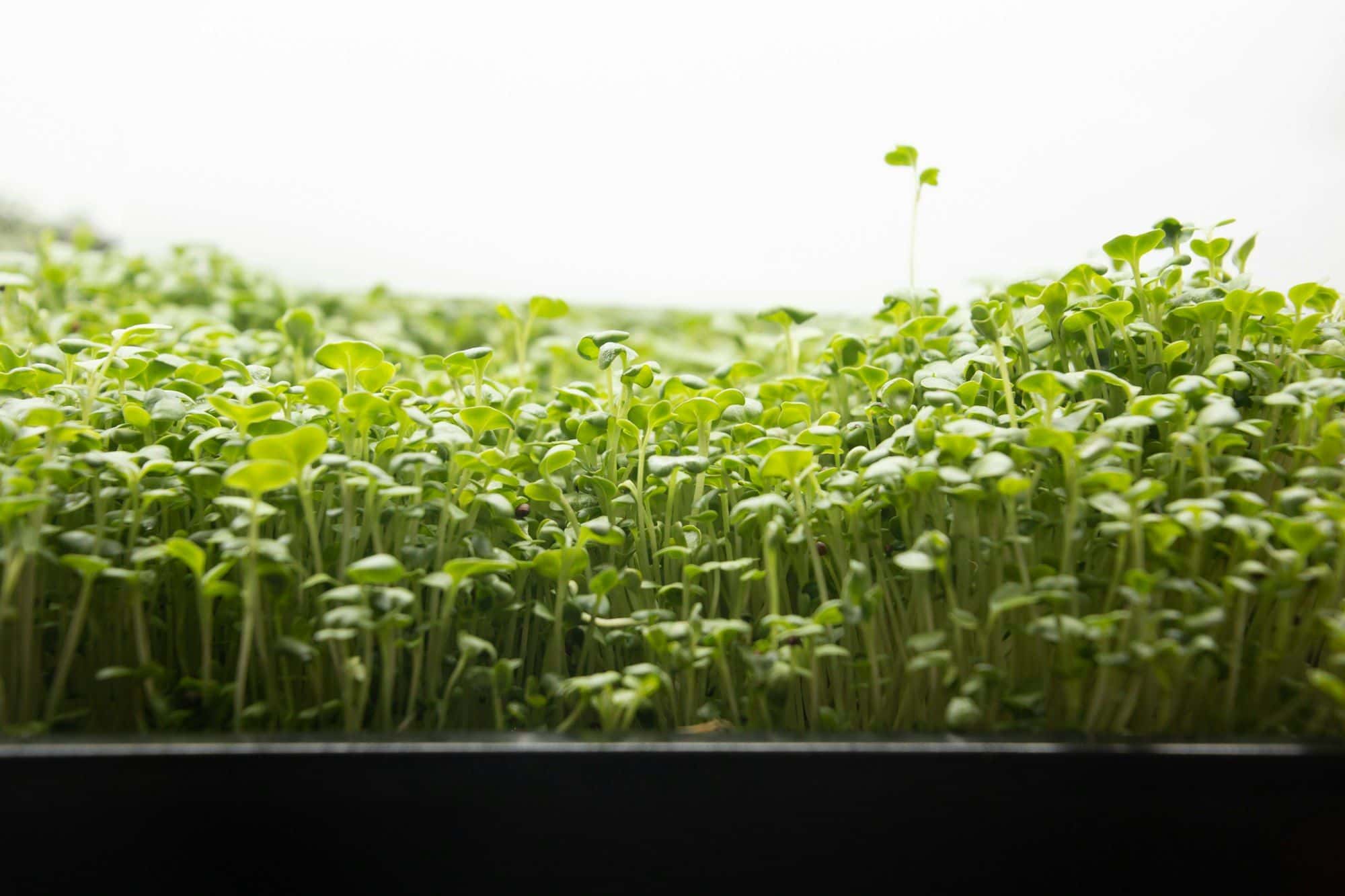
The University of Maryland Extension defines microgreens as fast-growing, closely spaced vegetable seedlings harvested at the true leaf stage, eaten with their stems and seed leaves. They are cut at 5–8 cm tall, 7–21 days after sowing. Baby greens are the next stage, at 10–15 cm and 21–40 days. Sprouts are different again: sprouts are germinated seeds eaten whole, roots and all, usually grown in water without light. Microgreens grow in a medium under light and are cut above the root line.
Three features make microgreens the easiest crop to run on vertical racks. The plants are short, so shelves can sit 30–45 cm apart and a single rack holds four or five layers. The cycle is short, so a tray earns several times a month. The crop is sold fresh and by weight to chefs, who pay for flavour, colour and reliable daily supply. The dining team's indoor farm on Microsoft's campus, for example, focused first on microgreens and lettuce, using automated cabinets that hold 16 trays of microgreens and turn a crop in as little as eight days.
Best microgreen varieties for vertical farming
The brassica family (radish, mustard, broccoli, kale, cabbage, arugula, mizuna) is the core of most microgreen farms. These seeds germinate in about 36 hours at 22 °C, grow evenly and are ready in 8–14 days. The amaranth family (beet, chard, amaranth) and herbs such as coriander and basil are slower, at 16–25 days, but they add colour and flavour that chefs ask for. Pea shoots and sunflower are heavier crops, usually grown from soaked seed.
The table below uses Johnny's Selected Seeds' 2017 yield trial, which sowed each variety at least three times in standard 10 × 20 inch (1020) trays and harvested at the first true leaf. Yields were published in ounces and are converted here at 28.35 g per ounce. Treat them as starting figures. The trial notes that yield varies widely with technique, system, climate, harvest stage and seed lot.
| Variety | Seed per tray | Yield per tray | Days to harvest |
|---|---|---|---|
| Radish, Red Arrow | 24.5 g | about 283 g | 8 |
| Radish, Hong Vit | 28.5 g | about 326 g | 9.5 |
| Broccoli | 13 g | about 326 g | 12.5 |
| Mustard, Garnet Giant | 8 g | about 269 g | 12.5 |
| Kale, Red Russian | 10 g | about 312 g | 13.5 |
| Red cabbage | 10.5 g | about 241 g | 13.5 |
| Arugula | 10 g | about 283 g | 14 |
| Amaranth, Garnet Red | 7.5 g | about 184 g | 17 |
| Beet, Bull's Blood | 23 g | about 213 g | 17 |
| Basil, Italian Large Leaf | 6.5 g | about 213 g | 19 |
| Coriander (cilantro) | 26 g | about 170 g | 20 |
Trays and growing media for microgreens
The standard commercial tray is the 1020 flat, about 10 × 20 inches (25 × 50 cm). Most growers use a two-tray system: an upper tray with drainage holes that holds the medium and seed, sitting inside a solid lower tray that holds water. This allows bottom watering, which keeps leaves dry and reduces mould. Racks are sized around the tray: with the short side facing forward, a shelf 120 cm wide and 60 cm deep holds four trays in a row.
Penn State Extension lists three kinds of medium: peat-based mixes, coconut coir, and fibre mats such as hemp, kenaf, cotton or rockwool. Coir is the common choice in India because it is produced locally and is clean and light. Mats are neater and easier to handle on high shelves but cost more per tray. The medium needs only 2.5–4 cm of depth. No fertiliser is needed for most microgreens because the seed carries enough energy for a short crop. Garden soil should not be used.
A third option is substrate-free growing on mesh trays over water. A 2023 study in Frontiers in Plant Science grew five radish cultivars this way in a multi-layer vertical unit, using only seeds and water changed daily. The trays yielded 1.97–3.11 kg of fresh microgreens per square metre in 10 days. The method removes the cost and waste of media, but it needs strict water hygiene.
Light, temperature and water for microgreens
Extension guides recommend about 16 hours of light a day, with lamps 15–30 cm above the leaves. LED strips are the standard on vertical racks because they run cool and can sit close to the crop. Lettuce and Asian greens tolerate lower light than other crops. Higher light gives shorter, thicker stems and deeper colour, which chefs prefer; too little light gives tall, pale, floppy greens. For reference, the substrate-free radish study described above used a 16-hour day at 600 µmol per square metre per second and 20 °C.
The UMD guide gives 21–24 °C as the best range for germination and growth. That is the main challenge in Indian summers, when an unconditioned room in most Indian cities runs well above that range for weeks at a time. Warm, humid air with little movement is the condition in which mould and damping-off spread across a tray. A small fan per shelf and an air conditioner or evaporative cooling for the room are normal in Indian set-ups. Tap water is acceptable if it is clean. Keep the medium moist, never saturated.
The microgreens growing cycle, day by day
Most farms run the same sequence for every tray, with the timing changed by variety. Large seeds such as pea and sunflower are soaked first. Brassicas are sown dry. The dark period, often called the blackout, keeps the seedlings stretching upward evenly before they meet light. Record the sowing date, variety and seed weight on each tray so yields can be compared. The steps below describe a typical 8–12 day brassica cycle.
- Day 0: clean and sanitise the tray, fill with moist coir or lay a mat, sow the seed evenly at the variety's rate, mist and cover.
- Days 1–3: keep the tray covered and dark at 21–24 °C, mist if the surface dries. Brassicas germinate in about 36 hours.
- Days 3–4: uncover once the seedlings are 2–3 cm tall and move the tray under the lights.
- Days 4–9: 16 hours of light a day, bottom water as needed, keep a fan running across the shelf.
- Days 8–12: cut when the first true leaves show, clean the tray, and start the next sowing the same day.
Harvesting and storing microgreens
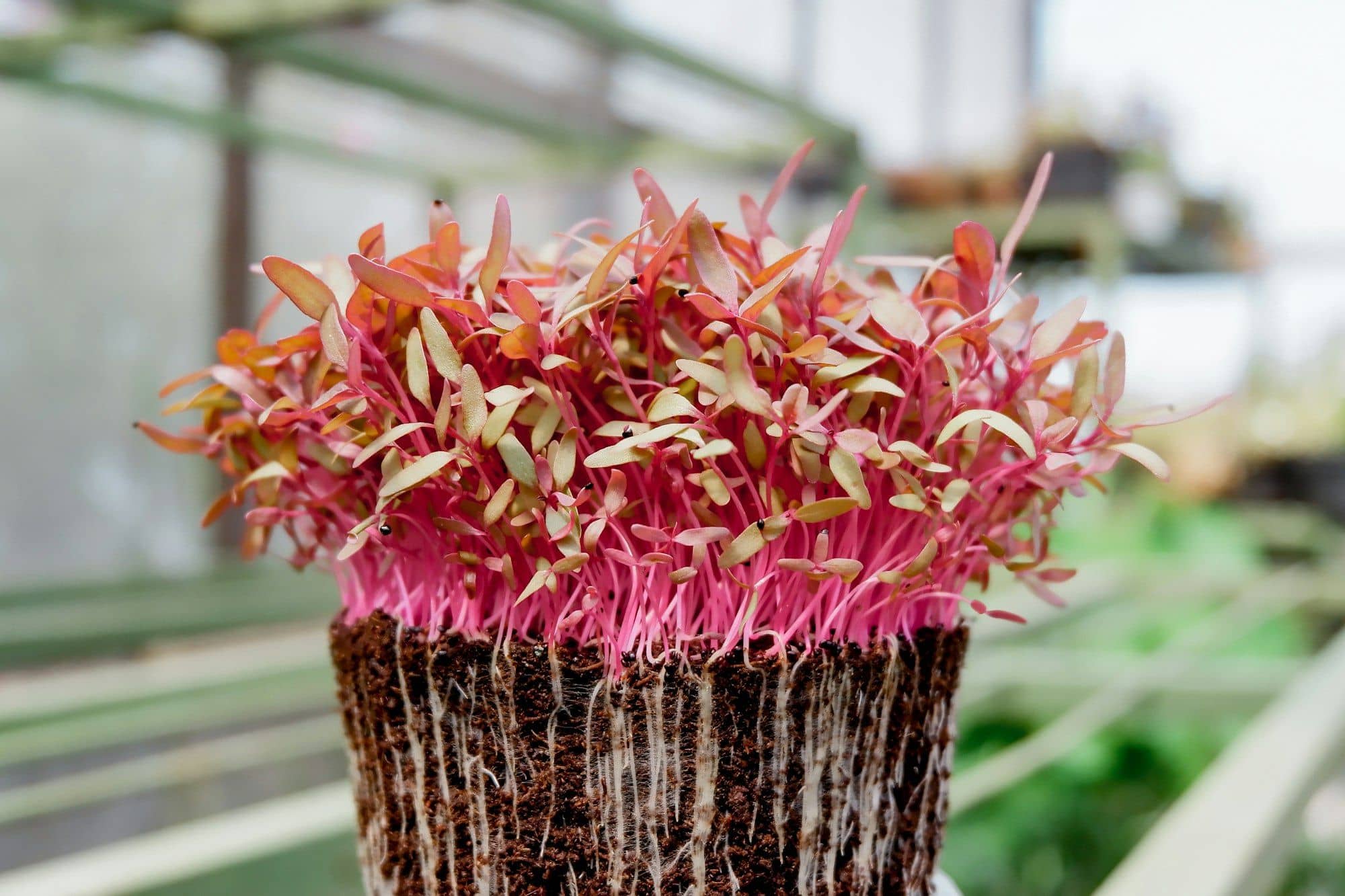
Cut the stems just above the medium with clean, sharp scissors or a knife once the true leaves have opened. Harvest dry: washing before storage shortens shelf life, so Penn State advises bagging unwashed greens and keeping them cold, then washing just before use. UMD gives up to 10 days in the refrigerator for rinsed and dried greens. USDA research on buckwheat microgreens found that storage at 5 °C with a modified atmosphere extended shelf life beyond 14 days.
For restaurant supply, most growers harvest to order the evening before or the morning of delivery, pack into clamshells or lined boxes in 50 g or 100 g units, and deliver in an insulated box. Some chefs prefer live trays, which they cut in the kitchen as needed. Live trays remove the harvest labour and give the longest freshness, but they need collection and cleaning of empty trays.
Food safety for microgreens
Microgreens are a raw food, often eaten as garnish. The main hazards are Salmonella, E. coli and Listeria, and the main sources are contaminated seed, growing media and irrigation water, followed by worker hygiene and handling. A 2023 study in Frontiers in Sustainable Food Systems tested 102 microgreen seed samples bought online: 48% carried coliforms, one onion sample was positive for Salmonella and one carrot sample presumptive positive for Listeria. The authors note that recalls of microgreens for Salmonella and Listeria have occurred, though no confirmed outbreak had been linked to them.
Practical controls follow from those routes. Buy seed sold for sprouting or microgreens from a supplier who tests lots. Keep seed dry and sealed. Wash and sanitise trays between every cycle. Use clean water, and do not reuse runoff. Keep harvest knives, gloves and packing tables separate from growing areas. The same study found that a 10-minute soak in 3% hydrogen peroxide followed by heat at 60 °C for 20 hours reduced seed microbes without hurting germination, but seed treatment should be tested on a small batch first.
In India, selling microgreens is a food business. Under FSSAI's eligibility criteria updated on 1 April 2026, basic registration (₹100 a year) covers annual turnover up to ₹1.5 crore, and a State licence applies from ₹1.5 crore to ₹50 crore. Hotels and larger restaurant groups will usually ask for the FSSAI number before placing an order, and some ask for a hygiene audit of the growing room. GST registration becomes compulsory once turnover crosses the threshold for your state.
Selling microgreens to restaurants in India
The buyers are fine-dining restaurants, five-star hotel kitchens, cafés, cloud kitchens, salad and juice bars, gyms and premium grocers. Demand is concentrated in metros and large cities such as Mumbai, Pune, Bengaluru, Delhi NCR and Hyderabad. IMARC puts the Indian microgreens market at USD 78.7 million in 2025 and projects USD 158.6 million by 2034. That is a small market in national terms, and each city's chef community is small, so a grower wins accounts one kitchen at a time.
Prices are not published by any official body and vary widely. The IIFL business guide quotes restaurant wholesale at ₹250–₹400 per 100 g and retail at ₹600–₹900 per 100 g, which is ₹2,500–₹4,000 per kg wholesale. Other published guides quote lower bulk figures. Treat any number as a quote to test with local chefs, not a planning price. What chefs value most is reliability: the same varieties, the same quality and delivery on the agreed days every week.
- Start with four to six varieties chefs already know, such as radish, mustard, pea shoots, sunflower, beet and basil.
- Offer a sample box and a fixed weekly order, delivered on set days.
- Price per 100 g or per live tray, not per kg, because that is how kitchens use them.
- Keep an FSSAI number, a clean invoice and a cold chain from harvest to kitchen.
Planning a microgreens rack: a worked example
Take a single four-shelf rack, 90 cm wide, with three 1020 trays per shelf, so 12 trays. Radish at about 8 days, plus a day for cleaning and sowing, allows roughly three cycles a month per tray. That gives 12 trays × 3 cycles = 36 trays a month. At Johnny's radish yield of about 283 g per tray, 36 × 0.283 kg = 10.2 kg a month. At the low end of IIFL's wholesale quote, ₹2,500 per kg, 10.2 kg × ₹2,500 = ₹25,500 a month in sales, before seed, media, power, packing, delivery and labour.
The seed line is easy to check: 36 trays × 24.5 g = 882 g of radish seed a month. Power depends on your LED wattage: a rack with 12 fixtures of 20 W running 16 hours for 30 days uses 12 × 20 W × 16 h × 30 = 115 kWh, which at an assumed ₹10 per unit is ₹1,150. The wattage and tariff here are assumptions; replace every number with your own quotes and your electricity bill. The real limit is not the rack but how many chefs will buy 10 kg a month from you, which is why most growers secure buyers before adding racks.
Setting up a microgreens farm with Garden & Acre
Garden & Acre designs and builds vertical farms for cafés, hotels, schools and commercial growers, including microgreens rooms with racks, lighting, airflow and a cleaning routine. A project starts with a call, then a written proposal priced for the site, then the site visit and build under the agreement, followed by commissioning and first-crop support. For a café or school that wants a small, self-contained unit, a hydroponic or aeroponic tower from ₹14,000 installed is the simpler option, although towers suit lettuce and herbs better than tray microgreens.
Questions
How many days do microgreens take to grow?
Most brassica microgreens, such as radish, mustard, broccoli and kale, are ready in 8–14 days. Beet, chard, amaranth and herbs such as basil and coriander take 16–25 days. Johnny's Selected Seeds' trial recorded 8 days for Red Arrow radish and 20 days for coriander. Warm rooms speed growth but reduce uniformity, so a steady 21–24 °C gives the most predictable cycle.
How much do microgreens yield per tray?
In a standard 10 × 20 inch tray, most varieties give about 170–330 g. Johnny's trial recorded about 283 g for Red Arrow radish, 326 g for broccoli and 170 g for coriander. Pea shoots and sunflower are heavier. Yield depends on seed rate, harvest stage, light and seed lot, so measure your own trays for several cycles before planning sales.
Do microgreens need grow lights?
A bright, south-facing window can work at home, but a vertical rack needs grow lights because the lower shelves get no daylight. Extension guides recommend about 16 hours of light a day with LEDs 15–30 cm above the leaves. Too little light produces tall, pale and weak stems that chefs will not buy.
Is an FSSAI licence needed to sell microgreens?
Yes. Selling microgreens is a food business in India. Under FSSAI's criteria updated on 1 April 2026, basic registration covers annual turnover up to ₹1.5 crore, and a State licence applies from ₹1.5 crore to ₹50 crore. Hotels and restaurant groups normally ask for the FSSAI number before buying. GST registration becomes compulsory only above the turnover threshold that applies in your state.
Are microgreens safe to eat raw?
They are generally safe when grown cleanly, but they are a raw food and can carry Salmonella, E. coli or Listeria from contaminated seed, media or water. Microgreens have been recalled for Salmonella and Listeria. Use tested seed, sanitise trays between cycles, use clean water, keep harvest tools clean and store greens cold.
What price do microgreens sell for in India?
There is no official price series. One published business guide from IIFL quotes ₹250–₹400 per 100 g wholesale to restaurants and ₹600–₹900 per 100 g retail. Other guides quote lower bulk rates. Prices depend on the city, the variety and whether you sell cut greens or live trays, so ask local chefs before planning.
Which microgreens are easiest for beginners?
Radish, mustard and broccoli are the easiest because they germinate in about a day and a half, grow evenly and are ready in 8–13 days. Pea shoots and sunflower are also forgiving once the seed has been soaked. Basil, coriander and amaranth are slower and less even, so add them after you have a steady routine.
Sources
- FSSAI FoSCoS, Kind of Business eligibility criteria and fee structure (updated 01.04.2026)
- Growing Microgreens and Baby Greens Indoors — University of Maryland Extension
- A Step-By-Step Guide for Growing Microgreens at Home — Penn State Extension
- Micro Greens Yield Trial 2017 — Johnny's Selected Seeds
- Radish microgreens produced without substrate in a vertical multi-layered growing unit are rich in nutritional metabolites — Tilahun et al., Frontiers in Plant Science, 2023
- Microbiological quality of microgreen seeds purchased from online vendors and evaluating seed decontamination techniques — Ocho Bernal, Lyttle & Jung, Frontiers in Sustainable Food Systems, 2023
- Microgreens research feature — USDA ARS AgResearch Magazine, January 2014
- How to start a microgreens business in India — IIFL
- How to Start a Microgreen Farm in India (FSSAI and GST) — LegalWiz.in
- India Microgreens Market Report — IMARC Group
- See Microsoft's in-office urban farming experiment — GreenBiz (Trellis)