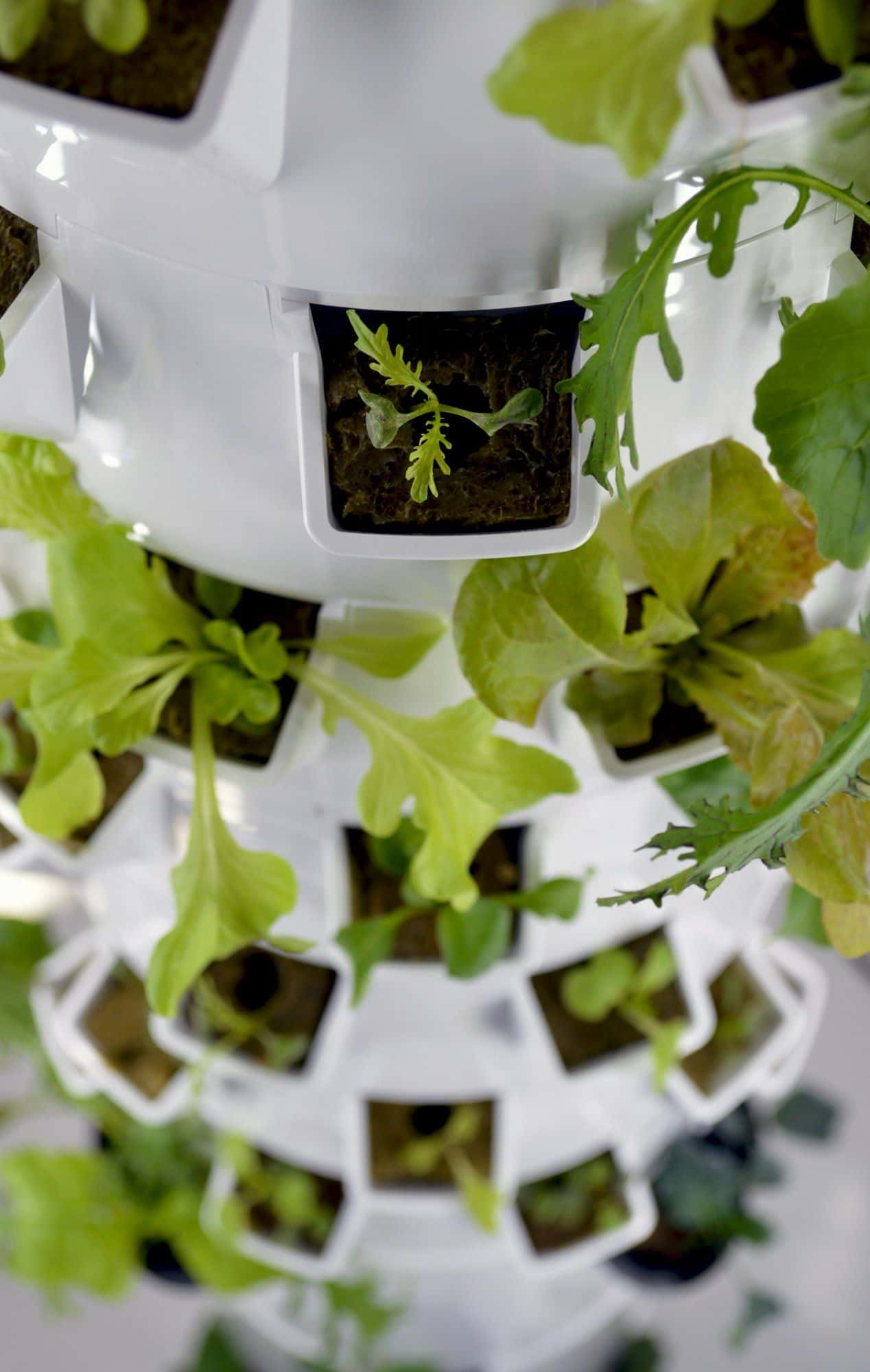
What vertical farming at home means
A home vertical farm grows food upward instead of across the floor, so a balcony, a kitchen corner or a spare shelf can hold dozens of plants. Most home systems are hydroponic or aeroponic: the plants grow without soil, with roots fed by water carrying dissolved nutrients. A pump and timer move that water, and the grower checks and tops up the tank. The same principles run commercial vertical farms, only at a smaller scale and usually with sunlight doing some of the work.
There are three common formats. Towers stand upright on a balcony or terrace and hold dozens of plants in pockets around a column. Shelf racks stack two to four trays or channels under LED lights and can sit anywhere indoors. Window farms hang in a window and use daylight. Decorative living walls look similar but are grown for looks, not food, and are a separate category.
Home vertical farming systems compared
The right system depends mostly on light. A balcony that gets several hours of direct sun can run a tower with no lights at all. A flat with little direct sun needs a shelf rack with LEDs, which adds an electricity bill but works in any room. Window farms sit in between. The table sets out the trade-offs for an Indian flat.
| Format | Where it goes | Light source | Best crops | Main running cost |
|---|---|---|---|---|
| Hydroponic or aeroponic tower | Balcony, terrace, sunny room | Sunlight, or LEDs indoors | Lettuce, herbs, leafy greens, strawberries | Small pump; nutrients |
| Shelf rack with LEDs | Any indoor corner | LED grow lights, about 16 hours a day | Microgreens, lettuce, herbs | Lights, the largest share |
| Window farm | Inside a bright window | Daylight | Herbs, lettuce | Small air or water pump |
| Wall pockets or planters | Balcony wall | Sunlight | Herbs, trailing greens | Watering time |
Hydroponic and aeroponic towers for homes
A tower is a hollow column with planting pockets on the outside and a tank at the base. A pump lifts nutrient solution to the top, from where it runs or is sprayed down over the roots inside the column and drains back to the tank. In an aeroponic tower the roots hang in air and are misted; in a hydroponic tower the solution trickles over them or through a light medium. Towers use very little floor space: a single tower on a 1 m² patch of balcony can hold more plants than a row of pots along the railing.
The pump usually runs on a timer, for example 15 minutes on and 15 minutes off, which keeps the roots moist and limits power use. Towers suit leafy crops best. A 2025 University of Georgia trial found that vertical towers were the second-best of four hydroponic systems for strawberries, well ahead of flat NFT channels, so a few strawberry plants are a reasonable addition once the greens are steady.
Shelf racks with grow lights
A shelf rack is the indoor version: two to four levels, each with a tray or channel and an LED fixture above it. It is the easiest format for microgreens, which need only shallow trays and 8–14 days per crop, and it also grows lettuce and herbs. Because there is no sunlight, the lights carry the whole crop, and the photoperiod matters as much as brightness.
Indian research gives a useful reference point. A 2023 study by scientists at ICAR-Indian Agricultural Research Institute grew iceberg lettuce in a vertical hydroponic system under LEDs. The best result came at 200 µmol per square metre per second for 16 hours a day, a daily light integral of 11.5 mol per square metre, with harvest 45 days after transplanting. Stretching the day to 20 hours gave lower fresh weight and poorer efficiency. That result converts to about 206 g of lettuce per kWh of electricity in that system.
Window farms
Window farms were developed in 2009 by Britta Riley, who built the first one in her Brooklyn apartment. The design hung recycled plastic bottles in a column inside a window; a small pump lifted nutrient solution from a reservoir at the base, and it trickled down from bottle to bottle past the roots. The project was shared as open-source instructions, and nearly 40,000 people registered to build their own. The company that sold kits, Windowfarms, was dissolved at the end of 2016.
The idea still works for herbs and lettuce in a bright window, and it costs little to build. Its limits are light and heat. An east- or north-facing window gives too little light for strong growth, and a west-facing window in an Indian summer can overheat the bottles and the solution. A window farm is best treated as a learning project or a herb supply, not a main source of greens.
What grows well in a home vertical farm
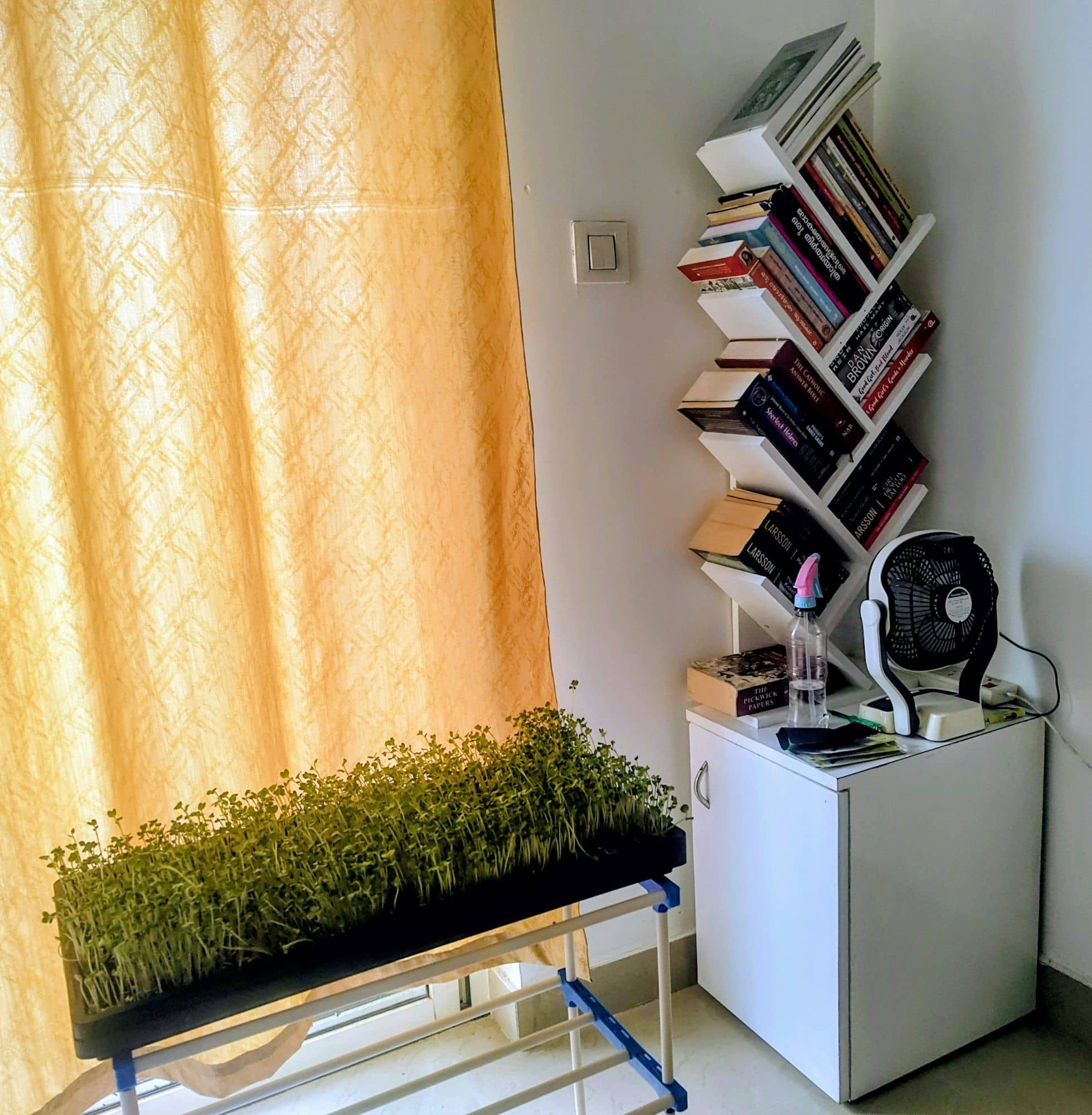
Leafy greens and herbs are the reliable crops: lettuce, spinach, pak choi, kale, rocket, basil, mint, coriander and parsley. They are harvested as leaves, stay short and can be picked a few leaves at a time. Microgreens are the fastest, ready in one to three weeks. Fruiting crops such as tomatoes, chillies and strawberries can grow in towers but need more light, support and patience. Root crops such as carrots and potatoes do not suit vertical systems.
| Crop | Best system | Notes |
|---|---|---|
| Lettuce (loose-leaf, butterhead, iceberg) | Tower or LED shelf | Research lettuce reached harvest 45 days after transplanting under 16-hour LEDs |
| Basil, mint, parsley | Tower or shelf | Pick regularly to keep plants bushy |
| Coriander | Shelf or tower | Slower, and bolts in heat; better in cooler months |
| Pak choi, kale, spinach, rocket | Tower | Cut outer leaves and let the centre regrow |
| Microgreens (radish, mustard, sunflower, pea) | Shelf trays | 8–14 days for most brassicas |
| Strawberries | Tower | Need long days and hand pollination indoors |
| Tomatoes, chillies | Large tower pockets or buckets | Need support, strong light and more space |
Grow lights for home vertical farms
LEDs are the standard for home systems because they use less electricity for the light they give and run cool enough to sit close to the plants. For leafy crops, the practical targets are about 16 hours of light a day and a light level similar to the ICAR-IARI lettuce study, 200 µmol per square metre per second at plant height. Manufacturers quote this as PPFD; if a product gives only watts or lumens, ask for the PPFD at a stated distance.
A timer is essential, because plants need a dark period and an irregular schedule slows growth. Hang lights 15–30 cm above leafy crops and raise them as the plants grow. Lighting is also where the electricity goes. A 2024 benchmarking study of commercial vertical farms found lighting made up 65–85% of total energy use, and a home shelf follows the same pattern.
Monthly running cost of a home vertical farm in India: a worked example
Electricity is the main running cost, and it depends on your tariff slab. For Maharashtra, MSEDCL's residential energy charge for FY 2025–26 is ₹5.74 per unit for the first 100 units and ₹12.57 per unit from 101 to 300 units, as reported by the Free Press Journal. A home farm's units usually fall in your highest slab, because they add to what the household already uses. The example below assumes a household already above 100 units, so every extra unit costs ₹12.57.
Assume an indoor shelf with two 40 W LED fixtures and a 30 W pump that runs half the time. Lights: 2 × 40 W × 16 hours × 30 days = 38.4 kWh. Pump: 30 W × 12 hours × 30 days = 10.8 kWh. Total 38.4 + 10.8 = 49.2 kWh × ₹12.57 = about ₹618 a month. A tower on a sunny balcony needs only the pump: 10.8 kWh × ₹12.57 = about ₹136 a month. The wattages are assumptions; read the labels on your own equipment and use your own bill.
Nutrients and seedlings are the other regular costs, and they vary by supplier and crop. Water use is small because the solution recirculates, with top-ups for what the plants take up and what evaporates. As a sanity check on output, at the 206 g per kWh reached in the ICAR-IARI study, the 38.4 kWh of lighting above could support at most about 38.4 × 0.206 = 7.9 kg of lettuce a month, and a home set-up will usually do less.
Care, cleaning and common problems
Home systems fail for simple reasons: the pump stops, the tank runs low, the pH drifts or the reservoir grows algae. Penn State Extension gives a pH range of 5.0–7.0 for hydroponic vegetables, and a cheap pH meter or test kit is worth having. Check the tank level every two or three days in summer, keep light out of the reservoir to stop algae, and clean the system between crops. Power cuts matter more for aeroponic towers, where bare roots can dry out quickly if misting stops.
In India, standing water also means mosquitoes. The WHO advises that domestic water containers be covered, emptied and cleaned weekly to stop Aedes mosquitoes, which spread dengue, from breeding. Keep the reservoir lid closed, check drip trays and saucers, and do not leave spare buckets of water on the balcony. A tank with a tight lid is also better for the plants, because it keeps light out and slows algae.
- Every 2–3 days: check the water level and top up.
- Weekly: check pH and nutrient strength; look for clogged pockets or emitters; clear any standing water outside the tank.
- Monthly or between crops: drain, clean and refill the tank.
- After a power cut: confirm the pump and timer restarted.
The Garden & Acre hydroponic tower for homes
Garden & Acre installs hydroponic and aeroponic towers for homes, cafés and schools, from ₹14,000 per tower installed. The price includes the tower, pump, timer, the first seedlings, nutrients, training on how to run it and a refill plan for nutrients. Grow lights are not part of that list, so a tower for a dim room needs lights added separately; ask about this on the call. For a larger rooftop or terrace farm, Garden & Acre's vertical farm setup service is priced in a written proposal after a call about the site.
Questions
Can I do vertical farming at home in India?
Yes. A hydroponic tower on a balcony with several hours of direct sun, or an LED shelf rack indoors, can grow lettuce, herbs, spinach, pak choi and microgreens year-round. Indian summers are the hard season, so place towers where they get morning sun and some afternoon shade, and keep reservoirs covered.
How much electricity does a home vertical farm use?
It depends on lights. In a worked example, two 40 W LEDs for 16 hours a day and a 30 W pump running half the time use 49.2 kWh a month, about ₹618 at Maharashtra's ₹12.57 slab. A balcony tower with only a pump uses about 10.8 kWh, around ₹136. Check the wattage on your own equipment.
What vegetables grow best in a vertical tower?
Leafy greens and herbs: lettuce, spinach, pak choi, kale, rocket, basil, mint and parsley. They stay compact and can be picked a few leaves at a time. Strawberries also grow in towers. Tall fruiting crops such as tomatoes need support and more space, and root crops do not suit towers at all.
How many hours of grow light do plants need indoors?
About 16 hours a day for leafy greens and microgreens. An ICAR-IARI study found 16 hours at 200 µmol per square metre per second gave the best lettuce, and stretching to 20 hours reduced fresh weight. Use a timer so the plants get a regular dark period every night.
Is a hydroponic tower better than soil pots on a balcony?
A tower holds more plants on less floor space and wastes less water because the solution recirculates. It needs power for the pump and regular checks of water level and pH. Soil pots need no electricity and tolerate neglect better. For leafy greens in a small flat, towers usually produce more from the same area.
Do hydroponic systems breed mosquitoes?
They can if water is left open. The WHO advises covering, emptying and cleaning domestic water containers weekly to stop Aedes mosquitoes breeding. Keep the reservoir lid closed, clear drip trays and saucers, and do not leave open buckets of water near the system.
Sources
- Determination of optimal daily light integral (DLI) for indoor cultivation of iceberg lettuce in an indigenous vertical hydroponic system — Gavhane et al., Scientific Reports, 2023
- MSEDCL revises Maharashtra power tariff from July 1 — Free Press Journal, 29 June 2025
- Hydroponic systems and principles of plant nutrition — Penn State Extension
- Windowfarm — Wikipedia
- Growing Microgreens and Baby Greens Indoors — University of Maryland Extension
- Substrate system outperforms water-culture systems for hydroponic strawberry production — Hutchinson et al., Frontiers in Plant Science, 2025
- Dengue and severe dengue — World Health Organization fact sheet
- Benchmarking energy efficiency in vertical farming — ScienceDirect, 2024