Vertical farming terms A–B
Terms from A to B cover the main growing methods, such as aeroponics and aquaponics, and some of the equipment and plant problems that growers talk about most. Where a term has a fuller article in this hub, the related links at the end of the page point to it. Terms are listed in alphabetical order within each group, and each definition gives the meaning used in commercial vertical farming rather than in general gardening.
- A-frame tower — A tall triangular growing frame with plants on both sloping faces. Sky Greens in Singapore uses rotating aluminium A-frames up to about 9 m tall that move troughs of vegetables up and down in the sunlight.
- Aeroponics — Growing plants with their roots hanging in air and sprayed with a fine mist of nutrient solution at set intervals. It gives roots plenty of oxygen but depends on nozzles and pumps working without fail.
- Air changes — The number of times the air in a growing room is replaced or recirculated per hour. Good airflow over the leaves prevents hot, humid pockets that encourage disease and tipburn.
- Aquaponics — A system that links fish farming and hydroponics. Fish waste is converted by bacteria into nitrates that feed the plants, and the plants clean the water that returns to the fish.
- Automation — Using sensors, controllers, conveyors or robots to do tasks such as dosing nutrients, switching lights, moving trays, seeding or harvesting without manual work.
- Backup power — A generator, inverter or battery system that keeps pumps, fans and controls running during a power cut. Essential in India, where a few hours without pumps or cooling can damage a whole crop.
- Biocontrol — Using beneficial insects, mites or microbes to control pests instead of chemical pesticides; part of integrated pest management.
- Blue light — Light in roughly the 400–500 nm range. In LED recipes it keeps plants compact and influences leaf thickness and colour.
- Bolting — When a leafy crop such as lettuce or coriander starts to form a flower stalk too early, making leaves bitter. Heat and long days are common triggers.
Vertical farming terms C
Terms beginning with C include the business measures that decide whether a farm pays, such as capex, and the name of the wider field that vertical farming belongs to: controlled environment agriculture, or CEA. It also includes the growing media and the container farms that many first-time growers in India look at first, because they are easy to buy and quick to set up.
- Capex (capital expenditure) — Money spent before production starts: the building works, racks, LEDs, pumps, climate control, sensors and backup power.
- Carbon dioxide (CO₂) enrichment — Raising CO₂ in a closed room above outdoor levels to speed photosynthesis. Only practical in sealed rooms; in ventilated polyhouses the added gas escapes.
- CEA (controlled environment agriculture) — Any method of growing crops where some or all of the climate is controlled: polyhouses, greenhouses, shade net houses, plant factories and vertical farms.
- Coco coir — A growing medium made from coconut husk fibre. Widely available and inexpensive in India, it is used in grow bags, plugs and living-wall panels.
- Container farm — A vertical farm built inside a shipping container, with its own racks, lights and climate control. Easy to move and install, but small and costly per square metre.
- Crop cycle — The time from sowing or transplanting to harvest. Lettuce in a vertical farm typically takes a few weeks; microgreens take one to three weeks.
- Cultivar — A plant variety selected for particular traits. Choosing compact, fast-growing, tipburn-resistant cultivars is one of the cheapest ways to raise indoor yield.
Vertical farming terms D–E
Terms from D to E include two of the most important measurements in any hydroponic farm: DLI, which describes how much light a crop gets in a day, and EC, which describes how strong the nutrient solution is. Both are checked daily on well-run farms. The group also covers the equipment that keeps the room's air and water in range, such as dehumidifiers, and the main hydroponic methods, including deep water culture and ebb and flow.
- Daily light integral (DLI) — The total photosynthetically active light a plant receives per square metre in a day, in moles (mol·m⁻²·d⁻¹). It equals PPFD × hours of light × 3,600 ÷ 1,000,000. For example, 200 µmol·m⁻²·s⁻¹ for 16 hours gives 200 × 16 × 3,600 ÷ 1,000,000 = 11.5 mol·m⁻²·d⁻¹.
- Deep water culture (DWC) — A hydroponic method where plants float on rafts with their roots in a deep tank of aerated nutrient solution. Stable and forgiving, but heavy.
- Dehumidifier — Equipment that removes moisture from the air. Plants transpire most of the water they take up, so closed rooms need dehumidifying to keep humidity in range; the recovered water can be reused.
- Dissolved oxygen (DO) — Oxygen dissolved in the nutrient solution, needed by roots. It falls as water warms, which is a problem in Indian summers without chilling.
- Drip irrigation — Delivering water and nutrients through small emitters at each plant or panel. Standard in polyhouses and living walls.
- Ebb and flow (flood and drain) — A method where trays are flooded with nutrient solution for a short time and then drained back to a tank.
- EC (electrical conductivity) — A measure of the total dissolved salts, and so the strength, of a nutrient solution, usually in mS/cm or dS/m. Each crop has a target range.
- Energy intensity — Electricity used per kilogram of produce. Current benchmarks put vertical-farm lettuce at about 10–18 kWh per kg.
- Evapotranspiration — Water lost from plants and growing surfaces to the air. It cools leaves and walls and is the reason living walls lower surface temperature.
Vertical farming terms F–G
Terms from F to G cover light colours, feeding methods and the structures that sit between a field and a fully indoor farm, such as the greenhouse and the polyhouse used widely in India. It also includes the stages and supplies that every indoor crop passes through, from germination and grow trays to the growing media that hold the roots in place of soil.
- Far-red light — Light in roughly the 700–750 nm range. Added to LED recipes it can make leaves expand faster, but it can also make plants stretch.
- Fertigation — Applying fertiliser through the irrigation system, common in Indian polyhouses and drip-irrigated fields.
- Food safety — The practices that keep produce free of contamination. In India, food businesses need FSSAI registration or a licence depending on size.
- Germination — The stage when a seed sprouts. Vertical farms usually germinate seeds in a dark, warm, humid area before moving seedlings under lights.
- Green wall — A wall covered in growing plants, also called a living wall or vertical garden. Built for looks and cooling rather than food.
- Greenhouse — A glass or plastic-covered structure that uses sunlight to grow crops in a sheltered climate. In India, plastic-covered ones are usually called polyhouses.
- Grow tray — The shallow tray or channel on a rack that holds plants, growing medium or plugs.
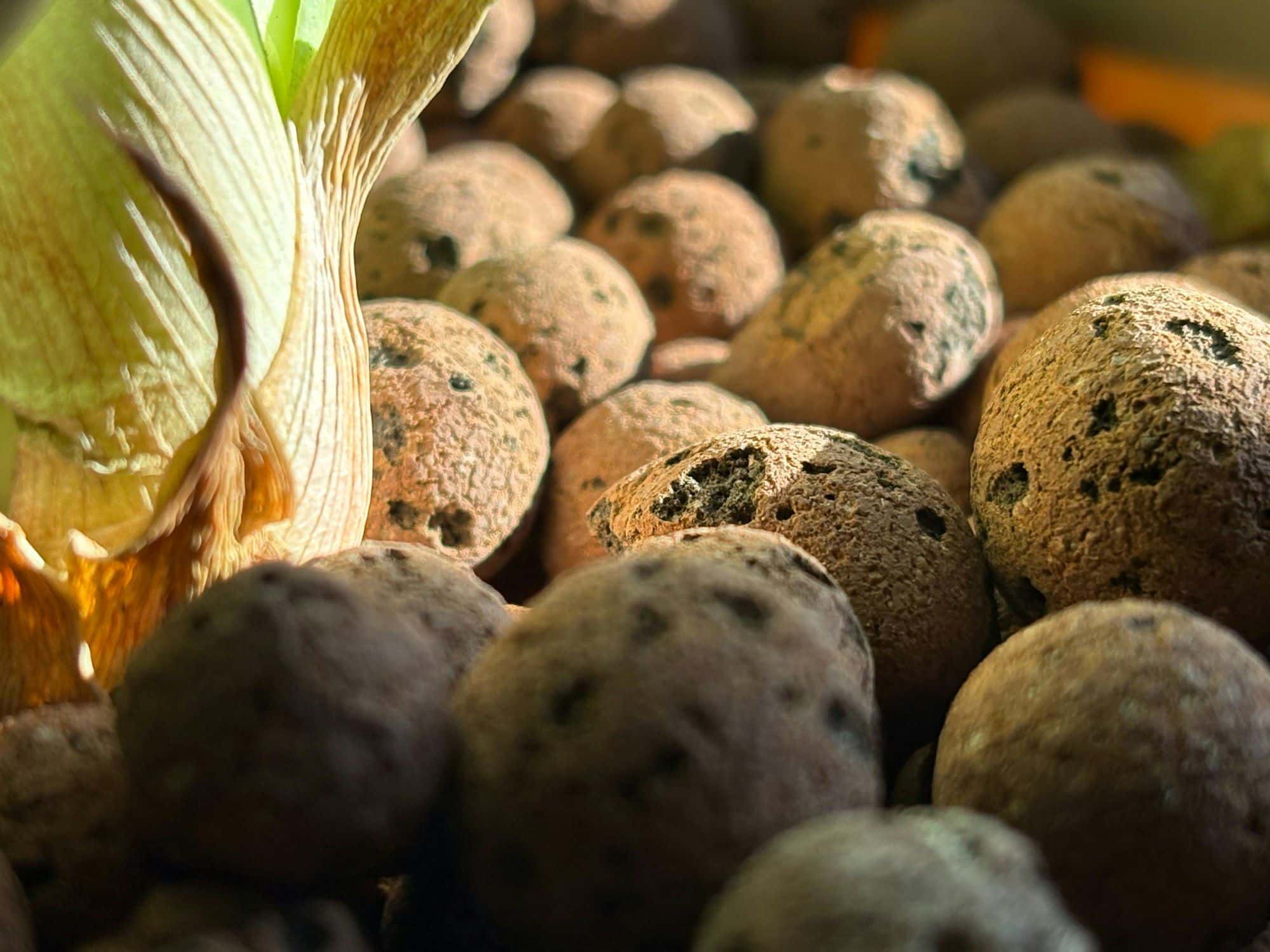
- Growing media — Material that supports roots in place of soil: coco coir, rockwool, perlite, peat, expanded clay or foam.
Vertical farming terms H–K
Terms from H to K include hydroponics, the method most vertical farms use, and the climate and pest-control terms that go with running a sealed growing room. In a closed room, air-conditioning, humidity and pest prevention decide as much of the yield as the nutrient solution does, so these terms come up in every farm design and every daily check.
- Harvest index — The share of a plant's total weight that is the harvested product. Leafy greens have a high harvest index, which is one reason they suit vertical farms.
- HVAC — Heating, ventilation and air-conditioning. In a vertical farm the HVAC removes the heat from lights and the moisture from plants, and is the second-largest energy use after lighting.
- Hydroponics — Growing plants without soil, with roots in a nutrient solution or in an inert medium fed with one. Most vertical farms are hydroponic.
- Integrated pest management (IPM) — Preventing and controlling pests with a combination of hygiene, screening, monitoring, biocontrol and, only when needed, targeted treatment.
- IoT (internet of things) — Networked sensors and controllers that report temperature, humidity, CO₂, pH, EC and water levels to a phone or computer and raise alerts.
- Kratky method — A passive hydroponic method with no pump: plants sit above a container of nutrient solution and the air gap grows as they drink. Suited to small home setups.
Vertical farming terms L–M
Terms from L to M include the LED lights that power indoor farms and the microgreens that are one of the most profitable crops for small indoor growers. It also covers the difference between lux, which describes light for human eyes, and the plant light measures in the P group, a common source of confusion when buying lights for an indoor farm.
- LED (light-emitting diode) grow light — The standard light source in vertical farms. Efficient, cool-running at the plant and tunable by colour.
- Light recipe — The combination of light colour, intensity and hours used for a crop at each stage of growth.
- Light use efficiency (LUE) — Grams of plant produced per mole of light. A 2023 review found average values of 0.55 g/mol for vertical farms, 0.39 for greenhouses and 0.23 for open fields in lettuce studies.
- Living wall — A wall with a growing medium fixed to it in panels, pockets or felt, with built-in irrigation, planted mainly with ornamental plants.
- Lux — A unit of light brightness as seen by the human eye. It is a poor guide to plant light; growers use PPFD instead.
- Microclimate — The local climate around the plants, which can differ from the room average. Poor airflow can leave pockets that are warmer or more humid.
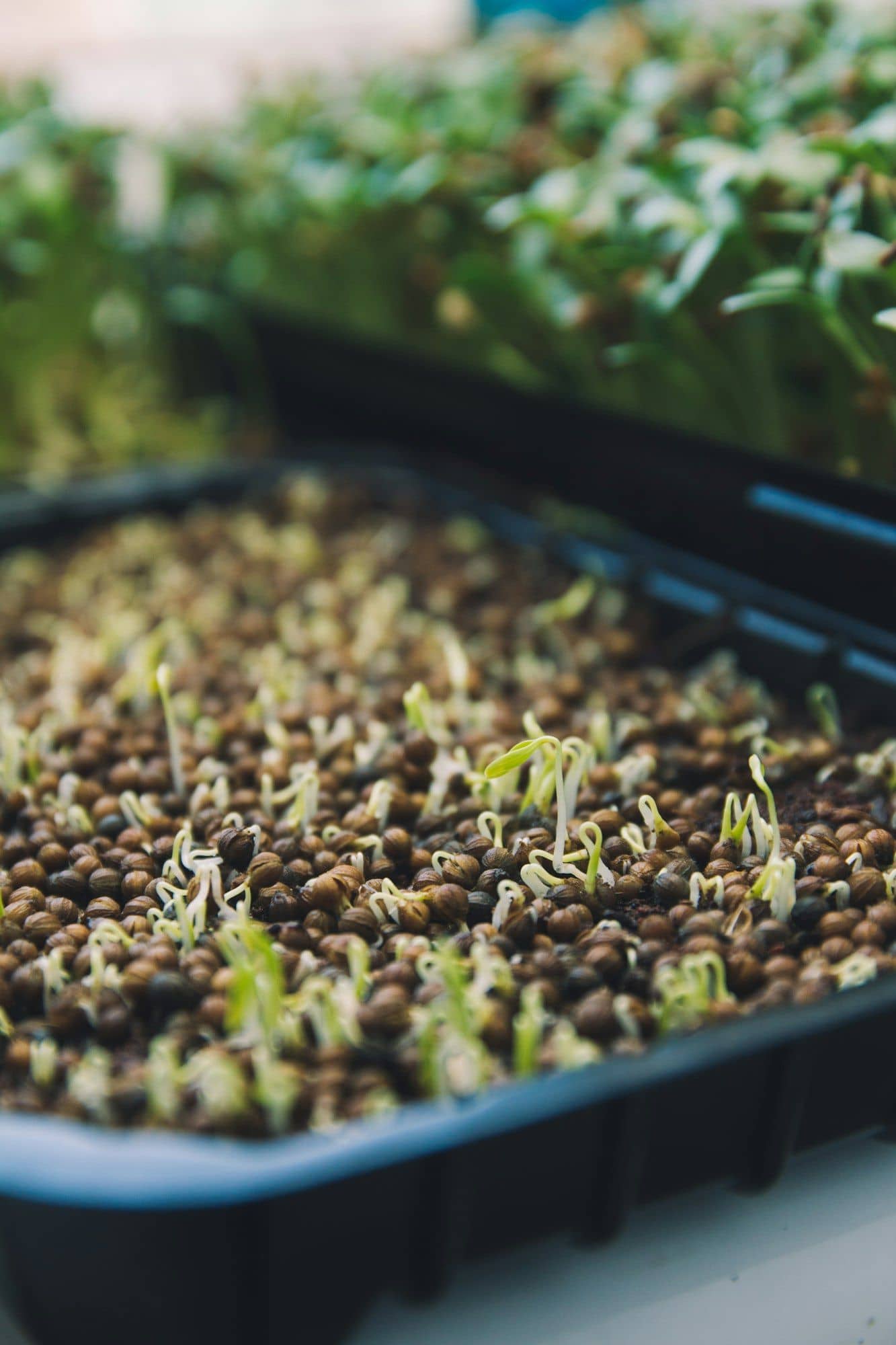
- Microgreens — Seedlings of vegetables and herbs harvested at the first true leaf, usually 1–3 weeks after sowing. High value per kilogram and well suited to indoor racks.
- Mineral wool (rockwool) — A spun-rock growing medium sold in cubes and slabs, used for seed plugs and fruiting crops.
Vertical farming terms N–O
Terms from N to O include NFT, the most common hydroponic method for leafy greens in Indian farms, and opex, the running cost that decides whether a farm is profitable after it is built. It also includes the basic nutrient terms, such as NPK and nutrient solution, and NHB, the Indian government body whose schemes support protected cultivation across the country.
- Net pot — A small mesh pot that holds a plant and its medium in a hydroponic channel or raft while letting roots grow through.
- NFT (nutrient film technique) — A hydroponic method where a thin film of nutrient solution flows along sloping channels past the roots. Widely used for lettuce and herbs.
- NHB (National Horticulture Board) — The Indian government body that runs horticulture schemes, including a credit-linked, back-ended subsidy that has been reported for hydroponic and aeroponic projects over 1,000 m².
- NPK — Nitrogen, phosphorus and potassium, the three main plant nutrients. Hydroponic solutions also include calcium, magnesium, sulphur and micronutrients.
- Nutrient solution — Water with dissolved fertiliser salts that feeds hydroponic plants. It is managed by EC, pH and regular top-ups or changes.
- Opex (operating expenditure) — Running costs after the farm is built: electricity, seeds, nutrients, labour, packaging, maintenance, rent and water.
Vertical farming terms P
P has the most entries, because it includes the light measurements used to design and run indoor farms. PAR, PPF and PPFD are often confused: PAR is the kind of light, PPF is how much a fixture emits, and PPFD is how much lands on the plants. The P group also includes pH, one of the two numbers checked daily in the nutrient tank, and polyhouse, the structure most Indian growers compare a vertical farm against.
- PAR (photosynthetically active radiation) — Light between 400 and 700 nm, the range plants use for photosynthesis.
- PFAL (plant factory with artificial lighting) — The term used in Japan and much of Asia for an indoor, multi-layer farm lit entirely by artificial light.
- pH — A measure of how acidic or alkaline the nutrient solution is. Most hydroponic crops grow best in a slightly acidic range, commonly around 5.5–6.5.
- Photon efficacy — How many micromoles of PAR a light fixture produces per joule of electricity (µmol/J). Higher efficacy means lower power bills for the same light.
- Photoperiod — The number of hours of light per day. Leafy greens in vertical farms often run long photoperiods such as 16 hours.
- Plant factory — A closed, climate-controlled building for producing plants, usually with artificial light and stacked layers. Often used as a synonym for vertical farm.
- Polyhouse — A plastic-covered greenhouse, the most common form of protected cultivation in India. NHB cost norms put a naturally ventilated tubular polyhouse at ₹844 per m² in plain areas.
- PPF (photosynthetic photon flux) — The total PAR a light fixture emits per second, in µmol/s.
- PPFD (photosynthetic photon flux density) — The PAR landing on a square metre of crop per second, in µmol·m⁻²·s⁻¹. The main number used to set light levels on each shelf.
- Propagation — Raising seedlings or cuttings before they go into the main growing system.
- Pythium — A water-borne root-rot organism that thrives in warm, poorly oxygenated nutrient solution. A common cause of crop loss in hydroponics.
Vertical farming terms Q–S
Terms from Q to S cover the physical parts of a farm, such as racks and reservoirs, and the sunlit forms of growing, such as shade net houses and sky farming. It also includes relative humidity, which growers watch alongside temperature, and the seedling plug, the small block of medium in which most indoor crops start life before they reach the racks.
- Rack — The multi-level shelving that holds trays or channels in a vertical farm. Racks may be fixed or on rails to save aisle space.
- Relative humidity (RH) — How much moisture the air holds compared with the most it could hold at that temperature, as a percentage.
- Reservoir — The tank that holds nutrient solution before it is pumped to the plants and after it drains back.
- Root zone — The area around the roots. Its temperature, oxygen and nutrient levels matter as much as the air above the leaves.
- Seedling plug — A small block of medium, such as rockwool or coir, in which a seed is germinated before transplanting.
- Shade net house — A structure covered with shade netting that cuts sunlight and heat. Cheaper than a polyhouse and common in India for nurseries and leafy greens.
- Sky farming — An informal term for growing food above ground: rotating sunlit towers such as Sky Greens in Singapore, rooftop farms, or proposed skyscraper farms.
- Stacked system — Any arrangement of growing layers one above another, the defining feature of a vertical farm.
- Substrate — Another word for growing media.
Vertical farming terms T–Z
The last group, from T to Z, includes common crop problems such as tipburn, climate measures such as VPD, and the output measures, such as yield per square metre, that are used to compare farms. When comparing two farms or two proposals, always check that yield and water figures use the same basis, for example per square metre of land or of growing area, and per kilogram of fresh weight.
- Tipburn — Browning of young leaf edges, mainly in lettuce, caused by a local shortage of calcium in fast-growing leaves. Airflow over the plants and moderate light help prevent it.
- Tower (hydroponic or aeroponic tower) — A vertical column with planting pockets, fed by a pump from a tank at the base. Suited to homes, cafés, balconies and schools.
- Transpiration — Water vapour released from leaves. It pulls water and nutrients up from the roots and must be removed from closed rooms by dehumidifying.
- Unit economics — Revenue and cost per unit of output, such as per kilogram or per head of lettuce. A farm is viable only when price per kilogram exceeds total cost per kilogram.
- UV sterilisation — Passing nutrient solution under ultraviolet light to kill microbes before it returns to the plants.
- Vertical farm — A farm that grows crops in stacked layers, usually indoors under LEDs with a controlled climate, to produce more food per square metre of land.
- Vertical garden — A decorative wall of plants; see green wall and living wall.
- VPD (vapour pressure deficit) — The difference between the moisture the air could hold at saturation and what it actually holds. It controls how fast plants transpire; growers use it together with temperature and RH.
- Water use efficiency — Produce per unit of water used. A 2022 review reported water use efficiency above 96% in plant factories; a 2015 study measured about 20 litres per kg for hydroponic lettuce against about 250 litres in the field.
- Yield per m² — Produce harvested per square metre per year. Always check whether it is per m² of growing area (all layers) or per m² of land; the two can differ several times over.
- Zone control — Managing climate, light or irrigation separately for different parts of a farm, so that each crop or growth stage gets its own settings.
Putting the terms to work
Most of these terms appear in any proposal for a vertical farm: the PPFD and DLI the lights will deliver, the EC and pH ranges for each crop, the HVAC capacity, and the expected energy intensity and yield per square metre. Garden & Acre designs and builds commercial and institutional vertical farms, from feasibility and design to build, commissioning and first-crop support, priced in a written proposal after an initial call. For homes, cafés and schools, hydroponic and aeroponic towers start at ₹14,000 per tower, including the pump, timer, first seedlings, nutrients, training and a refill plan.
Questions
What is vertical farming?
Vertical farming is growing crops in layers stacked one above another, usually indoors, with light, temperature, humidity, water and nutrients controlled by equipment. Most vertical farms are hydroponic and lit by LEDs, and they grow leafy greens, herbs, microgreens and some strawberries with far less land and water than a field.
What is hydroponics?
Hydroponics is growing plants without soil. Roots sit in a nutrient solution, or in an inert medium such as coco coir or rockwool that is fed with one. Common methods include NFT channels, deep water culture rafts, ebb and flow trays and drip systems. Most vertical farms use hydroponics.
What is aeroponics?
Aeroponics is a soilless method where plant roots hang in the air inside a closed chamber and are sprayed with a fine mist of nutrient solution at set intervals. Roots get plenty of oxygen, but the system depends on pumps and nozzles working reliably, because roots dry out quickly if misting stops.
What is aquaponics?
Aquaponics combines fish farming with hydroponics. Water from the fish tank, carrying fish waste, passes through bacteria that convert ammonia into nitrates, which feed the plants. The plants take up the nutrients and the cleaned water returns to the fish. It produces both fish and vegetables but is harder to balance.
What does CEA stand for in farming?
CEA stands for controlled environment agriculture: growing crops where some or all of the climate is controlled. It includes polyhouses, greenhouses, shade net houses, plant factories and vertical farms. Vertical farming is the most fully controlled form, with artificial light as well as controlled temperature, humidity and CO₂.
What is DLI and PPFD in vertical farming?
PPFD is the amount of photosynthetic light landing on a square metre of crop each second, in µmol·m⁻²·s⁻¹. DLI is the total over a day, in mol·m⁻²·d⁻¹, and equals PPFD × hours × 3,600 ÷ 1,000,000. For example, 200 µmol for 16 hours gives a DLI of about 11.5.
Sources
- Measuring daily light integral in a greenhouse — Purdue Extension HO-238-W
- Plant factory technology lights up urban horticulture in the post-coronavirus world — Zhang et al., Horticulture Research (2022)
- Light use efficiency of lettuce cultivation in vertical farms compared with greenhouse and field (Jin et al. 2023) — Vertical Farm Daily
- Plant factories versus greenhouses: comparison of resource use efficiency — Graamans et al., Agricultural Systems (2018)
- Comparison of land, water, and energy requirements of lettuce grown using hydroponic vs. conventional agricultural methods — Barbosa et al., IJERPH (2015)
- Benchmarking energy efficiency in vertical farming — ScienceDirect (2024)
- Farming in the Sky — SINGAPORE Magazine (2015)
- Cost norms and pattern of assistance — National Horticulture Board
- Govt. is providing subsidy for hydroponics & aeroponics farming — Krishi Jagran (2022)