Kashmir saffron and why indoor growing started
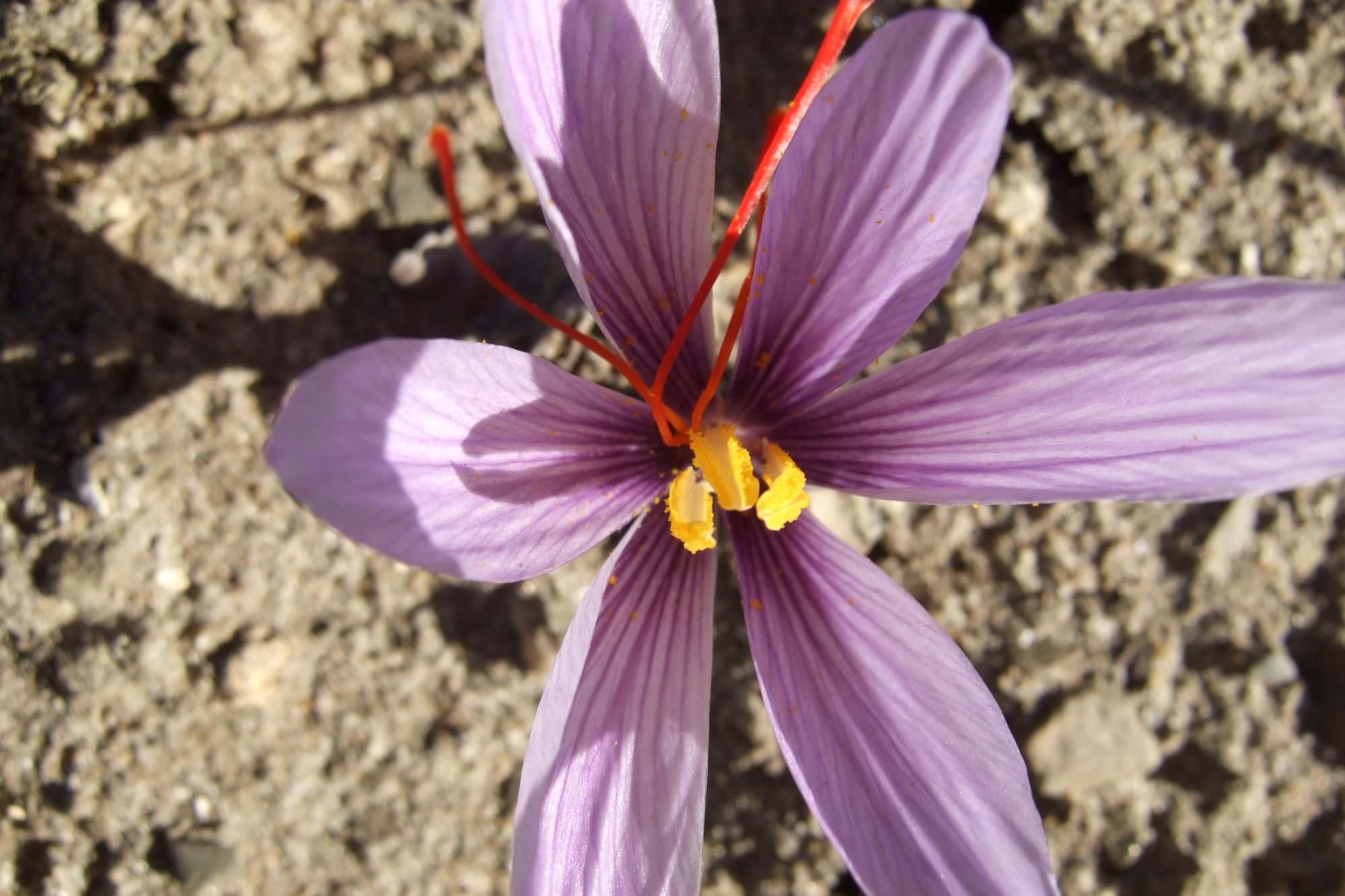
Saffron is the dried red stigma of the flower of Crocus sativus. In India it is grown mainly on the karewa uplands around Pampore in Kashmir, and Kashmir saffron received a Geographical Indication in 2020. Field output has fallen sharply. Mongabay India, citing official figures, reports that the area under saffron dropped from 5,707 hectares in 1996–97 to about 2,388 hectares in 2018–19, and production fell from 15.95 tonnes in the 1990s to 2.6 tonnes in 2023–24.
A 2020 review of saffron in Kashmir points to ageing fields, with the average saffron field more than 15 years old, and to corm rot, which spreads when ungraded corms are replanted. Indoor flowering is one response. Sher-e-Kashmir University of Agricultural Sciences and Technology (SKUAST-Kashmir), through its saffron research station at Dusoo, Pampore, ran a three-year indoor saffron project from 2021 to 2024 with five demonstration trials. The idea spread quickly outside Kashmir, and press reports now cover indoor saffron rooms in Pune, Noida, Punjab, Uttar Pradesh, Gujarat and West Bengal.
How saffron grows: the corm cycle
Saffron is a sterile plant and does not set viable seed. It multiplies only through its corm, a bulb-like underground stem. In Kashmir the cycle runs through one year. Corms are dormant in summer. They sprout in autumn, flower from mid-October to early November, and grow leaves through winter until about May. During those months the mother corm feeds a set of daughter corms, which become next year's planting stock. The mother corm is used up.
Every gram of saffron takes many flowers. A 2020 review of saffron production in Kashmir states that 1 kg of dried saffron comes from 5.0–5.5 kg of fresh stigmas and styles, taken from 45–50 kg of fresh flowers, or about 1.15–1.5 lakh flowers. That works out to roughly 1,000,000 mg ÷ 1,50,000 flowers = about 7 mg of dried saffron per flower at the low end, and 1,000,000 ÷ 1,15,000 = about 9 mg at the high end. Every yield claim can be checked against that figure.
How indoor saffron farming works
Indoor saffron replaces only the flowering part of the cycle. Corms are lifted from the field after the leaves die back in early summer, graded by weight and laid in trays on multi-tier racks in a closed room. They need no soil or water to flower, because the flower is fed by the corm's stored reserves. The room is kept dark and warm for flower formation, then cooled so the flowers push up. Stigmas are picked by hand each morning during the flowering weeks and dried.
The SKUAST model, as described to Mongabay, uses corms of 8 g or more for indoor flowering, and keeps smaller corms (below 6 g) for multiplication in the field. It needs a dark period of 90–100 days. After flowering, the corms are planted back into soil for the leafy phase, which rebuilds daughter corms for the next year. Aeroponic systems add a mist to the roots after flowering to try to carry the corm through the leafy phase indoors, but that stage is where results have been weakest.
- Summer: lift and grade corms; store dry and warm in trays.
- July–September: hold warm in the dark for flower formation.
- October–November: lower the temperature so flowers emerge; pick stigmas daily.
- November onwards: plant corms into soil or keep in aeroponic trays under light for the leaf and daughter-corm phase.
Temperature and humidity for indoor saffron
Saffron flowering is driven by temperature. The 2020 Kashmir review, summarising earlier research, gives 23–25 °C as the ideal range for flower formation inside the corm, held for at least 50 days, and warns that holding corms warm for too long causes the flowers to abort. Flowers then emerge when it turns cool: a 2025 greenhouse study notes that flowering begins once the day maximum falls below about 17 °C with nights near 10 °C. Other studies give humidity and light figures. The table combines these by stage; values are from the studies named, not a guaranteed recipe.
| Stage | Temperature | Relative humidity | Light | Source |
|---|---|---|---|---|
| Dry storage after lifting | About 28 °C | 60–80% | Dark | Gao et al. 2023 |
| Flower formation in the corm | 23–25 °C for at least 50 days | Not specified | Dark | JMPS review 2020 |
| Flower emergence (field cue) | Day maximum below about 17 °C, nights near 10 °C | Not specified | Daylight | Qaryouti et al. 2025 |
| Flowering in a growth room | 18 °C | 70% | LED, 10 hours a day | Gao et al. 2023 |
| Flowering in a greenhouse trial | Day 20–25 °C, night 18–20 °C | 70–80% | Daylight | Qaryouti et al. 2025 |
| Leaf and daughter-corm growth | 10–20 °C | Not specified | Light needed for leaves | Qaryouti et al. 2025 |
Light and aeroponics for the leaf phase
Flowers can emerge in the dark, but the leaf phase needs light, because that is when the plant photosynthesises and fills the new corms. A 2023 study in Scientific Reports from Fudan University, Shanghai, grew corms under blue and red LEDs for 10 hours a day at 18 °C and 70% humidity. The best treatment, a total light integral of 150 mol per square metre, gave up to 3.63 flowers per corm, 0.7 more than corms under natural light, and about 50% more dried stigma.
The corms in that study weighed about 18 g each, which is large, so the flower count is a best case rather than a typical one. A greenhouse trial published in Frontiers in Plant Science in 2025 found that denser planting raised stigma yield per square metre but produced more small corms under 3 g, which will not flower well the next year. Light, corm size and planting density all trade against each other.
Indoor saffron in India as reported by the press
The figures below are what the growers or institutions told reporters. None is an audited or peer-reviewed yield. They are useful mainly to show how widely results vary, and to set expectations before anyone spends money on corms or equipment. Where a report gives both the corm weight and the harvest, the next section converts it to grams of saffron per kilogram of corms, which is the fairest single measure.
| Where | Who | What was reported | Source |
|---|---|---|---|
| Pampore, Kashmir | SKUAST-Kashmir | Indoor project 2021–24; 900–1,100 g possible from a 20 × 20 ft structure | Mongabay India, Apr 2024 |
| Pampore, Kashmir | Abdul Majeed Wani, farmer | 600 g from 5 quintals (500 kg) of corms | Mongabay India, Apr 2024 |
| Pampore, Kashmir | Ali Mohammad, farmer | 28 g from 1 quintal (100 kg) of corms in his first year, 2023 | Mongabay India, Apr 2024 |
| Warje, Pune | Shailesh Modak, 365Dfarms | Started early 2022 in a shipping container; 875 g from 160 sq ft in the first year; about ₹10 lakh invested | Kashmir Life |
| Noida, UP | Ramesh Gera | 100 sq ft room since 2017; ₹4 lakh set-up and ₹2 lakh corms; runs a paid training course | The Better India, Mar 2024 |
| Mainpuri, UP | Shubha Bhatnagar | Converted cold room, from May 2023; 800 g–1 kg per 1,000 kg of corms | NITI Aayog Frontier Tech |
| Gandhinagar, Gujarat | Aeroponics start-up | Slightly over 0.5 kg from 100 kg of corms (claimed) | Kashmir Life |
| Ludhiana, Punjab | Grow Grower | Indoor aeroponic room recreating Kashmir conditions | VerticalFarmDaily, May 2026 |
Realistic indoor saffron yields and why claims vary
The fairest way to compare claims is grams of dried saffron per kilogram of corms. From the reports above: Wani's 600 g ÷ 500 kg = 1.2 g per kg; Ali Mohammad's 28 g ÷ 100 kg = 0.28 g per kg; Mainpuri's 800–1,000 g ÷ 1,000 kg = 0.8–1.0 g per kg. The Gujarat claim of just over 500 g ÷ 100 kg = about 5 g per kg is four times the best Kashmir result and should be treated with caution until measured independently.
Claims vary for several reasons. Corm size matters most: large corms give more flowers, and a room filled with small corms yields a fraction as much. Some figures are fresh weight, which is about five times dried weight. Some are projections for a full room rather than a measured harvest. Some count only a first year with bought Kashmir corms, which says nothing about whether the grower can produce corms for year two. A first-year beginner, like Ali Mohammad, can get a quarter of what an experienced grower gets from the same weight of corms.
The corm problem: multiplication is still unsolved indoors
Flowering indoors works. Producing the next year's corms indoors does not yet work reliably. Umar Manzoor, chief executive of a farmer producer company in Pampore, told Mongabay that the real challenge comes after flowering, during vegetative reproduction. SKUAST's senior scientist Dr Bashir Ahmad Allie told Kashmir Reader in November 2023 that producing corms indoors, especially outside Kashmir, is the major challenge, and that the technology was not yet profitable for farmers in other states.
This matters for costs. If the corms cannot be regrown, a grower outside Kashmir must buy fresh corms every year, and corms are the largest input. Mongabay reported Kashmir corm prices of about ₹40,000 per quintal. In Kashmir, SKUAST's model returns the corms to the field after flowering, so the farmer's own land does the multiplication. A grower in Pune or Delhi has no such field, which is why most indoor growers outside Kashmir depend on buying corms.
Indoor saffron economics: a worked example
Take 500 kg of corms, the quantity Wani used. At ₹40,000 per quintal, corms cost 5 quintals × ₹40,000 = ₹2,00,000. At his result of 1.2 g per kg, the harvest is 500 kg × 1.2 g = 600 g. At the ₹250 per gram market price Mongabay reported, 600 g × ₹250 = ₹1,50,000. So a buyer of new corms would lose ₹50,000 on corms alone before paying for racks, cooling, power, labour, packing and testing. At Ali Mohammad's 0.28 g per kg, the harvest would be 140 g, worth ₹35,000.
The arithmetic changes only if the corms are reused for several years, if the yield per kilogram rises well above 1.2 g, or if the saffron sells direct at retail prices. The Noida grower told The Better India of wholesale rates up to ₹2.5 lakh per kg and retail up to ₹3.5 lakh per kg, which is ₹250–₹350 per gram. Retail sale needs lab testing, packaging and a brand buyers trust. Anyone planning an indoor saffron room should run this calculation with their own corm quote before buying equipment.
Indoor saffron scams and overpromises: what to check
Indoor saffron attracts sellers because it combines a high price per gram with a simple-looking method. Training courses, corm kits, container packages and buy-back offers are marketed widely, often with monthly income figures. Training itself can be a larger business than the saffron: the Noida grower told The Better India that his course, priced at ₹12,000, had trained more than 370 people and brought in about ₹3.5 lakh a month. That is not wrong in itself, but it shows where the money in this field can come from.
Before paying anyone, check the claims against the numbers in this article. Saffron flowers once a year in autumn, so claims of several harvests a year need evidence. Apart from one unverified claim, none of the Indian reports gathered here exceeds 1.2 g per kg of corms. Corm size should be stated and verified on delivery, since small corms flower poorly.
- Ask for yield in grams of dried saffron per kg of corms, with the corm size used.
- Ask who grows the corms for year two, and at what cost.
- Treat buy-back promises as a contract term to be read by a lawyer, not as a guarantee.
- Ask for a lab test report for the saffron sold, and for the buyer's name.
- Visit a working room during the flowering weeks in October–November before buying.
Building a climate-controlled room with Garden & Acre
Garden & Acre designs and builds controlled-environment rooms and vertical farms for commercial and institutional clients. For a saffron project, the useful first step is a call about the corm source, the site and the market, followed by a written proposal that sets out the room, cooling and running costs so the arithmetic above can be done with real quotes. Garden & Acre does not sell saffron corms or offer buy-back. The site visit and build follow only once the proposal is agreed.
Questions
Can saffron be grown indoors in India?
Yes, saffron corms can be flowered indoors anywhere in India if the room is held warm for flower formation and then cooled to about 17 °C in autumn. SKUAST-Kashmir and several private growers have done it. The unsolved part is producing new corms indoors each year, so most growers outside Kashmir buy fresh corms.
How much saffron do you get from 1 kg of corms?
Indian reports range from about 0.28 g to 1.2 g of dried saffron per kg of corms. A Pampore farmer reported 600 g from 500 kg of corms, a first-year grower 28 g from 100 kg, and a Mainpuri unit 800 g–1 kg from 1,000 kg. Corm size and experience explain most of the difference.
What temperature does saffron need to flower?
Flower formation inside the corm is best at 23–25 °C held for at least 50 days, and very long warm storage causes flowers to abort. The flowers then emerge when it turns cool, with day maximums below about 17 °C. Growth-room studies used about 18 °C and 70% humidity for flowering. Flowering happens once a year, in October–November.
Is indoor saffron farming profitable?
Often not in the first year if corms are bought. At ₹40,000 per quintal, 500 kg of corms costs ₹2,00,000. At 1.2 g per kg and ₹250 per gram, 600 g of saffron brings ₹1,50,000. Profit depends on reusing corms, raising yield and selling at retail, and SKUAST scientists have said it is not yet profitable outside Kashmir.
How many flowers make 1 kg of saffron?
About 1.15–1.5 lakh flowers, according to a 2020 review of saffron production in Kashmir. Those flowers weigh 45–50 kg fresh and give 5.0–5.5 kg of fresh stigmas and styles, which dry to 1 kg. That is roughly 7–9 mg of dried saffron per flower.
Can saffron be harvested more than once a year indoors?
Saffron flowers once per corm cycle, after a long warm period followed by cooling. Claims of several harvests a year should be treated with caution and checked with evidence, such as dated harvest records and corm counts. The independent research cited here describes a single flowering period each year.
Where can I get saffron corms?
Most indoor growers in India buy corms from Kashmir, where Mongabay reported prices around ₹40,000 per quintal. Ask for graded corms with a stated weight, since corms of 8 g or more are used for indoor flowering and smaller ones mainly for multiplication. Check the corms for rot on delivery.
Sources
- Indoor saffron farming offers hope amidst declining saffron production — Mongabay India, April 2024
- SKUAST's Saffron Research Station Pampore works on indoor corm production — Kashmir Reader, 24 November 2022
- Revolutionizing saffron cultivation: SKUAST-K pioneers indoor techniques — Kashmir Reader, 24 November 2023
- The Saffron Race — Kashmir Life
- Grow saffron at home indoors: Noida grower — The Better India, March 2024
- Indoor saffron cultivation through IoT — NITI Aayog Frontier Tech Hub
- India: Finding a way to make saffron cultivation more accessible — VerticalFarmDaily, May 2026
- Effects of total daily light integral from blue and broad-band red LEDs on flowering of saffron — Gao et al., Scientific Reports, 2023
- Cutting-edge greenhouse practices for better stigma yield and corm quality of saffron — Qaryouti et al., Frontiers in Plant Science, 2025
- Saffron production technology in Kashmir, North India — Journal of Medicinal Plants Studies, 2020