
What radish microgreens are
They are seedlings of the same plant as the mooli and the small red salad radish, harvested for the stem and the heart-shaped seed leaves. The taste is the radish bite without the root: peppery and fresh, with a juicy stem. Radish comes in several microgreen types. Daikon radish, the long white mooli type, gives green leaves on white stems. Varieties such as 'Red Arrow' and 'Hong Vit' have pink to red stems. Purple types such as 'Sango' have purple leaves and stems. All grow the same way, and all are fast. In Johnny's Selected Seeds' 2017 trial of 29 microgreens, radishes were the quickest, at 8 to 9.5 days.
Nutrition: what studies measured
One of the first studies of microgreen nutrition, by Xiao and colleagues at the USDA and University of Maryland in 2012, measured vitamins and carotenoids in 25 commercial microgreens. Green daikon radish had the highest tocopherol (vitamin E) content of the 25. Alpha-tocopherol across all 25 ranged from 4.9 to 87.4 mg per 100 g fresh weight. Opal and China Rose radish were also in the set.
In India, Ghoora and colleagues (2020) analysed ten culinary microgreens for protein, fibre, minerals and vitamins and scored them with a Nutrient Quality Score. Radish came first, followed by French basil and roselle. They also found all ten microgreens were 2 to 3.5 times more nutrient-dense than mature spinach leaves grown under similar conditions. In a 2025 study of six microgreens, black radish showed the highest antioxidant capacity by the DPPH test. These are measurements of content, not proof of any health effect.
Purple radish microgreens
Purple radish microgreens get their colour from anthocyanins, a group of plant pigments. A 2023 study by Tilahun and colleagues grew five radish selections for 10 days in water-only trays in a multi-layer indoor unit. 'Asia Purple' had the highest anthocyanin content, while 'Asia Red' gave the highest yield and the most vitamin C and chlorophyll. The authors rated 'Asia Purple' and 'Koregon Red' the best of the five for nutritional quality. At Lovely Professional University in Punjab, Gunjal and colleagues (2024) grew seven microgreens on burlap without soil. Radish 'Sango', a purple type, had the highest anthocyanin (28.25 µmol per 100 g fresh weight) and the heaviest individual shoots of the seven.
| Type | Look | Recorded result |
|---|---|---|
| Green daikon | Green leaves, white stems | Highest vitamin E of 25 microgreens (Xiao 2012) |
| Red Arrow / Hong Vit | Green leaves, pink-red stems | 8 and 9.5 days to harvest (Johnny's 2017) |
| Sango (purple) | Purple leaves and stems | Highest anthocyanin of 7 microgreens (Gunjal 2024) |
| Asia Purple | Purple | Highest anthocyanin of 5 radish selections (Tilahun 2023) |
How to grow radish microgreens
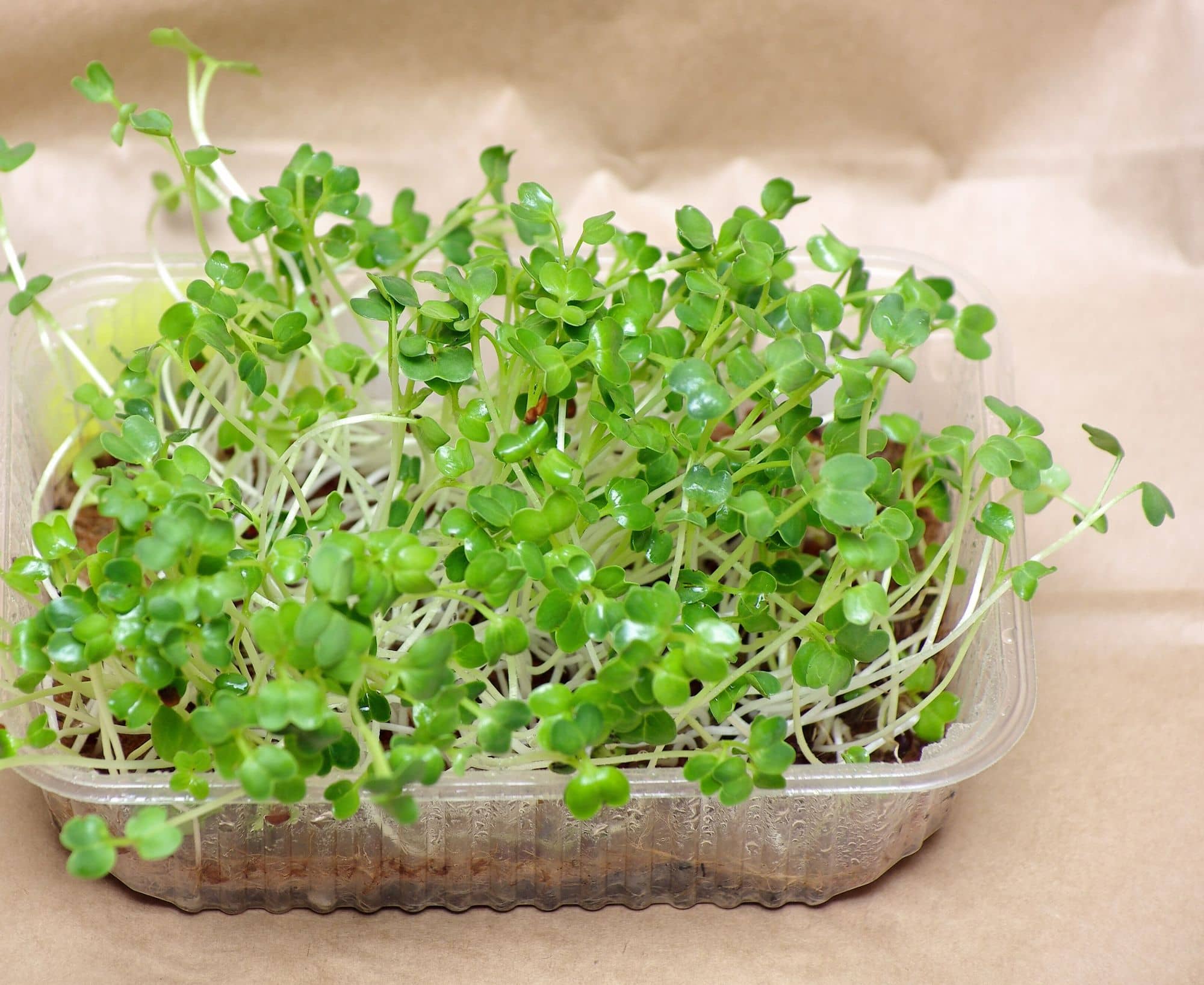
Radish seed is medium-sized and germinates without soaking. Johnny's sowed 22.5 g (daikon) to 28.5 g ('Hong Vit') per 10×20-inch tray and harvested at the first true-leaf stage. Radish belongs to the cabbage family, whose seeds germinate in about 36 hours at 22 °C according to the University of Maryland Extension, which recommends 21–24 °C for microgreens. Pune room temperatures suit it for most of the year. The steps below follow the Penn State and University of Maryland extension guides.
- Fill a drained tray with 2.5–4 cm of moist soil mix or coco peat, or use a wet grow mat.
- Scatter 22–28 g of seed evenly over a 10×20-inch tray and press it onto the surface without covering.
- Mist, cover and keep dark for about three days.
- Uncover and give bright light for about 16 hours a day.
- Water from below. Harvest at 5–7.5 cm, on day 8–10, before the true leaves grow large.
Tips and common problems
Radish is one of the easiest microgreens. It germinates fast and can even grow without a medium: Tilahun's team grew it on water alone, and the biomass increased 6 to 10 times over 10 days. The usual problems are over-watering and poor air. Penn State advises watering only when needed and letting trays drain to prevent mould, and UMD suggests a gentle fan. Discard any tray with grey, musty growth. If stems lean toward the window, move the tray to stronger light. Johnny's recorded 8 to 11.5 oz per tray across its three radishes: 8 × 28.35 g = about 227 g, up to 11.5 × 28.35 g = about 326 g.
How to eat radish microgreens, including Indian dishes
Use them wherever you would use grated mooli or a little green chilli for bite. Scatter them over a stuffed mooli paratha or aloo paratha just before serving, mix into cucumber or onion raita, or top a masala omelette, egg bhurji or besan chilla. They lift a plain dal-chawal, a bowl of rajma, or a vegetable sandwich with green chutney. Purple radish makes a sharp garnish on dahi vada or chaat. The flavour fades with heat, so add them raw at the end. Rinse just before eating and keep them refrigerated.
Fresh radish microgreens in Pune
Garden & Acre delivers fresh microgreens in Pune and Pimpri-Chinchwad from its own supply chain, as weekly home boxes, single-variety packs, and regular supply by weight for restaurants, cafés and hotels. Radish is one of the usual core varieties, subject to what is available that week. Order on WhatsApp with the varieties, quantity and delivery day you want. We reply with this week's availability, the prices and the first delivery date.
Questions
How long do radish microgreens take to grow?
About 8 to 10 days. In Johnny's Selected Seeds' 2017 trial, 'Red Arrow' and daikon radish averaged 8 days and 'Hong Vit' 9.5 days to the first true-leaf stage. A 2023 study harvested radish microgreens grown on water alone at 10 days.
Do radish microgreens taste like radish?
Yes. They have the peppery bite of radish, milder than the root and without the crunch of it. Purple and red-stemmed types taste much the same as green daikon types. The heat is strongest when eaten raw and fades with cooking.
Should I soak radish seeds before sowing?
It is not necessary. Penn State Extension says most microgreen seeds need no treatment and reserves soaking for large or hard-coated seeds such as pea and sunflower. Radish seed germinates quickly when pressed onto a moist surface and kept dark and humid for the first few days.
Can radish microgreens grow without soil?
Yes. Tilahun and colleagues grew five radish selections in trays with water only, in a multi-layer indoor unit, and harvested them at 10 days. Gunjal and colleagues grew radish on burlap. Grow mats of coco coir, jute or hemp also work, as UMD Extension describes.
Are purple radish microgreens more nutritious?
They contain more anthocyanin pigment. In the 2023 study, 'Asia Purple' had the most anthocyanin of five radish selections, while 'Asia Red' had the most vitamin C. So the purple types are richer in one group of compounds, not in everything.
Sources
- Assessment of vitamin and carotenoid concentrations of emerging food products: edible microgreens — Xiao et al., Journal of Agricultural and Food Chemistry, 2012
- Nutrient composition, oxalate content and nutritional ranking of ten culinary microgreens — Ghoora, Babu & Srividya, Journal of Food Composition and Analysis, 2020
- Radish microgreens produced without substrate in a vertical multi-layered growing unit are rich in nutritional metabolites — Tilahun et al., Frontiers in Plant Science, 2023
- Assessment of bioactive compounds, antioxidant properties and morphological parameters in selected microgreens cultivated in soilless media — Gunjal et al., Scientific Reports, 2024
- Nutritional quality profiles of six microgreens — Balik et al., Scientific Reports, 2025
- Micro Greens Yield Trial 2017 — Johnny's Selected Seeds
- A Step-By-Step Guide for Growing Microgreens at Home — Penn State Extension
- Growing Microgreens and Baby Greens Indoors — University of Maryland Extension