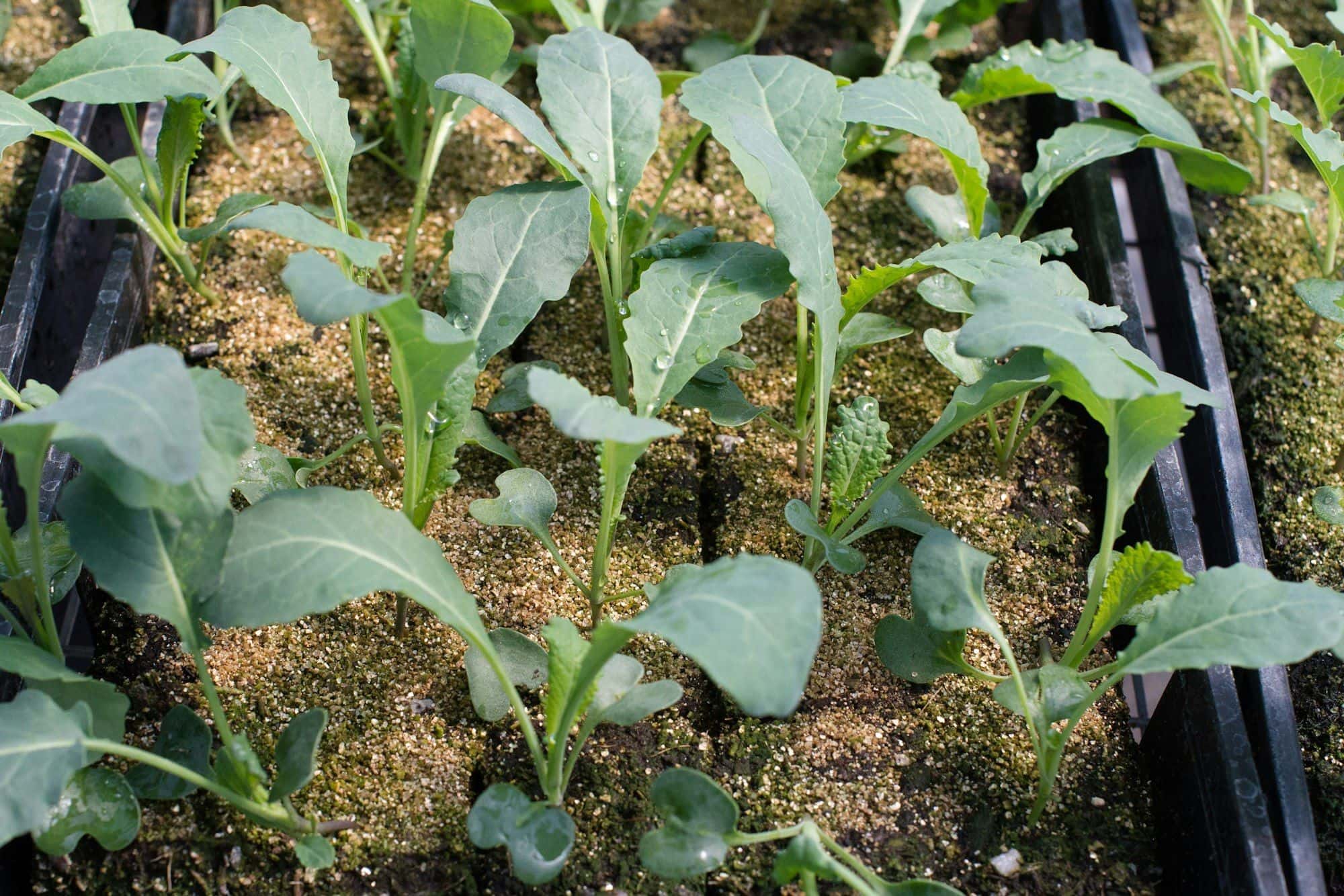
What kale microgreens are
Kale is a leafy cabbage that does not form a head. As a microgreen it grows as a tray of pale stems with two broad, heart-shaped seed leaves, cut before or just as the first frilly true leaf appears. The taste is mild and fresh, with a little cabbage sweetness and none of the toughness of mature kale leaves. Different varieties give different colours: green kales produce green trays, while 'Red Russian' and other red kales give purple-tinged stems and veins.
Not every kale is the same species. In their 2017 study, Waterland and colleagues grew 'Dwarf Blue Curled' and 'Scarlet', which are Brassica oleracea, and 'Red Russian', which is Brassica napus. The two species behaved similarly in their mineral profile. Kale was not one of the 25 microgreens in the well-known 2012 USDA-led nutrient study, so figures from that study do not apply to kale.
What the mineral study found
Waterland and colleagues measured potassium, calcium, magnesium, phosphorus, sodium, iron, manganese, zinc and copper in three kale cultivars at five stages, from cotyledon microgreens to adult leaves. On a dry-weight basis, total minerals fell from 14.6–19.1 per cent at the microgreen stages to 3.9–6.4 per cent in adult kale, and microgreen kale had higher concentrations of most minerals than adult kale in all three cultivars.
On a fresh-weight basis, the picture changed. The highest total mineral content was in young baby leaves, and there was no difference between microgreens and adult kale. Fresh microgreens had less calcium and magnesium and more sodium than fresh adult kale, partly because they are wetter: water content fell from 95.1 per cent in microgreens to 80.0 per cent in adult leaves. This is why 'more nutritious than the adult plant' claims need to say which basis they use.
| Measure | Microgreen stage | Adult kale |
|---|---|---|
| Total minerals, dry-weight basis | 14.6–19.1% | 3.9–6.4% |
| Total minerals, fresh-weight basis | No difference from adult | No difference from microgreen |
| Calcium and magnesium, fresh weight | Lower | Higher |
| Sodium, fresh weight | Higher | Lower |
| Water content | 95.1% (cotyledon stage) | 80.0% |
Other findings on kale microgreens
Ebert's 2022 review of sprouts and microgreens summarises work showing that kale sprouts had higher polyphenol values than kale microgreens and baby leaves, and that kale and broccoli microgreens grown on a windowsill had higher levels of certain phenolic compounds than those grown in a growth chamber. The Seth et al. 2025 review cites a biofortification study in which the total antioxidant capacity of kale microgreens was about 2.5 times higher under bright light than under normal light (9.2 against 3.6 mg per gram of dry weight).
On safety, Bianco and colleagues tested microgreens for cyanogenic glycosides in 2026 and found none in kale or broccoli raab microgreens, supporting their safety as ready-to-eat foods in that respect. Flax microgreens, tested in the same study, did contain these compounds. None of these studies shows a health effect in people, and kale microgreens should be seen as a fresh vegetable rather than a supplement.
How to grow kale microgreens
Kale is an easy, small-seeded brassica with no special needs. The Seth et al. review gives 30,000 to 40,000 seeds per square metre. A 10×20-inch tray covers 0.129 m², so that is 30,000 × 0.129 = about 3,900 to 40,000 × 0.129 = about 5,200 seeds per tray. Penn State Extension grew its microgreens at 10–15 g of seed per standard tray, which suits kale.
- Fill a tray with 2–3 cm of moist peat-based mix or coir and level it.
- Sow 10–15 g of seed per standard tray evenly over the surface.
- Mist, then cover with a second tray or black sheet for about 3 days.
- Uncover once most seeds have germinated and give bright light for 12–16 hours a day.
- Water from below so leaves stay dry.
- Harvest at 6–15 days, when the seed leaves are fully open and shoots are 2.5–7.5 cm tall.
Varieties and tips specific to kale
Variety changes both yield and colour. In Penn State's greenhouse trials, 'Russian' kale averaged 154.6 g per tray and 'Toscano' kale 117.9 g, over a two-week cycle without extra lighting. By comparison, red cabbage gave 106.1 g and cilantro 46.8 g under the same method. Red kales give purple stems and veins that make a mix look better; green curly kales give a uniform green tray.
Light also affects kale's composition. Penn State describes microgreens as a low-light crop, below 20 mol per square metre per day, but the bright-light study cited by Seth et al. suggests kale responds to stronger light with higher antioxidant capacity. Penn State gives 60–75°F (about 16–24°C) as the ideal soil temperature range for germination, so in Pune's hotter months keep trays indoors and out of direct afternoon sun.
Common problems
Kale is dependable, and most losses come from moisture and heat rather than the crop. Penn State Extension reports damping-off, a rot that collapses seedlings at the base, as the one disease it met in microgreen production, and it is favoured by warm, humid conditions. Watering from below, airflow from a small fan, and fresh medium for each tray are the main defences.
- Collapsed patches: damping-off; remove the patch, water less and add airflow.
- Tall, pale stems: covered too long or too little light.
- Yellowing seed leaves: Penn State saw iron-deficiency symptoms in microgreens grown on plain water; use a light feed.
- Seed hulls on leaves: brush the tray lightly or rinse just before eating.
Using kale microgreens in food
Kale microgreens are far more tender than kale leaves, so they need no cooking or massaging. Use them in salads and sandwiches, on avocado toast, in smoothies, or over pasta and soup just before serving. In Indian kitchens they work in a koshimbir or raita, on top of poha, upma and dosa, folded into a paneer or egg bhurji at the end, or chopped into paratha dough. Keep them chilled and dry, and wash just before eating.
Kale microgreens delivery in Pune
Garden & Acre delivers fresh microgreens in Pune and Pimpri-Chinchwad, as a weekly subscription for homes and as regular supply for restaurants, cafés and hotels. The microgreens come from our own supply chain. Orders are placed on WhatsApp, and prices are given there. Ask which varieties are available that week, including kale, and tell us the quantity and delivery day you need.
Questions
Are kale microgreens more nutritious than kale?
It depends on how you measure. A 2017 study found kale microgreens had higher mineral concentrations than adult kale on a dry-weight basis. On a fresh-weight basis, as eaten, total minerals were no different, and microgreens had less calcium and magnesium, because they contain more water.
How many days do kale microgreens take?
About 6 to 15 days. Research reviews list kale among microgreens harvested at 6 to 9 days in some studies and 13 to 15 days in others, and Penn State's yields came from a two-week cycle. Cut when the seed leaves are fully open and the first true leaf is just appearing.
Which kale is best for microgreens?
In Penn State Extension's trials, 'Russian' kale gave the higher yield, 154.6 g per tray, against 117.9 g for 'Toscano'. Red varieties such as 'Red Russian' and 'Scarlet' add purple colour. Note that 'Red Russian' is a different species, Brassica napus, though its mineral profile was similar to Brassica oleracea kales in one study.
How much kale seed do I need per tray?
A 2025 review gives 30,000 to 40,000 seeds per square metre, or about 3,900 to 5,200 seeds for a 10×20-inch tray of 0.129 m². Penn State Extension sowed 10–15 g of seed per standard tray for its microgreens. Sow evenly in one layer.
Are kale microgreens safe to eat raw?
Yes, for most people, when grown from clean seed and kept cold. A 2026 study found no cyanogenic glycosides in kale microgreens, unlike flax microgreens. As with any raw produce, buy from a clean source, store at about 5°C (41°F), which Penn State links with a longer shelf life, and wash just before eating.
Is there a Hindi name for kale?
Kale has no widely used Hindi or Marathi name; it is sold in India as kale, and sometimes described as a leafy cabbage. It is a relative of cabbage (patta gobhi) and cauliflower. The microgreens are young seedlings of kale, cut before the first true leaves grow large.
Sources
- Waterland et al. 2017, Mineral content differs among microgreen, baby leaf, and adult stages in three cultivars of kale (HortScience)
- Bianco et al. 2026, LC-MS to assess the occurrence of potentially toxic cyanogenic glycosides in edible microgreens (Plants)
- Ebert 2022, Sprouts and microgreens: novel food sources for healthy diets (Plants)
- Seth et al. 2025, Microgreens: functional food for nutrition and dietary diversification (Plants)
- Penn State Extension: Growing Microgreens