
What chia microgreens are
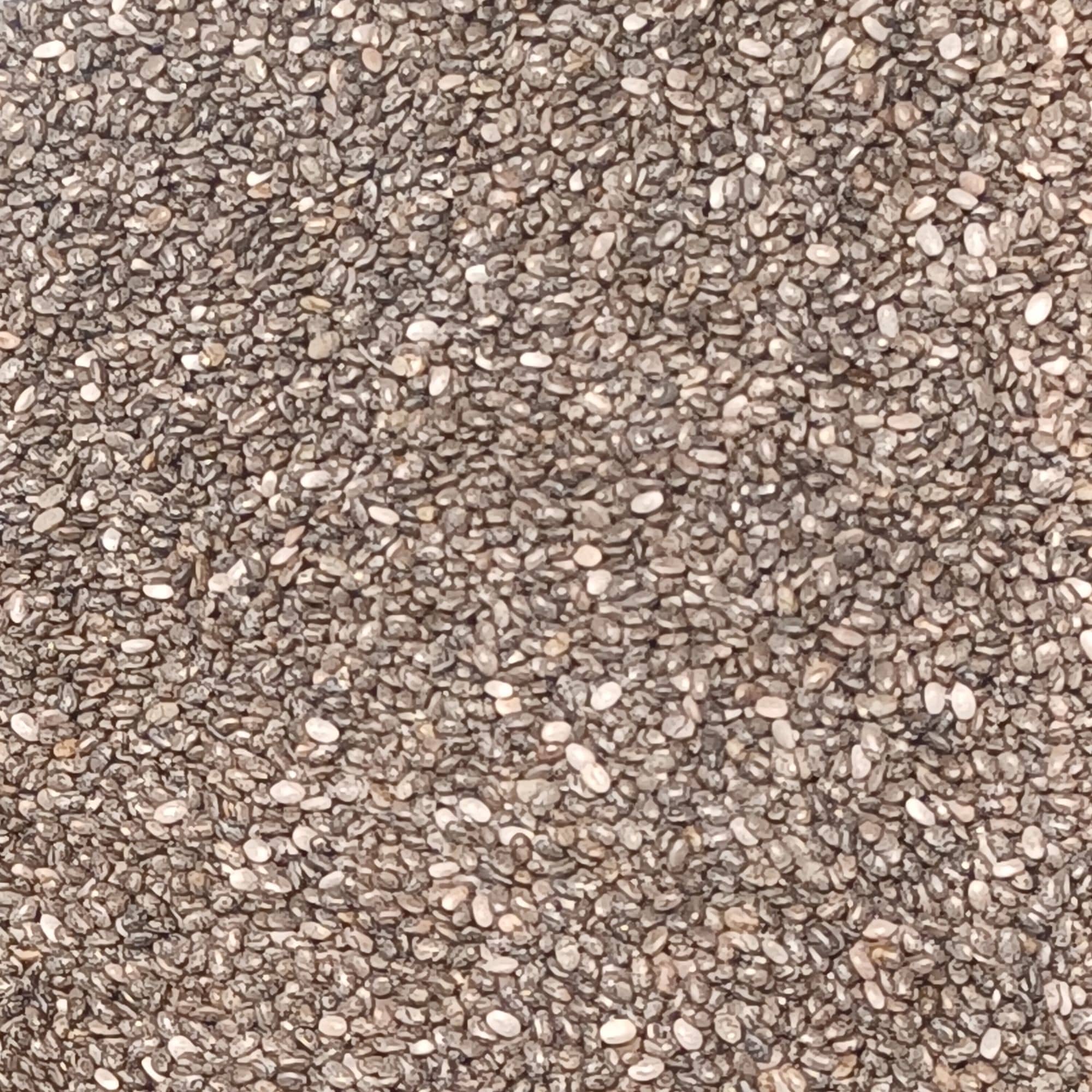
Chia is Salvia hispanica, a plant of the mint family grown for the small grey and black seeds sold as a health food. As a microgreen it gives short, tender stems and small rounded green seed leaves, harvested within about a week of sowing. The taste is mild and fresh, without the heat of mustard or radish, so chia works as a base for mixed microgreens. Chia is not the same as sabja. Sabja seeds, common across the Indian subcontinent, come from sweet basil (Ocimum basilicum). Both are small dark seeds that form a gel in water, but they are different plants and give different microgreens.
Why chia seed needs a different method
Chia seeds are coated in a layer that turns to gel when wet. A 2024 review in Food Hydrocolloids describes chia seeds as producing mucilage upon hydration in water, and notes that soaking time, temperature and the water-to-seed ratio change how much gel comes off. For growing, it means soaked chia does not stay as loose, separate seeds. It turns into a clump that is hard to spread in an even layer. A thick clump also holds water around the seeds, which in a warm room can favour mould.
Most growing guides for other seeds start with a soak. With chia, the easier route is to scatter dry seed evenly over an already moist mat or medium and then mist it. The seed gels in place and germinates where it fell, in a single layer. If you prefer to soak, spread the gel thinly and evenly with a spoon, and sow less seed than you would dry, because a gelled clump is easy to over-sow. Either way, the aim is one layer of seed with a little space around each.
What the chia microgreen trial found
Junpatiw and Sangpituk published four experiments on chia microgreens in the International Journal of GEOMATE in 2019. They compared unsoaked seed with seed soaked for 6 or 12 hours at room temperature, and with seed placed in water at 70–80 °C and left to cool for 6 or 12 hours. The hot-water treatment with 6 hours of cooling gave the highest germination, height and fresh weight. Of five growing media, coconut coir mixed with sand and rice husk ash (1:1:1) did best. Among sowing rates from 56 to 204 g per m², 204 g gave the most fresh weight. Harvesting 6 to 9 days after sowing gave the highest fresh weight.
| Factor tested | Options compared | Best result |
|---|---|---|
| Seed preparation | Dry; 6 or 12 h soak; hot water (70–80 °C) then 6 or 12 h cooling | Hot water, 6 h cooling |
| Growing medium | Five media | Coir, sand and rice husk ash, 1:1:1 |
| Sowing rate | 56, 93, 130, 167 and 204 g/m² | 204 g/m² |
| Harvest day | 5 to 9 days after sowing | 6–9 days |
How to grow chia microgreens
The steps combine the chia trial with the Penn State and University of Maryland extension guides. For a 10×20-inch tray, which is 25.4 × 50.8 cm = 0.129 m², the trial's best rate works out to 204 g/m² × 0.129 m² = about 26 g of seed. A 2025 study at CHRIST University, Bengaluru, grew chia microgreens in cocopeat and harvested when the first true leaves appeared.
- Fill a drained tray with moist coco peat or a coir mix, or lay a wet grow mat. The surface should be damp, not puddled.
- Scatter about 26 g of dry seed as evenly as you can. Do not cover it.
- Mist until the seed is wet all over and starts to gel.
- Cover to keep it dark and humid for about three days, misting if the surface dries.
- Uncover and give bright light for about 16 hours a day. Water from below from here on.
- Cut with clean scissors on day 6–9, when the seed leaves are open.
Nutrition and common problems
Chia microgreens have been studied far less than broccoli or radish. The Bengaluru study identified 32 compounds in a chia microgreen extract, including flavonoids, phenolic acids and terpenoids, and a 2025 ICAR review lists chia among microgreens whose nutritional value researchers have highlighted. The omega-3 fats chia is known for are in the seed, and the studies we found did not measure them in the microgreens. The main problem is mould in the wet gel layer. Keep the surface moist but not flooded, give air with a small fan as UMD advises, and discard any tray with grey, musty growth. Clumped seed germinates unevenly, so spread dry seed thinly.
How to eat chia microgreens, including Indian dishes
Their mild flavour makes chia a filler and softener in mixed microgreens. Toss them with radish or mustard microgreens to tame the heat, fold them into a cucumber or boondi raita, or scatter them over avocado toast, a paneer sandwich or a bowl of khichdi. They suit South Indian breakfasts as a fresh topping on a plain dosa, uttapam or pesarattu. Add them after cooking, since the stems are thin and wilt quickly in heat. Rinse gently just before eating and keep them refrigerated in a closed box.
Fresh microgreens in Pune
Garden & Acre delivers fresh microgreens in Pune and Pimpri-Chinchwad from its own supply chain, as weekly home boxes, single-variety packs, and regular supply by weight for restaurants, cafés and hotels. The usual core varieties are sunflower, radish, broccoli, mustard and pea shoots, and other varieties depend on what is available each week. Ask on WhatsApp whether chia is on this week's list. We reply with the varieties available, the prices and the first delivery date.
Questions
Should I soak chia seeds before growing microgreens?
It is not needed, and soaked chia turns into a gel that is hard to spread. Scatter dry seed on a moist surface and mist it. In one 2019 trial, seed placed in 70–80 °C water and cooled for 6 hours germinated best, so a soak can help if you spread the gel thinly.
How long do chia microgreens take to grow?
About 6 to 9 days. Junpatiw and Sangpituk compared harvests from 5 to 9 days after sowing and found 6 to 9 days gave the highest fresh weight. Cut when the two seed leaves have opened, before true leaves grow large.
How much chia seed do I need per tray?
About 26 g for a 10×20-inch tray. The 2019 trial found 204 g per square metre gave the highest fresh weight among the rates tested, and a 10×20-inch tray is 0.129 m², so 204 × 0.129 = about 26 g. Use proportionally less for smaller containers.
Are chia microgreens the same as sabja microgreens?
No. Chia is Salvia hispanica. Sabja seed comes from sweet basil, Ocimum basilicum, so sabja microgreens are basil microgreens and taste of basil. Both seeds form a gel when wet, so both are sown dry onto a moist surface rather than soaked loose.
Do chia microgreens have omega-3 like chia seeds?
We have not found a study measuring omega-3 fats in chia microgreens. The seed is the known source. Chia microgreens are best eaten as a fresh vegetable, not as a replacement for the seeds, and no study shows a specific health effect from eating them.
Sources
- Effects of seed preparation, sowing media, seed sowing rate and harvesting period on the production of chia microgreens — Junpatiw & Sangpituk, International Journal of GEOMATE, 2019
- Evaluation of extraction techniques for chia seed mucilage: a review — Mensah et al., Food Hydrocolloids, 2024
- Biogenically forged ZnO nanoparticles using Salvia hispanica L. microgreens — Naga Sahithi & Lakshmaiah, RSC Advances, 2025
- Microgreens: Functional Food for Nutrition and Dietary Diversification — Seth et al., Plants, 2025 (ICAR)
- Assessment of potential antimicrobial activity of Ocimum basilicum extract (sabja seeds) — Khot et al., Journal of Indian Society of Periodontology, 2023
- Growing Microgreens and Baby Greens Indoors — University of Maryland Extension
- A Step-By-Step Guide for Growing Microgreens at Home — Penn State Extension