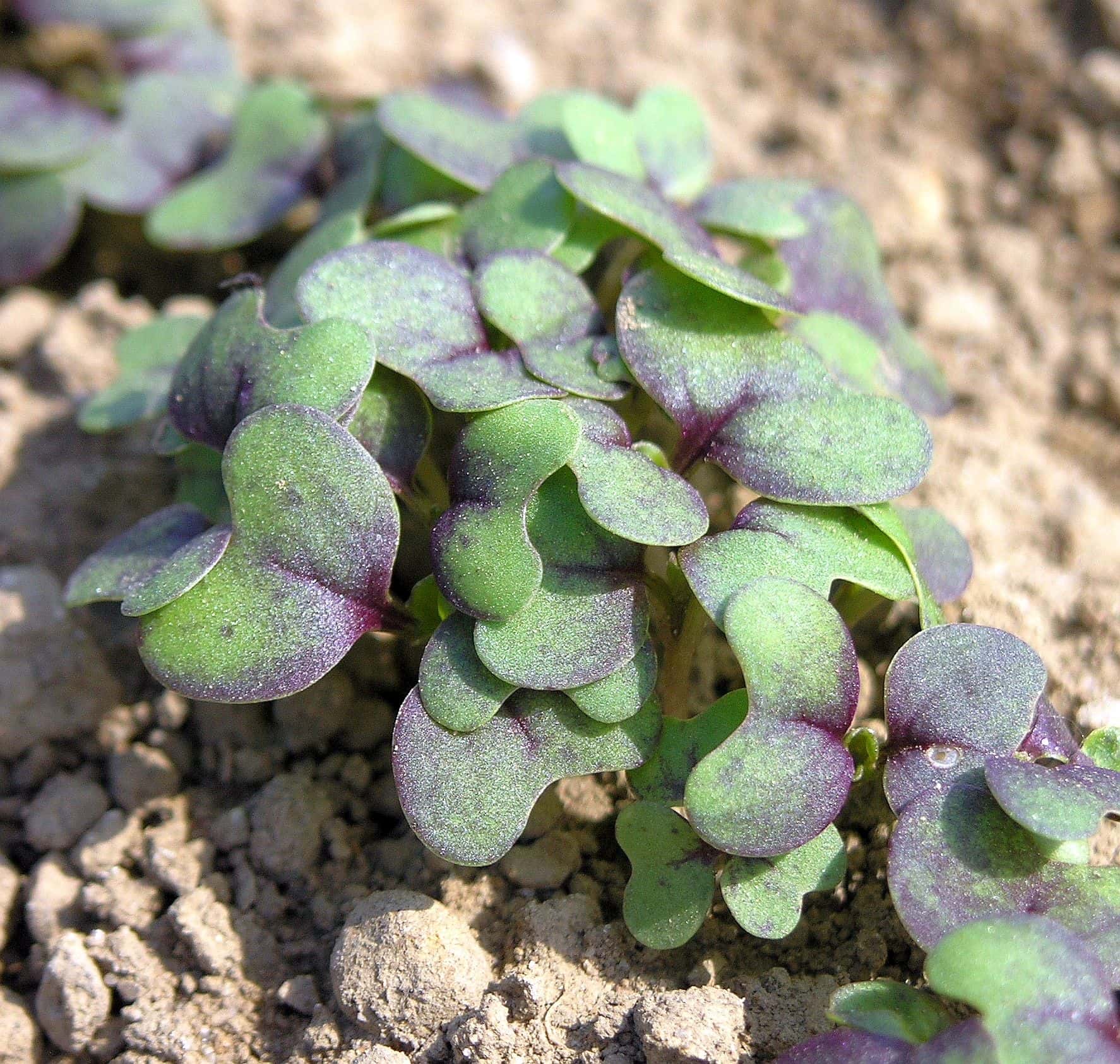
What mustard microgreens are
They are seedlings of the mustard plant, the same crop that gives sarson ka saag and the rai seed used in tadka. Indian mustard is Brassica juncea, called sarson or rai in Hindi and mohari in Marathi. The harvest is the stem and the two seed leaves, cut before the true leaves grow large. Green varieties taste of fresh mustard greens with a hot finish. Red and purple varieties, such as 'Garnet Giant', add colour. Mustard is quick: ICAR-IARI harvested it on the 8th day, and in Johnny's trial of 29 microgreens it averaged 12.5 days, faster than most. The flavour is strong enough that a small handful is enough for a plate.
What ICAR-IARI measured for Indian mustard
Priti and colleagues at ICAR-Indian Agricultural Research Institute, New Delhi, published a study on the yield, storage and safety of mustard, mungbean and lentil microgreens in PLoS One in 2022, which they describe as the first from India on the safety of these microgreens. They used two IARI mustard varieties: PM28, a short-duration variety, and PDZM31 (Pusa Double Zero Mustard-31), India's first double-zero mustard, with erucic acid below 2% and glucosinolates below 30 ppm in the seed. Seeds were sown at 6, 8 and 10 seeds per cm² in coco peat, vermiculite and sand (2:1:1) and harvested on the 6th, 8th and 10th day.
Yield rose with density, from 1.09–1.10 kg per m² at 6 seeds per cm² to 1.33–1.36 kg per m² at 10 seeds. But above 8 seeds per cm², shoots became elongated and crowded and air circulation suffered, which favours fungal growth, so 8 seeds per cm² was the optimum. The 8th day was the best harvest day. Across the 6th to 10th day, mustard yielded 1.07 to 1.35 kg per m². Salmonella and Listeria were not detected, and the other microbes counted were within safe limits.
| Setting | Result |
|---|---|
| Seeding density tested | 6, 8 and 10 seeds per cm² |
| Optimum density | 8 seeds per cm² |
| Best harvest day | 8th day after sowing |
| Yield, 6th–10th day | 1.07–1.35 kg per m² |
| Shelf life at 4 °C in sealed bags | About 4 days |
Nutrition: what studies measured
Mustard has been included in several nutrient surveys. Purple mustard and red mustard were among the 25 commercial microgreens in the 2012 USDA and University of Maryland study by Xiao and colleagues, which found that the microgreens as a group had higher vitamin and carotenoid densities than the mature leaves listed in the USDA nutrient database. Mustard was also one of the ten microgreens that Ghoora and colleagues analysed in India in 2020; the ten together met 28–116% of the reference daily intake of vitamin C and 28–332% of vitamin E, by the authors' calculation. A 2025 ICAR review notes a study in which blue light raised pigments such as carotenes, lutein and chlorophyll 1.2 to 4.3 times in mustard, beet and parsley microgreens. These describe content, not health outcomes.
How to grow mustard microgreens
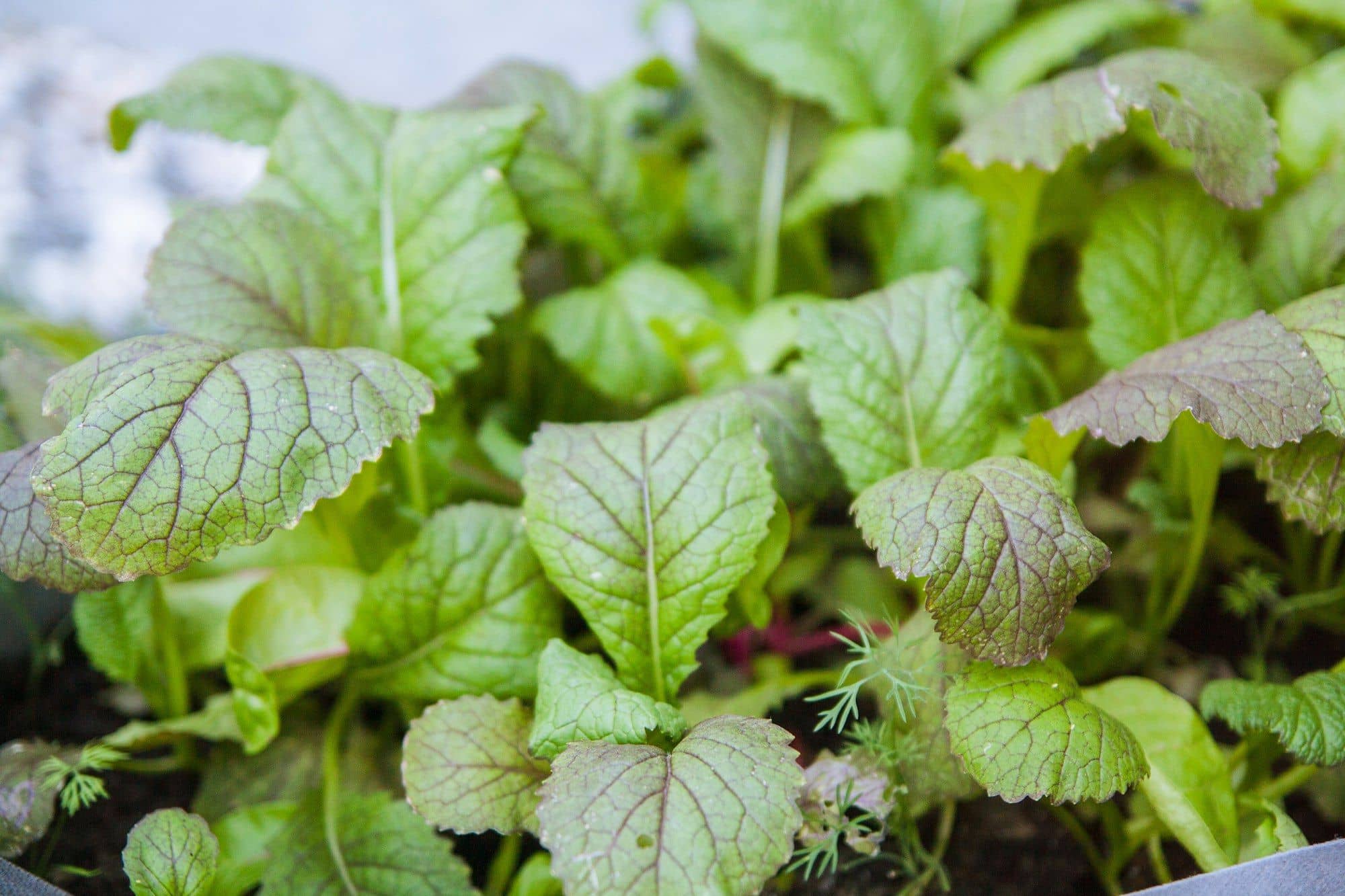
Mustard seed is small and needs no soaking. The seed rate depends on the seed. At ICAR-IARI's 8 seeds per cm², a 10×20-inch tray of 1,290 cm² takes 8 × 1,290 = about 10,300 seeds. With their 100-seed weights of 0.33–0.44 g, that is about 34–45 g of Indian mustard seed. Johnny's used much less, 8 g per tray, of its 'Garnet Giant' seed, harvesting at 12.5 days. Start in the middle and adjust.
- Fill a drained tray with 2.5–4 cm of moist coco peat mix or soil mix, or lay a wet grow mat.
- Scatter the seed evenly and press it onto the surface. Do not cover it.
- Mist, cover and keep dark for about three days.
- Uncover and give bright light for about 16 hours a day. Water from below.
- Cut 1 cm or more above the medium with clean scissors on day 8–10, at 5–7.5 cm tall.
Common problems
Over-sowing is the most common mistake. The ICAR-IARI team found that going beyond the optimum density gave elongated shoots and poorer air circulation, which favours fungal growth, and raised seed cost. Keep a fan on low and water only when the medium starts to dry, as Penn State and UMD advise. Discard any tray with grey, musty growth. Mustard also fades quickly after cutting. In the IARI trial, sensory scores stayed above the saleable limit until the 4th day in the refrigerator and dropped sharply by the 6th day, so harvest only what you will eat within a few days.
How to eat mustard microgreens, including Indian dishes
Use them the way you would use a pinch of mustard or a green chilli. A small handful on makki ki roti with sarson ka saag doubles the mustard flavour. Stir them into curd with salt and roasted jeera for a quick raita, add them to aloo tikki or a potato sandwich, or top a masala omelette or a bowl of dal-chawal. They cut through rich food, so they suit paneer tikka, kebabs and butter-heavy dishes. Mix them with milder microgreens such as pea shoots or sunflower if the heat is too much. Rinse just before eating.
Fresh mustard microgreens in Pune
Garden & Acre delivers fresh microgreens in Pune and Pimpri-Chinchwad from its own supply chain. Homes can take a weekly box or single-variety packs, and restaurants, cafés and hotels can take regular supply by weight on fixed delivery days. Mustard is one of the usual core varieties, subject to what is available that week. Order on WhatsApp: send the varieties, quantity and delivery day you want, and we reply with availability, prices and the first delivery date.
Questions
How many days do mustard microgreens take?
About 8 days in warm conditions. ICAR-IARI found the 8th day after sowing was the best harvest day for Indian mustard microgreens, among the 6th, 8th and 10th days tested. Johnny's recorded 12.5 days for its red 'Garnet Giant' mustard, harvested at the first true leaf.
Are mustard microgreens spicy?
Yes. They carry the same pungent heat as mustard leaves and seeds, which is why a small quantity is enough for a plate. The heat is strongest raw, and they are best added at the end of cooking or on top of the finished dish. Mix them with mild microgreens such as pea shoots, sunflower or broccoli if you want less bite.
Can I grow mustard microgreens from kitchen rai?
Kitchen seed may germinate, but its germination rate and cleanliness are unknown, and microgreens are eaten raw. The ICAR-IARI trial used fresh seed with more than 90% germination and surface-sterilised it before sowing. Seed sold for microgreens or sprouting is the safer choice.
How long do mustard microgreens last in the fridge?
About 4 days. In the ICAR-IARI study, Indian mustard microgreens stored in sealed food-grade bags at 4 °C kept saleable colour, aroma and taste until the 4th day, and the scores fell sharply by the 6th day. Store them dry and rinse just before eating.
What is the yield of mustard microgreens per tray?
ICAR-IARI measured 1.07 to 1.35 kg per m². A 10×20-inch tray is 0.129 m², so 1.35 × 0.129 = about 0.17 kg per tray at the top of that range. Johnny's recorded 9.5 oz per tray for 'Garnet Giant', which is 9.5 × 28.35 g = about 269 g.
Sources
- Priti et al., Microgreens of mungbean, lentil and Indian mustard: seeding density, harvest stage, shelf life and microbial load — PLoS One, 2022 (ICAR-IARI)
- Assessment of vitamin and carotenoid concentrations of emerging food products: edible microgreens — Xiao et al., Journal of Agricultural and Food Chemistry, 2012
- Nutrient composition, oxalate content and nutritional ranking of ten culinary microgreens — Ghoora, Babu & Srividya, Journal of Food Composition and Analysis, 2020
- Microgreens: Functional Food for Nutrition and Dietary Diversification — Seth et al., Plants, 2025 (ICAR)
- Micro Greens Yield Trial 2017 — Johnny's Selected Seeds
- A Step-By-Step Guide for Growing Microgreens at Home — Penn State Extension
- Growing Microgreens and Baby Greens Indoors — University of Maryland Extension