What arugula microgreens are
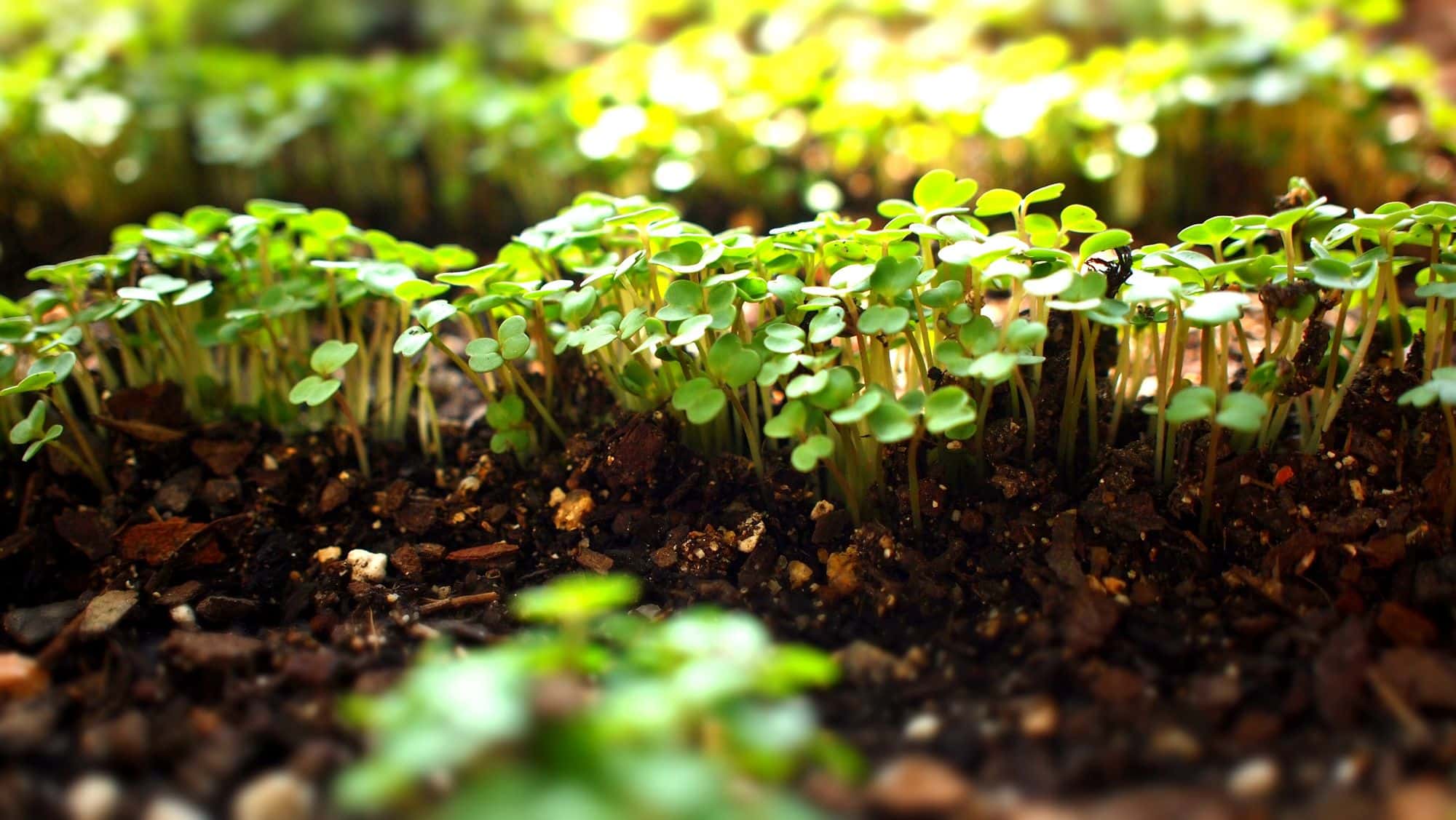
Arugula, also called rocket or roquette, is a leafy member of the mustard family. The same species is also grown for its oilseed, under the name taramira. As a microgreen it produces a tray of short, pale stems with small, notched seed leaves. The flavour is the main reason to grow it: sharp and peppery like the mature leaf, with a nutty finish, but milder and more tender. It is one of the standard microgreens in restaurant kitchens and mixed salad packs.
Penn State Extension lists arugula among the common microgreens, and its trials give a useful sense of how productive it is. Grown in a greenhouse without extra lighting at 10–15 g of seed per standard tray over a two-week cycle, arugula averaged 147.6 g per tray. That was more than red cabbage (106.1 g) and three times cilantro (46.8 g).
What studies have measured
Arugula was one of the 25 microgreens in the 2012 study by Xiao and colleagues with the USDA Agricultural Research Service, which measured vitamin C, vitamin E, vitamin K and carotenoids. Across the 25, microgreens had higher vitamin and carotenoid densities than the mature leaves in the USDA nutrient database. The highest concentrations of each nutrient group were found in red cabbage, cilantro, garnet amaranth and green daikon radish, not in arugula.
Johnson and colleagues at Colorado State University compared arugula and five other microgreens with the same plants grown to maturity in 2021. Using metabolomics and mineral analysis, they detected 3,321 compounds and 26 minerals across the samples, and found that each microgreen had a metabolite and mineral profile distinct from its mature form. These are measurements of composition. They do not show that eating arugula microgreens treats or prevents any disease.
| Measure | Result | Source |
|---|---|---|
| Yield per standard tray | 147.6 g | Penn State Extension |
| Seed per 1020 tray | 10 g | Johnson et al. 2021 |
| Seed density for highest yield | 12 seeds per cm² | Dubey et al. 2026 |
| Optimum harvest day | Day 9 | Berba & Uchanski, cited in Priti et al. 2022 |
| Shelf life | 14 days at 4°C; 7 days at 10°C | Berba & Uchanski, cited in Priti et al. 2022 |
How to grow arugula microgreens
Arugula seed is small and germinates quickly, so it needs little preparation. In the Colorado State trial, about 10 g of seed was sown on 1.5 cm of coir in each standard 1020 tray (26.7 × 53 cm), covered with black polythene for 24 to 48 hours, and grown under LED lights. A review in Food Chemistry X notes that some growers soak arugula seed overnight before sowing, but it is not required.
- Fill a tray with 1.5–3 cm of moist coir or peat-based mix and level it.
- Sow about 10 g of seed per 1020 tray evenly over the surface.
- Mist, then cover with black polythene or a second tray for 24–48 hours.
- Uncover once most seeds have germinated and give bright light for 12–16 hours a day.
- Water from below so leaves stay dry.
- Harvest from day 9, when the seed leaves are open and shoots are 2.5–7.5 cm tall.
Seed density and tips specific to arugula
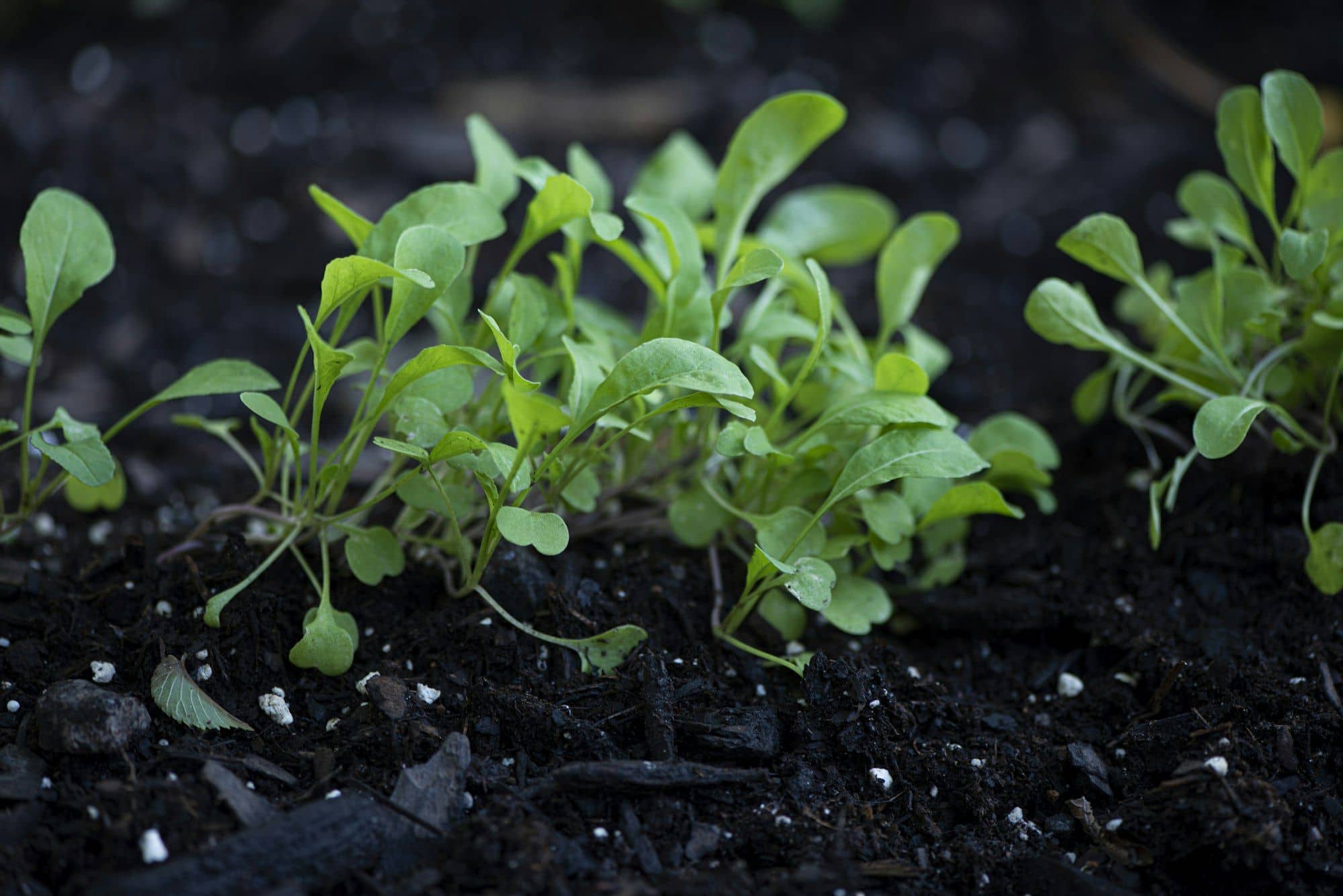
Sowing rates vary between studies. The Seth et al. 2025 review gives about 50–100 g of arugula seed per square metre, and a 10×20-inch tray covers 0.129 m², so that is 50 × 0.129 to 100 × 0.129, or about 6–13 g per tray. Dubey and colleagues found yield rose with seed density up to 12 seeds per cm² in rocket. But higher densities also raised counts of total aerobic bacteria, Enterobacteriaceae and fungi, so the heaviest sowing is not automatically the best.
Harvest timing changes both flavour and yield. Research cited by the IARI team found day 9 optimal for arugula under their conditions, while the Colorado State trial grew it to day 20. Earlier harvests are smaller and more tender; later ones give more weight per tray. Pune's summer heat speeds growth, so check trays daily in April and May and cut as soon as the seed leaves are fully open.
Common problems
Arugula is generally reliable, and most losses come from moisture and crowding. Penn State Extension reports damping-off, a rot that collapses seedlings at the base, as the one disease it met in microgreen production, favoured by warm, humid conditions. Watering from below and good airflow are the main defences, and the Dubey study suggests that sowing slightly thinner also keeps the microbial load lower.
- Collapsed patches: damping-off; remove the patch, water less and add airflow.
- Tall, pale, floppy stems: kept covered too long or too little light.
- Yellowing leaves before harvest: Penn State saw iron-deficiency symptoms in microgreens grown on plain water; use a light feed or harvest earlier.
- Tough, stringy stems: harvested too late.
Using arugula microgreens in food
Arugula microgreens bring heat and bite, so a small handful goes a long way. Use them on pizza after it leaves the oven, in sandwiches and burgers, on avocado toast, or with paneer tikka and grilled vegetables. In Indian food they work like a milder, fresher mustard green: scatter them over pav bhaji, misal, bhel or a chana chaat, or fold them into a tomato and onion kachumber. They wilt quickly under heat, so add them last. Keep them cold and dry until use, and wash just before eating.
Arugula microgreens delivery in Pune
Garden & Acre delivers fresh microgreens in Pune and Pimpri-Chinchwad, as a weekly subscription for homes and as regular supply for restaurants, cafés and hotels. The microgreens come from our own supply chain. Orders are placed on WhatsApp, and prices are given there. Ask which varieties are available that week, including arugula, and tell us the quantity and delivery day you need.
Questions
What do arugula microgreens taste like?
Peppery, nutty and slightly mustard-like, similar to mature rocket leaves but milder and more tender. They are one of the sharper-tasting microgreens, along with radish and mustard, so a small handful is enough to season a salad or sandwich. Mix them with milder greens such as alfalfa or pea shoots if you want less bite.
How many days do arugula microgreens take?
About 9 to 20 days. Research cited by ICAR-IARI scientists gives day 9 as the optimum harvest under one set of conditions, while a Colorado State University trial harvested at 20 days. Penn State's yields came from a two-week cycle. Cut earlier for a milder taste and later for more weight.
How much arugula seed do I need per tray?
About 10 g per standard 1020 tray, as in the Colorado State trial. A 2025 review gives 50–100 g per square metre, which is about 6–13 g for a 10×20-inch tray of 0.129 m². Sowing much heavier can raise microbial counts without much gain in yield.
How long do arugula microgreens last in the fridge?
In the storage study cited by ICAR-IARI researchers, arugula microgreens lasted 14 days at 4°C and 7 days at 10°C, judged by appearance. Home fridges run warmer and are opened often, so expect less. Keep them dry, sealed and unwashed until use.
Do I need to soak arugula seeds?
No. Arugula seed is small and germinates within a day or two on a moist surface. Some growers soak it overnight, as a review in Food Chemistry X notes, but the Colorado State trial and Penn State's method do not require it. Sow evenly, mist and cover for 24–48 hours.
What is arugula called in Hindi?
Arugula (Eruca sativa) is known in India as taramira, a name used mainly for the oilseed crop grown from the same species. In English it is also called rocket or roquette, and rucola in Italian. The microgreens are the seedlings of the same plant.
Sources
- Johnson et al. 2021, Comprehensive evaluation of metabolites and minerals in 6 microgreen species and the influence of maturity (Curr Dev Nutr)
- Dubey et al. 2026, Microgreens: optimising seed density and exploring the influence of white light and UV-A radiation (Plants)
- Xiao et al. 2012, Assessment of vitamin and carotenoid concentrations of emerging food products: edible microgreens (J Agric Food Chem)
- Seth et al. 2025, Microgreens: functional food for nutrition and dietary diversification (Plants)
- Priti et al. 2022, Yield optimization, microbial load analysis, and sensory evaluation of mungbean, lentil, and Indian mustard microgreens (PLoS One)
- Penn State Extension: Growing Microgreens
- Singh et al. 2024, Emergence of microgreens as a valuable food: a review (Food Chem X)
- Khan et al. 2025, Eruca sativa (taramira) field study (Sci Rep)