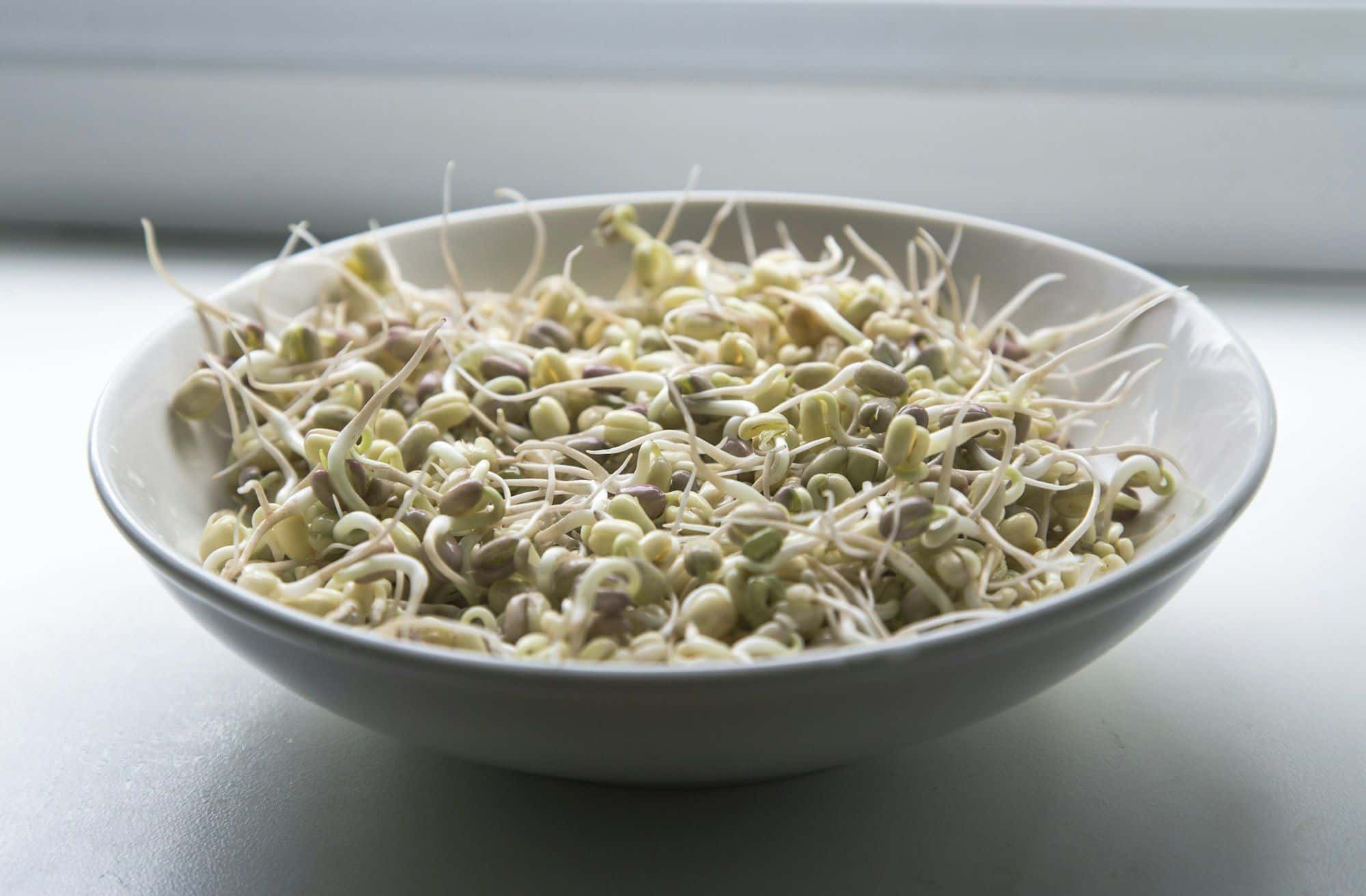
The short answer
Sprouts and microgreens both start as seeds, and many of the same seeds, such as moong, radish, alfalfa and broccoli, can become either. The difference is how long they grow, where, and which part is eaten. A sprout is harvested within days of germinating, before true leaves form, and eaten whole. A microgreen grows on until its seed leaves open and its first true leaves start, and only the part above the growing medium is eaten.
That one difference, whether the seed and root are eaten, drives the rest. Sprouts are grown in warm, wet conditions that suit bacteria, and every part of the sprout, including anything carried on the seed, is eaten raw. Microgreens are grown drier, in light, and cut above the root. They still carry food-safety risks, but regulators treat them differently from sprouts.
| Point | Sprouts | Microgreens |
|---|---|---|
| What is eaten | The whole seedling: seed, root and shoot | Stem and leaves, cut above the medium |
| Grown in | Water, in jars, trays or drums | Soil, coir, peat or a fibre mat |
| Light | Often grown in the dark | Light after the first few days |
| Time to harvest | A few days (about 5 in typical sprouting) | About 7–21 days, by variety |
| Leaves at harvest | Before true leaves develop | Seed leaves open, first true leaves starting |
| US produce rule | Sprout-specific rules (21 CFR 112 Subpart M) | Excluded from Subpart M when cut without roots |
| FDA advice | Vulnerable groups should avoid raw or lightly cooked sprouts | No equivalent FDA warning found; normal produce hygiene applies |
| Typical use | Cooked dishes, salads, chaat, stir-fries | Raw, as garnish or in salads and sandwiches |
How sprouts are grown
European Union Regulation 208/2013 defines sprouts as the product of germinating seeds and developing them in water or another medium, harvested before true leaves develop, and intended to be eaten whole, including the seed. That is the standard picture: seeds soaked, then kept moist in a jar, tray or drum and rinsed often, usually for a few days. A 2026 study of mung bean describes the sprouting period as typically about 5 days, depending on temperature.
Sprouts are grown in bulk, fast, and often in the dark. In India, sprouted moong, chana and matki are household foods, usually made by soaking the seed overnight and keeping it wrapped in a damp cloth for a day or two. The FDA notes that sprouts are grown from seeds and beans under warm and humid conditions, and that these conditions are also ideal for bacteria such as Salmonella, Listeria and E. coli.
How microgreens are grown
USDA's Agricultural Research Service describes microgreens as edible greens grown from the seeds of vegetables and herbs and harvested without roots at the seedling stage, when the two seed leaves have fully expanded. The University of Maryland Extension calls them fast-growing, closely spaced vegetable seedlings harvested at the true-leaf stage. They are sown thickly on a shallow layer of soil, coir, peat or a fibre mat, kept dark for the first few days while they germinate, then grown under light.
Harvest usually comes 7–21 days after sowing, depending on the variety; the ICAR review by Seth and colleagues gives harvest windows from 6–9 days for fast crops to 19–21 days for slow ones. The crop is cut with scissors or a knife above the medium, so the seed and root stay behind in the tray. Our types of microgreens guide lists days to harvest for 35 varieties.
Food safety: why the FDA treats sprouts differently
Sprouts have a long outbreak record in the United States. In its Produce Safety Rule, the FDA reports 43 outbreaks, 2,405 illnesses, 171 hospitalisations and 3 deaths associated with sprouts between 1996 and 2014. It attributes the risk to the warm, moist and nutrient-rich conditions needed to grow them. The rule's focus on treating seed reflects that contamination can start on the seed, and because the seed is eaten, any bacteria that multiply during sprouting are eaten too.
The FDA's consumer advice is direct: sprouts such as alfalfa or mung bean served raw or lightly cooked may carry bacteria that cause foodborne illness, and people more vulnerable to foodborne illness should avoid raw or lightly cooked sprouts of any kind. It names children, older adults, pregnant women and people with weakened immune systems. It also notes that cooking produce thoroughly kills harmful bacteria.
- Sprout growers under the rule must take steps to keep microbes off seed, and treat seed before sprouting.
- They must test spent irrigation water or sprouts from each batch for certain pathogens before sale.
- They must test the growing, packing and holding areas for Listeria.
- They must take corrective action when a test is positive.
Are microgreens safer than sprouts?
The law draws a line. Under 21 CFR 112.141, the sprout rules apply to all sprouts except soil- or substrate-grown sprouts harvested without their roots, which describes microgreens cut above their medium. Microgreens can still be covered by the general produce rules, but not by the sprout-specific ones. Researchers give the same reason: a 2023 study notes that microgreens are usually eaten without roots, whereas sprouts are eaten raw with the root system intact, which may reduce the risk for microgreens.
Lower risk is not no risk. That 2023 study tested 102 microgreen seed samples bought online and found coliforms on 48% of them, one onion sample positive for Salmonella by PCR and one carrot sample presumptive for Listeria. The authors note that no outbreak had been confirmed from microgreens, but that microgreens have been recalled for Salmonella and Listeria. In the ICAR-IARI 2022 study, no Salmonella or Listeria was detected on mungbean, lentil and mustard microgreens, and a 2026 mung bean study found higher microbial loads on sprouts than on microgreens.
Nutrition: microgreens vs sprouts
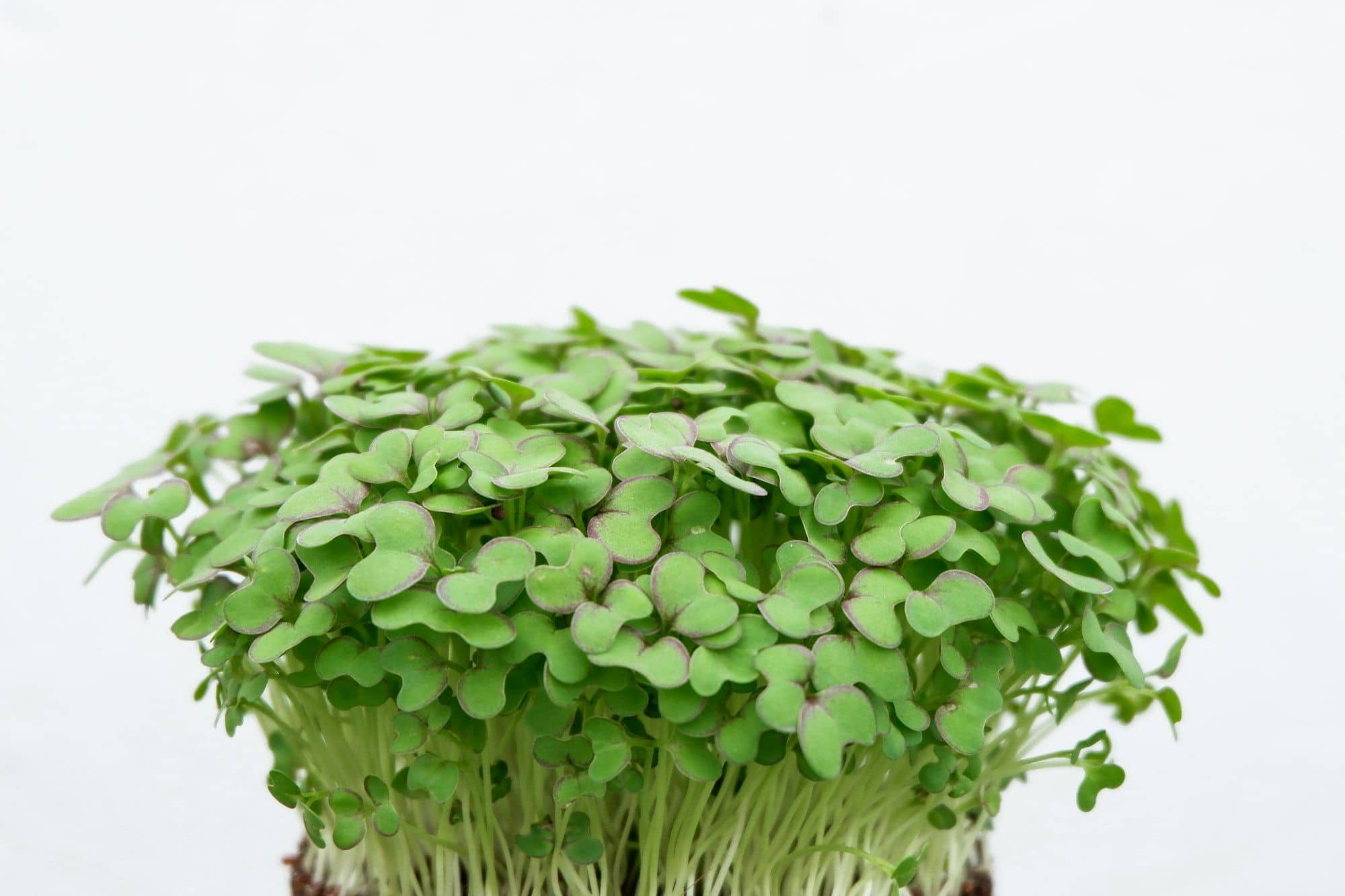
Direct comparisons are few, and they compare the same seed at two stages. A 2026 study in Open Life Sciences grew mung bean sprouts and mung bean microgreens and compared them on a fresh-weight basis. The microgreens had less protein and fat, nearly double the dietary fibre, more calcium, magnesium, iron and zinc, slightly less potassium and significantly more vitamin C. Chlorophyll showed no notable difference.
The ICAR review by Seth and colleagues cites work finding flaxseed microgreens higher than flax sprouts in chlorophyll, carotenoids and phenols, and broccoli microgreens higher in antioxidants than broccoli sprouts. It also notes that vitamin C is potentially higher at the microgreen stage than at the sprout, baby-leaf or mature stage. Sprouts keep more of the seed's stored protein and energy; microgreens have started to photosynthesise and build leaf nutrients. Our benefits and nutrition guide covers the microgreen studies in detail.
What are micro sprouts?
"Micro sprouts" is a search term, not a defined category. None of the regulators or studies we checked uses it. Sellers use it for two different things: sprouts grown in trays for a day or two longer than usual so that small green leaves appear, and very young microgreens cut early. The two differ on the point that matters most for safety, which is whether the root and seed are eaten.
When a product is sold as micro sprouts, ask two questions. Was it grown in water or in a medium such as soil or coir? Is it sold with roots, or cut above the root? A product grown in water and eaten with its roots should be treated like sprouts, including the FDA advice for vulnerable groups. A product grown in a medium and cut above the root is a microgreen by the definitions above.
How each is eaten
Sprouts are often cooked in Indian kitchens, in usal, misal, stir-fries and dals, and they are also eaten raw in chaat and salads. Given the FDA advice, cooking sprouts is the safer choice for children, older people, pregnant women and anyone with weakened immunity. Microgreens are almost always eaten raw, because heat wilts them quickly. They go on top of a dish at the end: salads, sandwiches, raita, soups, parathas, dosa, eggs and pizza.
Storage differs as well. Microgreens are delicate; the ICAR review puts their fresh life at 3–10 days under refrigeration at 4 °C, and the 2026 mung bean study notes that sprouts, harvested with roots, keep longer. Both should be kept cold, and both are best rinsed just before use rather than before storing. Throw out either if it smells sour, turns slimy or looks brown, and do not keep a tray of microgreens growing on the kitchen counter past its harvest stage.
Which should you choose?
Choose by use. For a cooked, filling, protein-rich dish, sprouts are the traditional and cheaper choice; cook them if anyone eating is in a vulnerable group. For a raw finish to a meal, with flavour and colour, microgreens are the better fit, and they avoid the sprout-specific risk because the seed and root are left behind. With either, buy from a clean source, keep it cold and eat it within a few days.
- Eat raw, as garnish or salad: microgreens.
- Cook into a dish for protein and bulk: sprouts.
- Serving children, older people, pregnant women or anyone with weak immunity raw greens: microgreens rather than raw sprouts, and still from a clean source.
- Growing at home: microgreens need a tray, medium and light; sprouts need only a jar or cloth, but strict hygiene.
Fresh microgreens delivered in Pune
Garden & Acre delivers fresh microgreens, cut above the root, in Pune and Pimpri-Chinchwad from its own supply chain. Homes can take a weekly subscription, and restaurants, cafés and hotels can arrange regular supply for salads, garnishes and plating. A regular weekly delivery means the greens arrive fresh rather than sitting in a shop. Orders are taken on WhatsApp, where prices and the week's varieties are shared.
Questions
What is the main difference between microgreens and sprouts?
Sprouts are germinated seeds grown in water for a few days and eaten whole, with the seed and root. Microgreens are grown in soil, coir or a mat under light for about 7–21 days and cut above the root, so only the stem and leaves are eaten. Microgreens are older, leafier and grown in drier conditions.
Are microgreens safer than sprouts?
They are generally considered lower risk, because they are grown in drier conditions and eaten without the seed and root. US law excludes substrate-grown sprouts harvested without roots from the sprout-specific rules. Microgreens are still a raw food: contaminated seed has been found, and microgreens have been recalled for Salmonella and Listeria, though no outbreak had been confirmed.
Why does the FDA warn against raw sprouts?
Sprouts grow in warm, humid conditions that also suit bacteria such as Salmonella, Listeria and E. coli, and the whole seed is eaten. The FDA records 43 outbreaks and 2,405 illnesses linked to sprouts in the US between 1996 and 2014. It advises children, older adults, pregnant women and people with weakened immunity to avoid raw or lightly cooked sprouts.
Are microgreens more nutritious than sprouts?
In the few direct comparisons, often yes for some nutrients. A 2026 study found mung bean microgreens had nearly double the fibre, more calcium, magnesium, iron, zinc and vitamin C, but less protein and fat, than mung bean sprouts on a fresh-weight basis. Results depend on the seed and the nutrient.
What are micro sprouts?
It is not a formal category. Sellers use the term for sprouts grown a little longer until small leaves appear, or for very young microgreens. Ask whether the product was grown in water or a medium, and whether it is sold with roots. If it was grown in water and eaten with roots, treat it as sprouts for safety.
Can I turn sprouts into microgreens?
Yes. Many microgreens start as the same seeds, such as moong, radish and alfalfa. Instead of eating the germinated seed after a few days, sow it on soil or coir, give it light, and cut it above the root once the leaves open: about 7 days for moong and 8–10 days for radish in the studies we cite. The 2026 mung bean study grew sprouts on for another 7 days to reach the microgreen stage.
Sources
- Selecting and Serving Produce Safely (raw sprouts advice) — U.S. Food and Drug Administration
- FSMA Final Rule on Produce Safety (sprout requirements and outbreak history) — U.S. Food and Drug Administration
- 21 CFR 112.141: What requirements apply to growing, harvesting, packing and holding sprouts — Cornell Legal Information Institute
- Specialty Greens Pack a Nutritional Punch (definition of microgreens) — USDA Agricultural Research Service, 2014
- Enhanced nutritional value of mung bean microgreens compared to sprouts — Marottickal et al., Open Life Sciences, 2026
- Microbiological quality of microgreen seeds purchased from online vendors — Ocho Bernal, Lyttle & Jung, Frontiers in Sustainable Food Systems, 2023
- Yield optimization, microbial load analysis, and sensory evaluation of mungbean, lentil, and Indian mustard microgreens — Priti et al., PLoS One, 2022
- Microgreens: Functional Food for Nutrition and Dietary Diversification — Seth et al., Plants, 2025
- Growing Microgreens and Baby Greens Indoors — University of Maryland Extension