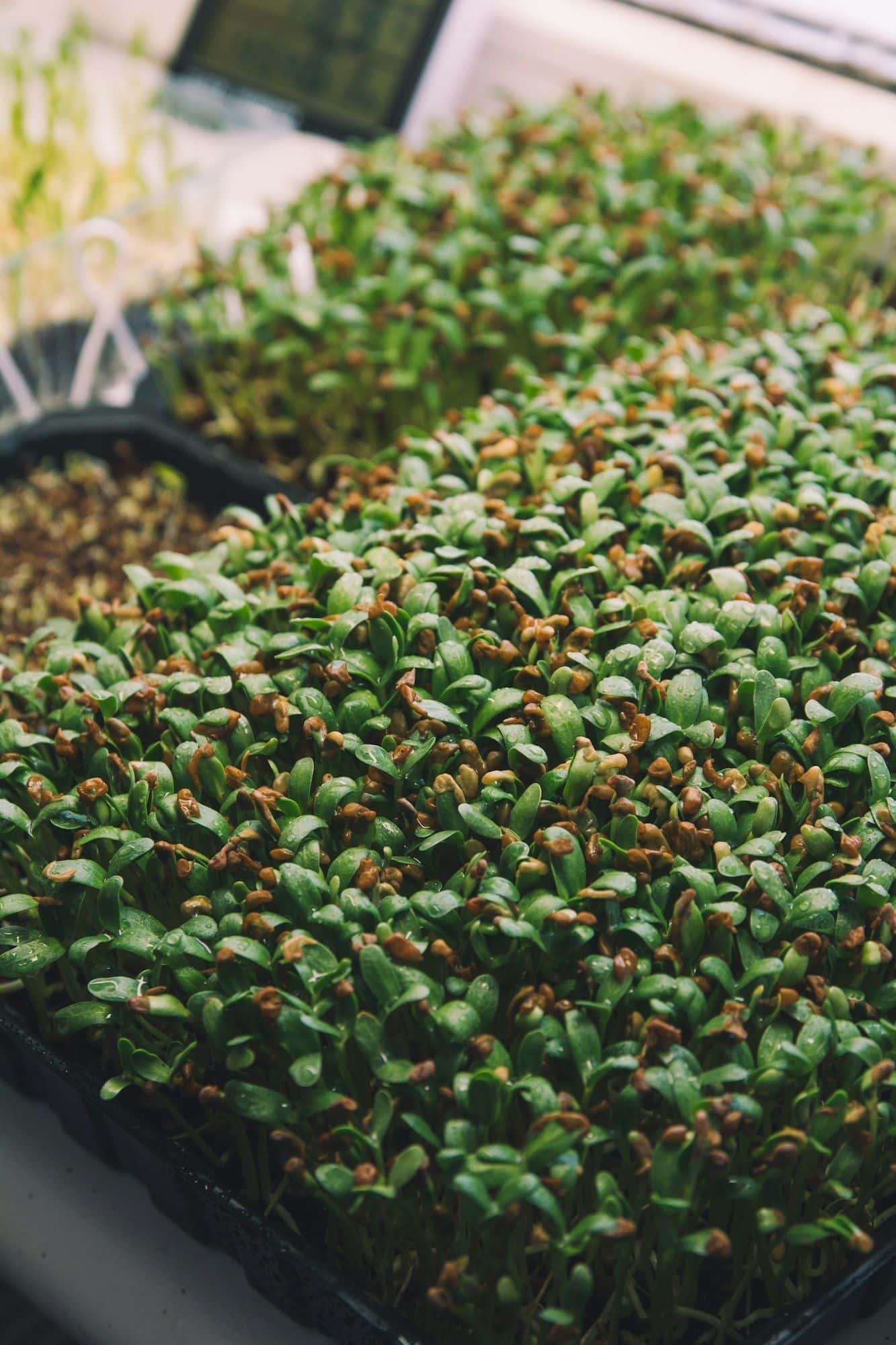
What methi microgreens are
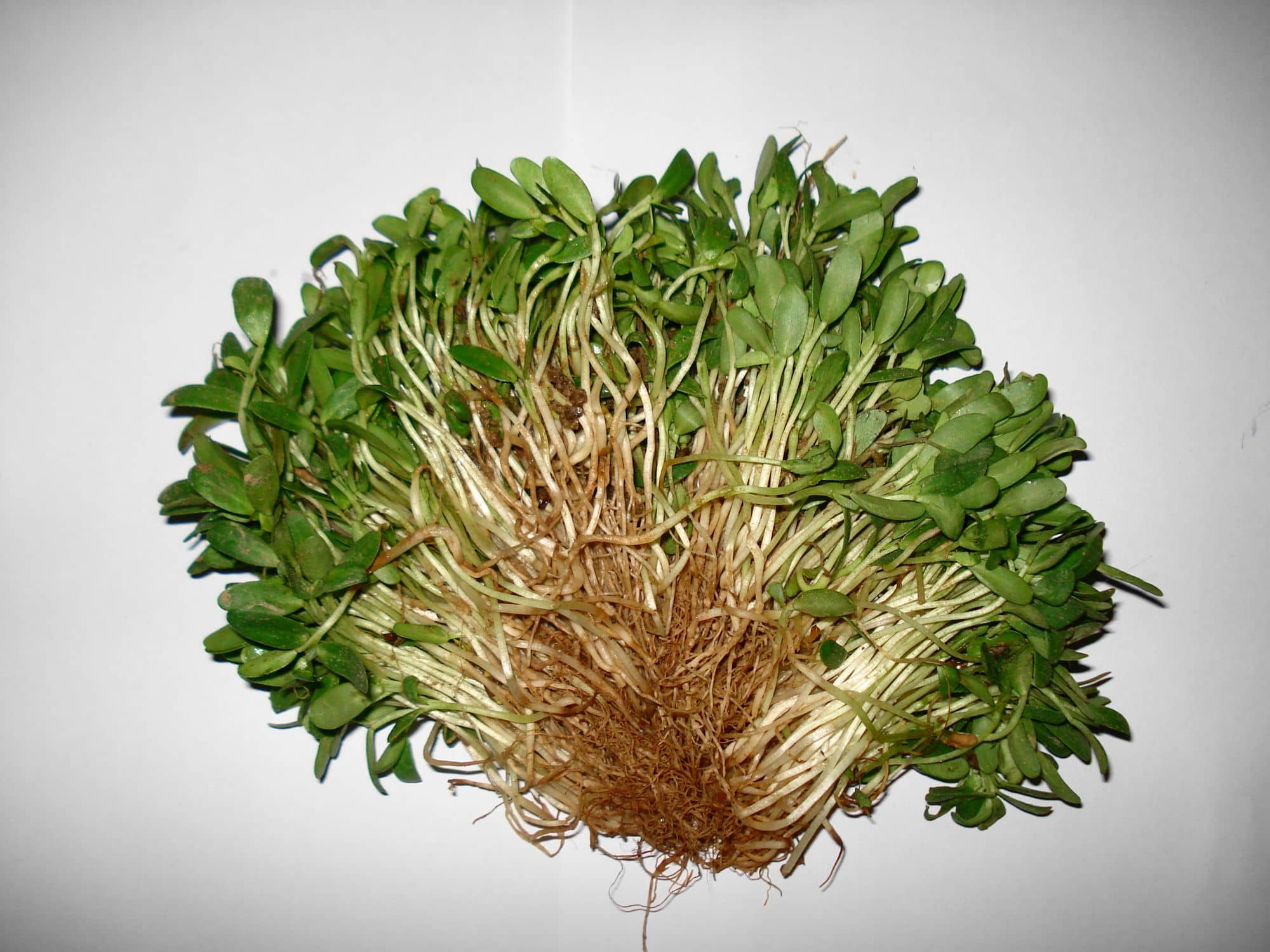
Fenugreek is the plant behind both methi leaves and the small yellow methi seeds used in tadka and pickles. It is a legume, in the same family as moong and peas. As a microgreen it is cut at the seed-leaf stage, when the stems are 5 to 8 cm tall and the two oval cotyledons have opened. The flavour is recognisably methi but gentler than the mature leaf, with the bitterness balanced by a slight sweetness. Because most Indian kitchens already cook with methi, it is one of the easiest microgreens to fit into everyday food. Methi microgreens are not the same as sprouted methi seeds, which are eaten whole after a day or two of soaking.
Nutrition: what studies measured
In India, Ghoora and colleagues (2020) analysed ten culinary microgreens for protein, fibre, minerals and vitamins and ranked them with a Nutrient Quality Score. Fenugreek and onion ranked lowest of the ten, and radish, French basil and roselle highest. The same study found all ten, fenugreek included, were 2 to 3.5 times more nutrient-dense than mature spinach leaves grown under similar conditions.
A 2025 study by Jambor and colleagues in Slovakia found flavonoids such as rutin and quercetin were the most common phytochemicals in fenugreek microgreens. It also cites a 2023 study (Ghevariya and colleagues) that measured higher total phenolics and flavonoids in fenugreek microgreens than in the stems and leaves of the adult plant, and the highest antioxidant activity by the DPPH test among seeds, microgreens and mature parts. These are laboratory measurements of content. They do not show that eating methi microgreens treats or prevents any condition.
How to grow methi microgreens
Fenugreek seed is hard and benefits from soaking. In a 2025 trial at United Arab Emirates University, Nishanth and colleagues soaked fenugreek seed overnight, sowed 30 g on each 50 × 25 cm tray, and harvested in 12 days, the fastest of the six microgreens they grew. In Slovakia, Jambor's team harvested at 6 days, at 5–6 cm, in a growth chamber at 22–24 °C with 16 hours of light. Seed rates in the literature vary; the ICAR review cites about 200 g per m² from one Indian study and 300–450 g per m² from Ghoora's work.
- Rinse the seed and soak it overnight, 8–12 hours, in drinking water. Rinse again before sowing.
- Fill a drained tray with 2.5–4 cm of moist soil mix or coco peat.
- Spread about 26–31 g of soaked seed evenly over a 10×20-inch tray and press it onto the surface.
- Mist, cover and keep dark for about three days.
- Uncover and give bright light for about 16 hours a day. Water from below.
- Harvest at 5–8 cm, on day 6–12, when the seed leaves are open.
| Study | Seed rate | Harvest | Result |
|---|---|---|---|
| Nishanth et al. 2025, UAE | 30 g per 50 × 25 cm tray | 12 days | 232.33 g fresh weight in sand; 7.83 cm shoots |
| Jambor et al. 2025, Slovakia | Not disclosed | 6 days | 5–6 cm at 22–24 °C |
| Cited in ICAR review, 2025 | About 200 g/m² | Not given | Not given |
| Ghoora et al., cited in ICAR review | 300–450 g/m² | Not given | Not given |
The tray arithmetic
The UAE trial tray was 50 × 25 cm = 0.125 m², so 30 g ÷ 0.125 m² = 240 g of seed per m². A standard 10×20-inch tray is 25.4 × 50.8 cm = 0.129 m², so the same rate is 240 × 0.129 = about 31 g of seed. At the lower 200 g per m², it is 200 × 0.129 = about 26 g. The UAE harvest of 232.33 g from 30 g of seed is 232.33 ÷ 30 = about 7.7 times the seed weight, or 232.33 ÷ 0.125 = about 1.86 kg per m². That was in desert sand under controlled conditions; the same study found fenugreek grew well in both sand and rockwool.
Common problems
Soaked seed sown thickly can go mouldy if the tray stays wet and the air is still. Penn State advises watering only when needed and letting trays drain, and UMD suggests a gentle fan and venting any cover. Rinse the seed during and after soaking. Discard any tray with grey, musty growth rather than cutting around it, because microgreens are eaten raw. If the seedlings are pale and stretched, the blackout ran too long or the light is weak. Harvest at the seed-leaf stage; the studies above cut at 6 to 12 days, and a tray left much longer is past the microgreen stage.
How to eat methi microgreens, including Indian dishes
Use them wherever methi leaves go, raw or at the very end. Knead a handful into thepla or methi paratha dough, or scatter them over the parathas just before serving. Stir them into dal, aloo methi or methi malai matar after switching off the heat. Raw, they work in a methi raita with curd, garlic and roasted jeera, on besan chilla, on khakhra with a little chutney, or mixed into a kachumber. Their bitterness pairs well with potato, paneer and curd. Rinse just before eating and keep refrigerated in a closed box.
Fresh microgreens in Pune
Garden & Acre delivers fresh microgreens in Pune and Pimpri-Chinchwad from its own supply chain, as weekly home boxes, single-variety packs, and regular supply by weight for restaurants, cafés and hotels. The usual core varieties are sunflower, radish, broccoli, mustard and pea shoots, and others such as methi depend on what is available that week. Ask on WhatsApp for this week's list. We reply with the varieties, the prices and the first delivery date.
Questions
How many days do methi microgreens take?
Between 6 and 12 days. A Slovak study harvested fenugreek microgreens at 6 days in a growth chamber at 22–24 °C, and a UAE trial harvested at 12 days, which was the fastest of the six crops in that trial. Warmer, brighter conditions shorten the cycle.
Do I need to soak methi seeds for microgreens?
Yes. The UAE trial soaked fenugreek seed overnight before sowing. Penn State Extension notes that larger or hard-coated seeds germinate faster after an 8–12 hour soak, and methi seed is hard. Rinse the seed once or twice during the soak.
Can I use kitchen methi seeds for microgreens?
Whole kitchen methi seed often germinates, but its germination rate and cleanliness are unknown, and microgreens are eaten raw. Seed sold for sprouting or microgreens is the safer choice. If you try kitchen seed, sow a small test tray first.
Are methi microgreens bitter?
Yes, but less than mature methi leaves. The bitterness is part of the methi flavour. Pair them with potato, paneer, curd or dal to balance it. A small handful is enough to flavour a plate, the way a pinch of kasuri methi flavours a curry.
Are methi microgreens more nutritious than other microgreens?
Not by the one Indian ranking that included them. Ghoora and colleagues ranked fenugreek and onion lowest of ten culinary microgreens on a Nutrient Quality Score, though all ten scored 2 to 3.5 times higher than mature spinach. Methi microgreens are valued mainly for their familiar flavour.
Sources
- Harnessing desert resources: a comparative study of microgreens growth, nutrient dynamics, and performance in desert sand and rockwool — Nishanth et al., Frontiers in Plant Science, 2025
- Determination of phytonutrients, antioxidant properties and in vitro effect of the microgreen Trigonella foenum-graecum L. — Jambor et al., 3 Biotech, 2025
- Nutrient composition, oxalate content and nutritional ranking of ten culinary microgreens — Ghoora, Babu & Srividya, Journal of Food Composition and Analysis, 2020
- Microgreens: Functional Food for Nutrition and Dietary Diversification — Seth et al., Plants, 2025 (ICAR)
- A Step-By-Step Guide for Growing Microgreens at Home — Penn State Extension
- Growing Microgreens and Baby Greens Indoors — University of Maryland Extension