How vertical farm subsidies work in India
Most horticulture support in India is paid as a credit-linked, back-ended subsidy. You take a term loan from a bank for the project, build it, and the bank claims the subsidy from the scheme after inspection. The subsidy then sits against the loan. This means you need the full project cost arranged before any subsidy arrives, and your bank must be willing to appraise a vertical farm.
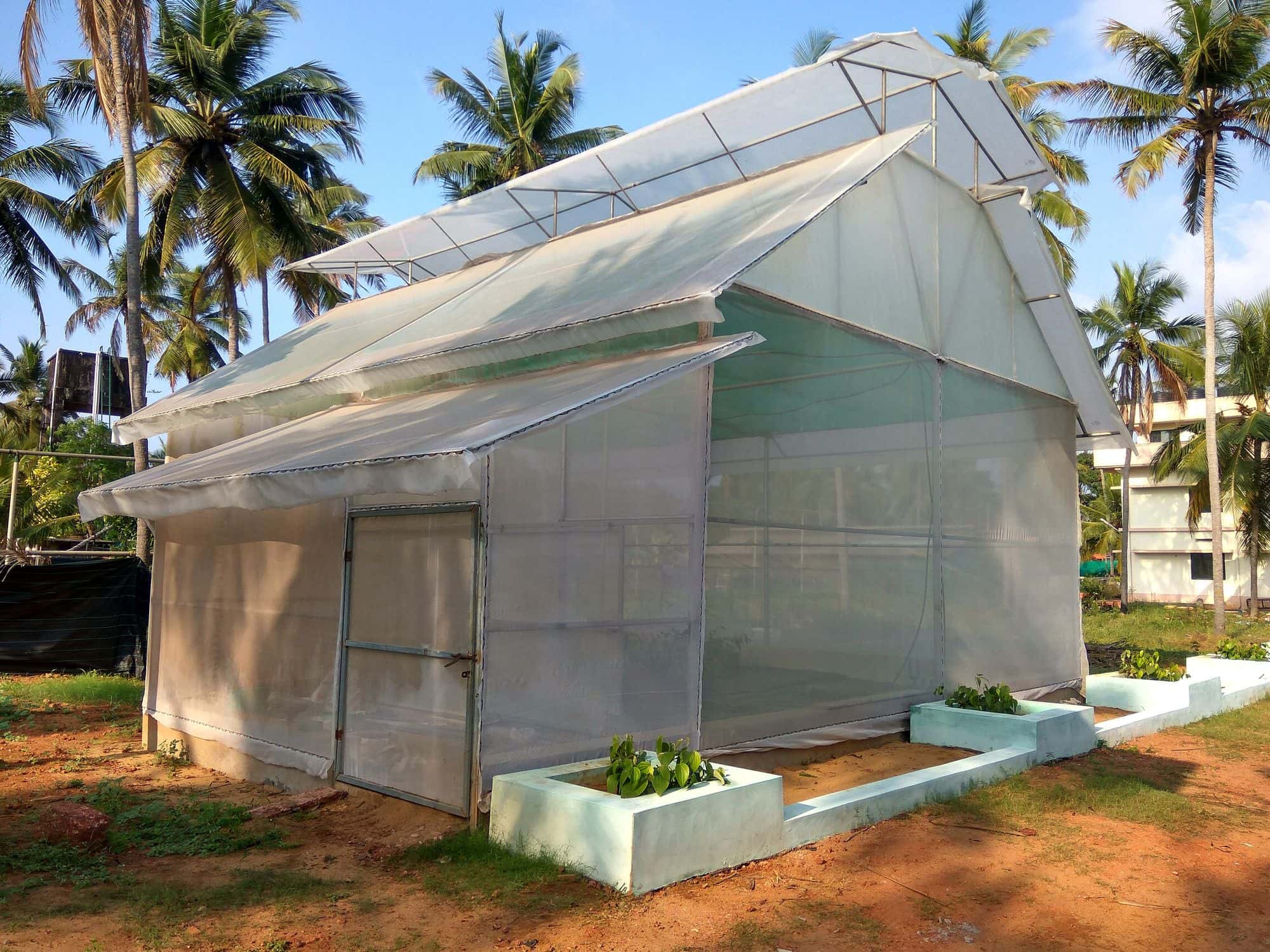
Schemes are written for crops and structures, not for the words vertical farming. MIDH and NHB support protected cultivation such as greenhouses and shade-net houses and name hydroponics and aeroponics as components. An indoor farm with LED lights and air conditioning may or may not fit the wording, which is why the application and the detailed project report (DPR) must show how your project matches each eligible item. Ask the implementing office in writing before you spend money on a DPR.
NHB subsidy for hydroponics and aeroponics
The National Horticulture Board runs the scheme Development of Commercial Horticulture through Production and Post-Harvest Management. Krishi Jagran reported on 20 March 2022 that this scheme gives hydroponic and aeroponic projects a credit-linked, back-ended subsidy of 20 percent of project cost, limited to ₹25 lakh per project, and ₹30 lakh in the North East, hilly and scheduled areas. The same report said support applies to protected-cultivation projects of more than 1,000 m², and that the term loan must be at least 15 percent higher than the admissible subsidy.
The Scheme-1 guideline currently posted on nhb.gov.in describes protected-cover projects above 2,500 m² (1,000 m² in the North East) with a 50 percent back-ended subsidy limited to ₹56 lakh per project, for listed flowers and high-value vegetables such as capsicum, cucumber and tomato. It does not mention hydroponics by name. The two sources differ, and neither confirms current terms, so check the latest NHB guideline at nhb.gov.in and ask the NHB regional office before relying on either figure.
MIDH support through state horticulture departments
MIDH is a centrally sponsored scheme run through each state's horticulture department or State Horticulture Mission. The MIDH Operational Guidelines 2025, dated 31 December 2024, state that the Government of India funds 60 percent of the programme in most states and the state funds 40 percent, with a 90:10 split in the North East and Himalayan states. The guidelines name hydroponics and aeroponics among new components to be promoted under protected cultivation.
The cost norm is set out as an add-on component. For hydroponics and aeroponics, the guidelines give a cost norm of ₹350 per m², with assistance at 50 percent for a maximum of 1,000 m² per beneficiary, and rates 15 percent higher in North East and Himalayan states, scheduled areas, vibrant villages, and the Andaman and Nicobar and Lakshadweep islands. The largest amount this line can give one beneficiary in a plains state is 1,000 m² × ₹350 × 50% = ₹1,75,000. States publish yearly implementation guidelines and their own targets, so the component may not be open in every district every year.
| Component | Cost norm | Assistance | Maximum per beneficiary |
|---|---|---|---|
| Hydroponics and aeroponics (add-on) | ₹350 per m² | 50%, up to 1,000 m² | 1,000 × ₹350 × 50% = ₹1,75,000 |
| Polyhouse, fan and pad system | ₹1,800 per m² up to 500 m²; ₹1,600 to 1,008 m²; ₹1,500 to 2,500 m² | 50%, up to 2,500 m² | 500 × ₹1,800 × 50% = ₹4,50,000 for a 500 m² house |
| Planting material and cultivation, high-value vegetables in polyhouse or net house | ₹150 per m² | 50%, up to 2,500 m² | 2,500 × ₹150 × 50% = ₹1,87,500 |
Agriculture Infrastructure Fund and bank loans
The Agriculture Infrastructure Fund (AIF) gives interest support rather than a grant. A PIB explainer posted on 9 August 2025 states that all loans under the facility carry interest subvention of 3 percent a year on loans up to ₹2 crore, for a maximum of 7 years, with the lending rate capped at 9 percent and credit guarantee cover under CGTMSE for loans up to ₹2 crore. On a ₹50 lakh loan, 3 percent is ₹50,00,000 × 0.03 = ₹1,50,000 of interest support in the first year, falling as the loan is repaid.
Krishi Jagran reported in April 2025 that vertical farming, including hydroponics and aeroponics, is eligible under AIF for farmers, FPOs, startups, cooperatives and other groups. The AIF portal's home page does not list vertical farming by name. The same PIB explainer says loan disbursement under the scheme was to be completed by the end of 2025-26, while the scheme runs to 2032-33. Check at agriinfra.dac.gov.in whether new sanctions are open when you apply.
Schemes for farmer groups and FPOs
A group of farmers can build a shared vertical farm through a Farmer Producer Organisation. The Central Sector Scheme for Formation and Promotion of 10,000 FPOs, run by the Ministry of Agriculture through agencies such as SFAC and NABARD, offers three kinds of support according to its operational guidelines. It gives a matching equity grant of up to ₹2,000 per farmer member, limited to ₹15 lakh per FPO. It pays management costs of up to ₹18 lakh per FPO over its first three years, and it provides handholding by Cluster Based Business Organisations for five years.
The guidelines also set up a Credit Guarantee Fund for FPO loans. For a project loan up to ₹1 crore, cover is 85 percent with a ceiling of ₹85 lakh. For loans above ₹1 crore and up to ₹2 crore, it is 75 percent with a ceiling of ₹150 lakh. The guidelines say FPOs were to be formed up to 2023-24 and supported until 2027-28, and an addendum has since been issued. Confirm current terms with SFAC or NABARD before planning around them.
Startup India and PM-FME
A vertical farming company recognised as a startup by DPIIT can apply to the Startup India Seed Fund Scheme through an approved incubator. The scheme guidelines provide up to ₹20 lakh as a grant for proof of concept, prototype development or product trials, and up to ₹50 lakh for market entry, commercialisation or scaling through convertible debentures or debt-linked instruments. The startup must have been incorporated not more than two years before applying, and funds go through the incubator, not straight to the founder.
PM-FME, the Prime Minister's Formalisation of Micro Food Processing Enterprises scheme, is for food processing, not growing. A PIB note from September 2025 describes a credit-linked capital subsidy of 35 percent of project cost, with a maximum of ₹10 lakh per unit, for individual micro enterprises, and gives the scheme period as 2020-21 to 2025-26. It may help if you add a separate processing unit, such as washing, cutting and packing salads, but not for racks and lights. Check whether the scheme has been extended.
Schemes compared
The table sums up what each route offers and what it is meant for. None of these schemes was written for indoor LED farms specifically, so fit and current status must be confirmed with the implementing office. Some may be combined on one project, while others bar double funding for the same asset, so ask the implementing office before you apply to more than one.
| Scheme | Type of support | Key figure | Where to check |
|---|---|---|---|
| NHB commercial horticulture | Back-ended capital subsidy | 20% up to ₹25 lakh (as reported, 2022) | nhb.gov.in, NHB regional office |
| MIDH via state horticulture | Back-ended subsidy on cost norm | ₹350/m² × 50%, up to 1,000 m² | State horticulture department |
| Agriculture Infrastructure Fund | Interest subvention and guarantee | 3% a year on up to ₹2 crore, 7 years | agriinfra.dac.gov.in, your bank |
| 10,000 FPOs scheme | Equity grant, management cost, credit guarantee | ₹2,000 per member, up to ₹15 lakh per FPO | SFAC, NABARD |
| Startup India Seed Fund | Grant and debt through incubators | Up to ₹20 lakh grant; up to ₹50 lakh debt | seedfund.startupindia.gov.in |
| PM-FME | Subsidy for food processing units | 35% up to ₹10 lakh | State nodal agency for PM-FME |
What to verify before you apply
Scheme terms change with each budget and each year's state guidelines, and several figures published online are several years old. Before you pay for a DPR or sign a supplier contract, confirm the points below in writing from the implementing office. Keep copies of every reply with your loan file, because the bank and the inspection team may ask for them.
- The current guideline and its date, downloaded from the official site, not a news report.
- Whether an indoor farm with LED lighting counts as protected cultivation or hydroponics under the scheme's wording.
- Minimum and maximum area, and whether area means floor area or growing area on shelves.
- Whether the subsidy needs prior approval before construction starts. Many schemes refuse subsidy on work begun before sanction.
- Approved suppliers and BIS standards for structures and equipment.
- Whether this year's state target for the component is open in your district.
- Whether two schemes can be combined, or whether one bars the other for the same asset.
- Your electricity category. In Maharashtra, the MERC order of 28 March 2025 lists indoor vertical farming under the Agriculture – Others tariff, which lowers running cost more than most capital subsidies.
How to apply for a vertical farming subsidy
The steps are broadly the same for NHB, MIDH and AIF. The order matters, because most schemes require the bank loan and the scheme approval to come before construction starts. Follow the sequence below and keep the DPR consistent across the bank and the scheme office, so that areas, costs and equipment lists match exactly in every document you submit.
- Confirm eligibility in writing with the NHB regional office, the district horticulture officer or the AIF portal helpdesk.
- Prepare a DPR with land or lease papers, layout, capex as quantity × rate with supplier quotes, running costs, cash flow and repayment.
- Apply to a bank for the term loan and ask it to process the scheme claim. For NHB, the bank's appraisal is part of the subsidy file.
- For NHB projects, obtain in-principle approval or the letter the current guideline requires before starting work.
- Register on the scheme portal where one exists, such as agriinfra.dac.gov.in for AIF or the state horticulture portal for MIDH.
- Build the project using approved materials, keep invoices, and request the joint inspection.
- The bank submits the subsidy claim after inspection, and the subsidy is adjusted against the loan.
Help with a subsidy-ready vertical farm project
Garden & Acre's Vertical Farm Consulting covers feasibility and due diligence, the business model and system design, which are the inputs a bank and a scheme office ask for in a DPR. For commercial and institutional sites, Vertical Farm Setup covers design, build, commissioning and first-crop support. Both are priced in a written proposal after an initial call. We do not process subsidy claims; the bank and the implementing office do that.
Questions
Is there a government subsidy for vertical farming in India?
There is no scheme only for vertical farms, but horticulture schemes cover hydroponics and aeroponics. MIDH lists them as a protected-cultivation add-on at ₹350 per m² with 50 percent assistance up to 1,000 m², and NHB support for hydroponic projects has been reported at 20 percent up to ₹25 lakh. Confirm current terms before applying.
How much subsidy does NHB give for hydroponics?
Krishi Jagran reported in 2022 that NHB gives a credit-linked, back-ended subsidy of 20 percent of project cost, capped at ₹25 lakh (₹30 lakh in North East and hilly areas), for hydroponic and aeroponic projects above 1,000 m² of protected cultivation. Check the current guideline on nhb.gov.in, as terms change.
Can I get a loan for a vertical farm under the Agriculture Infrastructure Fund?
Press reports in 2025 said vertical farming, hydroponics and aeroponics are eligible. AIF gives 3 percent interest subvention a year on loans up to ₹2 crore for up to 7 years, with a credit guarantee. PIB said disbursement was to finish by 2025-26, so check whether new sanctions are open.
Is the vertical farming subsidy paid before or after construction?
Mostly after. NHB and MIDH support is usually credit-linked and back-ended: you build with a bank loan and your own money, the project is inspected, and the subsidy is then credited against the loan. Many schemes refuse subsidy for work started before approval.
Can a startup get government funding for a vertical farm?
A DPIIT-recognised startup incorporated within the last two years can apply to the Startup India Seed Fund Scheme through an approved incubator: up to ₹20 lakh as a grant for proof of concept and up to ₹50 lakh as debt or convertible instruments for market entry.
Can farmer groups get support to set up a shared vertical farm?
Farmer Producer Organisations formed under the 10,000 FPOs scheme can receive a matching equity grant of up to ₹2,000 per member (maximum ₹15 lakh per FPO), management cost support of up to ₹18 lakh over three years, and credit guarantee cover on project loans, per the scheme's operational guidelines.
Sources
- MIDH Operational Guidelines 2025 (dated 31 December 2024), National Horticulture Board
- National Horticulture Board, Scheme-1: Development of Commercial Horticulture through Production and Post-Harvest Management
- Krishi Jagran (20 March 2022), Govt. is providing subsidy for hydroponics and aeroponics farming
- PIB explainer (9 August 2025), Agriculture Infrastructure Fund
- Krishi Jagran (April 2025), Vertical farming: govt offering loans up to Rs 2 crore with interest subsidy
- Agriculture Infrastructure Fund portal
- Operational Guidelines for Formation and Promotion of 10,000 Farmer Producer Organizations (SFAC)
- Guidelines for Startup India Seed Fund Scheme (DPIIT)
- PIB (September 2025), Pradhan Mantri Formalisation of Micro Food Processing Enterprises (PMFME)
- MERC MYT order, Case No. 217 of 2024 (28 March 2025), MSEDCL tariff schedule