How nutrition works without soil
Soil stores nutrients and buffers pH. In hydroponic and aeroponic vertical farms there is no such buffer. Oklahoma State University's extension guide on EC and pH makes the point directly: because soil's buffering is absent in soilless culture, the grower has to maintain a suitable root environment artificially. That makes nutrient management faster to correct and faster to go wrong.
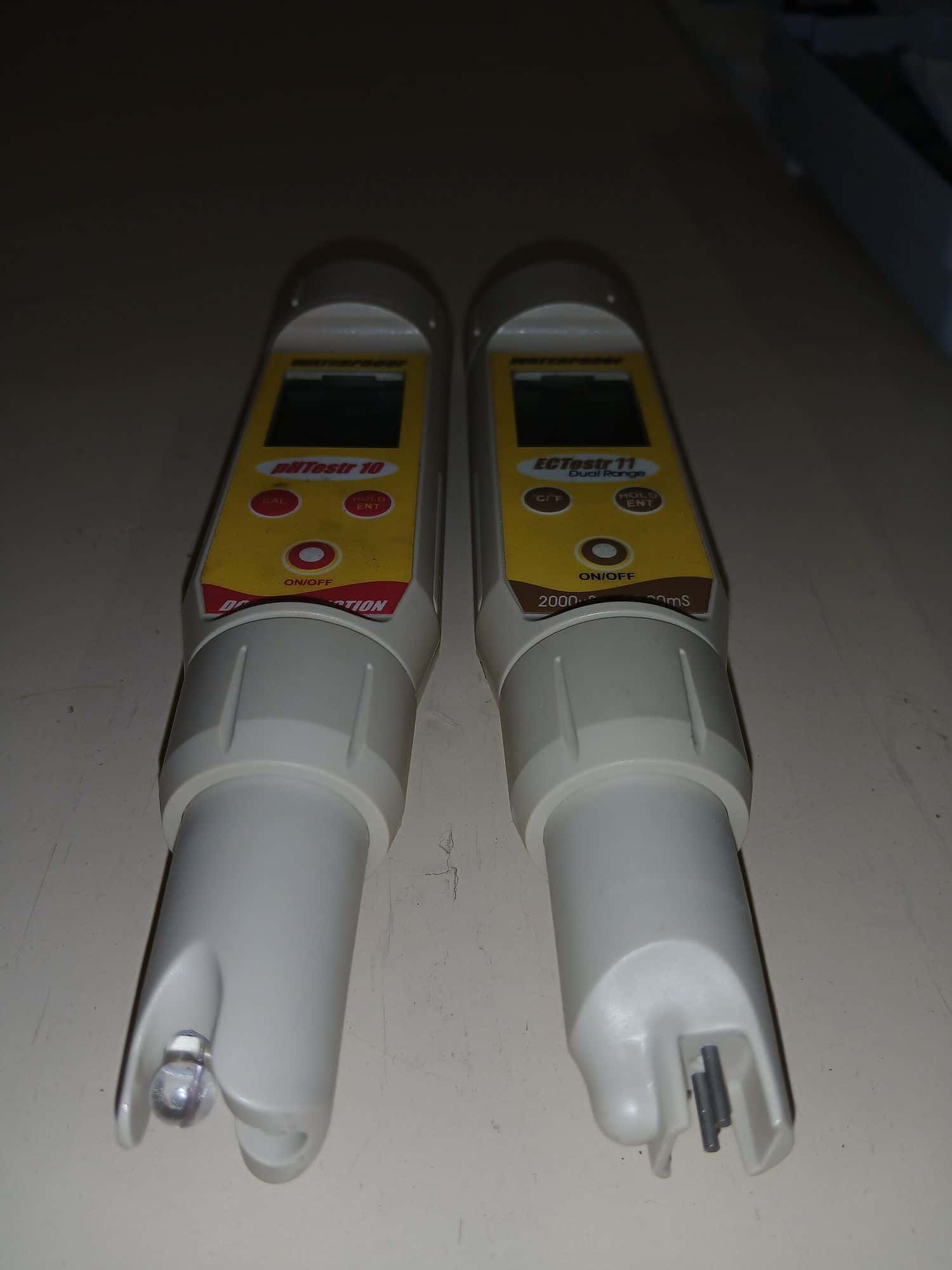
Nutrients are dissolved as salts, which split into charged ions. Those ions carry electric current, so the electrical conductivity (EC) of the solution rises as more fertiliser is added. As plants take up nutrients, EC falls; as water evaporates or is transpired, EC rises. pH, the acidity of the solution, controls which of those ions are available to the roots. A good recipe at the wrong pH still leaves plants hungry. Cornell researchers add a warning specific to recirculating systems: reused solution can build up some elements while others run short, and pH changes much faster than in pots. They recommend checking pH and EC daily and sending solution to a laboratory from time to time.
Macronutrients and micronutrients in a hydroponic recipe
Plants need six elements in large amounts from the solution: nitrogen (N), phosphorus (P), potassium (K), calcium (Ca), magnesium (Mg) and sulfur (S). They need iron (Fe), manganese (Mn), zinc (Zn), copper (Cu), boron (B) and molybdenum (Mo) in trace amounts. Carbon, hydrogen and oxygen come from air and water. The table shows the final concentrations in the Cornell lettuce formula. It is built from two stock tanks mixed into reverse osmosis (RO) water: calcium nitrate, potassium nitrate, ammonium nitrate and chelated iron in one tank, and potassium nitrate, monopotassium phosphate, potassium and magnesium sulfate plus the trace elements in the other. Calcium is kept apart from phosphate and sulfate because, as the handbook explains, mixing concentrates causes precipitates that make nutrients unavailable.
| Element | ppm | Element | ppm |
|---|---|---|---|
| Nitrogen (N) | 125 | Iron (Fe) | 0.94 |
| Phosphorus (P) | 31 | Manganese (Mn) | 0.14 |
| Potassium (K) | 215 | Boron (B) | 0.16 |
| Calcium (Ca) | 84 | Zinc (Zn) | 0.13 |
| Magnesium (Mg) | 24 | Copper (Cu) | 0.03 |
| Sulfur (S) | 35 | Molybdenum (Mo) | 0.03 |
EC and pH targets by crop
Published targets vary between sources because they come from different systems, water and cultivars. The Oklahoma State University chart below is a general guide for hydroponic crops. Research vertical farms and university handbooks, listed underneath it, give narrower working values. Where they differ, start with the narrower, system-specific figure and adjust from plant response. Note the pH difference for lettuce. OSU lists 6.0–7.0, while Cornell's floating-raft system runs 5.6–6.0. OSU's own text explains the gap: it recommends a solution pH of 5 to 6 (usually 5.5) so that the root zone settles at 6 to 6.5.
| Crop | EC (mS/cm) | pH | Source |
|---|---|---|---|
| Lettuce | 1.2–1.8 | 6.0–7.0 | OSU HLA-6722 |
| Lettuce (floating raft) | 1.15–1.25 above source water | 5.6–6.0 (5.8 target) | Cornell lettuce handbook |
| Baby spinach | 1.3 ± 0.1 above source water | 5.6–6.0 | Cornell spinach handbook |
| Spinach | 1.8–2.3 | 6.0–7.0 | OSU HLA-6722 |
| Baby-leaf kale (vertical farm) | 2.3 | 5.8 | Zauli et al. 2024 |
| Basil | 1.0–1.6 | 5.5–6.0 | OSU HLA-6722 |
| Basil (indoor LED trial) | 1.6 | 6.5 | Pennisi et al. 2019 |
| Coriander (hydroponic channels) | About 1.7–2.4 | 5.7–5.8 | da Silva et al. 2020 |
| Parsley | 1.8–2.2 | 6.0–6.5 | OSU HLA-6722 |
| Pak choi | 1.5–2.0 | 7.0 | OSU HLA-6722 |
| Strawberry | 1.8–2.2 | 6.0 | OSU HLA-6722 |
| Tomato | 2.0–4.0 | 6.0–6.5 | OSU HLA-6722 |
| Cucumber | 1.7–2.0 | 5.0–5.5 | OSU HLA-6722 |
| Peppers | 0.8–1.8 | 5.5–6.0 | OSU HLA-6722 |
EC, TDS and ppm: reading your meter
EC is the direct measurement. It is reported in mS/cm (the same number as dS/m) or in µS/cm, where 1.2 mS/cm equals 1,200 µS/cm. Cornell writes its lettuce target both ways: 1,200 µS/cm, or 1.2 dS/cm. Many hobby and farm meters show TDS or ppm instead. These meters still measure EC; they then multiply it by a conversion factor chosen by the manufacturer to estimate dissolved solids. That is why one lettuce guide can quote a range in both units. The University of Florida's hydroponic lettuce guide gives 1.2–1.8 mS/cm as 560–840 ppm, a factor of 560 ÷ 1.2 = about 467 ppm per mS/cm. Another meter brand can show a different ppm for the same solution. Record and share EC in mS/cm, and treat ppm only as a label on one particular meter.
Always subtract the source water. Cornell sets its target as 1,150–1,250 µS/cm above the source water. If your water reads 0.4 mS/cm before any fertiliser, a lettuce solution should read about 0.4 + 1.2 = 1.6 mS/cm on the meter. Cornell gives the reason in its handbook: the meter reads all dissolved salts, including those already in the water, so the base EC of the source water must be subtracted to know how much fertiliser is present.
Water quality: RO, hard water and chlorine in Indian cities
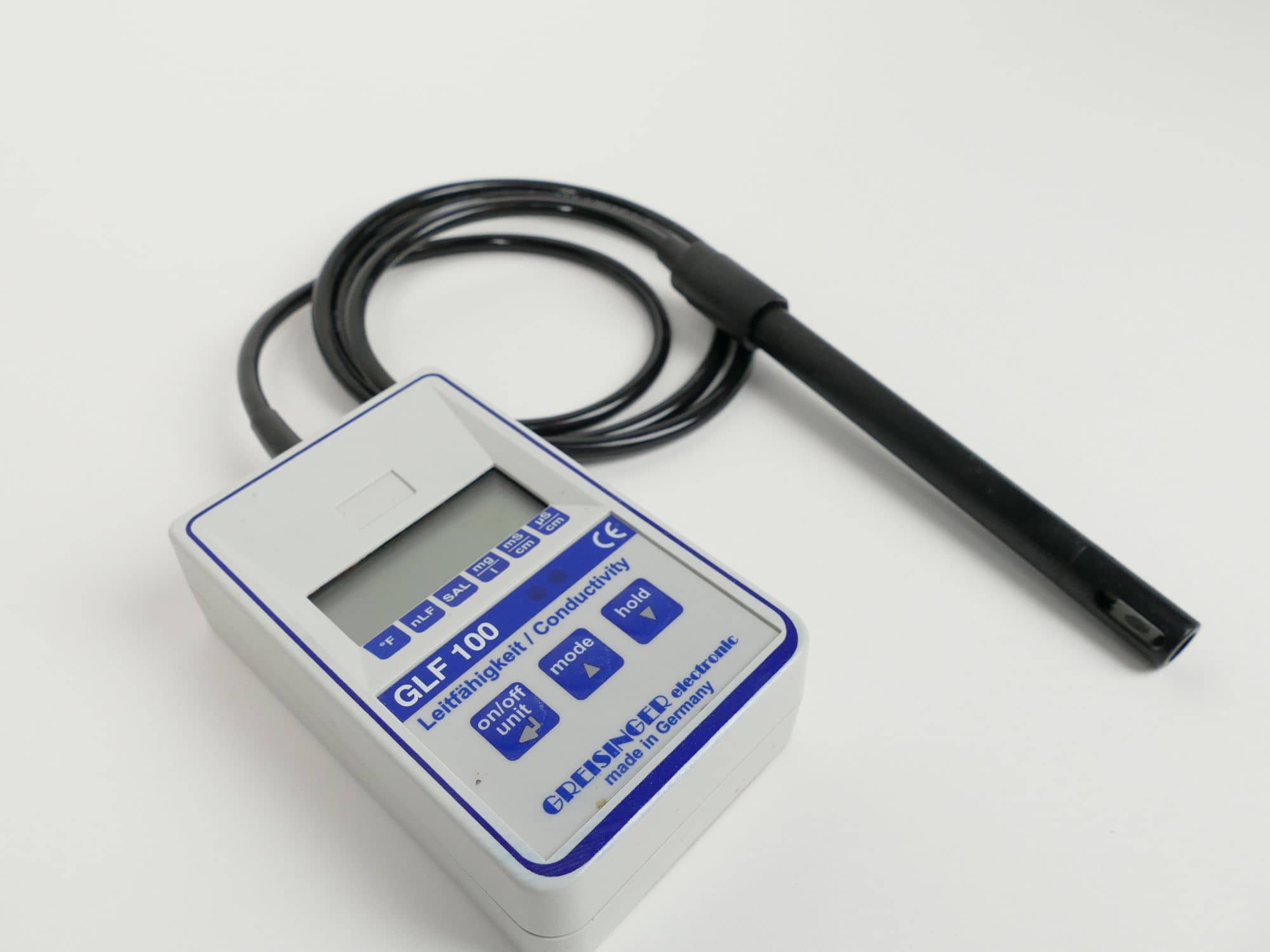
Start with a water test. OSU recommends testing pH, EC and alkalinity before growing, and lists acceptable levels in source water for hydroponics: sodium below 50 ppm, calcium below 150 ppm, chloride below 140 ppm and sulfate below 100 ppm. It warns that alkalinity above 75 ppm will keep pushing pH up, so acid has to be added more often.
Drinking water standards are looser than those limits. India's standard IS 10500:2012 accepts total dissolved solids up to 500 mg/L and permits up to 2,000 mg/L where no other source exists. Total hardness is acceptable to 200 mg/L and permissible to 600 mg/L, and alkalinity follows the same 200 and 600 mg/L limits. Water that is legal to drink can still carry more calcium, bicarbonate or sodium than a recirculating system tolerates, and OSU notes that sodium chloride builds up in recirculated solution as water is topped up.
Many buildings in Indian cities draw on more than one supply, such as municipal, borewell and tanker water, so quality can change through the year. The standard answers are to acidify moderately alkaline water, blend it with RO water, or use RO alone as Cornell does. Municipal chlorine is the other check: Cornell's research notes list total chlorine residuals above 1 ppm in the solution as toxic to lettuce, so let treated water stand or filter it before use.
- Test source water for pH, EC, alkalinity, calcium, magnesium, sodium, chloride and sulfate.
- Retest after the monsoon and in summer if you use borewell or tanker water.
- If alkalinity is high, plan for acid dosing or an RO unit before buying nutrients.
- Recalculate the recipe if source water already supplies calcium or magnesium.
Mixing and dosing nutrients
Commercial farms use concentrated A and B stock solutions and dilute them into the main tank. Never mix the two concentrates directly. Add one stock to a large volume of water, stir, then add the other. Check EC, and only then correct pH, which OSU says should always follow EC adjustment. To lower pH, OSU lists phosphoric acid, citric acid or commercial pH-down products, added slowly with a few minutes between additions. To raise it, potassium hydroxide or potassium carbonate. Check pH and EC daily at the same time of day. OSU also recommends replacing the solution completely every two weeks in small systems, because unused ions such as sodium and chloride build up as water is topped up.
At commercial scale, manual adjustment becomes a full-time job. OSU's 2016 guide priced automatic monitoring and dosing systems at US$500 to US$4,000 and listed their benefits as labour savings, fewer nutrient shocks and less human error. Whatever the controller, calibrate the EC probe with a standard solution (commonly 1.41 mS/cm) and the pH probe with pH 4 and 7 buffers on a schedule.
- Keep calcium nitrate and iron chelate in stock A; phosphates and sulfates in stock B.
- Log EC, pH, water temperature and dissolved oxygen every day.
- Keep dissolved oxygen near 7 mg/L; Cornell reports crop failure below 3 mg/L.
- Keep nutrient solution at or below 25 °C for lettuce and 15–20 °C for spinach.
Common nutrient deficiencies and what they look like
Where a symptom appears tells you a lot. Elements that move inside the plant, such as nitrogen, phosphorus, potassium and magnesium, are pulled from old leaves to feed new growth, so their shortage shows on older leaves first. Calcium, iron and boron cannot be moved easily, so their shortage shows on new growth. The table summarises what Cornell researchers Neil Mattson and Tanya Merrill recorded when they grew butterhead lettuce in solutions missing one element at a time. Tipburn is the notable exception: it usually appears when the solution has enough calcium but humid, still air stops it reaching the young leaves. Fix airflow before adding calcium.
| Element | Where it shows first | What it looks like |
|---|---|---|
| Nitrogen | Older leaves | Paler green, then uniform yellowing; growth slows within two weeks |
| Phosphorus | Older leaves | Stunted plants; yellow patches on old leaf margins, then dead spots |
| Potassium | Older leaves | Small dead spots on old leaf margins that grow; leaves curl down |
| Magnesium | Mature leaves | Yellowing between veins after about 10 days, then dead margins |
| Calcium | Youngest leaves | Dead spots and distorted young leaves; growing tip can die |
| Iron | New growth | Yellowing between veins on young leaves within about 10 days |
| Sulfur | Newer growth, then whole plant | Even pale yellowing across the leaf blade |
| Boron | New growth | Symptoms appear on new growth, as with calcium and iron |
Troubleshooting pH and EC drift
Rising EC over a day or two usually means plants are taking up water faster than nutrients, which is common under high light or low humidity. Top up with plain or RO water rather than more stock. Falling EC means plants are taking up nutrients faster than water; add a small amount of stock as Cornell describes. Rising pH is typical with alkaline source water or high nitrate uptake. Falling pH can come from ammonium in the recipe. If pH swings quickly despite correct dosing, look at the roots. Brown, slimy roots with a sour smell point to low dissolved oxygen, warm solution or Pythium, and no amount of acid or nutrient will fix them.
When plants show symptoms but EC and pH look normal, send solution and leaf samples to a laboratory. A reading of total strength cannot tell you that one element has run out while another has built up. Cornell researchers make the same recommendation for recirculating systems: monitor pH and EC daily, and have the solution tested by a laboratory from time to time so that the recipe can be corrected element by element.
Getting help with nutrition in your farm
Garden & Acre's Vertical Farm Consulting service reviews water tests, recipes, dosing set-ups and records for existing farms, including farms built by others, and writes SOPs your team can follow. For a new commercial or campus farm, the Vertical Farm Setup service includes water treatment, dosing design and first-crop support. Both are priced in a written proposal after a first call. For homes, cafés and schools, our hydroponic and aeroponic towers start at ₹14,000 per tower installed, with first nutrients, training and a refill plan included.
Questions
What is the best EC for hydroponic lettuce?
Cornell's lettuce programme uses about 1.2 mS/cm above the source water, within 1.15–1.25. Oklahoma State University's general chart gives 1.2–1.8 mS/cm. Start near 1.2 above your water reading, watch for tipburn or slow growth, and adjust in small steps. Seedlings usually do better at the lower end.
What pH should a hydroponic nutrient solution be?
Most leafy greens are grown between pH 5.5 and 6.0. Cornell targets 5.8 for lettuce and accepts 5.6–6.0. Oklahoma State University recommends a solution pH of 5 to 6, usually 5.5, so the root zone settles near 6 to 6.5. Always adjust EC first, then pH.
Is TDS the same as EC?
No. EC is what the meter measures. A TDS or ppm reading is EC multiplied by a conversion factor chosen by the meter maker, so two meters can show different ppm for the same solution. For example, the University of Florida lists 1.2–1.8 mS/cm as 560–840 ppm. Record EC in mS/cm when comparing notes or following guides.
Can I use hard borewell water for hydroponics in India?
Test it first. India's drinking water standard permits hardness up to 600 mg/L and TDS up to 2,000 mg/L where no alternative exists, but Oklahoma State University advises source water with calcium below 150 ppm, sodium below 50 ppm and alkalinity that does not exceed 75 ppm without correction. High-alkalinity water needs acid or RO treatment.
Do I need an RO system for a vertical farm?
Not always, but many commercial farms use one. Cornell's lettuce and spinach handbooks mix nutrients into RO water because it removes the buffering that makes pH hard to control. If a water test shows low alkalinity, sodium and chloride, you may manage with acid dosing alone. Decide after the test, not before.
How often should I change the nutrient solution?
Oklahoma State University recommends a full change every two weeks for small systems, because ions plants do not use, such as sodium and chloride, build up as water is topped up. Larger farms often replace less often but rely on regular laboratory analysis to correct individual elements.
Why are the tips of my lettuce leaves turning brown?
That is tipburn. Cornell researchers found it usually occurs when the solution holds enough calcium but humid, still air slows transpiration, so calcium does not reach young leaves. Improve airflow across the canopy and check humidity before raising calcium. A true calcium deficiency causes more severe damage and can kill the growing tip.
Sources
- Cornell University CEA Program, Hydroponic Lettuce Handbook (2013)
- Cornell University CEA Program, Hydroponic Baby Spinach Handbook
- Singh and Dunn (2016), Electrical Conductivity and pH Guide for Hydroponics, Oklahoma State University HLA-6722
- Mattson and Merrill (2015), Symptoms of Common Nutrient Deficiencies in Hydroponic Lettuce, e-GRO Research Update 2015.09
- Bureau of Indian Standards, IS 10500:2012 Drinking Water Specification
- University of Florida IFAS, HS1422 Growing Lettuce in Small Hydroponic Systems
- Zauli et al. (2024), Increasing Red and Blue Ratio on Baby-Leaf Kale, Horticulturae 10:1134
- da Silva et al. (2020), Growth, production and water consumption of coriander in hydroponic channels, Emirates Journal of Food and Agriculture 32(4)
- Pennisi et al. (2019), Red:Blue LED Lights and Indoor Grown Sweet Basil, Frontiers in Plant Science 10:305