Why climate control decides whether a vertical farm works
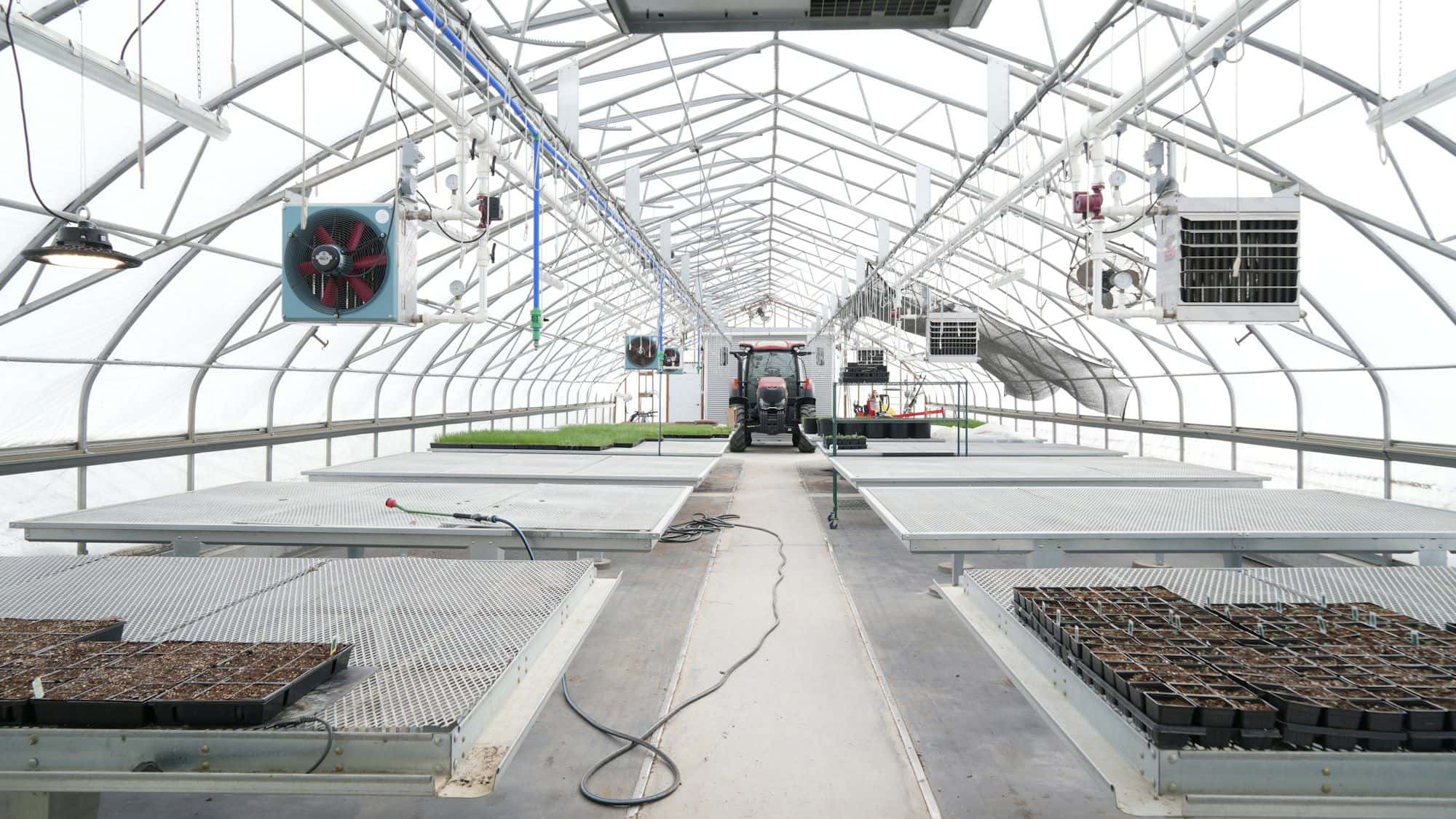
A vertical farm is a sealed room full of lamps and plants. Nearly all the electricity the lamps use ends up as heat in that room, and nearly all the water the plants take up leaves their leaves as vapour. Without mechanical cooling and dehumidification, the room would get hotter and wetter every hour the lights are on. The heating, ventilation and air-conditioning (HVAC) system is therefore not an accessory. It is the second-largest energy user after the lights and the main reason crops either grow evenly or fail in patches.
A 2024 benchmarking study of vertical farms found lettuce needs roughly 10–18 kWh of electricity per kilogram, with lighting taking 65–85% of that energy. Most of the remainder goes to climate control. A University of Bologna team writing in 2024 put lighting at 50–70% of vertical farm energy and total energy at about 40% of production cost. The practical point is simple: every watt of light you buy is also a watt of heat you must remove.
Target ranges for leafy greens
The table below collects published set points from two university programmes. The Cornell Controlled Environment Agriculture (CEA) handbooks for lettuce and baby spinach are written for hydroponic ponds and are still the most cited practical reference. The Bologna figures come from AlmaVFarm, a multi-layer research vertical farm that grew baby-leaf kale under LEDs. VPD values are calculated from those temperature and humidity set points using the standard saturation vapour pressure formula, so treat them as air-based estimates rather than leaf-level readings. Ranges are starting points, not laws. Cultivar, plant spacing, light intensity and airflow all move the ideal. Cornell notes, for example, that one lettuce cultivar could only take a daily light integral of 12 mol/m²/day without tipburn until strong downward airflow was added, after which 17 mol/m²/day was possible.
| Parameter | Target | Source |
|---|---|---|
| Air temperature, lights on | 24 °C | Cornell lettuce and spinach handbooks; Bologna VF (24 ± 1 °C) |
| Air temperature, lights off | 19–21 °C | Cornell (19 °C); Bologna VF (21 ± 1 °C) |
| Relative humidity | 50–70% | Cornell (minimum 50%, maximum 70%); Bologna VF 65% day / 70% night |
| VPD (calculated at 24 °C) | About 0.9–1.5 kPa | From Cornell humidity range; 1.04 kPa at the Bologna day setting |
| CO2, lights on | 850–1,500 ppm | Bologna VF 850 ppm; Cornell 1,000–1,500 ppm speeds growth |
| CO2, lights off | Ambient (about 390 ppm in 2013) | Cornell lettuce handbook |
| Nutrient solution temperature | No higher than 25 °C; 15–20 °C for spinach | Cornell lettuce and spinach handbooks |
| Dissolved oxygen | About 7 mg/L; crop failure below 3 mg/L | Cornell lettuce handbook |
| Daily light integral | 17 mol/m²/day, with downward airflow | Cornell lettuce handbook |
Temperature: air, leaf and root zone
Temperature sets the speed of plant chemistry. Cornell's lettuce handbook explains that enzymes work within narrow ranges, and growth slows on either side. Its set point of 24 °C by day and 19 °C at night is typical for lettuce and similar greens. A cooler dark period is standard practice in both handbooks and in the Bologna farm. The root zone matters as much as the air. Cornell caps nutrient solution at 25 °C for lettuce, with cooling triggered at 26 °C. For baby spinach it goes further and keeps the solution at 15–20 °C with a water chiller, because the root pathogen Pythium aphanidermatum thrives in warm water and can wipe out a pond. Warm water also holds less dissolved oxygen, which is why a hot solution tank often shows up first as brown, slimy roots.
In a stacked farm, temperature is rarely even. Warm air rises, so the top shelf can run hotter than the bottom unless air is mixed well. Measure at crop height on the top, middle and bottom tiers before trusting a single wall sensor. If the tiers differ, fix the air distribution first, with fans or ducts on each shelf, rather than lowering the whole room's set point, which only overcools the lower tiers and wastes energy.
Humidity and VPD for lettuce and other greens
Relative humidity on its own is misleading because warm air holds more water than cool air. VPD is the gap between how much water vapour the air holds and how much it could hold at saturation. The simplified formula is saturation vapour pressure multiplied by (1 − RH/100). At 24 °C the saturation pressure is about 2.98 kPa, so 70% RH gives 2.98 × 0.30 = 0.90 kPa, 65% RH gives 2.98 × 0.35 = 1.04 kPa, and 50% RH gives 2.98 × 0.50 = 1.49 kPa.
Low VPD means the air is close to saturation. Leaves transpire slowly, less calcium reaches young leaves, and water films form on leaves. Cornell notes that high humidity encourages Botrytis and mildew, and caps RH at 70%. High VPD pushes transpiration hard and can stress seedlings and cuttings. The general greenhouse guidance summarised on Wikipedia is that most plants grow well between 0.8 and 0.95 kPa. Humidity control in a sealed room is mostly dehumidification. A seedling or germination zone is the exception: Cornell covers lettuce trays with humidity domes for the first two days so seed does not dry out, then removes them.
Airflow, tipburn and uniform growth
Air movement is the setting new farms most often underrate. Tipburn, the browning of young lettuce leaf edges, usually happens when there is enough calcium in the solution but the plant cannot move it to fast-growing inner leaves. Calcium travels in the transpiration stream, and still, humid air around a dense canopy slows that stream. Cornell describes the mechanism in its handbook: moving air increases transpiration, which carries more calcium to the young, fast-growing leaves and so prevents tipburn.
Cornell solved this with overhead paddle fans blowing air straight down onto the crop. With the fans, lettuce could take 17 mol/m²/day of light without tipburn; without them the limit for the cultivar tested was 12 mol/m²/day. That is a 17 ÷ 12 = 1.4 times difference in usable light, which translates directly into faster growth. In multi-tier racks, the equivalent is horizontal fans or ducted air on every shelf so that air passes across and through the canopy rather than over the top of the rack. Good airflow also evens out temperature and CO2 between tiers and dries leaf surfaces, which lowers disease pressure.
CO2 enrichment in a sealed room
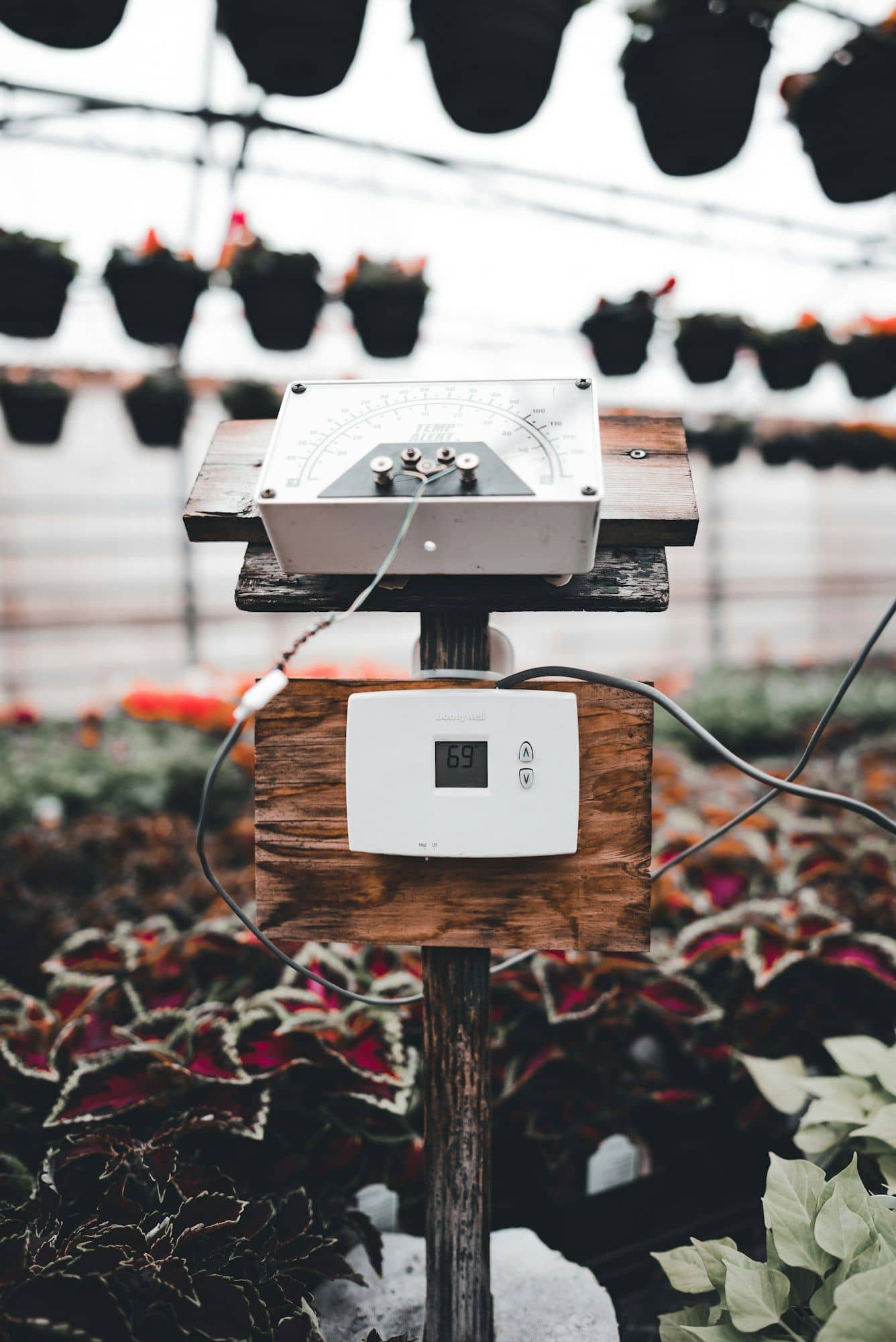
Plants use CO2 to photosynthesise. Cornell notes that outdoor air held about 390 ppm when the handbook was written, and that a closed greenhouse on a bright day can pull CO2 down to 100 ppm, which sharply cuts photosynthesis. Raising it to 1,000–1,500 ppm speeds growth. The Bologna vertical farm held a constant 850 ppm. Cornell's own set point is 1,500 ppm when light is available and ambient when it is not, because plants only use the extra CO2 while they are photosynthesising.
A sealed vertical farm is the easiest place to enrich because very little CO2 leaks out through vents. The usual source is bottled or bulk liquid CO2 dosed through a controller. Cornell mentions heaters that release CO2 as a by-product but does not recommend them. Enrichment only helps while the lights are on, so dose during the photoperiod and let the level fall to ambient in the dark. Fit CO2 alarms where staff work, because enriched rooms are designed for plants, not people, and any fault in dosing should be caught quickly.
HVAC load from lights: sizing the cooling
Cooling load has two parts. The sensible load is heat that raises air temperature, and in a vertical farm it is mostly the lamps plus pumps, fans and people. The latent load is the energy in water vapour that the crop transpires, which the system removes when it condenses that water on a cold coil. Both loads peak while the lights are on, so equipment must be sized for the lit period, not the daily average.
A rough way to size the sensible part is to treat lamp power as heat. One tonne of refrigeration (TR) removes 3.517 kW. If the lamps in a room draw 20 kW, they add about 20 ÷ 3.517 = 5.7 TR of heat while on. For the latent part, evaporating one kilogram of water takes about 2,450 kJ. A room in which the crop transpires 100 litres a day therefore adds 100 × 2,450 = 2,45,000 kJ, or 2,45,000 ÷ 86,400 seconds = 2.8 kW on average, and more while the lights are on. These are illustrative figures; a real design uses measured fixture wattage and crop water use.
Because the latent load is large relative to the sensible one, a system that only cools can overshoot on temperature while humidity stays too high. A common answer is to pair cooling with dedicated dehumidification, and to collect the condensate, which can be tested and reused. Size both from measured data where you can: log fixture power, room temperature and humidity for a few weeks in a pilot room before specifying equipment for a full farm.
Indian summer: heat, power and building choices
India's hot season adds a third load: heat coming through the walls and roof. The India Meteorological Department considers heat waves when plains stations reach at least 40 °C, and declares one whenever the maximum stays at 45 °C or above. The NDMA notes that heat waves typically run from March to June. A farm in a tin shed or on an uninsulated rooftop will fight that heat all afternoon.
A 2022 review in Agronomy, citing Graamans and colleagues, notes that vertical farms currently cannot cut energy use in hot, arid regions the way greenhouses can, because natural sunlight saves more electricity than a greenhouse spends on cooling. That does not rule out indoor farms in Indian cities, but it does mean the building envelope is part of the crop plan: insulated panels, a cool or shaded roof, a vestibule at the door, and no west-facing glass.
Power tariffs shape the schedule. Maharashtra's regulator, for 2025–26 onwards, applies a 10% rebate on energy charges from midnight to 6 am and a peak charge from 5 pm to midnight for commercial and industrial consumers. Running the lamps at night uses cheaper power and cooler outdoor air for heat rejection. Plan for outages too, with backup for fans, pumps and dosing even if the lamps must wait.
Monsoon: humidity, condensation and disease
The monsoon reverses the problem. Outdoor air is warm and close to saturated, so any fresh air brought in adds moisture the HVAC must then remove. On a day at 30 °C and 90% RH, for example, the outside VPD is only about 4.24 × 0.10 = 0.42 kPa. Keep fresh air to what staff and pressure control need, and dehumidify it before it reaches the crop.
Cold surfaces are the next risk. Chilled pipes, ducts and the undersides of trays sweat in humid air, and that water drips onto leaves and into trays. Insulate chilled lines, keep coil drain pans clean, and watch for condensation on the top tier after the lights switch off, when the temperature drops. High humidity also favours Botrytis grey mould and bacterial soft rots, which UC Davis lists as common problems for lettuce. Clean airflow, drier nights and sanitation between crops are the standard defences.
Sensors, controllers and alarms
Every climate decision rests on the sensors. Cornell's handbooks place temperature and humidity sensors in an aspirated box, a shaded enclosure with a small fan that draws air over the sensors, so that lamp heat and still air do not distort readings. Put sensing at crop height on several tiers, not just at the return air grille. The minimum set is air temperature, relative humidity (from which the controller calculates VPD), CO2, and solution temperature, EC, pH and dissolved oxygen. A controller ties these to the HVAC, dehumidifiers, CO2 valve and lighting schedule, logs the data, and sends alarms by phone when a value leaves its band. Calibrate humidity and CO2 sensors on a schedule, because drift of a few percent changes the calculated VPD.
- Log temperature and RH at the top, middle and bottom tiers.
- Alarm on high temperature, high humidity, CO2 out of range and loss of airflow.
- Keep a written set-point sheet per crop and per growth stage.
- Review a week of logs before changing any set point.
Planning a vertical farm with Garden & Acre
If you are planning a vertical farm on a rooftop, in a warehouse or on a campus, Garden & Acre's Vertical Farm Setup service covers feasibility, climate and HVAC design, build, commissioning and first-crop support. If you already run a farm, including one built by someone else, and are fighting heat, humidity, tipburn or uneven tiers, our Vertical Farm Consulting service covers audits, troubleshooting, crop planning and written SOPs for your team. Both are priced in a written proposal after a first call. For homes, cafés and schools that want a smaller start, hydroponic and aeroponic towers begin at ₹14,000 per tower installed, including the pump, timer, first seedlings, nutrients, training and a refill plan.
Questions
What temperature should a vertical farm be for lettuce?
Cornell's lettuce handbook uses 24 °C while the lights are on and 19 °C in the dark. The University of Bologna's research vertical farm used 24 °C and 21 °C for baby-leaf kale. Keep the nutrient solution no higher than 25 °C, and cooler for spinach, which is prone to root rot in warm water.
What is the best VPD for lettuce in a vertical farm?
Working from Cornell's 50–70% humidity range at 24 °C gives a VPD of roughly 0.9 to 1.5 kPa, and general greenhouse guidance puts most crops at 0.8 to 0.95 kPa. Pair the humidity target with strong airflow to keep calcium moving and prevent tipburn.
Is CO2 enrichment worth it in a vertical farm?
Usually yes, because the room is sealed and little CO2 escapes. Cornell reports that raising CO2 to 1,000–1,500 ppm speeds growth, and a Bologna research farm ran at 850 ppm. Dose only while lights are on, use bottled or liquid CO2 rather than burners, and fit alarms for staff safety.
How much air conditioning does a vertical farm need?
Start with lamp power: nearly all of it becomes heat, and each tonne of refrigeration removes 3.517 kW. So 20 kW of lamps needs about 5.7 TR for that heat alone. Add the latent load from crop transpiration, heat through walls and roof, pumps and fans. A proper design uses measured wattage and crop water use.
Why is my hydroponic lettuce getting tipburn indoors?
Tipburn is usually a calcium delivery problem, not a shortage. When the air around the canopy is still and humid, transpiration slows and calcium does not reach young inner leaves. Cornell found downward airflow let lettuce take 17 mol/m²/day of light without tipburn, against 12 without it. Improve airflow before changing nutrients.
Can a vertical farm run through an Indian summer?
Yes, but the building must keep outside heat out. IMD heat waves start from 40 °C in the plains and run mainly from March to June. Insulated walls and roof, a cool roof, sealed doors and night-time lighting on cheaper off-peak power reduce the cooling load. Budget for backup power for fans and pumps.
How do you control humidity in a vertical farm during the monsoon?
Limit fresh air, because monsoon air is already close to saturation, and dehumidify what you do bring in. Pair cooling with dedicated dehumidification so humidity can be pulled down without overcooling. Insulate chilled pipes and ducts to stop dripping, keep night humidity lower, and sanitise trays between crops to limit mould.
Sources
- Cornell University CEA Program, Cornell Controlled Environment Agriculture Hydroponic Lettuce Handbook (2013)
- Cornell University CEA Program, Hydroponic Baby Spinach Handbook
- Zauli et al. (2024), The Perfect Match: Testing the Effect of Increasing Red and Blue Ratio on Baby-Leaf Kale Growth, Yield and Physiology, Horticulturae 10:1134
- Van Gerrewey, Boon and Geelen (2022), Vertical Farming: The Only Way Is Up?, Agronomy 12:2
- Benchmarking energy efficiency in vertical farming: Status and prospects (ScienceDirect, 2024)
- Vapour-pressure deficit (Wikipedia)
- NDMA, Government of India: Heat Wave (IMD criteria)
- MERC press note: Retail electricity tariff of MSEDCL, FY2025-26 to FY2029-30
- UC Davis Postharvest Research and Extension Center: Lettuce (Romaine and Loose-Leaf)