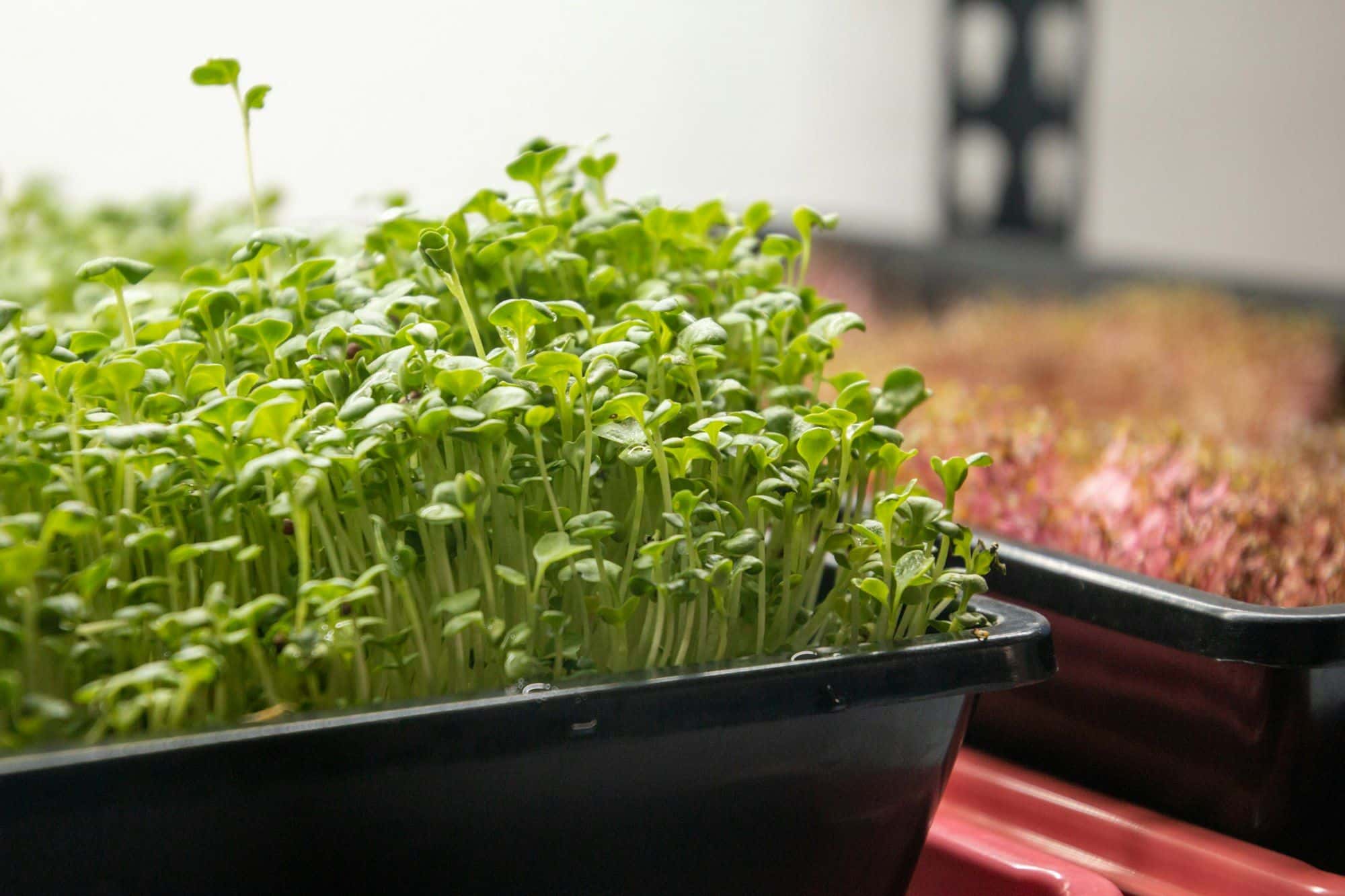
The 1020 tray: the standard size
"1020" is the trade name for a greenhouse flat about 10 inches wide and 20 inches long. Penn State Extension recommends "1020 (standard) greenhouse trays" for microgreens, the University of Maryland Extension gives its seed rates per 10 × 20-inch flat, and Johnny's Selected Seeds ran its 2017 microgreen yield trial on 1020 flats. Because seed rates, lids, mats and racks are all sized to it, the 1020 is the easiest tray to plan around.
The name is nominal. Actual trays vary a little by maker and wall thickness. One US maker lists its shallow 1020 microgreen tray at 21 × 10¾ × 1¼ inches outside, or about 53 × 27 × 3 cm, and also sells a standard 1020 about 2.5 inches (6.4 cm) deep. For seed rates, this guide uses the nominal 200 square inches, which is 200 × 6.45 = 1,290 cm². Check that trays you plan to nest together come from the same maker and are the same depth.
Trays with holes and trays without holes
Most microgreen growers use two trays together. The top tray has drainage holes and holds the growing medium and seed. The bottom tray has no holes and holds water. Pour water into the bottom tray and the medium draws it up through the holes. Penn State recommends this kind of sub-irrigation because it keeps leaves and stems dry, which it says is important for avoiding disease, and the University of Maryland Extension says to keep the medium moist but not saturated.
A tray without holes is also the usual blackout cover: turned upside down over the sown tray, it keeps the seed dark and humid, and with a weight on top it presses large seeds such as pea and sunflower into the medium, as Penn State suggests. Mesh trays are a third type. They have many small holes for fast drainage and suit mats, hydroponic racks and bottom-watering systems. One maker's mesh 1020 has 3.4 mm holes and is designed to sit inside a no-hole tray of the same depth.
- Tray with holes: holds the medium and seed; lets water in from below and drains the excess
- Tray without holes: holds water under the growing tray; doubles as a blackout cover
- Mesh tray: maximum drainage; for mats, soil blocks and flood-and-drain racks
- Humidity dome or lid: keeps germinating seed moist; lift it once shoots are up
Tray sizes compared
Smaller trays suit a kitchen, a single variety or a trial of a new seed. Larger trays suit a steady weekly supply. The table lists common sizes with example dimensions from manufacturer listings and Penn State, and scales the University of Maryland and Penn State seed rate of 10–15 g per 1020 tray to each tray's area. For example, a 5 × 5-inch tray is 25 square inches, one-eighth of a 1020, so it takes 10 ÷ 8 = 1.25 g to 15 ÷ 8 = 1.9 g of small seed.
| Tray | Example outer size | Growing area (approx.) | Small seed at 10–15 g per 1020 |
|---|---|---|---|
| 1020, standard depth | About 10 × 20 in; 2.5 in (6.4 cm) deep | 200 sq in (1,290 cm²) | 10–15 g |
| 1020, shallow | 21 × 10¾ × 1¼ in (53 × 27 × 3 cm) | 200 sq in (1,290 cm²) | 10–15 g |
| 1020, mesh | 20⅞ × 10⅝ × 1⅜ in (53 × 27 × 3.5 cm) | 200 sq in (1,290 cm²) | 10–15 g on a mat |
| 1010 (half tray) | 10.6 × 10.4 × 2.5 in (27 × 26 × 6.4 cm); two fit in a 1020 | 100 sq in (645 cm²) | 5–7.5 g |
| 5 × 5 insert | 5 × 5 × 1.3 in (13 × 13 × 3.3 cm); eight fit in a shallow 1020 | 25 sq in (161 cm²) | 1.25–1.9 g |
| Vented clamshell with seeding mat | 11 × 7⅛ × 5 in tall (28 × 18 × 13 cm), per Penn State | 78 sq in (506 cm²) | 3.9–5.9 g |
| Takeaway container (DIY) | For example 15 × 20 cm | 300 cm² | 2.3–3.5 g |
Depth, material and care of trays
Microgreens need little depth. The University of Maryland Extension suggests 1 to 1½ inches (2.5–4 cm) of soilless mix, and UF/IFAS suggests a container 2 to 3½ inches (5–9 cm) deep that is food grade and clean. Shallow trays of about 3 cm suit mats and thin layers of mix, and make it easier to get scissors under the leaves at harvest. Deeper trays hold more mix and more water, which helps in hot, dry weather.
One US maker lists its solid trays as polypropylene (plastic #5) and its mesh trays as polyethylene (#2), both BPA-free and food safe; look for the same when buying locally. The same maker notes that long exposure to direct sunlight degrades its trays, so store trays out of the sun when they are not in use. Wash trays between batches, rinse off any detergent, and let them dry fully. Penn State recommends fresh growing medium for each cycle to reduce damping-off, and a clean tray is part of the same routine.
Growing media for trays
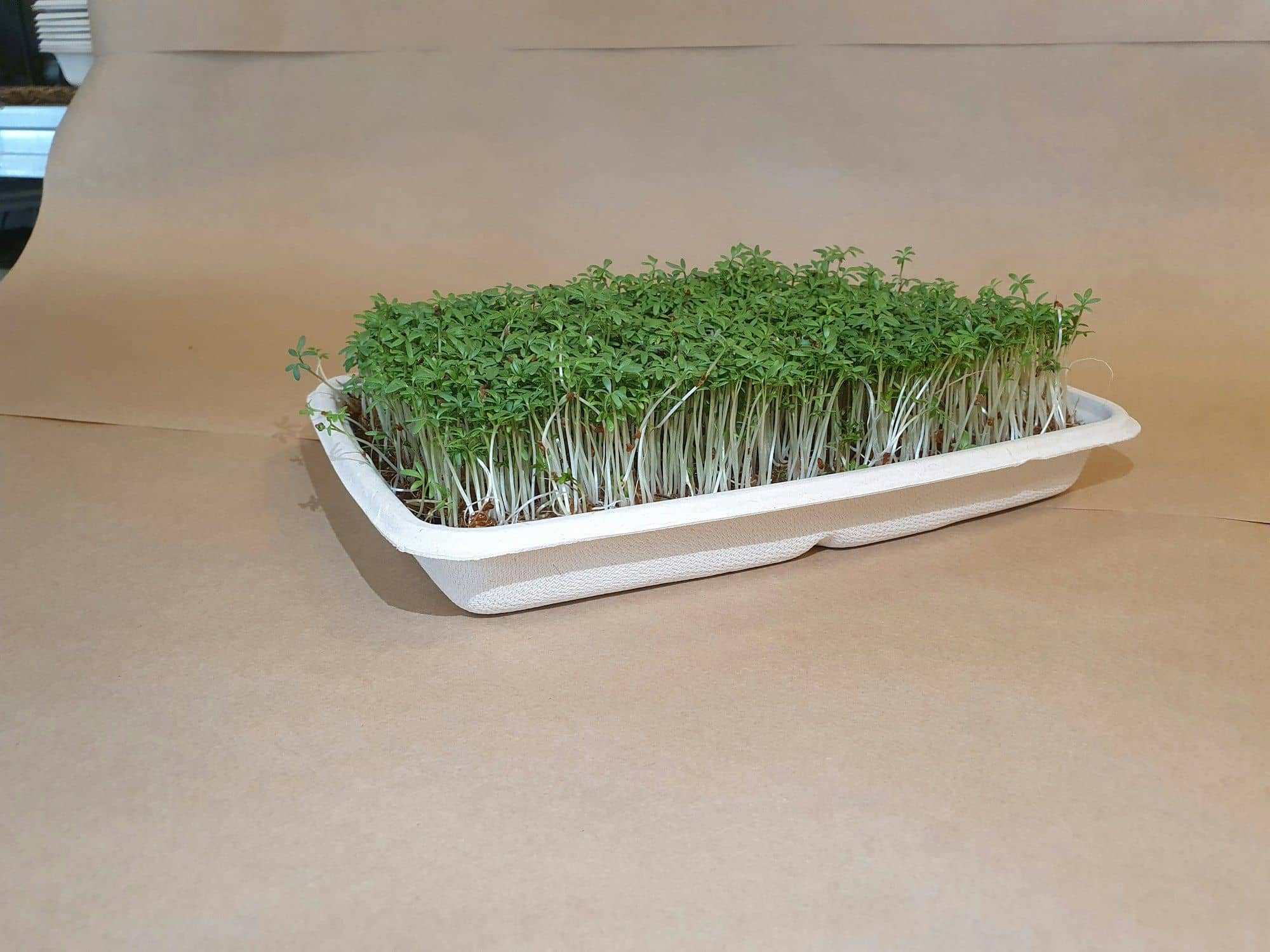
The medium is the second half of the tray decision. The University of Maryland Extension recommends a lightweight soilless mix and adds that a 50:50 blend of screened plant-based compost and potting mix saves money. In India, cocopeat is the usual base. The ICAR-IARI study by Priti and colleagues (2022) tested three blends of cocopeat, vermiculite and sand and found 2:1:1 held water best. Mats of hemp, jute or coco coir replace loose media in soil-free growing.
Media affect yield. Kyriacou and colleagues (2020) grew coriander, kohlrabi and pak choi on five media with the same nutrient solution and recorded 2.96 kg per m² on peat moss, 1.65 on coconut fibre and 1.18–1.31 on synthetic pads. The MANAGE handbook from Hyderabad also tested wet tissue paper, which it describes as quick to set up. For a first tray, a soilless mix or cocopeat blend is the most forgiving.
| Medium | Depth or form | Notes from the sources |
|---|---|---|
| Soilless potting mix | 2.5–4 cm | No fertiliser needed (UMD); can be mixed 50:50 with screened compost |
| Cocopeat, vermiculite and sand, 2:1:1 | Tray filled and levelled | Best water holding of three blends in the ICAR-IARI trial |
| Peat moss | Tray filled | Highest fresh yield, 2.96 kg/m², in Kyriacou et al. 2020; environmental cost of peat extraction |
| Coco coir or coconut fibre | Loose or as a mat | 1.65 kg/m² in the same trial |
| Hemp or jute mat | Single pad | Soil-free; see the hydroponic microgreens article |
| Tissue paper | Several wet layers | Tested by MANAGE (2023); quick to set up; dries fast |
Microgreen kits compared
A kit bundles trays, a growing medium and seed, and sometimes a lid, a mister or a light. It saves the effort of sourcing parts, and it suits a first attempt or a gift. The trade-off is that the seed and media in a kit run out after a few trays, and refills may be sold only by the same seller. Before buying, check what refills cost and whether the trays are a standard size, so that you can use any seed and media later. A kit with standard 1020 or 1010 trays stays useful long after its seed runs out.
The table describes the common kit types without naming brands. Whichever you choose, check four things: that the seed is labelled untreated, that the trays are food-safe plastic, that there is a tray without holes for bottom watering, and that the kit includes, or leaves room for, a way to keep the seed dark for the first few days of germination.
| Kit type | Usually includes | Suits | Watch for |
|---|---|---|---|
| Tray starter kit | Tray with holes, tray without holes, lid, soilless mix or cocopeat, seed packets | Beginners; a first few trays | Seed quantity per packet; whether trays are standard 1020 or 1010 |
| Mat kit (soil-free) | Trays, pre-cut hemp, jute or coco mats, seed | Kitchens where soil is unwelcome | Mats are single use; check refill cost |
| Countertop self-watering grower | Container with a water reservoir, mats or pads, seed | Small households; a steady small batch | Proprietary pad sizes; cleaning the reservoir |
| Shelf kit with LED light | Rack or shelf, LED light, several trays | Year-round growing; several varieties | Light height and timer; power use; fit of standard trays |
| Clamshell with seeding mat | Vented clear container with a mat (Penn State describes this format) | Selling or gifting live greens | Small area per unit |
DIY trays from what you already have
Any clean, food-grade container 5–9 cm deep can grow microgreens, following the UF/IFAS guidance. Cut or punch drainage holes in the base of one container and stand it in a second, identical container that has no holes. Takeaway boxes, bakery clamshells and shallow food-storage boxes all work. Wash them well first, and do not use containers that held paint, chemicals or motor oil.
A DIY setup costs almost nothing, and it is a good way to test whether you will keep growing before buying trays. Its limits are size, since small containers give small harvests, and durability, since thin takeaway plastic cracks after a few washes. For a weekly supply, most home growers move to one or two standard trays once they know which varieties they eat.
- Two identical food containers, 5–9 cm deep: one with holes, one without
- A heated skewer or a drill to make drainage holes across the base
- A lid or a third container, upside down, as the blackout cover
- Soilless mix, cocopeat or a few layers of tissue paper
- Seed at the scaled rate: about 2.3–3.5 g of small seed for a 15 × 20 cm box
How many trays you need
Plan by harvest, not by sowing. A brassica such as radish, mustard or broccoli takes about 8–14 days in the Johnny's and ICAR-IARI trials, and a tray is cut once. For a steady supply, stagger sowings. If a tray takes about 14 days and you eat one tray a week, two trays sown 7 days apart keep the supply going: 14 days ÷ 7 days = 2 trays growing at any time. Add one tray without holes per growing tray, for watering and as a cover.
More trays do not mean more seed per tray. Keep to the seed rate for the tray size, because overcrowding reduces quality. Dubey and colleagues (2026) found that bacteria, yeasts and moulds on cress, rocket and pea rose as seed density increased. If you need more greens, add a tray rather than sowing an existing tray more thickly, and keep a note of the seed weight and harvest day for each tray so you can repeat what worked.
Fresh microgreens in Pune
Trays and kits are the way to start growing your own. If you would rather skip the trays, Garden & Acre delivers fresh microgreens across Pune and Pimpri-Chinchwad from our own supply chain, as a weekly box for homes or as regular supply for restaurants, cafés and hotels. We do not sell trays, kits or seeds. Orders are taken on WhatsApp, where we share the varieties available that week and the prices.
Questions
What size is a 1020 microgreens tray?
Nominally 10 × 20 inches, which is about 25 × 51 cm and 1,290 cm² of growing area. Actual trays are a little larger outside: one maker lists its shallow 1020 at 21 × 10¾ × 1¼ inches. The same maker's shallow trays are about 1¼ inches deep and its standard ones about 2.5 inches.
Do microgreens trays need holes?
The tray you grow in should have holes, so excess water drains and you can water from below. Stand it inside a second tray without holes, which holds the water. Penn State recommends this sub-irrigation because it keeps leaves and stems dry and helps prevent disease.
How much seed goes in a 1020 tray?
About 10–15 g of small seed, according to the University of Maryland and Penn State Extensions. Larger seed needs more: Johnny's used 13 g of broccoli, 22.5–28.5 g of radish and 23 g of beet per 1020 tray. See the microgreen seeds article for a full table by variety.
Are microgreen kits worth buying?
A kit is worth it for a first attempt or a gift, because it removes the need to source parts. For ongoing growing, standard trays with seed and media bought separately usually work out cheaper. Before buying a kit, check the cost of refills and whether its trays are a standard size.
Can I grow microgreens in a plastic takeaway container?
Yes. UF/IFAS says any clean, food-grade container about 5–9 cm deep works, and drainage helps. Punch holes in one container and stand it in an identical one without holes. A 15 × 20 cm box takes about 2.3–3.5 g of small seed, scaled from the 10–15 g used for a 1020 tray.
How do I clean microgreens trays between batches?
Empty the used medium and roots onto the compost, scrub the tray in hot soapy water, rinse off all detergent and let it dry fully before the next sowing. Penn State recommends fresh growing medium for every cycle to reduce damping-off, so never reuse the old mix in a clean tray.
Sources
- Growing Microgreens — Sanchez and Berghage, Penn State Extension
- Growing Microgreens and Baby Greens Indoors — University of Maryland Extension
- Microgreens — UF/IFAS Gardening Solutions
- 1020 shallow microgreen tray specifications (manufacturer listing, dimensions only) — Bootstrap Farmer
- 1020 shallow mesh tray specifications (manufacturer listing, dimensions only) — Bootstrap Farmer
- 1010 tray specifications (manufacturer listing, dimensions only) — Bootstrap Farmer
- 5 × 5 shallow tray specifications (manufacturer listing, dimensions only) — Bootstrap Farmer
- Yield optimization, microbial load analysis, and sensory evaluation of mungbean, lentil, and Indian mustard microgreens — Priti et al., PLoS One, 2022 (ICAR-IARI)
- Phenolic Constitution, Phytochemical and Macronutrient Content in Three Species of Microgreens as Modulated by Natural Fiber and Synthetic Substrates — Kyriacou et al., Antioxidants, 2020
- Microgreens for Nutritional Security — Kumari, Junuthula and Mandapaka, MANAGE Hyderabad, 2023
- Micro Greens Yield Trial 2017 — Johnny's Selected Seeds
- Microgreens: Optimising Seed Density and Exploring the Influence of White Light and UV-A — Dubey et al., Plants, 2026