
What makes a seed suitable for microgreens
Microgreens use seed far more heavily than a garden, because every plant is cut as a seedling and nothing is thinned out. Johnny's Selected Seeds used 22.5–28.5 grams of radish seed per 10 × 20-inch tray in its 2017 trial, and 23 grams of beet. So the seed has to be cheap enough to buy by the hundred grams or the kilo, and every seed has to count, because a tray is cut once and resown.
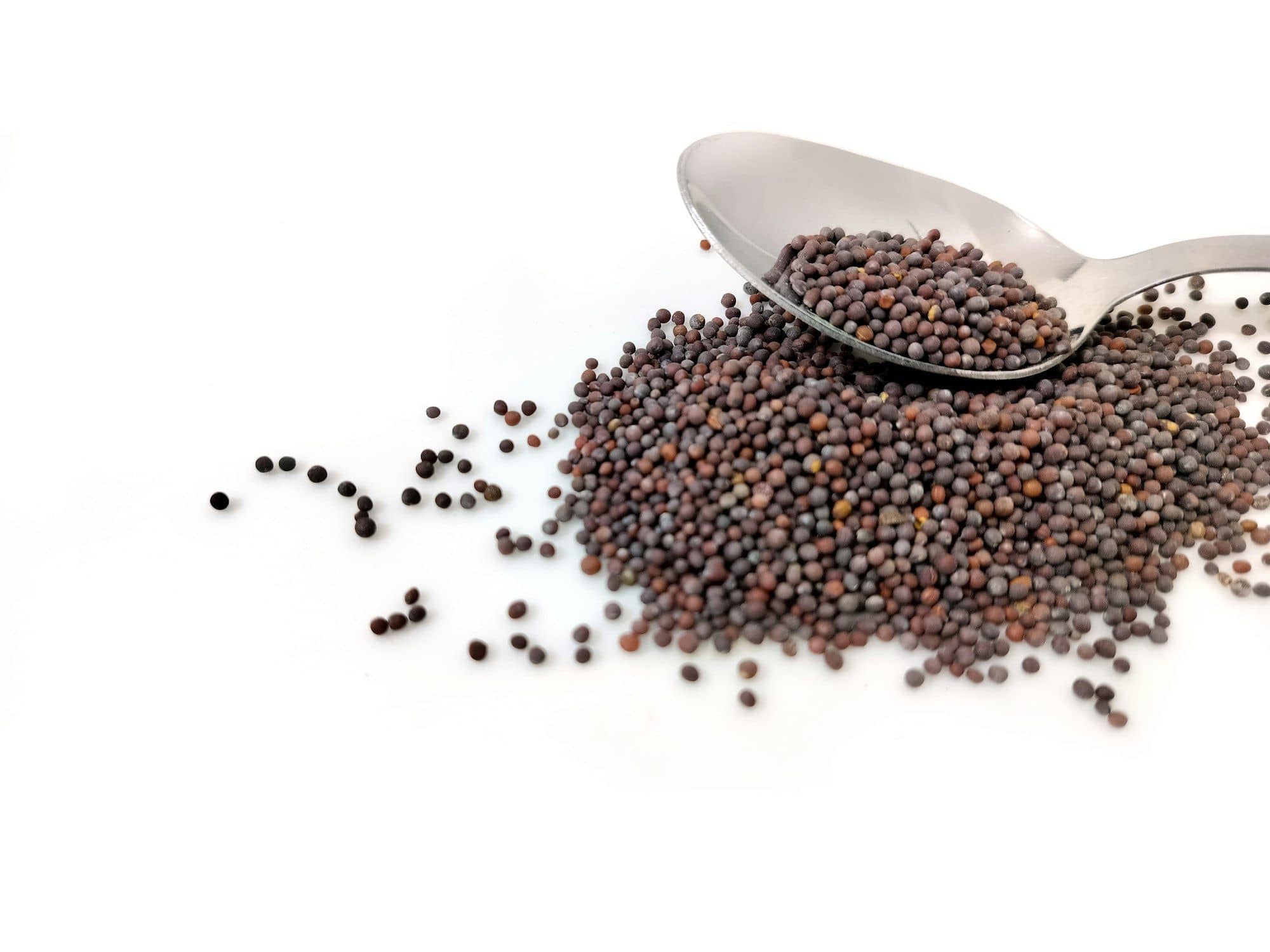
Five things matter. The seed must be untreated. It must germinate well and evenly, so the tray grows as one crop. It must be clean, both of dirt and chaff and of microbes, because the greens are eaten raw. It must be the right variety for colour and flavour. And it must be fresh enough to still germinate. The ICAR-IARI study by Priti and colleagues (2022) started with seed that had more than 90% germination, which is a sensible bar for a buyer too.
- Untreated: no fungicide, insecticide or coloured coating
- High germination: 90% or more, from a recent test
- Clean: free of chaff, broken seed and weed seed; from a seller who handles seed for eating
- Sold in bulk: 100 g, 500 g or 1 kg packs for the varieties you grow most
- Labelled: variety, lot, and a packing or test date
Why treated seed is dangerous
Some seed sold for field and garden sowing is treated with a fungicide or insecticide to protect it in the soil. That seed is meant to be sown and grown to maturity over weeks or months, not eaten within two weeks of sowing, and the treatment is chosen with that use in mind, not for a crop that is cut and eaten as a seedling.
Penn State Extension tells microgreen growers to avoid pesticide-treated seed because, for some species, the seed coat persists on the seedling. Anything on the seed coat can then end up in the bowl. If a packet does not say it is untreated, or the seed looks coloured or dusty, do not use it for microgreens. Penn State notes that many seed companies have sections devoted to microgreens.
Seed rates by variety
The table gives two kinds of figure. Where Johnny's weighed the seed for a 1020 tray, that figure is shown directly. For Indian crops, the ICAR review by Seth and colleagues (2025) collected seed rates per square metre from published studies, and we have converted those to a 1020 tray. A 10 × 20-inch tray is 200 square inches, which is about 1,290 cm², or 0.129 m². So a rate of 200 g per m² works out to 200 × 0.129 = 25.8 g, or about 26 g per tray.
Rates in the literature vary widely, because studies harvest at different sizes and use different seed lots. The review lists mustard and radish at about 50–60 g per m², while Gunjal and colleagues (2024) sowed radish at 292 g per m². Treat the table as a starting point. Sow one tray at the figure given, look at how crowded it is at harvest, and adjust the next tray up or down from what you see. Crowding is not only a yield question: Dubey and colleagues (2026) found microbial counts rose as seed density rose.
| Microgreen | Seed rate in source | Per 1020 tray | Source |
|---|---|---|---|
| Radish | 22.5–28.5 g per tray | 22.5–28.5 g | Johnny's 2017 trial |
| Broccoli | 13 g per tray | 13 g | Johnny's 2017 trial |
| Red cabbage | 10.5 g per tray | 10.5 g | Johnny's 2017 trial |
| Kale (Red Russian) | 10 g per tray | 10 g | Johnny's 2017 trial |
| Arugula | 10 g per tray | 10 g | Johnny's 2017 trial |
| Mustard (Garnet Giant) | 8 g per tray | 8 g | Johnny's 2017 trial |
| Amaranth (Garnet Red) | 7.5 g per tray | 7.5 g | Johnny's 2017 trial |
| Basil | 5–6.5 g per tray | 5–6.5 g | Johnny's 2017 trial |
| Beet | 23 g per tray | 23 g | Johnny's 2017 trial |
| Coriander | 26 g per tray | 26 g | Johnny's 2017 trial |
| Fenugreek (methi) | about 200 g per m² | about 26 g (200 × 0.129) | Seth et al. 2025 |
| Chia | about 200 g per m² | about 26 g (200 × 0.129) | Seth et al. 2025 |
| Flax | about 200 g per m² | about 26 g (200 × 0.129) | Seth et al. 2025 |
| Moong and lentil | about 220 g per m² | about 28 g (220 × 0.129) | Seth et al. 2025 |
| Sunflower | about 350 g per m² | about 45 g (350 × 0.129) | Seth et al. 2025 |
| Ragi (finger millet) | about 500 g per m² | about 65 g (500 × 0.129) | Seth et al. 2025 |
| Wheat (wheatgrass) | about 700 g per m² | about 90 g (700 × 0.129) | Seth et al. 2025 |
| Pea | about 1,300 g per m² | about 168 g (1,300 × 0.129) | Seth et al. 2025 |
| Moong, by count | 3 seeds per cm² | about 3,870 seeds (3 × 1,290) | Priti et al. 2022 (ICAR-IARI) |
| Indian mustard, by count | 8 seeds per cm² | about 10,320 seeds (8 × 1,290) | Priti et al. 2022 (ICAR-IARI) |
Scaling seed rates to your own tray
Not every tray is a 1020. To scale a rate, work out your tray's growing area and multiply. A takeaway container 15 × 20 cm has 300 cm² of surface. Using the UMD and Penn State guide of 10–15 g for a 1,290 cm² tray, it takes 10 × 300 ÷ 1,290 = 2.3 g to 15 × 300 ÷ 1,290 = 3.5 g of small seed. For a larger seed, use the table: at about 26 g per 1020 tray for methi, the same container takes 26 × 300 ÷ 1,290 = 6 g.
If you prefer to count, UF/IFAS gives a rule of thumb of 10–12 seeds per square inch for small seeds and 6–8 for large ones. A square inch is 6.45 cm², so that is about 1.5–1.9 seeds per cm² for small seeds and 0.9–1.2 for large ones. The ICAR-IARI study found higher densities worked for Indian crops: 3 seeds per cm² for moong and lentil, and 8 for Indian mustard. Weigh 100 seeds once, and you can turn any count into grams from then on.
The germination test: check seed before you sow a tray
A germination test tells you how much of the seed will come up, and it costs a few seeds and a week. The University of Maine Extension describes the method in its seed-saving bulletin. It is worth running on every new lot, and on any seed that has been open for a few months, because a tray sown with 60% seed gives a patchy crop and wastes the rest of the seed and the mix.
Count the germinated seeds and divide by the number you started with. If 88 of 100 seeds sprouted, germination is 88%. UMaine suggests over-seeding to make up for poor germination. For microgreens, a simple rule is to divide the tray rate by the germination rate: at 13 g per tray for broccoli and 80% germination, sow 13 ÷ 0.8 = 16 g. UMaine treats germination below 50% as poor; at that level it is usually cheaper to buy a new lot.
- Count out 100 small seeds, or 25 large ones such as pea or sunflower.
- Lay them in a line on a paper towel, about 5 cm from one edge.
- Fold the towel over the seeds and roll it up loosely.
- Moisten the roll, squeeze out the excess water, and put it in a plastic bag.
- Keep the bag somewhere warm, out of direct sun.
- After 7 days, unroll the towel and count the seeds that have germinated.
- Germination % = germinated seeds ÷ seeds tested × 100.
How to store microgreen seeds
Seed stays alive longest when it is cool, dry and kept at a steady temperature. UMaine advises storing dry seed in clearly marked containers with the species, variety and date, in a cool, dry place with constant temperature and humidity, and notes that large seeds generally store longer than small ones. Airtight containers suit larger quantities. How long seed lasts depends on the storage conditions, the starting quality of the seed and the species.
Indian homes add two challenges: summer heat and monsoon humidity. Keep seed in airtight jars or zip bags, away from the stove, the window and the top of the refrigerator, where it is warm. A sachet of silica gel in the jar helps in the monsoon. Buy in amounts you will sow within a season, and write the purchase date on the jar. Run a quick germination test on any seed you have held through a monsoon before relying on it.
Seed hygiene: what research found on microgreen seed
Because microgreens are eaten raw, the seed is one of the main ways germs reach the plate. Ocho Bernal, Lyttle and Jung (2023) at West Virginia State University tested 102 microgreen seed samples of 14 species bought from 26 online vendors. They found no E. coli, but coliform bacteria were present in 48% of samples. One onion sample tested positive for Salmonella by PCR, though no live Salmonella was recovered. Carrot and borage seed carried the most bacteria; pea seed carried none.
The same team tested ways to clean seed. The best combination was a 10-minute soak in 3% hydrogen peroxide, followed by dry heat at 60°C for 20 hours, which reduced microbial counts by 1.2–3.4 log, meaning roughly 16 to 2,500 times fewer microbes. Germination was not affected. A dilute mix of hydrogen peroxide and vinegar was also tested. The authors caution that the right method depends on the seed. The food-safety article in this hub covers seed sanitation in more detail.
Buying microgreen seeds in India
There is no single right place to buy. Each kind of seller has strengths, and the table compares them without naming brands. Whichever you use, ask whether the seed is untreated, ask for the germination percentage and test date, and check that the lot is recent. Buy a small pack first, run a germination test and one tray, and only then buy in bulk. A buyer growing one tray a week of broccoli at 13 g needs 13 × 52 = 676 g of seed a year.
Kitchen staples are a special case. Whole moong, masoor, methi, sarson, rai and wheat from a grocery are sold as food, so they are not coated with fungicide, and many home growers use them. But they are not graded for germination or cleaned as seed, and some grocery grains are split, polished or old. If you try them, run the germination test first and use the tray only if most of the seed sprouts evenly.
| Seller type | Strengths | Watch for |
|---|---|---|
| Seed companies with a microgreens or sprouting range | Untreated seed, labelled lots, germination data, wide variety | Price per gram; small packs only in some ranges |
| Online marketplaces and microgreen specialist sellers | Bulk packs and many varieties; delivery anywhere | Mixed quality; check that it says untreated and look for a test date |
| Agri-input shops and nurseries | Local, can inspect the pack | Stock is mostly seed for field sowing, which may be treated; ask specifically for untreated |
| Grocery and kirana stores (whole moong, methi, sarson, wheat) | Cheap, food-grade, easy to find | Not graded for germination; may be old, split or polished; test first |
| Bulk seed traders and wholesale markets | Lowest price per kg for large volumes | Lot-to-lot variation; test every lot; confirm untreated in writing |
Fresh microgreens in Pune
Seed, trays and a week of care are the price of home-grown microgreens. If you are in Pune or Pimpri-Chinchwad and would rather have them ready to eat, Garden & Acre delivers fresh microgreens from our own supply chain, as a weekly box for homes or as regular supply for restaurants, cafés and hotels. We do not sell seeds. Orders for microgreens are taken on WhatsApp, where we share the varieties available that week and the prices.
Questions
Can I use regular garden seeds for microgreens?
Only if they are untreated. Much garden and field seed is coated with fungicide or insecticide, and Penn State Extension warns against using treated seed for microgreens because the seed coat can stay on the seedling you eat. Check that the packet says untreated. Seed sold for microgreens or sprouting is the safest choice.
Can I grow microgreens from grocery store moong, methi or mustard?
Often, yes. Whole moong, methi and sarson from a grocery are sold as food, so they are not coated with fungicide. But they are not graded for germination, and some are old or polished. Run a germination test first: if most of 100 seeds sprout within a week, the lot is usable for a tray.
How many grams of seed do I need for one tray?
It depends on seed size. For a 10 × 20-inch tray, Johnny's used 8 g of mustard, 13 g of broccoli, 22.5–28.5 g of radish and 23 g of beet. Converted from the ICAR review, methi and flax need about 26 g, sunflower about 45 g and pea about 168 g. UMD's general rule is 10–15 g for small seeds.
How do I test if my microgreen seeds are still good?
Roll 100 seeds in a damp paper towel, put it in a plastic bag in a warm place, and count the sprouted seeds after 7 days, as the University of Maine Extension describes. If 85 sprout, germination is 85%. Sow a little more seed to make up the difference, or replace lots below about 50%.
How long do microgreen seeds last?
It depends on the species, the seed's starting quality and how it is stored. UMaine notes that large seeds generally keep longer than small ones, and that cool, dry, steady conditions extend life. Rather than rely on a fixed number of years, run a germination test on any seed that has been stored for a season, especially through a monsoon.
Should I disinfect microgreen seeds before sowing?
It lowers risk. A 2023 study found coliform bacteria on 48% of 102 microgreen seed samples bought online. A 10-minute soak in 3% hydrogen peroxide followed by dry heat at 60°C for 20 hours cut microbial counts by 1.2–3.4 log without hurting germination. The food-safety article in this hub has details.
Are microgreen seeds different from sprouting seeds?
Often they are the same species. Both should be untreated and clean, because both are eaten young. Microgreens are grown in light on a medium and cut above the roots, while sprouts are eaten whole, roots and all, after a few days in water. Seed sold for either use is suitable.
Sources
- Growing Microgreens — Sanchez and Berghage, Penn State Extension
- Micro Greens Yield Trial 2017 — Johnny's Selected Seeds
- Microgreens: Functional Food for Nutrition and Dietary Diversification — Seth et al., Plants, 2025
- Yield optimization, microbial load analysis, and sensory evaluation of mungbean, lentil, and Indian mustard microgreens — Priti et al., PLoS One, 2022 (ICAR-IARI)
- Assessment of bioactive compounds, antioxidant properties and morphological parameters in selected microgreens cultivated in soilless media — Gunjal et al., Scientific Reports, 2024
- Bulletin #2750, An Introduction to Seed Saving for the Home Gardener — University of Maine Cooperative Extension
- Microbiological quality of microgreen seeds purchased from online vendors and evaluating seed decontamination techniques — Ocho Bernal, Lyttle and Jung, Frontiers in Sustainable Food Systems, 2023
- Microgreens: Optimising Seed Density and Exploring the Influence of White Light and UV-A — Dubey et al., Plants, 2026
- Growing Microgreens and Baby Greens Indoors — University of Maryland Extension
- Microgreens — UF/IFAS Gardening Solutions