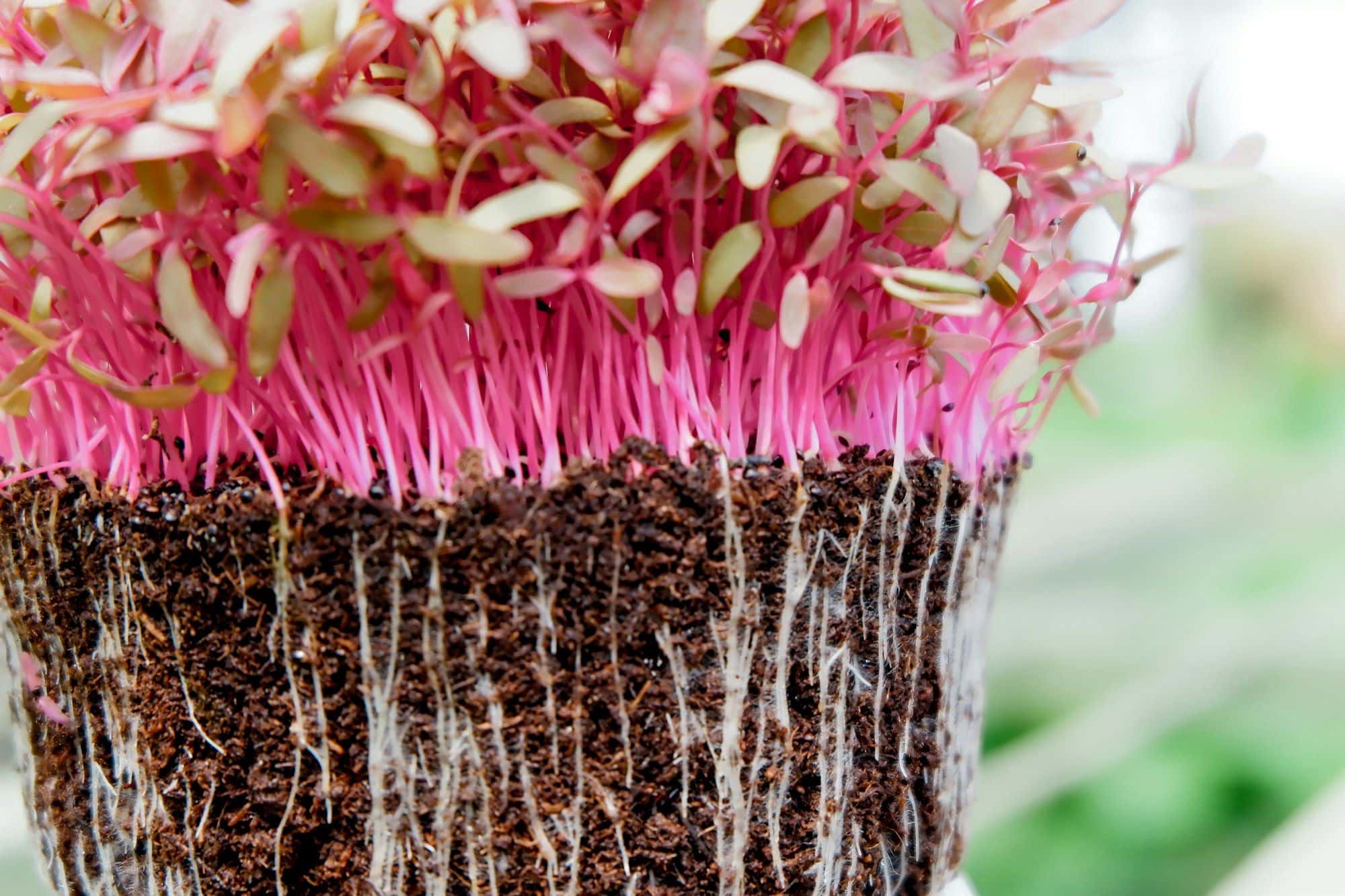
What amaranth microgreens are
Amaranth is the plant behind two familiar Indian foods: chaulai or lal math, the leafy green cooked as a sabzi, and rajgira, the tiny seed of grain amaranth. The ICAR review of microgreens lists vegetable amaranth (Amaranthus tricolor) and red amaranth (A. cruentus) as microgreen crops, with green or red colour. Red types such as 'Garnet Red' are the ones used in the microgreen trials cited here, and the colour is the point: the stems and small oval seed leaves turn magenta to deep red. The taste is mild and slightly earthy, with none of the heat of radish or mustard. The seedlings are small and delicate, so amaranth is used more as a colourful garnish than as a salad base.
Nutrition: what studies measured
In 2012, Xiao and colleagues at the University of Maryland and USDA measured vitamins and carotenoids in 25 commercial microgreens. Garnet amaranth had the highest phylloquinone (vitamin K1) of the 25; the range across all 25 ran from 0.6 to 4.1 micrograms per gram of fresh weight, with garnet amaranth at the top. At Lovely Professional University in Punjab, Gunjal and colleagues (2024) grew seven microgreens on burlap; red amaranthus had the highest ash, the mineral fraction, of the seven. A study cited in the 2025 ICAR review found that red and blue LED light (70:30) at a 16-hour photoperiod raised fresh yield, chlorophyll, carotenoids, anthocyanin and vitamin C in red amaranth microgreens. These describe content and growing effects, not health outcomes.
| Study | What was compared | Amaranth result |
|---|---|---|
| Xiao et al. 2012 (USDA, UMD) | Vitamins in 25 microgreens | Garnet amaranth highest in vitamin K1 |
| Gunjal et al. 2024 (Punjab) | Seven microgreens on burlap | Red amaranthus highest ash; lowest yield and shoot weight |
| LED study cited by ICAR, 2025 | Light spectra | Red + blue light raised yield, pigments and vitamin C |
| Johnny's trial 2017 | 29 microgreens | Garnet Red: 17 days, 6.5 oz per tray |
How to grow amaranth microgreens
Amaranth seed is tiny and needs no soaking. In Johnny's Selected Seeds' 2017 trial, 'Garnet Red' amaranth was sown at about 7.5 g per 10×20-inch tray and took 17 days on average to reach the first true leaf. The ICAR review gives about 80,000 seeds or 50 to 100 g per m² for amaranth, which for a 0.129 m² tray is 50 × 0.129 = 6.5 g to 100 × 0.129 = 13 g. The University of Maryland Extension notes that the amaranth family germinates and grows more slowly than the cabbage family.
- Fill a drained tray with 2.5–4 cm of moist, fine soil mix or coco peat, or a wet grow mat. Level the surface.
- Scatter 7–10 g of seed as evenly as you can. The seed is tiny, so sow in two passes across the tray rather than one.
- Press the seed onto the surface. Do not cover it.
- Mist, cover and keep dark for about three days.
- Uncover and give bright light for about 16 hours a day. Water from below only.
- Harvest at about 17 days, when the seed leaves are fully open and coloured.
Tips specific to amaranth
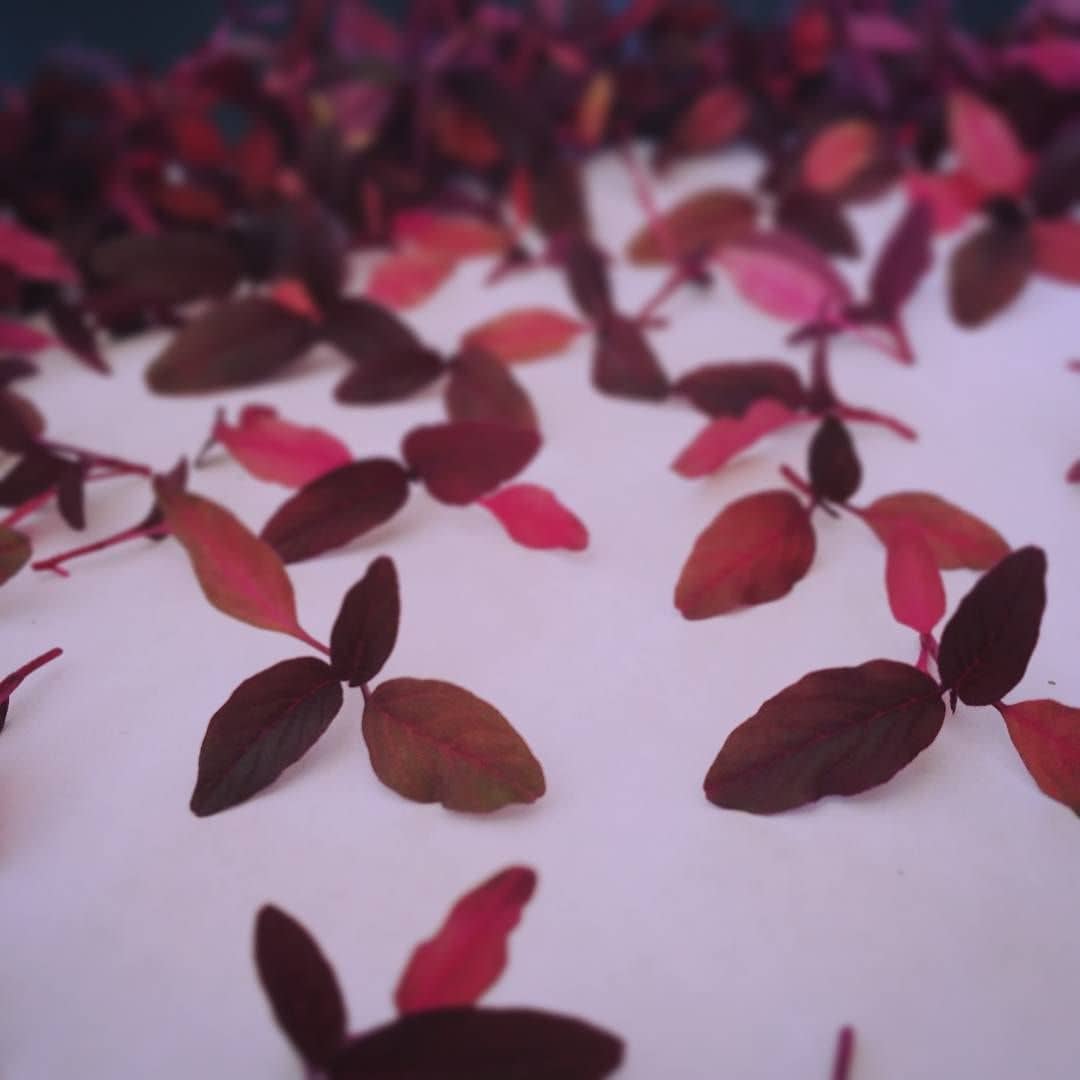
Amaranth is a low-yield crop, so sow for colour, not bulk. Johnny's averaged 6.5 oz per tray, which is 6.5 × 28.35 g = about 184 g, compared with about 326 g for its broccoli. In the Punjab study, red amaranthus had the lowest fresh yield and the lightest individual shoots of the seven microgreens tested. Strong light helps. Penn State notes that good light exposure raises antioxidant levels in microgreens, and the LED study cited by ICAR found red and blue light raised anthocyanin, the red pigment, in amaranth microgreens. A bright window or a grow light 15–30 cm above the tray gives deeper colour than a dim room.
Common problems
The small seedlings are easily knocked over by overhead watering, so water from below. Keep the medium moist but not wet: Penn State advises watering only when needed, and damping-off, which a 2024 review attributes to water moulds such as Pythium, collapses seedlings at the base. A gentle fan, as UMD suggests, helps the surface dry between waterings. Discard trays with grey, musty growth. Pale, green-tinged seedlings in a red variety often mean too little light. Because growth is slow, the tray spends longer at risk than a radish tray, so start with clean trays and fresh medium.
How to eat amaranth microgreens, including Indian dishes
Use them for colour and a soft texture. Scatter them over curd rice, a plain dosa, idli or upma, where the red shows against a pale dish. Top dahi puri, sev puri or a fruit chaat just before serving. Mix them with sunflower or pea shoots for a two-colour salad, or add them to a paneer or egg sandwich. They go well with the dishes that already use amaranth leaves, such as a simple lal math bhaji or chaulai dal, as a fresh topping added after cooking. Handle them gently, rinse just before eating and keep them refrigerated.
Fresh microgreens in Pune
Garden & Acre delivers fresh microgreens in Pune and Pimpri-Chinchwad from its own supply chain, as weekly home boxes, single-variety packs, and regular supply by weight for restaurants, cafés and hotels. The usual core varieties are sunflower, radish, broccoli, mustard and pea shoots, and others such as red amaranth depend on what is available that week. Ask on WhatsApp for this week's list. We reply with the varieties, the prices and the first delivery date.
Questions
How long do amaranth microgreens take to grow?
About 17 days. Johnny's Selected Seeds recorded 17 days on average for 'Garnet Red' amaranth, harvested at the first true leaf. The amaranth family is slower than the cabbage family, so expect roughly twice the time of radish, which Johnny's harvested at 8 days. Cooler rooms slow it further.
Why are my red amaranth microgreens not red?
Often too little light. A study cited in the 2025 ICAR review found red and blue LED light raised anthocyanin in red amaranth microgreens. Move the tray to a brighter window or put a grow light 15–30 cm above it.
Are amaranth microgreens high in vitamin K?
In the 2012 USDA and University of Maryland study of 25 microgreens, garnet amaranth had the highest vitamin K1 of all, at the top of a range of 0.6 to 4.1 micrograms per gram fresh weight. Other amaranth types were not in that study, and the figure describes content, not a health effect.
Is amaranth microgreen the same as chaulai or rajgira?
It is the same group of plants. Chaulai and lal math are amaranth leaves eaten as a vegetable, and rajgira is the seed of grain amaranth. Amaranth microgreens are the seedlings of these plants, cut at about 17 days, usually from red-leaved types.
How much amaranth seed do I need per tray?
About 7 to 10 g for a 10×20-inch tray. Johnny's used about 7.5 g. The ICAR review gives 50 to 100 g per m², which is 6.5 to 13 g for a 0.129 m² tray. Amaranth seed is tiny, so a little goes a long way; over-sowing crowds the seedlings.
Sources
- Assessment of vitamin and carotenoid concentrations of emerging food products: edible microgreens — Xiao et al., Journal of Agricultural and Food Chemistry, 2012
- Micro Greens Yield Trial 2017 — Johnny's Selected Seeds
- Assessment of bioactive compounds, antioxidant properties and morphological parameters in selected microgreens cultivated in soilless media — Gunjal et al., Scientific Reports, 2024
- Microgreens: Functional Food for Nutrition and Dietary Diversification — Seth et al., Plants, 2025 (ICAR)
- Microgreens on the rise: Expanding our horizons from farm to fork — Lone, Pandey & Gayacharan, Heliyon, 2024
- Growing Microgreens and Baby Greens Indoors — University of Maryland Extension
- A Step-By-Step Guide for Growing Microgreens at Home — Penn State Extension