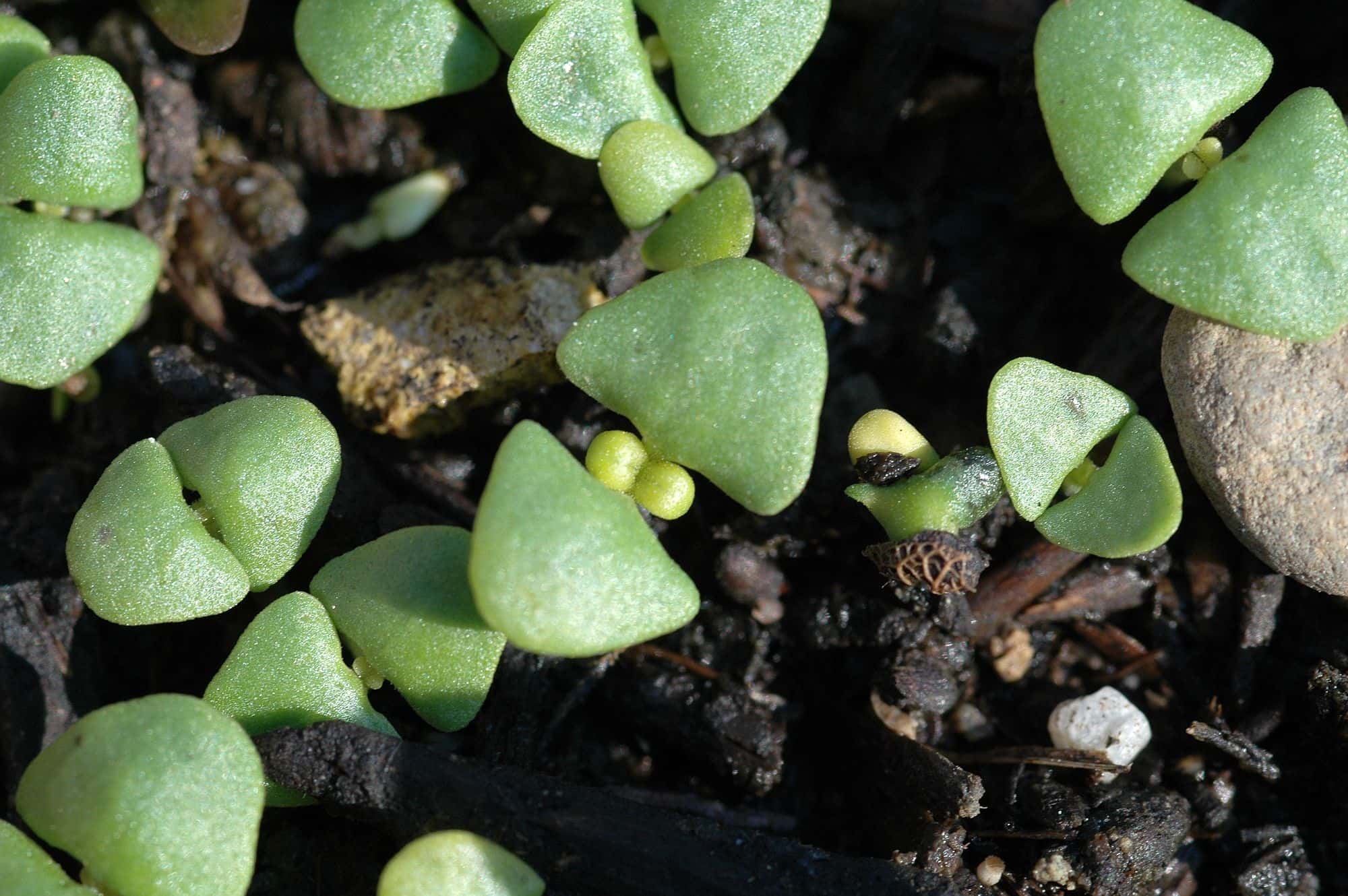
What basil microgreens are
Basil microgreens are young plants of sweet basil, Ocimum basilicum, cut at the first true-leaf stage. They carry the full basil aroma in a leaf small enough to use whole. Green types such as Italian large leaf basil give bright green leaves; purple types such as 'Dark Opal' and 'Red Rubin' give deep purple leaves and stems. In India, the seed of sweet basil is sold as sabja, so a pack of sabja seed is, botanically, basil seed. Tulsi, or holy basil, is a different plant from sweet basil and has a different flavour. Chefs in San Francisco were already using basil microgreens in the 1980s, according to a 2025 ICAR review.
Nutrition: what studies measured
In India, Ghoora and colleagues (2020) analysed ten culinary microgreens for protein, fibre, minerals and vitamins and ranked them on a Nutrient Quality Score. French basil came second of the ten, after radish and ahead of roselle. All ten were 2 to 3.5 times more nutrient-dense than mature spinach leaves grown under similar conditions. Green basil and opal basil were among the 25 commercial microgreens in the 2012 University of Maryland and USDA study by Xiao and colleagues, which found microgreens as a group denser in vitamins and carotenoids than mature leaves. The ICAR review lists red basil microgreens as a source of caffeic and rosmarinic acids. These are measures of content, not evidence of a health effect.
Why basil seed needs a different method
Basil seed, like chia, is covered in mucilage that swells into a gel when wet. This is the same gel that forms around sabja seeds in a glass of water, and it has been studied as a material in its own right, for example by Tripathi and colleagues (2024). For growing, it means soaked basil seed clumps and is hard to spread. The simpler method is to sow the dry seed evenly onto a moist surface and mist it. The seed gels where it lands and stays in place. Do not bury it. The gel holds moisture around the seed, so the surface should be damp, not wet.
How to grow basil microgreens
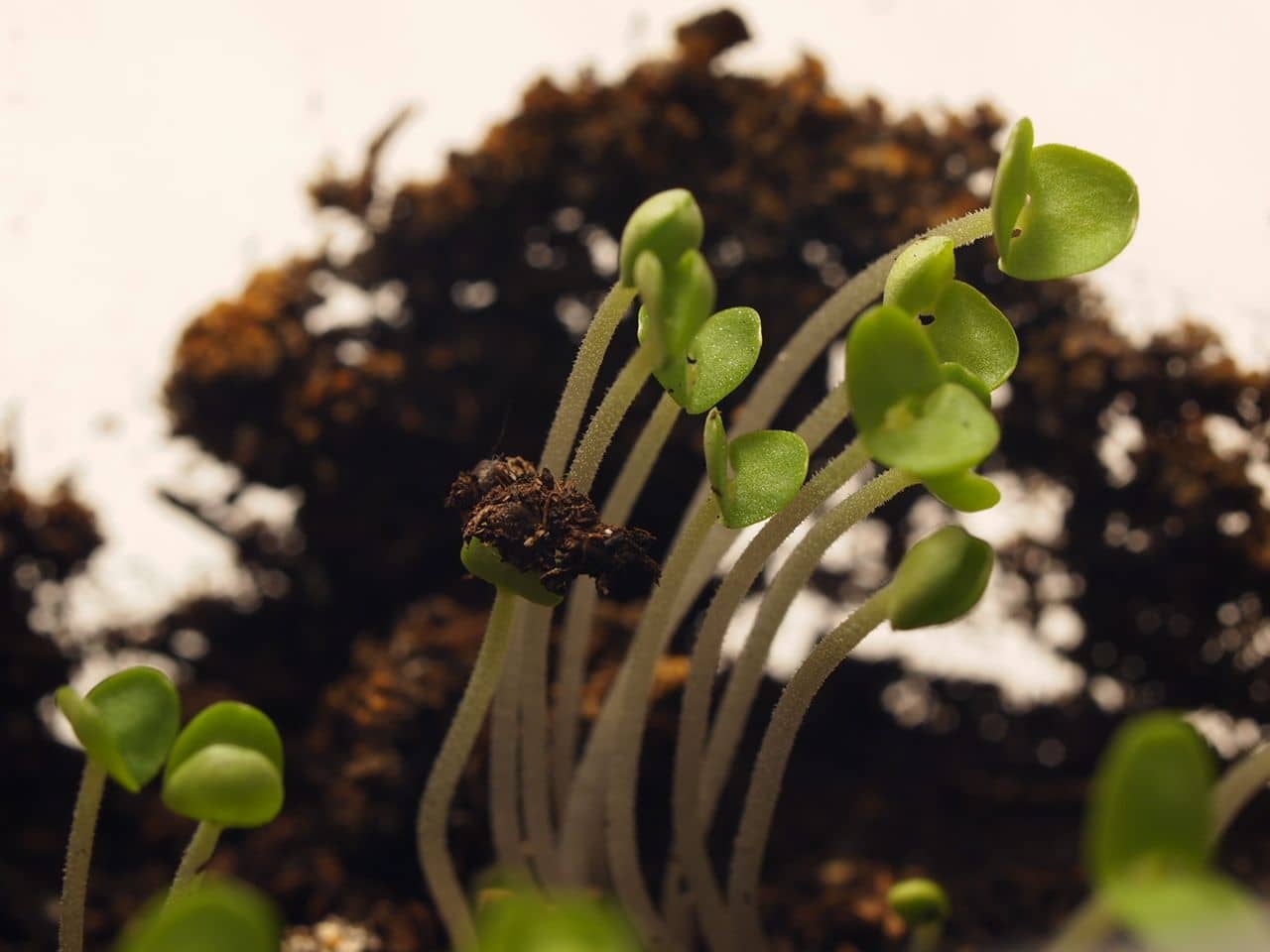
Johnny's Selected Seeds' 2017 trial sowed 6.5 g of Italian large leaf basil per 10×20-inch tray and harvested it at 19 days, and sowed 6 g of 'Red Rubin' and 5 g of 'Dark Opal', both harvested at 25.5 days. These are among the longest cycles of the 29 microgreens in that trial. The University of Maryland Extension also describes basil as slow-growing. Published optimum harvest times vary: the ICAR review cites 13 to 15 days for French and green basil in some studies and 20 days for green and purple basil in others.
- Fill a drained tray with 2.5–4 cm of fine, moist soil mix or coco peat, or lay a wet grow mat.
- Scatter 5–6.5 g of dry seed evenly over a 10×20-inch tray.
- Mist until the seed is wet and starts to gel. Do not cover it with soil.
- Cover to keep it dark and humid for about three days, misting if the surface dries.
- Uncover and give bright light for about 16 hours a day. Water from below.
- Harvest at 19–26 days, when the first true leaves are showing.
| Variety | Seed per tray | Days to harvest | Yield per tray |
|---|---|---|---|
| Italian Large Leaf (green) | 6.5 g | 19 | 7.5 oz (about 213 g) |
| Red Rubin (purple) | 6 g | 25.5 | 5.5 oz (about 156 g) |
| Dark Opal (purple) | 5 g | 25.5 | 6 oz (about 170 g) |
Common problems
The long cycle is the main challenge. A basil tray is on the shelf for three weeks or more, against 8 days for radish in the same trial, so there is more time for mould and damping-off to set in. Keep the surface damp rather than wet, water from below, and keep air moving with a small fan, as UMD advises. Discard any tray with grey, musty growth. Clumped seed germinates unevenly and holds water, so sow dry and spread it thinly. Purple types grow more slowly than green in Johnny's trial, so do not expect them to catch up. Yields are modest: 7.5 oz × 28.35 g = about 213 g for the green variety.
How to eat basil microgreens, including Indian dishes
Use them where you want basil aroma without chopping. Scatter them over pizza, pasta, bruschetta or a tomato and paneer salad just before serving. They suit Indian-Italian café food such as a paneer tikka sandwich, a masala pasta or a tomato-basil soup. Add a few to a nimbu pani or a sabja-and-lemon cooler, stir them into a mint and coriander chutney at the end, or put them on a cucumber and tomato kachumber. Add them raw, at the end. Rinse just before eating and keep them refrigerated in a closed box.
Fresh microgreens in Pune
Garden & Acre delivers fresh microgreens in Pune and Pimpri-Chinchwad from its own supply chain, as weekly home boxes, single-variety packs, and regular supply by weight for restaurants, cafés and hotels. The usual core varieties are sunflower, radish, broccoli, mustard and pea shoots, and others such as basil depend on what is available that week. Ask on WhatsApp for this week's list. We reply with the varieties, the prices and the first delivery date.
Questions
How long do basil microgreens take to grow?
About 19 to 26 days. In Johnny's Selected Seeds' 2017 trial, green Italian large leaf basil took 19 days and the purple 'Red Rubin' and 'Dark Opal' took 25.5 days. Some studies cited by ICAR harvested French and green basil earlier, at 13 to 15 days.
Can I grow basil microgreens from sabja seeds?
Sabja seed is sweet basil seed, Ocimum basilicum, so it can grow into basil microgreens if it is viable. Seed sold for eating may not state a germination rate, and microgreens are eaten raw, so seed sold for sowing or microgreens is the safer choice. Try a small test tray first.
Should I soak basil seeds before sowing?
No. Basil seed forms a gel when wet, like chia and sabja in a drink, so soaked seed clumps together. Sow it dry onto a moist surface and mist it. The seed gels in place and germinates where it lands.
Are basil microgreens the same as tulsi microgreens?
No. Basil microgreens are usually grown from sweet basil, Ocimum basilicum, the species whose seed is sold as sabja. Tulsi, or holy basil, is a different plant with its own flavour. The growing figures on this page are for sweet basil.
Why are my basil microgreens so slow?
Basil is naturally slow. It was among the slowest of 29 microgreens in Johnny's 2017 trial, at 19 to 25.5 days, and UMD Extension describes it as slow-growing. Warmth and good light help, but a basil tray will still take two to three times as long as radish, which Johnny's harvested at 8 to 9.5 days.
Sources
- Micro Greens Yield Trial 2017 — Johnny's Selected Seeds
- Nutrient composition, oxalate content and nutritional ranking of ten culinary microgreens — Ghoora, Babu & Srividya, Journal of Food Composition and Analysis, 2020
- Assessment of vitamin and carotenoid concentrations of emerging food products: edible microgreens — Xiao et al., Journal of Agricultural and Food Chemistry, 2012
- Microgreens: Functional Food for Nutrition and Dietary Diversification — Seth et al., Plants, 2025 (ICAR)
- Assessment of potential antimicrobial activity of Ocimum basilicum extract (sabja seeds) — Khot et al., Journal of Indian Society of Periodontology, 2023
- Basil seed mucilage as a bioadhesive polymer — Tripathi et al., ADMET & DMPK, 2024
- Growing Microgreens and Baby Greens Indoors — University of Maryland Extension
- A Step-By-Step Guide for Growing Microgreens at Home — Penn State Extension