What drives the cost of vertical farming
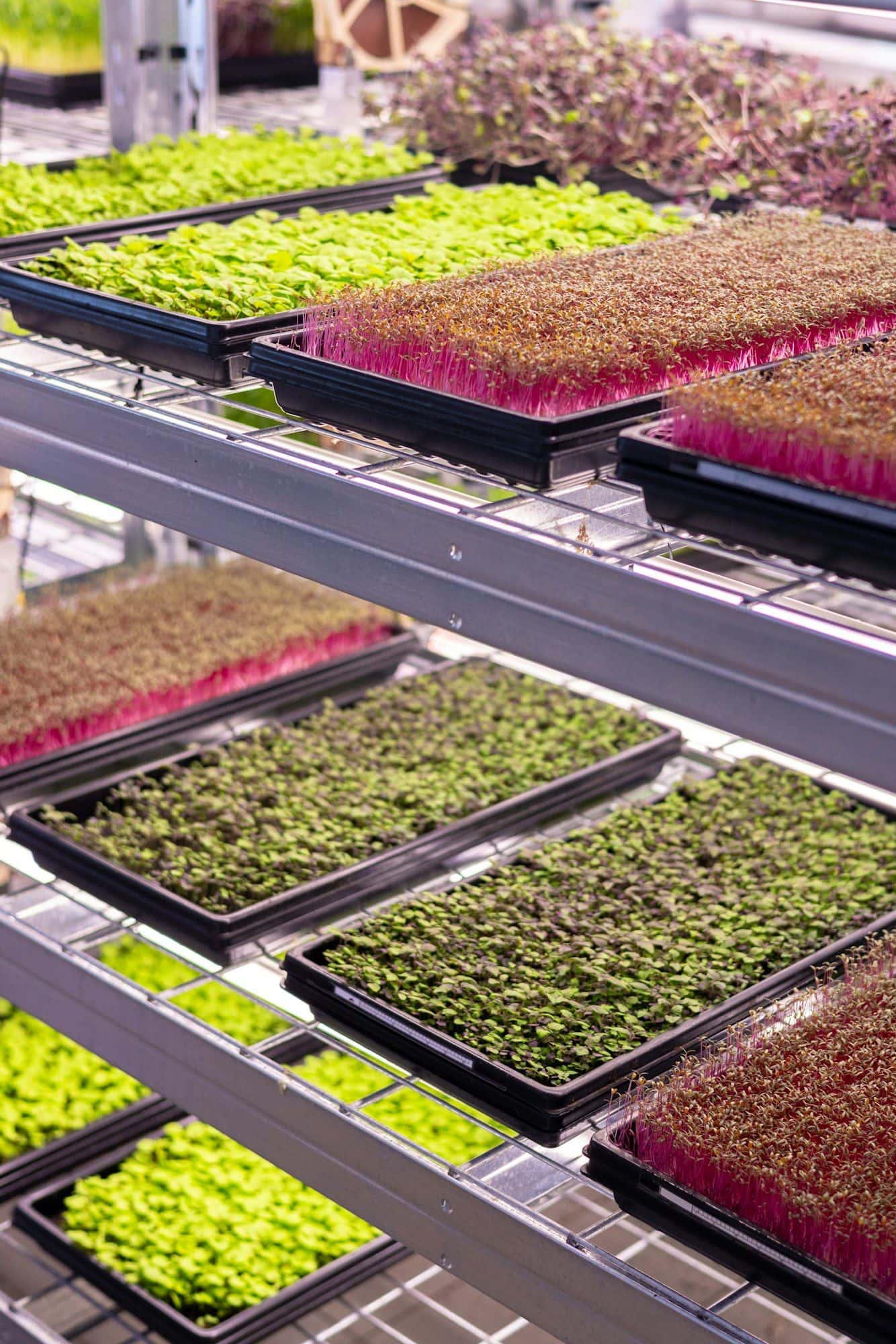
A vertical farm replaces sunlight with LED lamps and replaces the weather with air conditioning. That swap is what makes year-round, pesticide-free growing possible, and it is also what makes the farm expensive. The benchmarking study by Miserocchi and Franco (2025) found current vertical farms use 10 to 18 kWh of electricity per kg of lettuce, with lighting taking 65 to 85 percent of that energy. Everything else in the budget, from racks to labour, is smaller than the power bill over the life of the farm.
Capital cost is also dominated by the same two systems. A 2026 techno-economic model by Meeuws and colleagues at Leiden University found lighting was the largest capital component in every scenario they ran, followed by the climate system. So the first questions for any Indian project are how many watts of LED the crop needs, how many tonnes of cooling will remove that heat, and which electricity tariff category the farm will be billed under.
Capex components of a vertical farm
Capital expenditure covers everything bought once. The list is the same whether the farm sits in a warehouse, a basement or a rooftop room. Sizes follow from the growing area, so it helps to fix that number first. The growing area is the total shelf area under lights, which is the floor area covered by racks multiplied by the number of layers.
- Building fit-out: insulation, a washable floor and walls, a clean-room style entry, drainage and a lockable plant room. Insulation cuts the cooling load in Indian summers.
- Racks and growing system: steel racks, NFT channels or DWC trays, pumps, tanks and plumbing for each layer.
- LED lighting: fixtures sized by the light level the crop needs and the fixture efficacy in µmol/J.
- HVAC and dehumidification: air conditioners sized to remove the heat from the lamps and the water the plants transpire, plus fans for air movement across each shelf.
- Water and nutrients: an RO plant where the source water is hard or salty, dosing pumps, pH and EC controllers, and a sterilisation step such as UV.
- Automation and monitoring: sensors for temperature, humidity, CO₂, pH and EC, timers, alarms and remote monitoring.
- Electrical works and backup: a new connection or load increase, distribution boards, and an inverter or generator so pumps and fans keep running during outages.
Sizing the lights and cooling from the growing area
LED power per square metre follows from two numbers. Lettuce is commonly grown at a light level (PPFD) of 150 to 300 µmol per m² per second, according to the literature reviewed by ICAR-IARI researchers Gavhane and colleagues in 2023. The DesignLights Consortium's Horticultural Technical Requirements V4.0 set a minimum fixture efficacy of 2.5 µmol per joule from April 2025. Watts per m² equal PPFD divided by efficacy, so 250 ÷ 2.5 = 100 W per m² of growing area, assuming all the light lands on the crop.
Almost all the electricity a lamp uses ends up as heat in the room, so the cooling plant has to remove at least the lamp load. One tonne of refrigeration is 3.517 kW of heat. A farm with 23.2 kW of LEDs therefore needs 23.2 ÷ 3.517 = 6.6 tonnes of cooling for the lamps alone, before adding pumps, people and the heat released when transpired water is removed by dehumidification. In Indian cities, add a margin for summer outdoor temperatures and for the hours when lights run in the afternoon.
Worked example: a 1,000 sq ft farm with 5 layers
Take a room of 1,000 sq ft, which is 1,000 × 0.0929 = 92.9 m². Assume racks cover half the floor and the rest is aisles and equipment (assumption A1). The rack footprint is 92.9 × 0.5 = 46.45 m², and with 5 layers the growing area is 46.45 × 5 = 232 m². With 100 W per m² of LED, the lighting load is 232 × 100 = 23,200 W, or 23.2 kW.
Assume lights run 16 hours a day (assumption A2; the ICAR-IARI study found a 16-hour photoperiod gave the best iceberg lettuce weight at 200 µmol). Lighting energy is 23.2 kW × 16 h × 365 days = 1,35,488 kWh a year. If lighting is 75 percent of the total, the midpoint of the benchmark's 65 to 85 percent, the whole farm uses 1,35,488 ÷ 0.75 = 1,80,651 kWh a year. At a typical yield of 71 kg per m² a year, output is 232 × 71 = 16,472 kg, so energy use is 1,80,651 ÷ 16,472 = 11.0 kWh per kg, inside the published 10 to 18 range.
| Input | Value | Status |
|---|---|---|
| Floor area | 1,000 sq ft = 92.9 m² | Defined |
| Share of floor under racks | 50% | Assumption A1 |
| Layers | 5 | Defined |
| Growing area | 92.9 × 0.5 × 5 = 232 m² | Derived |
| LED power density | 250 µmol ÷ 2.5 µmol/J = 100 W/m² | Derived from ICAR-IARI review and DLC V4.0 |
| Photoperiod | 16 h/day | Assumption A2 |
| Lighting share of energy | 75% | Midpoint of 65–85% (Miserocchi & Franco) |
| Lettuce yield | 71 kg/m²/year | Derived from benchmark (see calculator notes) |
| Annual output | 232 × 71 = 16,472 kg | Derived |
| Annual electricity | 1,80,651 kWh (11.0 kWh/kg) | Derived |
Setup cost for the example farm
Equipment prices in India vary widely by quality and supplier, so the capex table uses round rates marked as assumptions. They are there to show the method, not to quote a price. LED fixtures listed on IndiaMART on 24 September 2026 ranged from about ₹21 to ₹64 per watt for small panels and bars, and most listings did not state an efficacy in µmol/J. The example assumes ₹60 per watt, near the top of that range, for fixtures with a stated efficacy of at least 2.5 µmol/J. Ask each supplier for a test report showing µmol/J.
Government cost norms give a reference point for the growing system only. The MIDH Operational Guidelines 2025 set a cost norm of ₹350 per m² for hydroponics and aeroponics as an add-on in protected cultivation, which is a greenhouse setting without stacked racks or lamps. Indoor racks with channels, pumps and trays cost more than that, which is why the example assumes ₹3,000 per m² of growing area. Collect at least three written quotes for each line before you rely on any total.
| Item | Quantity × rate | Amount |
|---|---|---|
| Fit-out and insulation | 1,000 sq ft × ₹800 (assumed) | ₹8,00,000 |
| Racks, channels, pumps, tanks | 232 m² × ₹3,000 (assumed) | ₹6,96,000 |
| LED fixtures | 23,200 W × ₹60/W (assumed) | ₹13,92,000 |
| Air conditioning and dehumidification | 10 TR × ₹60,000 (assumed) | ₹6,00,000 |
| RO, dosing, UV | Lump sum (assumed) | ₹1,50,000 |
| Sensors, controls, alarms | Lump sum (assumed) | ₹2,00,000 |
| Backup power | Lump sum (assumed) | ₹3,00,000 |
| Electrical works and connection | Lump sum (assumed) | ₹2,00,000 |
| Total | ₹43,38,000 |
Electricity: the largest running cost
The tariff category can nearly halve the power bill. In Maharashtra, the MERC multi-year tariff order of 28 March 2025 lists "Indoor Vertical Farming" by name under LT IV(C) Agriculture – Others. For 2026-27, the MERC order of 25 March 2026 in Case 75 of 2025 sets that category at ₹5.61 energy charge plus ₹1.60 wheeling, a variable charge of ₹7.21 per kWh. A farm billed as a shop or office instead falls under LT-II non-residential, where a connection of 20 to 50 kW pays ₹12.40 plus ₹1.52, or ₹13.92 per kVAh.
For the example farm, 1,80,651 kWh × ₹13.92 = ₹25,14,662 a year on the non-residential tariff, against 1,80,651 × ₹7.21 = ₹13,02,494 under Agriculture – Others. That is ₹153 or ₹79 of electricity per kg of lettuce. Fixed charges come on top. At an assumed 40 kVA sanctioned load, LT-II(B) adds ₹550 × 40 × 12 = ₹2,64,000 a year. Under LT IV(C), 40 kW is about 54 HP, so ₹157 × 54 × 12 = ₹1,01,736. Electricity duty and fuel adjustment charges are extra in both cases.
Other running costs: labour, seeds, nutrients and packaging
After power, labour is the next large line. Seeding, transplanting, harvesting, cleaning and packing are still manual in most small farms, and someone must check the crop, the water and the alarms every day, including holidays. The example assumes three staff at ₹20,000 a month each: 3 × ₹20,000 × 12 = ₹7,20,000 a year. Wages differ by city and by the minimum wage notified by each state, so use your own figure.
Consumables are smaller and scale with output. The example assumes ₹12 per kg for seeds and growing media (16,472 × ₹12 = ₹1,97,664), ₹5 per kg for nutrients (16,472 × ₹5 = ₹82,360) and ₹15 per kg for packaging (16,472 × ₹15 = ₹2,47,080). Maintenance, such as filter changes, pump replacement and AC servicing, is assumed at 3 percent of capex: ₹43,38,000 × 0.03 = ₹1,30,140. Depreciation spreads the capex over an assumed 7-year life: ₹43,38,000 ÷ 7 = ₹6,19,714 a year.
| Line | Non-residential LT-II(B) | Agriculture – Others LT IV(C) |
|---|---|---|
| Electricity, variable | ₹25,14,662 | ₹13,02,494 |
| Electricity, fixed | ₹2,64,000 | ₹1,01,736 |
| Labour (assumed) | ₹7,20,000 | ₹7,20,000 |
| Seeds and media (assumed) | ₹1,97,664 | ₹1,97,664 |
| Nutrients (assumed) | ₹82,360 | ₹82,360 |
| Packaging (assumed) | ₹2,47,080 | ₹2,47,080 |
| Maintenance, 3% of capex (assumed) | ₹1,30,140 | ₹1,30,140 |
| Cash operating cost | ₹41,55,906 | ₹27,81,474 |
| Depreciation, 7 years (assumed) | ₹6,19,714 | ₹6,19,714 |
| Total annual cost | ₹47,75,620 | ₹34,01,188 |
| Cost per kg (÷ 16,472 kg) | ₹290 | ₹206 |
What the cost per kg means for crop choice
A cost of ₹206 to ₹290 per kg has to be compared with what buyers pay. On 24 September 2026, the B2B supplier Hyperpure listed iceberg lettuce at ₹99 per kg and green leafy lettuce at ₹35 for 250 g, which is ₹140 per kg. Both are below the example's cost per kg even on the agricultural tariff. That is the core reason leafy greens alone are hard to run at a profit indoors in India, where field and polyhouse lettuce set the price.
The numbers improve with higher-value crops and better efficiency. The same listing site showed hydroponic microgreens at ₹37 per 50 g pack, or ₹740 per kg, in Pune. Culinary herbs and speciality greens sit between. On efficiency, the Meeuws model found lettuce cost falls as light-use efficiency rises, and the Miserocchi benchmark sets a future target of 3.1 to 7.4 kWh per kg. Run the example with your own crop mix, prices and quotes before committing money.
How Karnataka and other states compare
Tariff categories differ by state, so the same farm can cost very different amounts to run. The Karnataka Electricity Regulatory Commission's Tariff Order 2025, dated 27 March 2025, charges LT-3(a) commercial users 680 paise per kWh in 2026-27 plus ₹215 per kW a month. Its LT-5 schedule, which names floriculture (including lighting for photoperiod), green houses and tissue culture, charges 440 paise per kWh in 2026-27 plus ₹150 per HP a month. Whether an indoor farm qualifies for LT-5 is decided by the ESCOM.
In Tamil Nadu, the TNERC tariff order of 30 June 2025 places horticulture under LT III-A(1) with a bi-monthly energy charge of ₹4.95 up to 500 kWh and ₹7.15 above it, while LT V commercial users pay ₹10.45 per unit above 100 units. For the example farm, 1,80,651 kWh × ₹4.40 = ₹7,94,864 in Karnataka on LT-5, against 1,80,651 × ₹6.80 = ₹12,28,427 on LT-3(a). Ask your DISCOM in writing which category applies before you size the business case.
Ways to reduce the cost of vertical farming
The biggest savings come from the lighting and cooling design rather than from cheaper racks. Racks are bought once, while every extra watt of lamp power is paid for on every electricity bill for the life of the farm. The main levers are listed below. Each one changes an input in the worked example, so you can see its effect by re-running the same arithmetic with your own numbers.
- Apply for the right tariff category first. In Maharashtra, Agriculture – Others at ₹7.21 against non-residential at ₹13.92 saves ₹12.1 lakh a year on the example farm.
- Buy LED fixtures by efficacy, not price per watt. Kusuma, Pattison and Bugbee (2020) put the physical limit at about 3.4 µmol/J for white plus red fixtures. At 3.0 instead of 2.5 µmol/J, the same light needs 250 ÷ 3.0 = 83 W per m² instead of 100.
- Use time-of-day tariffs. The MERC order of 28 March 2025 gives MSEDCL non-residential users 10 percent off energy charges from midnight to 6 am, which suits a night photoperiod.
- Insulate the room and keep light off walls and aisles, so less energy leaves the crop area as waste heat.
- Grow crops that sell for more per kg than they cost to light, such as microgreens and herbs, and keep lettuce as a smaller share.
- Start with a smaller room and prove sales before building more layers.
Planning a vertical farm budget with Garden & Acre
Garden & Acre offers Vertical Farm Consulting for feasibility and due diligence, the business model, system design and crop planning, including for farms that others will build. For commercial and institutional sites such as rooftops, warehouses, campuses, hotels and cafés, Vertical Farm Setup covers feasibility, design, build, commissioning and first-crop support. Both are priced in a written proposal after an initial call, and the budget is built line by line in the same way as the worked example above.
Questions
How much does it cost to set up a vertical farm in India?
It depends on the growing area, light level and cooling. In our worked example, a 1,000 sq ft room with 5 layers and 232 m² of growing area comes to about ₹43 lakh using assumed rates for racks, LEDs, AC, RO, controls and backup power. Treat that as a method, not a quote, and replace each rate with written supplier quotes.
What is the biggest running cost in a vertical farm?
Electricity. Benchmarks put current vertical farms at 10 to 18 kWh per kg of lettuce, with lighting using 65 to 85 percent of it. In the worked example, power costs ₹13 lakh to ₹25 lakh a year depending on the Maharashtra tariff category, which is more than labour, seeds, nutrients and packaging combined.
Can a vertical farm get an agricultural electricity tariff?
In Maharashtra, yes. The MERC tariff order of 28 March 2025 lists indoor vertical farming under LT IV(C) Agriculture – Others, which costs ₹7.21 per kWh in 2026-27 before fixed charges. Other states use different categories, so ask your DISCOM in writing which one applies to your connection.
What does it cost to grow 1 kg of lettuce in a vertical farm in India?
In the worked example, the full cost including depreciation is about ₹206 per kg on Maharashtra's agricultural tariff and ₹290 per kg on the non-residential tariff. That is higher than the ₹99 to ₹140 per kg that B2B listings showed for lettuce in September 2026.
How many watts of LED does a vertical farm need per square metre?
Divide the light level by the fixture efficacy. For lettuce at 250 µmol per m² per second and fixtures at the DLC minimum of 2.5 µmol per joule, 250 ÷ 2.5 = 100 W per m² of growing area. More efficient fixtures or a lower light level reduce that figure.
Is vertical farming profitable in India?
It can be for crops that sell for more than they cost to light and cool, such as microgreens and herbs, and for farms that secure a low tariff and steady buyers. Leafy lettuce alone is difficult at current Indian prices. Model your own crop mix, price and tariff before investing.
Sources
- Miserocchi & Franco (2025), Benchmarking energy efficiency in vertical farming: Status and prospects, Thermal Science and Engineering Progress
- Meeuws et al. (2026), Vertical farming economics: crop performance targets for cost-competitive vertical farming, Frontiers in Sustainable Food Systems
- Gavhane et al. (2023), Optimal daily light integral for iceberg lettuce in an indigenous vertical hydroponic system (ICAR-IARI), Scientific Reports
- Kusuma, Pattison & Bugbee (2020), From physics to fixtures to food: current and potential LED efficacy, Horticulture Research
- DesignLights Consortium, Horticultural Technical Requirements V4.0
- MERC MYT order, Case No. 217 of 2024 (28 March 2025), MSEDCL tariff schedule
- MERC order, Case No. 75 of 2025 (25 March 2026), MSEDCL tariffs
- KERC Combined Tariff Order 2025 (27 March 2025), Karnataka ESCOMs
- TNERC Tariff Order No. 6 of 2025 (30 June 2025), TNPDCL
- MIDH Operational Guidelines 2025 (National Horticulture Board)
- IndiaMART, LED grow light listings (read 24 September 2026)
- Hyperpure, Lettuce Iceberg 1 kg listing (read 24 September 2026)
- Hyperpure Pune, Microgreen Leaf (Hydroponic) 50 gm listing (read 24 September 2026)