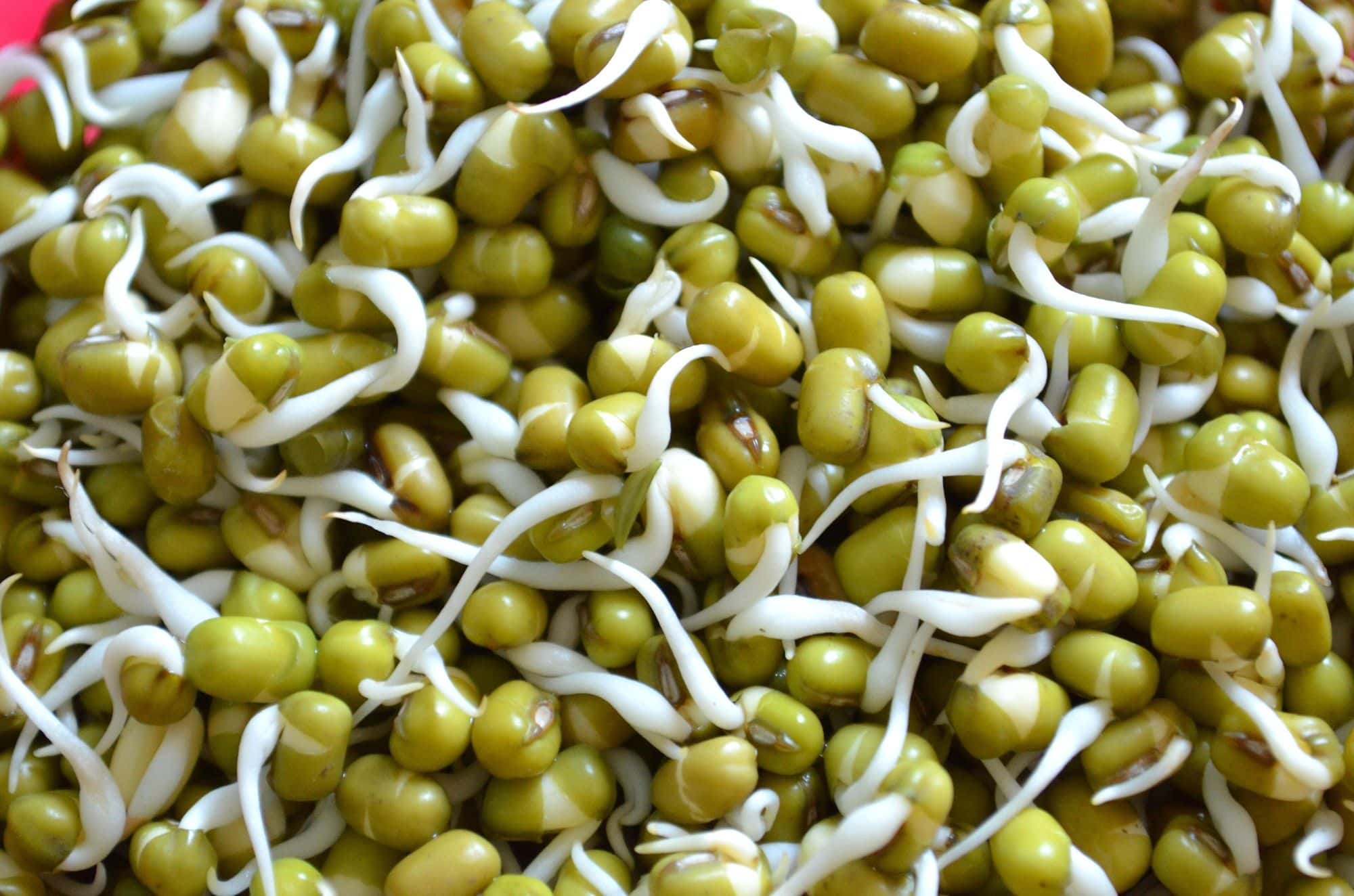
What moong microgreens are
Moong microgreens are the young shoots of the same green gram used for dal, grown in light for about a week and cut above the medium. They are different from moong sprouts. Sprouts are germinated seeds eaten whole, root and all, usually within two days of soaking. Microgreens grow in a tray under light, form green leaves, and only the stem and leaves are eaten. The flavour is mild, slightly sweet and nutty, and the stems are crisp and juicy.
What the ICAR-IARI trials measured
Priti and colleagues at ICAR-IARI, New Delhi, grew 20 mungbean genotypes as microgreens and published the results in PLoS One in 2022. They tested two, three and four seeds per square centimetre and harvests on days 5, 7 and 9. Three seeds per cm² and a harvest on day 7 gave the best marketable quality. Yield rose with seed size, and larger-seeded genotypes gave more microgreens (r² = 0.73).
Across harvest days 5 to 9, mungbean microgreen yield ranged from 1,774 to 2,645 g per square metre. The top figure came from the variety Pusa 105 on day 9. For a home tray the arithmetic is simple: a 10×20-inch tray covers 0.129 m², so at 2,000 g/m² it gives 2,000 × 0.129 = about 258 g. Stored at 4°C in sealed polyethylene bags, the microgreens kept acceptable quality for nearly 4 days.
| Measure | Result |
|---|---|
| Seeding densities tested | 2, 3 and 4 seeds per cm² |
| Best seeding density | 3 seeds per cm² |
| Harvest days tested | 5, 7 and 9 days after sowing |
| Best harvest day | Day 7 |
| Yield range, days 5–9 | 1,774–2,645 g/m² |
| Shelf life at 4°C | Nearly 4 days |
Nutrition compared with moong sprouts
A 2026 study from Kerala compared mung bean microgreens with mung bean sprouts grown from the same seed. On a fresh-weight basis the microgreens had lower protein and fat than the sprouts, but nearly double the dietary fibre. They also had more calcium, magnesium, iron and zinc, slightly less potassium, and significantly more vitamin C. These are measured differences in composition. The authors describe moong microgreens as a convenient way to add fibre, minerals and vitamin C to meals, not as a treatment for anything.
The same paper notes a food-safety difference. Sprouts are eaten raw with their roots after days in warm, wet conditions, and many food agencies classify them as high-risk foods. The US FDA lists mung bean sprouts among those that vulnerable people should not eat raw. Microgreens are grown on a medium, in light, and cut above the roots, and the IARI paper notes that microbial contamination is less common in microgreens than in sprouts. They are still eaten raw, so clean seed and hygiene matter.
How to grow moong microgreens
Moong is a large seed that germinates fast, which makes it a good first microgreen. In the Kerala study, seeds were washed and soaked for 12 hours at about 27°C before sowing. The IARI team rinsed their seed in dilute sodium hypochlorite for one minute and used seed with more than 90 per cent germination. At home, buy fresh whole moong, pick out broken and shrivelled grains, and rinse it well.
- Soak whole moong for about 12 hours, then drain.
- Fill a tray with 3–4 cm of moist cocopeat or a cocopeat, vermiculite and sand mix.
- Weigh about 29 g of dry seed per 10×20-inch tray before soaking, and spread it in a single layer.
- Cover for about 3 days, keeping the medium moist but not wet.
- Uncover and give bright light for 12–16 hours a day.
- Harvest on day 7, when the leaves have opened, cutting just above the medium.
Seed rate and tips specific to moong
Seed rates in the literature vary widely, so start in the middle. The IARI optimum of 3 seeds per cm² works out to 30,000 seeds per square metre. The Seth et al. 2025 review cites about 222 g of mungbean seed per m² for the highest yield, which is 222 × 0.129 = about 29 g per 10×20-inch tray. Another trial, of tropical species, used much more green gram, about 850 g per m². Heavier sowing gives more weight per tray but crowds the shoots and holds more moisture.
Moong seed coats often cling to the leaves. Brush the top of the tray with a flat hand a day or two after uncovering, or rinse the harvest in cold water and spin it dry. Large-grained varieties such as Pusa Vishal and Pusa 105 were among the highest yielders at IARI, so bold-seeded moong is worth choosing if you have the option.
Common problems
Most problems with moong come from dense, wet trays in warm weather. Damping-off, a rot that collapses seedlings at the base, was the one disease Penn State Extension met when growing microgreens for its hydroponics course, and it is favoured by warm and humid conditions. Moong also grows fast, so a tray left a few days too long turns tough and stringy.
- Seeds that do not sprout: old or damaged grain; use fresh, whole moong and test a handful first.
- Sour smell: over-soaking or standing water; drain fully and water from below.
- Mould on seed coats: sow thinner, add airflow, and brush off hulls.
- Pale, leggy shoots: too long under cover or too little light.
- Stringy stems: harvested after day 9; cut at 7 days.
Using moong microgreens in food
Moong microgreens suit almost any dish that already uses moong. Add a handful on top of moong dal chilla or pesarattu just before folding, stir them into kosambari with cucumber and grated coconut, or fold them into poha and upma after cooking. They work in bhel, chaat and sandwiches, and in raita with roasted cumin. Add them at the end of cooking so they stay crisp. Wash them just before eating rather than before storing; in the IARI trial, washing mustard microgreens before storage did not reduce microbial load significantly.
Moong microgreens delivery in Pune
Garden & Acre delivers fresh microgreens in Pune and Pimpri-Chinchwad, as a weekly subscription for homes and as regular supply for restaurants, cafés and hotels. The microgreens come from our own supply chain. Orders are placed on WhatsApp, and prices are given there. Ask which varieties are available that week, including moong, and tell us the quantity and day you want delivery.
Questions
How many days do moong microgreens take?
About 7 days from sowing. ICAR-IARI tested harvests on days 5, 7 and 9, and found day 7 gave the best marketable quality. Yield keeps rising to day 9, but the shoots get tougher. In cool weather allow a day or two more.
Are green gram microgreens the same as moong sprouts?
No. Sprouts are germinated seeds eaten with their roots after a day or two. Microgreens are grown in light for about a week, form green leaves and are cut above the roots. A 2026 study found moong microgreens had nearly double the fibre and more vitamin C, calcium, iron and zinc than moong sprouts, but less protein on a fresh-weight basis.
Should I soak moong before growing microgreens?
Yes. Moong is a large, hard seed and soaking starts germination evenly. In a 2026 study from Kerala, seeds were soaked for 12 hours at room temperature before sowing. Drain them fully afterwards, because seed sitting in water can turn sour and grow mould.
How much moong seed do I need per tray?
The ICAR-IARI optimum was 3 seeds per square centimetre. A 2025 review cites about 222 g per square metre, which is 222 × 0.129 = about 29 g for a 10×20-inch tray. Some growers sow more for a heavier yield, but crowded trays are more prone to rot.
How long do moong microgreens last in the fridge?
In ICAR-IARI's trial, mungbean microgreens kept acceptable quality for nearly 4 days at 4°C in sealed polyethylene bags. Keep them dry, cold and unwashed until you use them, and avoid moving them in and out of the fridge. Lentil microgreens in the same trial lasted about 6 days.
Can I use moong from the kirana store?
Often, yes, if it is whole, unpolished moong with good germination. Test a small handful first by soaking and keeping it moist for two days. If most grains sprout, it will grow. Avoid split dal, which cannot germinate, and seed treated with fungicide.
Sources
- Priti et al. 2022, Yield optimization, microbial load analysis, and sensory evaluation of mungbean, lentil, and Indian mustard microgreens (PLoS One, ICAR-IARI)
- Marottickal et al. 2026, Enhanced nutritional value of mung bean microgreens compared to sprouts (Open Life Sciences)
- Seth et al. 2025, Microgreens: functional food for nutrition and dietary diversification (Plants)
- Penn State Extension: Growing Microgreens
- US FDA: Selecting and Serving Produce Safely