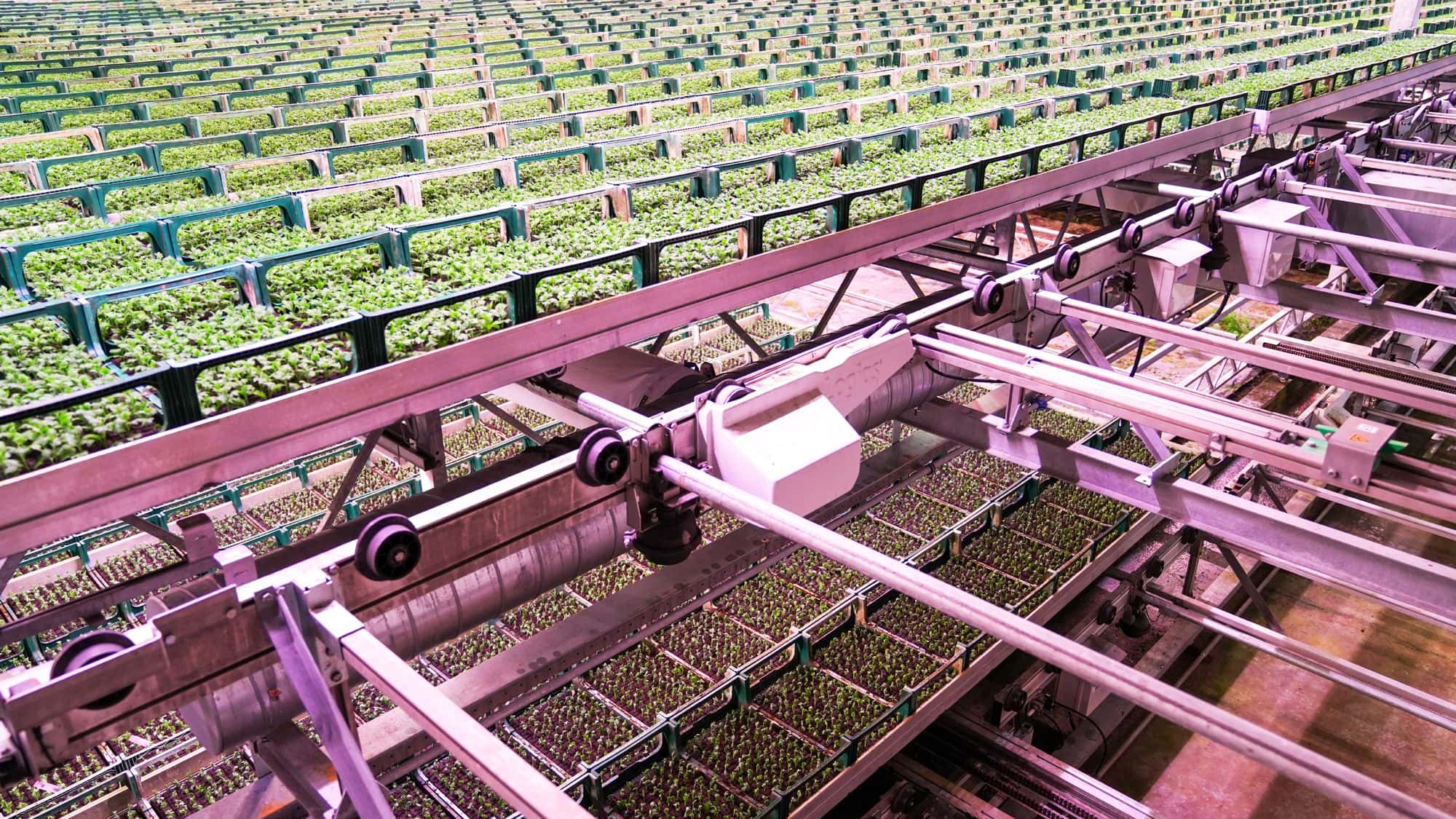
What automation means in a vertical farm
A vertical farm repeats the same tasks thousands of times: sowing, moving trays, spacing plants, checking solution, harvesting and cleaning. It also depends on conditions that drift every hour, such as temperature, humidity, CO2, pH and EC. Automation is any system that measures or performs these jobs without a person doing each step by hand. It helps to separate the layers. Monitoring tells you what is happening. Control changes equipment settings in response. Materials handling moves physical trays and plants. Decision support, including computer vision and machine learning, turns data into recommendations. Each layer has a different cost, a different payback and a different failure mode. A farm can start with the first two layers and add the third when volumes justify it.
Sensors: the foundation of any automated farm
Every automated decision depends on sensor readings, so sensor placement and calibration matter more than the brand of controller. Cornell's hydroponic handbooks house air temperature and humidity sensors in an aspirated box, a shaded enclosure with a fan that draws air over the sensors, so that lamp heat and still air do not distort the readings. Cornell also recommends quantum sensors that measure photosynthetically active radiation in µmol/m²/s. Its lettuce handbook states that foot-candle and lux meters are inappropriate for plants because they are weighted to the human eye and overestimate usable light by roughly a quarter. Dissolved oxygen sensors matter in water-based systems: Cornell reports stress around 3 ppm and keeps ponds near 7 ppm.
- Climate: air temperature, relative humidity, CO2 and airflow at crop height on several tiers.
- Light: PAR quantum sensor for intensity and daily light integral.
- Solution: EC, pH, temperature, dissolved oxygen and tank level.
- Equipment: power, pump pressure or flow, and door or leak alarms.
Controllers and automated nutrient dosing
A climate controller reads the sensors and switches cooling, dehumidifiers, fans, CO2 valves and lights to hold set points. A fertigation controller does the same for the nutrient tank, adding stock solution when EC falls and acid when pH rises. Both should log data and send alarms by phone. Automated dosing is usually the first automation a hydroponic farm buys. Oklahoma State University's 2016 extension guide explains that manual pH and EC correction becomes time consuming at commercial volumes, and lists the benefits of automatic systems as labour savings, avoiding nutrient shock and removing human error. It priced such systems at US$500 to US$4,000 at the time.
Scheduling is another easy gain. Maharashtra's electricity regulator gives commercial and industrial users a 10% rebate on energy charges from midnight to 6 am and adds a peak charge from 5 pm to midnight, from 2025–26. A controller that runs lamps in the cheaper hours, and shifts cooling to cooler night air, cuts the bill without any robot. Check your own state's tariff order, because time-of-day slabs and rebates differ between states.
Moving racks and automated tray transport
In a static rack, workers must reach every tray on every tier, which needs aisles between racks and ladders or lifts for the top shelves. Moving systems bring the crop to the worker instead. Racks roll on rails to close up aisles, or trays travel along conveyors and lifts to a single work station for seeding, spacing and harvest. Fewer aisles mean more growing area in the same room.
One published example is MACARONS, an open-source tray transport system from Wichitwechkarn and Fox (2022). It moves trays up to 1,060 × 630 mm and 12.5 kg along guide rails and up lifts, and the authors report it runs fast enough to automate tray loading and unloading. They put the build cost at US$128.85 per square metre of growing area. At that rate a 100 m² growing area would cost about 100 × 128.85 = US$12,885 for the transport hardware alone, before controls, installation and import costs. Mechanical designs can avoid complex software. A June 2026 Vertical Farm Daily report on a supplier's moving tower system described a design built to avoid complex robotics and software dependencies, to keep maintenance and energy overheads down.
Robots for seeding, transplanting, spacing and harvest
The labour-heavy tasks in a leafy greens farm are predictable. Cornell's lettuce handbook, for example, re-spaces plants on day 21 from 97 to 38 plants per square metre, so each plant has room to finish. In a farm producing 1,245 heads a day, as in Cornell's model, that means lifting and replanting about 1,245 plants every day. Its spinach handbook uses a vacuum seeder for sowing. Robots aimed at these jobs include automatic seeders, transplanters that move plugs from nursery trays into grow channels, spacing machines, harvest lines that cut and pack at a station, and tray washers. Picking fruit such as strawberries or tomatoes is harder, because the machine must find each ripe fruit and handle it gently.
The supplier analysis reported by Vertical Farm Daily argued that as a farm grows, more processes can be automated, naming harvesting, transplanting and internal logistics. It put the cost of producing a 150 g crispy lettuce at €5.50 per kg at small scale and €3.80 per kg at medium and large scale. That is a difference of 5.50 − 3.80 = €1.70 per kg, which the analysis linked partly to labour becoming a smaller share at scale. Treat such figures as a vendor's estimate, calculated at €0.11 per kWh, not a benchmark.
Computer vision and AI in vertical farms
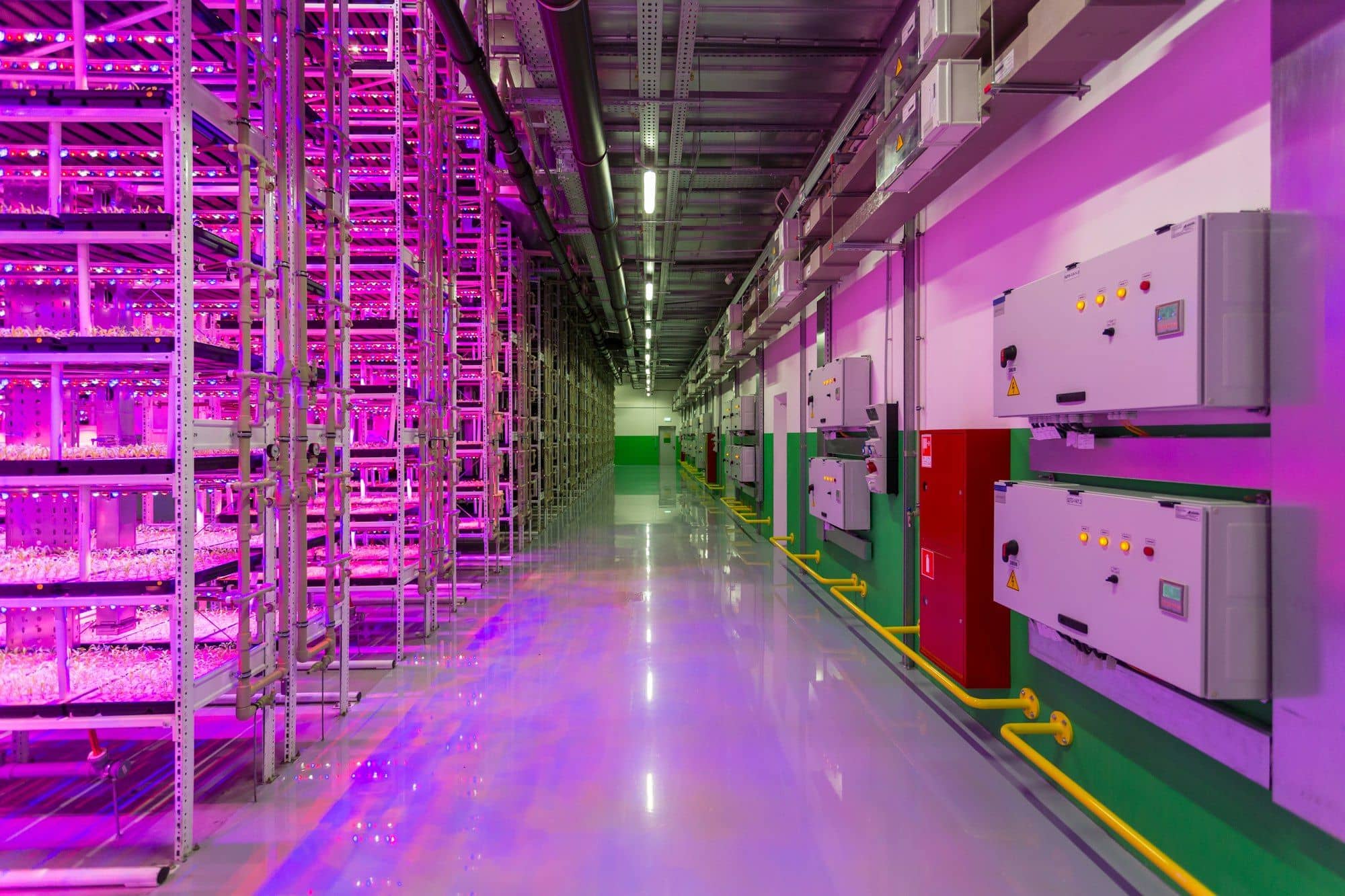
Cameras can see what a person walking the aisles sees, on every tray, every day. Computer vision systems measure canopy size and colour to track growth, flag yellowing, wilting or tipburn early, count plants and gaps, and judge harvest readiness. A 2023 review by Chowdhury, Argha and Ahmed on artificial intelligence in vertical farming covers these uses along with machine learning on sensor data, and notes that models still need to be better optimised and more explainable.
Research farms already use imaging routinely. The University of Bologna's AlmaVFarm used a multispectral imaging device to measure photosynthetic efficiency and a chlorophyll index across whole trays of baby kale in a 2024 study. That kind of measurement, repeated daily, is what commercial vision systems try to deliver at lower cost. Vision is most useful when someone acts on it. A dashboard of plant images that nobody reviews is data, not automation. Start with clear questions, such as which tier grows slowest, and add cameras to answer them.
What the failures of automated farms show
Some of the most automated indoor farms have closed or restructured, and the press record is worth reading before buying robots. AgFunder News reported in November 2022 that Iron Ox, which grew leafy greens and berries with robots and people, cut about 50 jobs, nearly half its staff, to extend its cash runway, days after Fifth Season shut down its indoor farm robotics operation.
AeroFarms filed for Chapter 11 on 8 June 2023, citing industry and capital market headwinds, according to Food Dive. TechCrunch reported on 4 November 2024 that Bowery Farming was ceasing operations after raising more than US$700 million. On 24 March 2025 TechCrunch reported that Plenty had filed for bankruptcy after raising nearly US$1 billion, while continuing a strawberry farm in Virginia and an R&D centre in Wyoming. The reports do not show that automation caused these outcomes; where they give reasons, they point to funding and market conditions. They do show that expensive automation does not by itself make a farm profitable. The crop, the buyer and the energy bill still decide the result.
What to automate at small and large scale
The right level of automation depends on output, crop and local costs. The table is a practical guide, not a rule. Run the sum with your own wage rates and equipment quotes: a handling robot pays back only if the labour it replaces costs more each year than the robot's capital, power and maintenance. Sensing, dosing and alarms are different. They protect the whole crop, so they are worth having at almost any commercial size.
| Automation | Home, café or school system | Small commercial farm | Large commercial farm |
|---|---|---|---|
| Timers for lights and pumps | Yes | Yes | Replaced by controller |
| Temperature, RH and CO2 sensors with alarms | Optional | Yes | Yes, on every tier |
| Automatic EC and pH dosing | Manual testing is fine | Yes | Yes, with lab checks |
| Climate controller with data logging | No | Yes | Yes, integrated with lighting |
| Automatic seeder | No | Useful | Yes |
| Moving racks or tray conveyors | No | Rarely | Often |
| Transplanting and spacing robots | No | No | Where volumes justify |
| Automated harvest and packing line | No | No | Where volumes justify |
| Computer vision | No | Simple cameras | Yes, tied to decisions |
Practical notes for automating a farm in India
Power quality comes first. Voltage swings and outages damage controllers and stop pumps, so fit stabilisers or UPS units for controls and sensors, and backup power for pumps and fans. Make sure the system fails safe: if the controller freezes, lights should switch off and pumps should keep roots wet rather than the reverse. Dust in summer and humidity in the monsoon shorten the life of electronics. Choose sealed enclosures for controllers and plan sensor cleaning and calibration as a monthly task. Check that spare parts and service are available locally, because a sensor waiting weeks for an import is a crop at risk.
Keep a manual fallback. Staff should know how to test EC and pH by hand, run lights on a timer and water a rack without the control system. Automation should reduce routine work, not remove the team's ability to grow. Write these manual steps into the farm's SOPs, and practise them during a planned shutdown so that the team can use them during a real one.
Planning automation with Garden & Acre
Garden & Acre's Vertical Farm Setup service designs and builds commercial and institutional farms, including sensors, controllers, dosing and the level of handling automation that suits your output. If your farm is already running and the automation is not delivering, our Vertical Farm Consulting service audits the system, fixes set points and alarms, and writes SOPs, including for farms built by other suppliers. Both are priced in a written proposal after a first call.
Questions
What is automation in vertical farming?
It is the use of sensors, controllers and machines to monitor and run the farm with less manual work. That includes climate and nutrient sensors, controllers that adjust cooling, CO2, lighting and dosing, moving racks and conveyors, seeding and harvest robots, and computer vision that tracks plant growth and health.
Which sensors does a vertical farm need?
At minimum: air temperature, relative humidity and CO2 at crop height, a PAR quantum sensor for light, and EC, pH, temperature and dissolved oxygen in the nutrient solution. Cornell recommends housing climate sensors in an aspirated box and warns that lux meters are not suitable for measuring plant light.
Is automatic nutrient dosing worth it?
For a commercial farm, usually yes. Oklahoma State University notes that manual pH and EC correction becomes time consuming at commercial volumes, and lists labour savings, fewer nutrient shocks and less human error as benefits. Its 2016 guide priced systems at US$500 to US$4,000. Keep calibrating probes and checking by hand.
Do vertical farms use robots to harvest?
Some large farms automate harvest, transplanting and tray transport, usually by bringing trays to a fixed station where machines cut and pack. Fruit picking is harder because each ripe fruit must be found and handled gently. Small farms typically harvest by hand and automate sensing and dosing first.
Did automation save the big vertical farms that failed?
No. Iron Ox cut nearly half its staff in 2022, AeroFarms filed for Chapter 11 in June 2023, Bowery ceased operations in November 2024 and Plenty filed for bankruptcy in March 2025, according to press reports. Where reasons were reported, they were funding and market conditions. Automation alone did not make these farms profitable.
How is AI used in vertical farming?
Mainly to analyse camera images and sensor data: tracking canopy growth, spotting stress and disease early, predicting harvest dates and suggesting climate or nutrient changes. A 2023 review of AI in vertical farming found real promise but called for better-optimised and more explainable models before growers rely on them.
Sources
- Cornell University CEA Program, Hydroponic Lettuce Handbook (2013)
- Cornell University CEA Program, Hydroponic Baby Spinach Handbook
- Singh and Dunn (2016), Electrical Conductivity and pH Guide for Hydroponics, Oklahoma State University HLA-6722
- Wichitwechkarn and Fox (2022), MACARONS: A Modular and Open-Sourced Automation System for Vertical Farming (arXiv)
- Chowdhury, Argha and Ahmed (2023), Artificial Intelligence in Sustainable Vertical Farming (arXiv)
- Zauli et al. (2024), Increasing Red and Blue Ratio on Baby-Leaf Kale, Horticulturae 10:1134
- Vertical Farm Daily (2026), Vertical farm CAPEX as low as €650 per square meter
- AgFunder News (2022), Another blow for indoor farm robotics as Iron Ox lays off nearly half its staff
- TechCrunch (2024), Bowery Farming is ceasing operations
- TechCrunch (2025), Vertical farming company Plenty files for bankruptcy after raising nearly $1B
- Food Dive (2023), AeroFarms files for Chapter 11 bankruptcy protection
- MERC press note: Retail electricity tariff of MSEDCL, FY2025-26 to FY2029-30