
What flax microgreens are
Flax is the plant that gives linseed, called alsi in Hindi and javas in Marathi, where the roasted seed is eaten as chutney and mukhwas. As a microgreen, flax grows as a tray of thin, upright stems topped with two small, oval seed leaves. It is cut about a week after sowing. The taste is mild and fresh, without the heat of mustard or radish, and the texture is tender. It works well as a base for mixed microgreens.
Research interest is recent. Puccinelli and colleagues described flax in 2022 as an emerging species for sprouts and microgreens, and trials by Gunjal and colleagues have grown it in soil, cocopeat and jute cloth. The Seth et al. 2025 review lists flax among microgreens usually harvested 6 to 9 days after sowing, alongside mustard, radish and mung bean. Most published work so far measures colour pigments and antioxidants rather than vitamins.
What studies have measured
Puccinelli et al. 2022 grew flax sprouts and microgreens indoors under four light treatments: all blue, all red, all green, and an equal red, green and blue mix. Compared with sprouts, the microgreens had 62.6 per cent more chlorophyll, 24.4 per cent more carotenoids, 37.8 per cent more phenols and 25.1 per cent higher antioxidant capacity. Under 100 per cent blue light, the microgreens had the highest flavonoids, total phenols and chlorogenic acid. In the Gunjal trials, flax and cabbage microgreens had the highest chlorophyll of the species grown, about 26–29 µg per gram fresh weight.
These are measurements of plant compounds in the laboratory. They do not show health effects in people, and no study we found tested flax microgreens in human diets. We also found no study that measured omega-3 fats in flax microgreens specifically, so the omega-3 content of flaxseed should not be assumed to carry over to the greens. The one clear finding with a practical meaning is the cyanogen result below.
| Measure | Microgreens compared with sprouts |
|---|---|
| Chlorophyll | +62.6% |
| Carotenoids | +24.4% |
| Total phenols | +37.8% |
| Antioxidant capacity | +25.1% |
| Dry matter | −30.7% |
A safety note: cyanogenic glycosides
Flaxseed naturally contains cyanogenic glycosides, compounds that can release small amounts of hydrogen cyanide when the plant tissue is broken down. Bianco and colleagues tested microgreens for these compounds in 2026. They found none in kale or broccoli raab microgreens, but flax microgreens contained four: linamarin, lotaustralin, linustatin and neolinustatin. Lotaustralin alone measured 5.5 mg per gram of dry weight.
The authors estimated that, at 1, 10 and 25 per cent conversion, flax microgreens would release about 3, 33 and 81 mg of hydrogen cyanide per kilo of fresh microgreens. All three figures are below the EU limit of 150 mg per kilo for flaxseed sold for direct eating, and comparable to other foods. They described the cyanogenic potential as non-negligible and called for more testing. A sensible reading is to eat flax microgreens as one part of a mixed salad or garnish, not in large amounts every day.
How to grow flax microgreens
The key difference with flax is the seed coat. Flax seed releases mucilage, a gel of complex sugars, when it takes up water, which is why soaked linseed turns slimy. Soaked in a bowl, the seed sets into one sticky lump that is hard to spread. Many growers therefore sprinkle dry seed on a wet medium and mist it. In one trial, seeds were soaked for 8 to 12 hours and then spread on layers of jute cloth, which also works if you spread the gel carefully.
- Fill a tray with 2–3 cm of moist cocopeat or soil, or lay wet jute cloth in a tray.
- Sprinkle about 26 g of dry seed per 10×20-inch tray evenly over the surface.
- Mist well so every seed is wet; the gel will stick the seed in place.
- Cover for about 3 days, misting if the surface dries.
- Uncover and give bright light for 12–16 hours a day; water from below.
- Harvest at 6–9 days, when the seed leaves are fully open.
Seed rate and tips specific to flax
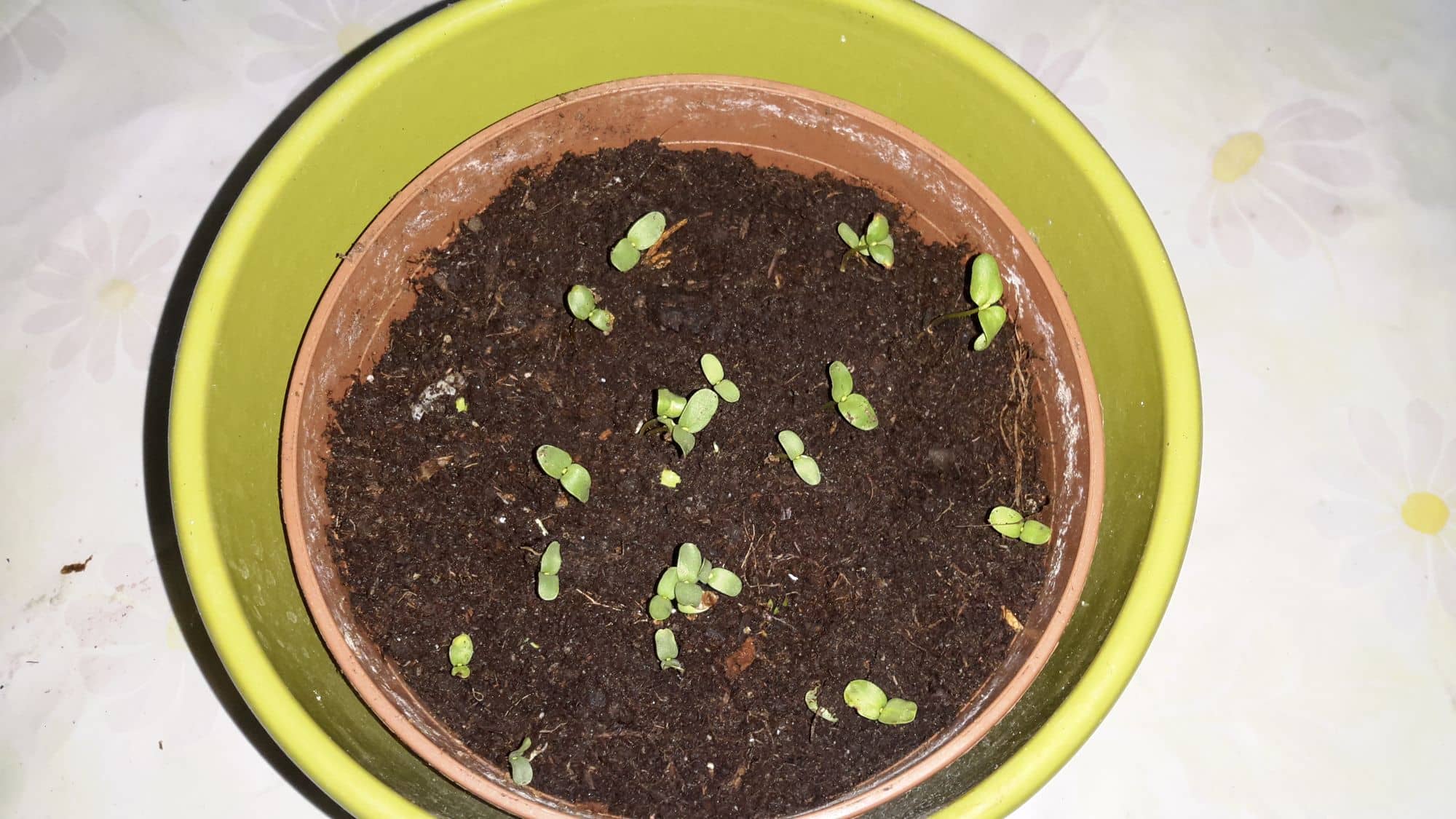
The Seth et al. review cites about 200 g of flax seed per square metre from a trial by Gunjal and colleagues. A 10×20-inch tray covers 0.129 m², so 200 × 0.129 = about 26 g per tray. Flax seed is flat and slippery when dry, so it spreads easily, but it does not bury well; leave it on the surface. Because the gel holds water, flax trays need less watering than most, and overwatering is the usual mistake.
Choose the medium for how clean you want the harvest. In the Gunjal trials, flax gave good height and yield in both soil and cocopeat, and it also grew on jute cloth, which leaves no soil on the stems. Penn State notes that seeding mats give cleaner harvests than potting soil. Buy food-grade or sowing seed that is untreated, and avoid roasted linseed, which will not germinate.
Common problems
Flax problems nearly all come from its gel. A wet, sticky surface with little air movement invites mould, and seed clumped in gel germinates unevenly. Penn State Extension notes that damping-off, a rot that collapses seedlings, is favoured by warm and humid conditions, and that watering from below keeps stems dry. Mist lightly, and let the surface lose its shine before watering again.
- Seed in a single sticky lump: it was soaked in a bowl; sow dry onto a wet surface instead.
- Mould on the gel: too much water and no airflow; mist less and add a fan.
- Seed sliding into clumps: surface too wet at sowing; drain the tray first.
- Leaning, pale stems: too long under cover or too little light.
Using flax microgreens in food
Flax microgreens have a mild flavour that suits most dishes without taking them over. Use them raw on sandwiches, wraps and kathi rolls, in a koshimbir or cucumber raita, or on top of dal, khichdi, thalipeeth and dosa just before serving. They mix well with spicier microgreens such as radish and mustard. Because of the cyanogen findings, keep them to salad and garnish amounts. Keep them cold and dry, and wash just before eating.
Flax and other microgreens in Pune
Garden & Acre delivers fresh microgreens in Pune and Pimpri-Chinchwad, as a weekly subscription for homes and as regular supply for restaurants, cafés and hotels. The microgreens come from our own supply chain. Orders are placed on WhatsApp, and prices are given there. Ask which varieties are available that week, including whether flax is being supplied, and tell us the quantity and delivery day you want.
Questions
Should I soak flax seeds for microgreens?
Usually not. Flax seed forms a sticky gel when it takes up water, so seed soaked in a bowl sets into a clump that is hard to spread. Sprinkle dry seed onto a wet medium and mist it instead. One study did soak seed for 8 to 12 hours, then spread it on jute cloth.
Are flax microgreens safe to eat?
In normal amounts, yes. A 2026 study found cyanogenic glycosides in flax microgreens and estimated hydrogen cyanide release of about 3 to 81 mg per kilo of fresh greens, depending on conversion. That is below the EU limit of 150 mg per kilo for flaxseed. The authors called the potential non-negligible, so eat them as part of a mix rather than in large daily amounts.
Do flax microgreens contain omega-3?
Flaxseed is known for its omega-3 fat, but we did not find a study that measured omega-3 in flax microgreens. The greens are mostly water, and their composition differs from the seed. So do not assume flax microgreens give the same omega-3 as a spoonful of ground flaxseed.
How many days do flax microgreens take?
About 6 to 9 days. A 2025 research review groups flax with microgreens usually harvested 6 to 9 days after sowing, and one study harvested on day 9 at the true leaf stage. Cool weather slows them slightly. Harvest once the seed leaves are fully open and before the stems start to lean.
How much flax seed do I need per tray?
About 200 g per square metre was used in a trial cited by a 2025 review. For a 10×20-inch tray of 0.129 m², that is 200 × 0.129 = about 26 g. Sprinkle it evenly over a wet surface in one layer.
What is flax called in Marathi and Hindi?
Flax seed is javas in Marathi and alsi in Hindi, and it is also known as linseed or tisi in parts of north and east India. The microgreens are simply the young seedlings of the same plant, Linum usitatissimum, grown for about a week.
Sources
- Puccinelli et al. 2022, Can light spectrum composition increase growth and nutritional quality of Linum usitatissimum L. sprouts and microgreens? (Horticulturae)
- Bianco et al. 2026, LC-MS to assess the occurrence of potentially toxic cyanogenic glycosides in edible microgreens (Plants)
- Gunjal et al. 2024, Assessment of bioactive compounds, antioxidant properties and morphological parameters in selected microgreens cultivated in soilless media (Sci Rep)
- Gunjal et al. 2024, Comparative analysis of selected microgreens in alternative growing medium (S Afr J Bot)
- Seth et al. 2025, Microgreens: functional food for nutrition and dietary diversification (Plants)
- Grant-Grant et al. 2025, Two Chilean flaxseed varieties with contrasting mucilage production (Front Plant Sci)
- Penn State Extension: Growing Microgreens