
What a vertical garden (living wall) is
A vertical garden is a system that holds plants on a wall, indoors or outdoors, so that the wall looks green. The plants are chosen for foliage, colour and hardiness: ferns, philodendrons, pothos, peperomias, bromeliads, grasses and small shrubs. They are meant to stay in place for years and are trimmed and replaced as needed, not harvested. The purpose is visual and environmental: a better-looking space, some shade and cooling on the wall, and a sense of nature in a built-up setting.
One of the best known examples is the wall designed by the French botanist Patrick Blanc for the Musée du quai Branly in Paris, completed in the mid-2000s. It is about 200 metres long and 12 metres high, and after a renovation in 2018 it carries about 350 plant species. The plants grow without soil on a felt layer fed by a dilute nutrient solution, a method Blanc calls Le Mur Végétal.
Green façades and living walls: the two main types
Vertical greenery comes in two broad types. A green façade uses climbing plants rooted in the ground or in planters at the base, trained up the wall on wires, mesh or trellis. It is cheaper and simpler but slow to cover and limited to climbers. A living wall fixes the growing medium to the wall itself, in modular panels, pockets, trays or felt, with drip irrigation running through it. It covers the wall at once and allows many kinds of plant, but costs more to install and needs regular care.
The difference matters for performance. A 2022 study by Bao and colleagues in the International Journal of Environmental Research and Public Health describes living walls as including planting substrate, plant canopy and supporting structure, while green façades rely only on the plant canopy for shading, and reports that living walls are about 3 to 4 °C more effective thermally. In practice, green façades suit large, low-budget boundary and compound walls, while living walls suit lobbies, feature walls and façades where full cover is wanted at once.
What a vertical farm is
A vertical farm grows food crops on several layers stacked one above another. Most commercial vertical farms are insulated rooms with no windows, where plants grow in hydroponic or aeroponic systems under LED lights, with temperature, humidity and carbon dioxide controlled by equipment. The crops are chosen for yield and price: lettuce, basil and other herbs, microgreens, spinach, kale and sometimes strawberries. They are harvested every few weeks and replanted.
A vertical farm is judged by output: kilograms per square metre per year, cost per kilogram and electricity per kilogram. The 2022 Horticulture Research review reported lettuce yields of about 120 kg per m² a year in plant factories, more than 40 times the open field. Current benchmarks put electricity at about 10 to 18 kWh per kilogram of lettuce, most of it for lighting. None of these measures applies to a decorative living wall.
Vertical garden vs vertical farm: side-by-side comparison
The table sets out the main differences. The two can look similar in photographs, because both put plants on vertical surfaces, but they differ in purpose, plants, light, water, maintenance and what the owner gets back. The most useful question to ask before choosing is simple: at the end of a year, do you want a better-looking space, or a harvest you can weigh? The answer points to one column of the table.
| Point | Vertical garden / living wall | Vertical farm |
|---|---|---|
| Purpose | Looks, shade, cooling, a greener building | Food production for eating or sale |
| Typical plants | Ferns, philodendron, pothos, peperomia, grasses | Lettuce, herbs, microgreens, spinach, kale, strawberries |
| Plant life | Stays for years; trimmed and replaced | Harvested every few weeks and replanted |
| Where | Building façades, lobbies, offices, balconies, boundary walls | Warehouses, rooms, rooftops, containers, towers |
| Light | Mostly natural; indoor walls may add lamps | Mostly LED grow lights on each layer |
| Water and nutrients | Drip irrigation with light feeding | Recirculating hydroponic solution with controlled pH and EC |
| Measured by | Coverage, plant health, surface temperature | Kg per m² a year, cost and kWh per kg |
| Main running cost | Maintenance visits, plant replacement, water | Electricity, seeds, nutrients, labour |
| What you get back | A better space and a cooler wall | Produce to eat or sell |
Benefits of a vertical garden
The main measured benefit of a living wall is lower surface temperature on the wall it covers. Plants shade the wall and cool it by evapotranspiration. In Bao and colleagues' 2022 experiment, a modular vertical greening shade over a window lowered indoor temperature by up to 4 °C compared with an unshaded window, and kept indoor air 2.6 °C cooler than conventional louvres. For west-facing walls in Pune, Mumbai or Delhi that take the afternoon sun, this can make rooms behind them more comfortable.
Other benefits are harder to measure but are the reason most clients ask for a green wall: a lobby, office or café that looks and feels better, a boundary wall that softens a view, and greenery in a place with no ground for a garden. A living wall is not a significant source of food, and the plants used are often not edible.
Benefits of a vertical farm
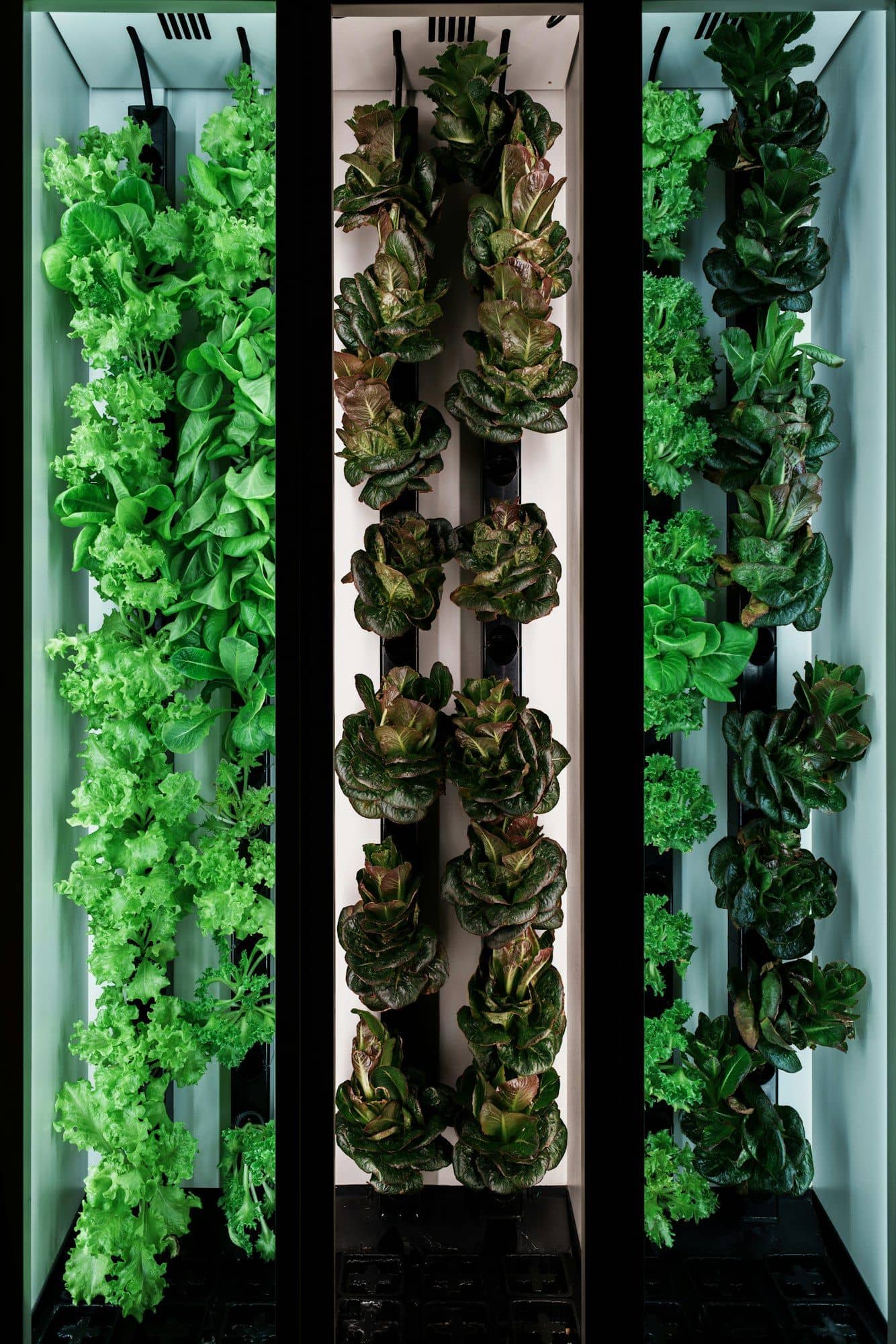
A vertical farm produces food all year with very little water and land. Hydroponic lettuce used about 20 litres of water per kilogram against about 250 litres in the field in a 2015 study by Barbosa and colleagues, and a 2025 UK study measured about 97 kg of lettuce per m² a year in a commercial vertical farm against 3.3 kg in fields. Produce is grown without soil and usually without pesticides, and can be harvested on the day it is sold.
The cost is electricity. At 10 to 18 kWh per kilogram of lettuce, even a small indoor farm has a noticeable power bill. For a home, school or café, a hydroponic tower placed in natural light, or with modest supplementary lighting, gives the food benefit on a smaller scale without the cost of a sealed room. A tower of this kind can supply a family or a small café kitchen with herbs and salad leaves, and it teaches the basics of pH, EC and replanting before any larger investment.
Edible walls: where the two overlap
Some people want both: a wall that looks green and also gives herbs or salad leaves. An edible wall, planted with basil, mint, coriander, lettuce or strawberries in pockets or modular panels, can do some of each. It will look less uniform than a foliage wall, because food plants are harvested, bolt, and need replanting every few weeks or months. It will also produce less than a proper hydroponic system, because pockets and felt are not designed for fast growth.
If food is the main goal, a hydroponic or aeroponic tower gives more produce per square metre of floor and is easier to replant and clean. If appearance is the main goal, a foliage living wall stays tidy with far less work. Mixing the two on one wall usually means compromising on both, so decide which matters more before designing.
Light, water and maintenance in Indian conditions
Outdoor living walls in India must cope with strong summer sun, heavy monsoon rain and, in many cities, dust. Plant choice has to match the wall's orientation: sun-tolerant species on west and south faces, shade plants on north faces and under overhangs. Drip irrigation on a timer is essential, with a filter to stop emitters clogging, and the system needs a drain line so water does not stain the façade. Indoor walls need enough light; below a certain level plants thin out and die back, so many indoor walls add lamps.
Vertical farms need more precise control. Light is measured as the daily light integral (DLI), the total photosynthetically active light a plant receives per square metre per day, in moles. The nutrient solution's pH and EC must be checked often. In both cases, most failures come from irrigation faults: a blocked emitter on a living wall, or a failed pump in a vertical farm.
Which one you need
Choose by what you want to get back from the space. The list below matches common goals to the right system. If your answer includes both looks and food, consider putting a living wall where people see it and a tower or small farm where it is easy to work. Food crops need easy access for harvesting and replanting, good light and a nearby water point, which a display wall in a lobby rarely offers.
- You want a lobby, office, café wall or façade to look green: a vertical garden (living wall).
- You want a hot west-facing wall or window to run cooler: a living wall or green façade.
- You want fresh herbs and salad for a home, café or school kitchen: a hydroponic or aeroponic tower.
- You want to sell greens to hotels, restaurants or shops: a commercial vertical farm.
- You want students to learn how food grows: towers for a classroom, or a small farm for a campus.
- You want both: a living wall for display and a separate tower or farm for food.
Garden & Acre builds both
Garden & Acre designs and installs decorative green walls and vertical gardens for homes, offices, hotels and public spaces, chosen for the wall's light, orientation and climate. For food, Garden & Acre installs hydroponic and aeroponic towers for homes, cafés and schools from ₹14,000 per tower, including the tower, pump, timer, first seedlings, nutrients, training and a refill plan, and designs and builds commercial and institutional vertical farms, priced in a written proposal after an initial call.
Questions
What is the difference between a vertical garden and a vertical farm?
A vertical garden or living wall covers a wall in ornamental plants for looks, shade and cooling, and the plants stay for years. A vertical farm grows food crops such as lettuce and herbs in stacked layers, usually under LED lights, and is harvested every few weeks. One improves a space; the other produces food.
Can I grow vegetables on a vertical garden?
Yes, on a small scale. An edible wall planted with herbs, lettuce or strawberries will give some produce, but it looks less even than a foliage wall and yields less than a hydroponic tower. If food is your main aim, a hydroponic or aeroponic tower is easier to harvest, replant and clean.
Does a green wall cool a building?
It can lower the temperature of the wall it covers, through shading and evapotranspiration. In one 2022 experiment, a modular vertical greening shade over a window lowered indoor temperature by up to 4 °C compared with an unshaded window. The effect depends on climate, orientation, plant cover and irrigation.
Is a living wall the same as a green façade?
No. A green façade uses climbing plants rooted at the base and trained up wires or mesh. A living wall fixes the growing medium to the wall in panels, pockets or felt, with drip irrigation. Living walls cover faster and allow more plant types but cost more and need more maintenance.
Which plants are used in vertical gardens in India?
Common choices are foliage plants that tolerate the wall's light and heat, such as ferns, philodendrons, pothos, peperomias, syngoniums and ornamental grasses. Sun-tolerant species go on west and south walls, shade plants on north walls and indoors. The final list depends on the city's climate and the wall's orientation.
Do vertical gardens need soil?
Many do not. Modern living walls often use felt, coir, mineral wool or a light soilless mix in panels, fed by drip irrigation with a dilute nutrient solution. Patrick Blanc's wall at the Musée du quai Branly in Paris grows on felt with no soil at all.
Sources
- Musée du quai Branly green wall — Greenroofs.com
- Quai Branly Jacques Chirac Museum — Vertical Garden Patrick Blanc
- Experimental study on the modular vertical greening shading in summer — Bao et al., IJERPH (2022)
- Plant factory technology lights up urban horticulture in the post-coronavirus world — Zhang et al., Horticulture Research (2022)
- Comparison of land, water, and energy requirements of lettuce grown using hydroponic vs. conventional agricultural methods — Barbosa et al., IJERPH (2015)
- Can vertical farms really feed the UK sustainably? (Gargaro et al., Food and Energy Security 2025) — Phys.org
- Benchmarking energy efficiency in vertical farming — ScienceDirect (2024)
- Measuring daily light integral in a greenhouse — Purdue Extension HO-238-W