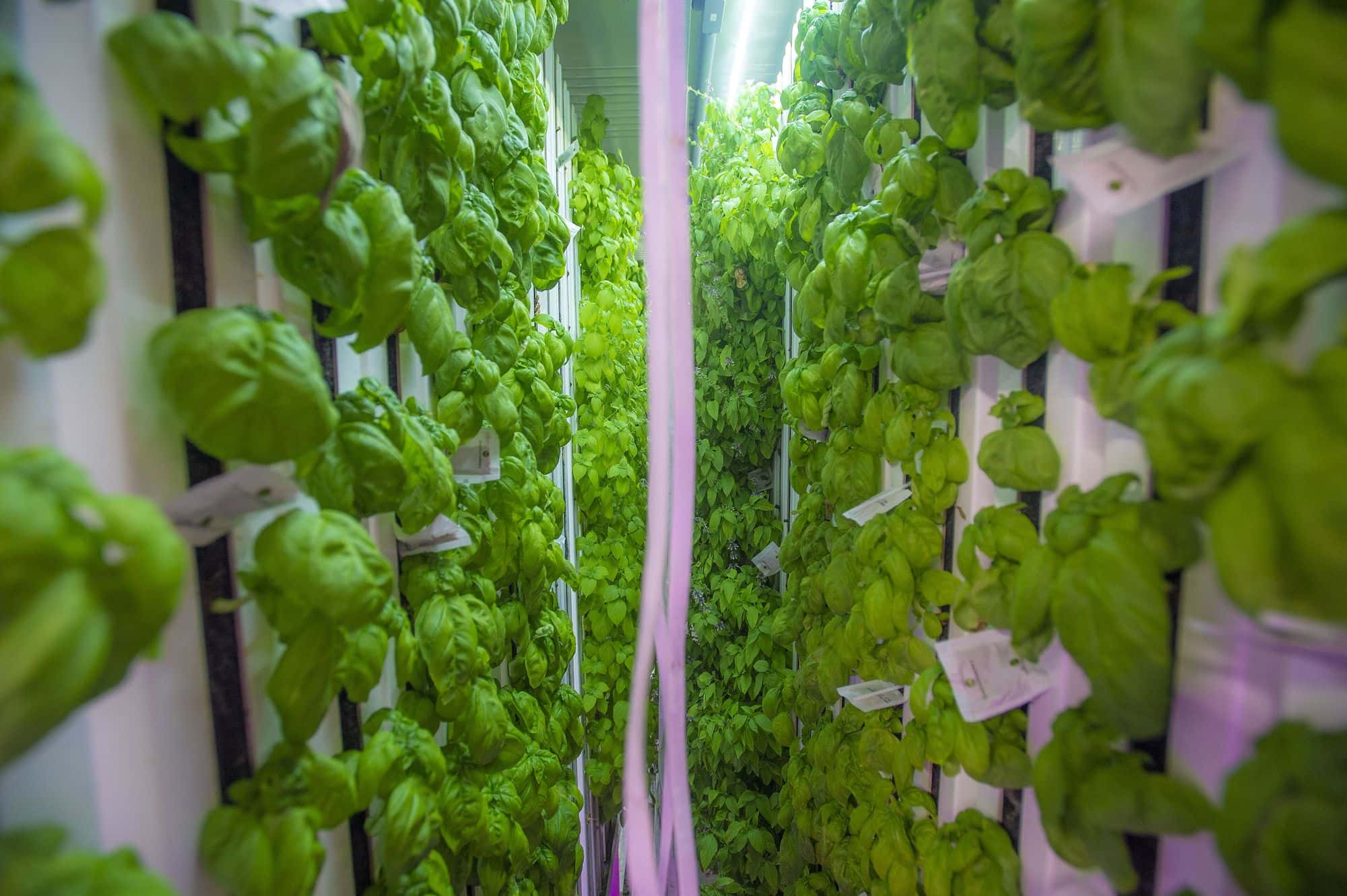
What a container farm is
A container farm takes a standard intermodal shipping container, insulates it, and fits it out as a sealed growing room. Inside are hydroponic growing structures, LED grow lights, an air conditioner or heat pump, dehumidification, fans, a nutrient tank with dosing, and a control system. Some add CO₂ enrichment. The result is a plant factory the size of a truck load that can be placed in a car park, on a campus, behind a restaurant or at a remote site, and connected to power and water.
Container farms became known through companies that sold them as ready-made units. The best-known was Freight Farms of Boston, which built and sold hydroponic container farms for 13 years and, according to the Boston Globe, had built a network of more than 800 container farms before it shut down in 2025. Other makers in North America, Europe and Asia sell similar units, and some growers build their own from a used container.
Typical container farm specs
The most detailed public specification is Freight Farms' Greenery S, which is a useful benchmark for what a commercial 40-foot container farm offers. The figures below are from the maker's specification page. Other units vary in layout and equipment, but the scale of plant sites, power and output is similar for leafy-green containers. Two interior layouts dominate. In vertical-column layouts, plants grow in tall hanging panels or bars with lights between them, as in the container 365DFarms runs in Pune (HortiDaily, 2020). In horizontal-rack layouts, plants sit in NFT channels or trays on shelves with lights above, like a miniature rack farm. Both usually have a separate nursery area for seedlings.
| Item | Published figure |
|---|---|
| Size | 40 ft × 8 ft × 9.5 ft container |
| Plant sites | Up to 8,800, split between nursery and cultivation area |
| Electricity, Eco mode | 151–246 kWh per day |
| Electricity, Standard mode | 171–268 kWh per day |
| Electricity, Performance mode | 191–350 kWh per day |
| Water | About 5 US gallons per day on average |
| Annual output | 2–6 tonnes |
| Climate control | Temperature, humidity, air circulation and CO₂ |
| Base price | US$215,000 (varies by model and site electrical needs) |
What a container farm costs to run in India
Electricity is the largest running cost. Using the Greenery S published range and the Maharashtra low-tension non-residential tariff for loads up to 20 kW approved by MERC for 2026-27 (₹8.51 energy charge + ₹1.60 wheeling charge = ₹10.11 per kWh, before fixed charges and duties), the daily and monthly electricity bill works out as shown in the table. A 40-foot container at these loads may need a connection above 20 kW, which moves it into a higher tariff slab, so check the sanctioned load with your distribution company.
The same numbers give a range for electricity per kg. In the best case, 151 kWh a day × 365 days = 55,115 kWh a year for 6,000 kg of produce, or 55,115 ÷ 6,000 = 9.2 kWh per kg. In the worst case, 350 kWh a day × 365 = 1,27,750 kWh for 2,000 kg, or 63.9 kWh per kg. Most real containers sit between these ends. For comparison, a 2024 benchmarking study put larger indoor vertical farms at about 10 to 18 kWh per kg of lettuce. Small sealed boxes lose efficiency to their high surface area and small scale.
| Mode | kWh per day | ₹ per day | ₹ per 30-day month |
|---|---|---|---|
| Eco, low end | 151 | 151 × 10.11 = ₹1,527 | 1,527 × 30 = ₹45,810 |
| Eco, high end | 246 | 246 × 10.11 = ₹2,487 | 2,487 × 30 = ₹74,610 |
| Standard, high end | 268 | 268 × 10.11 = ₹2,709 | 2,709 × 30 = ₹81,270 |
| Performance, high end | 350 | 350 × 10.11 = ₹3,539 | 3,539 × 30 = ₹1,06,170 |
Capital cost of a container farm
Imported turnkey containers are priced in US dollars. Freight Farms listed the Greenery S at a base of US$215,000, and the Boston Globe reported the Greenery system cost more than US$160,000. For an Indian buyer, add sea freight, import duty and GST, installation, a transformer or upgraded electricity connection, and backup power, then convert at the exchange rate on the day. Locally built containers cost less, because the container shell, insulation, racks and plumbing can be sourced in India, but the LED lights, controls and air conditioning still make up most of the bill.
Compare the price per square metre of growing area, not per container. A 40-foot container measures 40 ft × 8 ft = 320 sq ft, or about 29.7 m² on its outside dimensions and less inside, and that floor has to carry aisles, the nursery, the tank and the air conditioner as well as crops. The same budget spent on an insulated room inside an existing building often gives more growing area, because the building already provides the shell.
What container farms are used for
Container farms make most sense where the buyer values speed, mobility or a self-contained unit more than the lowest cost per kilogram. They also suit sites where a permanent building is not allowed or not worth building, and projects where the owner wants to move the farm later. The common uses are listed below. In India, 365DFarms in Pune was reported by HortiDaily in 2020 to grow lettuce in a shipping container, with seedlings raised in grow boxes and then moved to LED-lit vertical bars.
- Campuses, schools and universities, as teaching and research units that also supply the canteen
- Restaurants, hotels and cafés that want a steady supply of greens and herbs on site
- Remote or hard-to-supply locations, such as mining camps, islands, border posts and high-altitude sites
- Pilot projects, where a grower tests crops and markets before building a larger farm
- Propagation and nursery production for a larger greenhouse or field operation
- Research on light recipes, nutrients and crop varieties under repeatable conditions
Heat and power: container farming in Indian conditions
A steel container in direct sun absorbs a lot of heat, and inside it the LED lights add more. Every watt of electricity used by lights ends up as heat that the air conditioner must remove. In much of India, the National Disaster Management Authority notes that heat waves typically run from March to June and can reach 45 °C or more. A container built for a temperate climate can run out of cooling capacity in those months, which means warm nutrient solution and stressed plants.
The fixes are well known. Place the container in shade or build a roof over it with an air gap. Specify extra insulation and a reflective outer coat. Size the air conditioning for Indian peak temperatures, not the maker's home-market figures, and add a nutrient chiller. Run the lights at night, when outside air is cooler and the air conditioner works less hard. For power, assume interruptions and voltage dips: a stabiliser, an inverter for pumps, fans and controls, and a generator for longer outages protect the crop. Without backup, a sealed container loses cooling and air movement within minutes of a power cut.
Container farm vs building-based vertical farm
A container farm and a vertical farm fitted into a building use the same technology: hydroponic growing structures, LED lights, air conditioning and a nutrient system. The differences are in how they are bought, installed, cooled and scaled, and in how dependent the owner is on one supplier. The table compares them for a typical Indian site, such as a campus, hotel or warehouse with some spare space.
| Point | Container farm | Vertical farm in an existing building |
|---|---|---|
| Speed to start | Fast; delivered as a unit | Slower; room must be designed and fitted |
| Mobility | Can be moved by truck | Fixed |
| Growing area per rupee | Lower; shell and fixed equipment in every unit | Higher; building provides the shell |
| Heat in Indian summer | Exposed steel box; needs shade and extra cooling | Easier to insulate; can use interior rooms |
| Scaling up | Add more containers | Add racks or floors |
| Supplier dependence | High if controls are cloud-based and proprietary | Lower if built from standard parts |
Lessons from the Freight Farms shutdown
Freight Farms ceased operations on 30 April 2025 and filed for Chapter 7 bankruptcy (liquidation) in Massachusetts the same day, as reported by the Boston Globe and Vertical Farm Daily. The Globe reported about US$7 million of liabilities against US$600,000 of assets. Vertical Farm Daily reported that customers lost the company's cloud software for remote monitoring and alerts, its supply shop, technical support and replacement parts, and had to run their containers manually, with growers turning to online forums for help.
The lesson for any container buyer is to check what happens if the supplier disappears. Prefer controllers that work locally without a cloud account, standard LED fixtures, pumps and air conditioners that can be replaced from the local market, and a full set of manuals, wiring diagrams and nutrient recipes handed over at commissioning. These reduce the risk that one company's fate decides whether a farm can keep growing.
Is a container farm right for your project
A container farm fits when you need a self-contained unit quickly, may need to move it, or want to test indoor growing before a bigger build. It fits less well when the aim is the lowest cost per kilogram, when there is an existing building with space, or when the site is in full sun with weak power supply. For most Indian sites, an insulated room, a rooftop greenhouse or sunlit towers cost less to run than a steel container.
Container and indoor farm setup with Garden & Acre
Garden & Acre designs and builds vertical farms for rooftops, warehouses, campuses, hotels, schools and cafés, including sealed indoor rooms and container-based units where they suit the site. The work covers feasibility, design, build, commissioning and first-crop support, and is priced in a written proposal after an initial call. Where a smaller start makes more sense, hydroponic and aeroponic towers are available from ₹14,000 per tower installed.
Questions
What is a container farm?
A container farm is a hydroponic vertical farm built inside a shipping container, usually a 40-foot high-cube. It includes insulation, LED grow lights, air conditioning, dehumidification, fans, a nutrient system and controls. It grows leafy greens and herbs year-round and can be moved by truck. Freight Farms' Greenery S, for example, lists up to 8,800 plant sites.
How much electricity does a container farm use?
Freight Farms published 151 to 350 kWh per day for its Greenery S 40-foot container, depending on mode. At a Maharashtra small commercial tariff of ₹10.11 per kWh, that is about ₹1,527 to ₹3,539 per day, or ₹45,810 to ₹1,06,170 per 30-day month, before fixed charges and duties. Hot Indian summers can raise the cooling load.
How much does a shipping container farm cost?
Imported turnkey units are priced in US dollars; Freight Farms listed its Greenery S at a base of US$215,000. Indian buyers must add freight, import duty, GST, installation, electrical upgrades and backup power. Locally built containers cost less, but LEDs, air conditioning and controls still make up most of the cost.
What can you grow in a container farm?
Container farms are designed for leafy greens and herbs, such as lettuce, rocket, kale, basil, mint and coriander, and for microgreens and seedlings. These crops are short, grow fast and fit the height of a container. Tall or long-cycle crops, such as tomatoes or cucumbers, are a poor fit because of the limited height and high electricity cost per kilogram.
Do container farms work in India's heat?
They can, but only with planning. A steel container in sun heats fast, and heat waves in India typically run from March to June with temperatures that can pass 45 °C. Shade or a roof over the container, extra insulation, air conditioning sized for Indian peaks, a nutrient chiller, night-time lighting and backup power are needed.
What happened to Freight Farms?
Freight Farms, the Boston maker of hydroponic container farms, ceased operations on 30 April 2025 and filed for Chapter 7 bankruptcy the same day, according to the Boston Globe. Customers lost its cloud monitoring software, support and parts supply, and had to run their containers manually. It had built more than 800 container farms.
Sources
- Freight Farms: The Greenery S specification
- Boston Globe (12 May 2025): Freight Farms shuts down, files for bankruptcy
- Vertical Farm Daily (2025): Freight Farms files for Chapter 7 bankruptcy, leaving growers disconnected
- HortiDaily (2020): Have a look at a container farm in India
- National Disaster Management Authority: Heat Wave
- MERC tariff order, Case No. 75 of 2025 (25 March 2026), MSEDCL
- Benchmarking energy efficiency in vertical farming: status and prospects (2024)