What vertical farming means in the Indian market
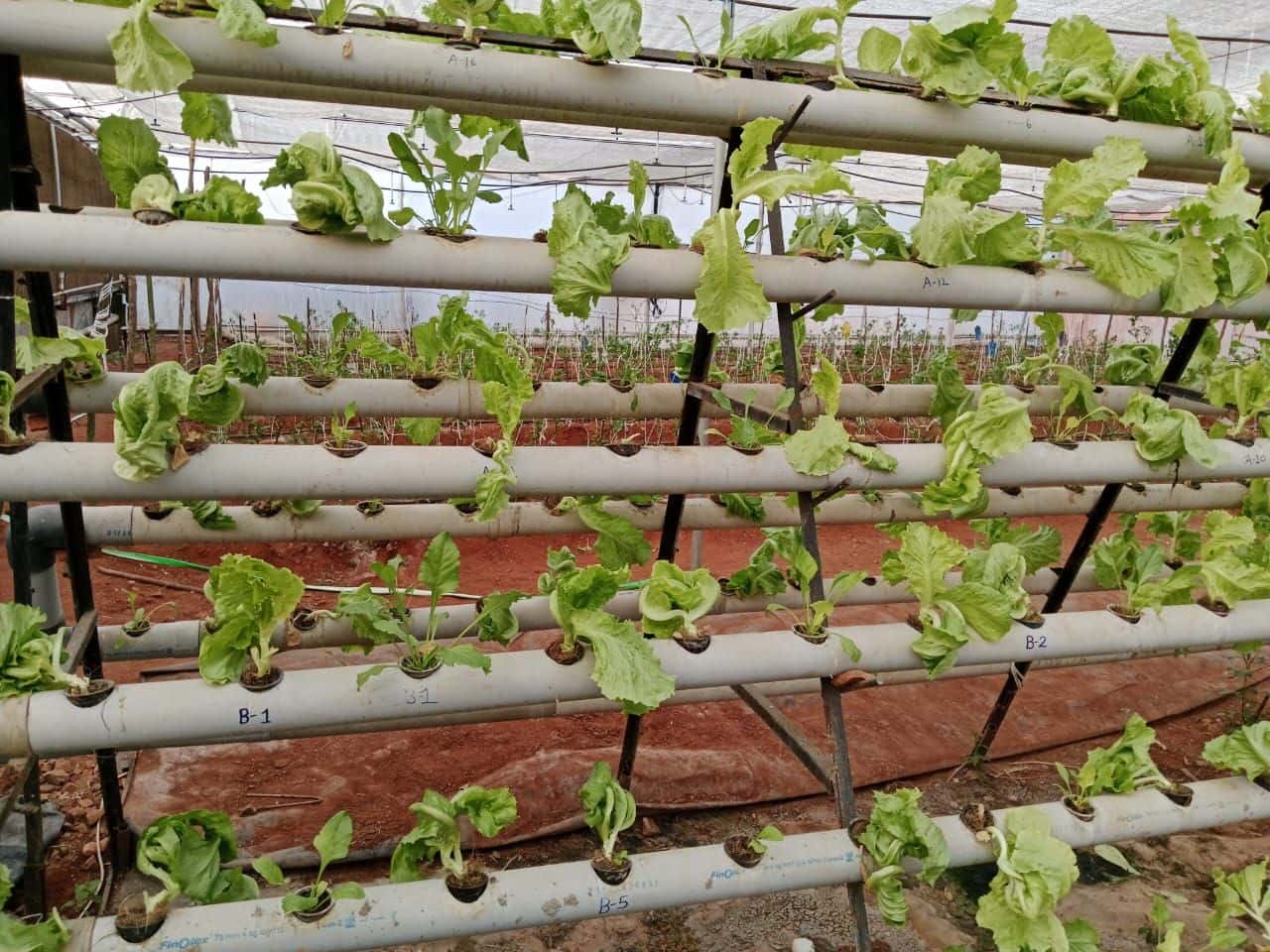
In India the term covers more than fully indoor, LED-lit rooms stacked with racks. Press coverage and company descriptions also use it for hydroponic greenhouses and polyhouses, rooftop NFT channels, and home or café tower systems. UrbanKisaan, for example, was described by its investor BASF in 2021 as running both suburban greenhouses and vertical indoor farms. Nutrifresh, a large Pune hydroponic grower, farms in climate-controlled greenhouses.
The distinction matters for costs. A greenhouse uses natural sunlight and needs cooling and shading. A fully indoor farm buys all its light as electricity, so its costs track the power tariff. A 2024 benchmarking study put indoor lettuce at roughly 10–18 kWh per kilogram. When you read about an Indian vertical farm, check which kind it is before comparing its costs or prices with your own plan.
Market size estimates and how to read them
Published estimates of the Indian vertical farming market vary widely and are not built from disclosed company data. A 2024 review by Sharma, Tabassum and Goyal in Progressive Research reports a value of US$0.78 billion in 2021 and a projection of US$2.77 billion by 2026. An IIM Bangalore issue brief from September 2025 gives ₹1,400 crore in 2024 rising to ₹3,200 crore by 2030. Neither explains its method, and each defines the market in its own way. Treat such figures as a sign of interest, not as a basis for a business plan. What matters for a new farm is the demand you can confirm: named buyers, volumes, pack sizes and prices. Those come from conversations with chefs, store buyers and category managers, not from market reports.
Vertical farming companies in India, as reported
The table lists Indian companies that press or research sources have described as working in vertical farming or hydroponics, with only what those sources reported and when. It is not a ranking, and several details may have changed since publication. A 2024 review by Sharma and colleagues also lists Triton Foodworks and Agricool India among Indian players, and an IIM Bangalore brief (2025) describes Agricool India as running container farms in Bengaluru and Nature's Miracle as running warehouse farms in Mumbai that supply restaurants.
| Company | Base | What was reported | Source and date |
|---|---|---|---|
| UrbanKisaan | Hyderabad | Raised US$1.5 million seed funding in Y Combinator's Winter 2020 batch; about 30+ hydroponic farms installed across Telangana; home kits and urban farms | Inc42, August 2020 |
| UrbanKisaan | Hyderabad and Bengaluru | Investment from BASF Venture Capital, amount undisclosed; suburban greenhouses and vertical indoor farms; hydroponics adapted for tropical climates | BASF press release, July 2021 |
| UrbanKisaan | Hyderabad | Hydroponic farms serving over 10,000 households by subscription | IIM Bangalore brief, September 2025 |
| Barton Breeze | Gurugram | Raised US$800,000 in a pre-series round led by angel investors; hydroponic farms; plans for 20 more FMCG SKUs and farms across Delhi NCR | Indian Startup News, March 2023 |
| Letcetra Agritech | Goa | Started in 2016 by three engineers; grows lettuce, tomatoes, bell peppers and basil; sets up hydroponic systems for clients | WeRIndia, December 2017 |
| Future Farms | Chennai | Hydroponic kits and turnkey farms; turnover of ₹2 crore in 2016–17; clients included the Adani Group | The Weekend Leader, August 2017 |
| Nutrifresh | Pune | Hydroponic produce from climate-controlled farms; ₹145.22 crore operating revenue in FY25; buyers include Zepto, Swiggy Instamart, Blinkit, McDonald's and Spar | Entrackr, October 2025 |
Cities where vertical farms are concentrated
The reported activity sits in and around large cities with high incomes, many restaurants and fast delivery networks. Hyderabad has UrbanKisaan. Bengaluru has UrbanKisaan's farms and, per the IIM Bangalore brief, Agricool's container farms. Delhi NCR has Barton Breeze in Gurugram. Mumbai has warehouse farms described in the same brief, and Pune has Nutrifresh's hydroponic operation. Chennai and Goa have Future Farms and Letcetra. The logic is proximity to buyers. Leafy greens and herbs are perishable, and the premium for indoor produce depends on delivering it fresh and clean within hours. A farm on the edge of a city, near the hotels, cloud kitchens and dark stores it serves, cuts transport time and cold-chain cost.
Climate: advantages and challenges in India
Indoor growing removes crops from the weather. Sharma and colleagues list protection from droughts, floods and extreme temperatures among the main benefits for Indian growers. For exotic greens such as lettuce, a controlled room can supply the same quality every week of the year, whatever the season outside. The same climate makes indoor farms costly to run. The India Meteorological Department considers heat waves once plains stations reach 40 °C and declares one at 45 °C or above, and the NDMA notes they typically run from March to June. A 2022 review in Agronomy, citing Graamans and colleagues, found that vertical farms cannot currently cut energy use in hot, arid regions the way greenhouses can, because natural sunlight saves more than a greenhouse spends on cooling. The monsoon then brings months of humid air that must be dehumidified.
The practical response is a well-insulated building, efficient cooling and dehumidification, lights run at night, and backup power. Sharma and colleagues list high electricity costs, especially where supply is unreliable, among the main barriers for Indian farmers. They also point to renewable energy such as solar panels as a way to reduce that cost. Our guide to climate control in vertical farms covers set points, HVAC sizing and monsoon humidity in detail.
Power tariffs and energy cost per kilogram
Electricity is the largest running cost of a fully indoor farm, so the tariff category matters. Tariffs are set by each State Electricity Regulatory Commission and differ by state and category. Maharashtra's figures show the spread. MERC's multi-year tariff order of 28 March 2025 lists "Indoor Vertical Farming" under LT IV(C) Agriculture – Others. For 2026–27, MERC's order of 25 March 2026 in Case 75 of 2025 sets that category at ₹5.61 energy charge plus ₹1.60 wheeling, or ₹7.21 per kWh. LT-II(A) non-residential (commercial) connections up to 20 kW pay ₹8.51 plus ₹1.60, or ₹10.11 per kWh. Fixed charges, electricity duty and fuel adjustment are extra.
Which category a vertical farm falls into is decided by the distribution company, not the farmer. MERC's 2025 order added mushroom cultivation to the agriculture category, and placed agro-tourism units in agriculture (others). Ask your discom in writing before you sign a lease. Maharashtra's time-of-day structure also matters: from 2025–26 there is a 10% energy-charge rebate from midnight to 6 am and a peak charge from 5 pm to midnight for commercial and industrial users. The arithmetic for lettuce, using the benchmark of 10–18 kWh per kg, is below. Energy is only part of the cost; rent, labour, seed, nutrients, packaging and equipment come on top.
| Tariff category | Rate (₹/unit) | At 10 kWh/kg | At 18 kWh/kg |
|---|---|---|---|
| LT-II(A) non-residential (commercial), up to 20 kW | 10.11 | 10 × 10.11 = ₹101.10 | 18 × 10.11 = ₹181.98 |
| LT IV(C) Agriculture – Others (names indoor vertical farming) | 7.21 | 10 × 7.21 = ₹72.10 | 18 × 7.21 = ₹129.78 |
Buyers: HoReCa, quick commerce and subscriptions
There are four main groups of buyers. Hotels, restaurants and caterers (HoReCa) buy lettuces, herbs and microgreens in steady weekly volumes and value consistency. Premium supermarkets and speciality stores buy packed salad leaves and herbs. Quick-commerce apps list hydroponic produce in their fresh sections. Some farms sell direct to households by subscription, as UrbanKisaan does according to the IIM Bangalore brief.
Quick commerce has grown fast. The US Department of Agriculture's July 2025 report on Indian e-commerce says it delivers groceries in 10–30 minutes in urban cities, accounts for 5–6% of household grocery spending there, and is led by Swiggy Instamart, Blinkit and Zepto with over 85% of the market. The same report estimates that only 5–10% of fresh produce is bought online, so most volume still moves through offline channels. Nutrifresh shows the model at scale: Entrackr reported ₹145.22 crore of operating revenue in FY25, with Zepto, Swiggy Instamart, Blinkit, McDonald's and Spar among its buyers. Its farms are climate-controlled greenhouses rather than stacked indoor rooms, but its buyer list shows where hydroponic produce sells.
Government policy and subsidy pointers
The main central scheme cited for hydroponic and aeroponic projects is the National Horticulture Board's Development of Commercial Horticulture through Production and Post-Harvest Management. Krishi Jagran reported in March 2022 that it offers a credit-linked, back-ended subsidy of 20% of project cost, capped at ₹25 lakh per project (₹30 lakh in the North East, hilly and scheduled areas), for protected cultivation projects over 1,000 m². It also reported 25% of project cost up to ₹50 lakh for capital-intensive high-value crops under protected cultivation, and that the bank term loan must exceed the subsidy rate by at least 15%.
Two points follow from those terms. The subsidy is paid after the project is built and financed by a bank loan, so the promoter must fund the full cost first. And at 20%, the ₹25 lakh cap is reached on a project cost of 25 ÷ 0.20 = ₹1.25 crore; above that, the subsidy stays at ₹25 lakh. Scheme terms change, so confirm the current NHB and MIDH guidelines, and any state scheme, before building a plan around them. Our guide to vertical farming subsidy in India covers the process in more detail.
Challenges for vertical farming in India
Sharma, Tabassum and Goyal (2024) group the barriers for Indian farmers into five areas, listed below. None of them is solved by better technology alone. Capital cost is eased by phased building and bank-linked subsidy, energy by efficient design and tariff planning, expertise by training and written procedures, inputs by local suppliers, and markets by confirmed buyers before the build.
- High initial investment in racks, LEDs, climate control and hydroponic systems.
- Energy consumption and high electricity bills, worse where supply is unreliable.
- Lack of expertise in hydroponics, aeroponics and climate control, and in troubleshooting.
- Limited access to inputs such as quality seed, nutrient salts and equipment, especially outside metros.
- Market and supply chain: low consumer awareness and the need for fast, cold distribution.
How to start a vertical farm in India
Begin with the buyer, then the crop, then the building. The steps below keep the costly decisions until you have evidence that the farm can sell what it grows at a price that covers electricity. A pilot of a few racks costs a small fraction of a full farm and gives you your own numbers for yield, energy and labour, which matter more than any published average.
- Line up buyers first: chefs, stores or quick-commerce managers who will state volume, pack size and price.
- Choose one or two crops that fit those orders, usually lettuce, salad leaves, basil or microgreens.
- Get your electricity category confirmed in writing by the discom and check time-of-day rates.
- Test your water for pH, EC, alkalinity and hardness, and budget for RO if needed.
- Pick a site with insulation, a strong floor, three-phase power and space for backup power.
- Build a pilot of a few racks, run several crop cycles and record yield, energy and labour per kg.
- Check NHB, MIDH and state scheme eligibility and arrange bank finance before scaling up.
- Scale only when the pilot shows cost per kg below your selling price with a margin.
Working with Garden & Acre on a farm in India
Garden & Acre is headquartered in Pune. Our Vertical Farm Setup service covers feasibility, design, build, commissioning and first-crop support for rooftop, warehouse, campus, hotel, school and café farms. Our Vertical Farm Consulting service covers feasibility and due diligence, business model, system design, audits, troubleshooting, crop planning and SOPs, including for farms built by others. Both are priced in a written proposal after a first call. For a smaller start, our hydroponic and aeroponic towers begin at ₹14,000 per tower installed.
Questions
Is vertical farming profitable in India?
It can be, for the right crop and buyer, but the margins are thin. Electricity alone costs ₹64 to ₹212 per kg of lettuce at Maharashtra's 2025–26 average rates, depending on tariff category and efficiency. Farms that succeed usually sell premium greens and herbs to confirmed buyers and keep energy per kilogram low.
Which are the vertical farming companies in India?
Companies reported by press and research sources include UrbanKisaan (Hyderabad), Barton Breeze (Gurugram), Letcetra Agritech (Goa), Future Farms (Chennai), Triton Foodworks and Agricool India. Nutrifresh in Pune runs hydroponic greenhouses and reported ₹145.22 crore revenue in FY25. Details change quickly, so check recent news before relying on any profile.
Is there a government subsidy for vertical farming in India?
The National Horticulture Board has been reported to give a credit-linked, back-ended subsidy of 20% of project cost, capped at ₹25 lakh (₹30 lakh in NE and hilly areas), for hydroponic and aeroponic protected cultivation projects over 1,000 m². It needs a bank loan. Confirm current NHB and MIDH guidelines before applying.
Which electricity tariff applies to a vertical farm?
It depends on your state and how your discom classifies the farm. In Maharashtra, MERC's order of 28 March 2025 lists indoor vertical farming under LT IV(C) Agriculture – Others, at ₹7.21 per kWh in 2026–27 under the Case 75 of 2025 order. LT-II(A) non-residential up to 20 kW pays ₹10.11. Fixed charges, electricity duty and fuel adjustment are extra. Get your category confirmed in writing before committing to a site.
Which crops are grown in vertical farms in India?
Mainly lettuces and other exotic salad greens, basil and other herbs, microgreens, and some cherry tomatoes and strawberries. Letcetra in Goa was reported growing lettuce, tomatoes, bell peppers and basil. Everyday leaves such as coriander and palak are cheap in mandis, so indoor farms usually focus on produce with a clear premium.
Does vertical farming work in the Indian summer?
Yes, indoors, but at a cost. Heat waves run mainly from March to June, with IMD thresholds from 40 °C in the plains. Insulated buildings, efficient cooling, night-time lighting on off-peak power and backup supply keep crops growing. Expect cooling bills to rise in summer and dehumidification to rise in the monsoon.
How do I start a vertical farm in India?
Confirm buyers and prices first, pick one or two crops that match them, check your electricity category and water quality, and build a pilot of a few racks. Record yield, energy and labour per kilogram over several cycles. Scale, and apply for NHB or state support, only when the pilot shows a margin.
Sources
- BASF Venture Capital invests in Indian hydroponics pioneer UrbanKisaan (BASF, 2021)
- Vertical Farm Daily (2021), BASF Venture Capital invests in Indian startup UrbanKisaan
- Inc42 (2020), Will This Y Combinator-Backed Startup's Urban Home Farms Take Root In India?
- Indian Startup News (2023), Agritech startup Barton Breeze raises $800K led by angel investors
- WeRIndia (2017), Letcetra Agritech: a high-tech hydroponic farm
- The Weekend Leader (2017), Future Farms, Chennai
- Entrackr (2025), Agritech startup Nutrifresh books Rs 14 Cr PAT on Rs 145 Cr revenue in FY25
- Ramanathan and Vinothagan (2025), Vertical Villages: Japanese Urban Farming Technology Feeding India's Megacities Sustainably, IIM Bangalore MIJSC issue brief
- Sharma, Tabassum and Goyal (2024), Vertical Farming: The Next Frontier in Indian Agriculture, Progressive Research: An International Journal 19 (Special-1): 545–551
- USDA FAS GAIN Report IN2025-0043, India's E-commerce and Quick Commerce Market (2025)
- MERC MYT order, Case No. 217 of 2024 (28 March 2025), MSEDCL tariff schedule
- MERC order, Case No. 75 of 2025 (25 March 2026), MSEDCL tariffs FY 2026-27
- Krishi Jagran (2022), Govt. is Providing Subsidy For Hydroponics & Aeroponics Farming
- NDMA, Government of India: Heat Wave (IMD criteria)
- Van Gerrewey, Boon and Geelen (2022), Vertical Farming: The Only Way Is Up?, Agronomy 12:2
- Benchmarking energy efficiency in vertical farming: Status and prospects (ScienceDirect, 2024)