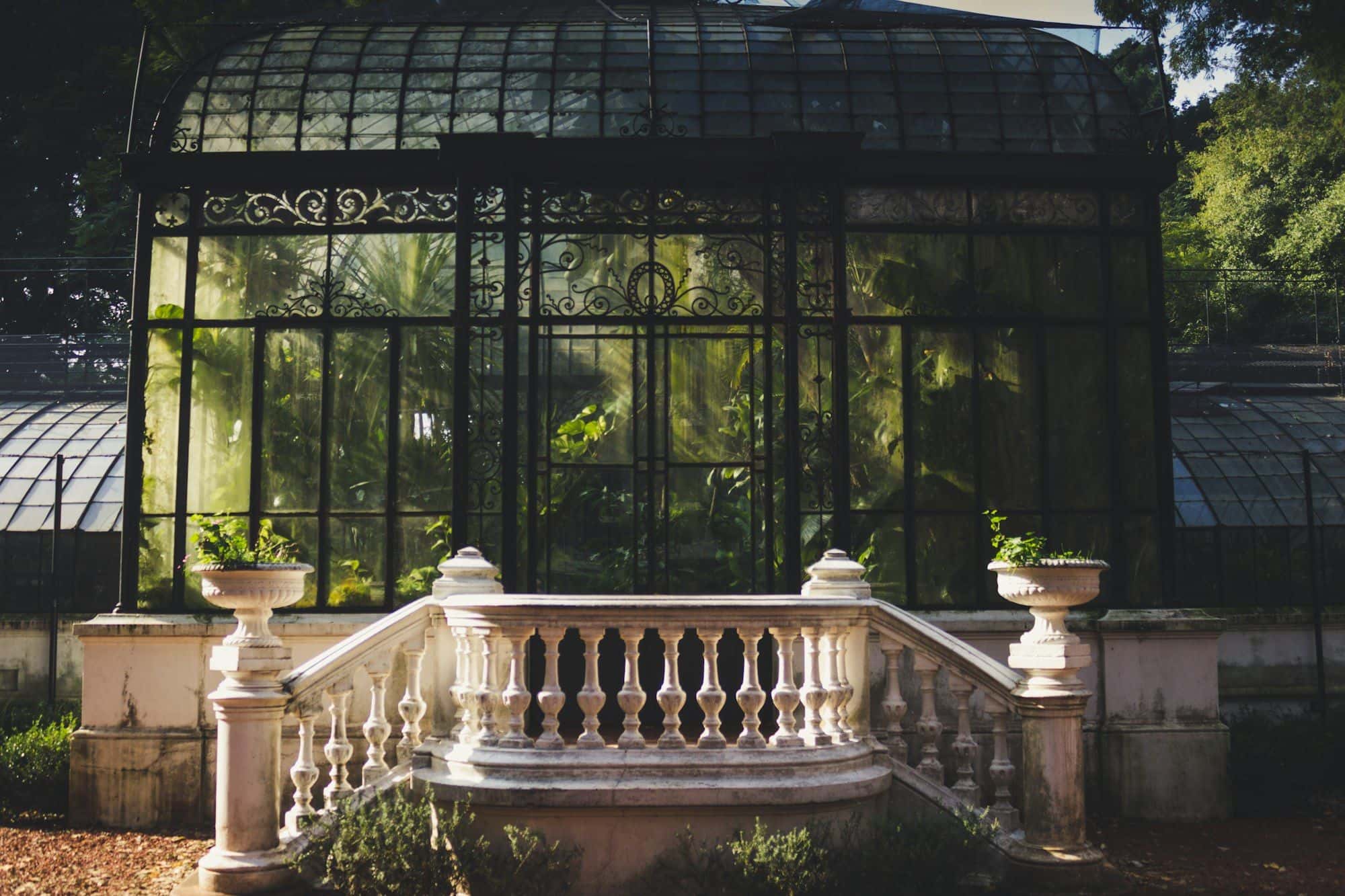
Where the term vertical farming came from: Gilbert Ellis Bailey, 1915
The phrase vertical farming first appears as the title of a 1915 book by Gilbert Ellis Bailey, an American geologist. Bailey was not writing about shelves of lettuce under lamps. His book dealt with farming downward: working the soil to greater depth, including with explosives, so that roots could reach more of the soil profile and a farmer could get more from the same field. His interest was in soil origin and root structure. The book is still available through the Internet Archive and reprint publishers, and it is sometimes misread as an early description of indoor stacked farming, which it is not.
The book matters to this history only because it gave the words their first printed use. The meaning changed completely later. Today vertical farming means growing crops in layers stacked one above another, usually indoors, in a warehouse, a multi-storey building, a basement or a shipping container, with the climate, water and often the light controlled by machines. That later meaning is the one used in the rest of this article.
Dickson Despommier and the Columbia University class of 1999
The modern idea began in a classroom. Dickson Despommier was a professor of microbiology and public health at Columbia University in New York, where he worked from 1971 to 2009. In 1999 he set his graduate students in a medical ecology class a problem that started with rooftop gardening in New York City. The rooftops could not feed many people, so the class asked what a whole building given over to crops might do.
Over about ten years, Despommier and his students worked on a design for a skyscraper farm that they estimated could feed 50,000 people. The building was never constructed. The idea spread widely online, and Despommier set it out in his 2010 book The Vertical Farm: Feeding the World in the 21st Century (St. Martin's Press). He died in New York on 7 February 2025, aged 84.
Skyscraper farm designs of the 2000s
In the early 2000s the concept was mainly architectural. Despommier's outline described a tall building on a single city block, with hydroponic crops on the upper floors. Architecture students and designers produced their own versions. One of the best known was Skyfarm, a design for downtown Toronto by Gordon Graff, a Master of Architecture student at the University of Waterloo, drawn up around 2007 and 2008.
Graff's design was a 59-storey hydroponic tower with about 9.5 million square feet of growing area, which he estimated could feed about 40,000 people a year. It included a biogas plant to turn plant waste into electricity and a water recycling system. Like Despommier's building, it stayed on paper. These designs set the public image of a vertical farm as a glass tower, even though the farms that were actually built looked very different: low warehouses, greenhouses and containers.
Japan's plant factories: the long-running experiment
Japan grew crops indoors under artificial light long before the phrase vertical farming became common in the West. Japanese researchers and companies call these facilities plant factories with artificial lighting, or PFALs. Research and development began in the 1970s, commercial operation started in the 1980s, and the sector went through booms in the 1980s and 1990s and a third boom from 2009. By the time Urban Ag News reported on the sector, more than 150 PFALs were operating in Japan, which it described as the largest number in any country.
Two companies show the pattern. Mirai was set up in September 2004 by the plant physiologist Shigeharu Shimamura. After the 2011 earthquake and tsunami, he converted a former Sony factory in Miyagi Prefecture into a large LED-lit indoor farm. Mirai was acquired in 2015 by Masaru Industries. Spread opened its Kameoka plant near Kyoto in 2007, reported that it turned profitable in 2013, and later built a more automated Techno Farm at Keihanna Science City designed for 30,000 heads of lettuce a day.
The first commercial vertical farms, 2004 to 2016
Outside Japan, the first companies that still shape the industry were founded in the 2000s. AeroFarms was set up in 2004 in New York's Finger Lakes region by David Rosenberg, Marc Oshima and Edward Harwood, and opened a 70,000 square-foot indoor farm in Newark, New Jersey, in 2016. In the United Kingdom, Paignton Zoo installed a pilot vertical growing system for research and education in 2009.
In Singapore, Sky Greens, founded by Jack Ng, opened what is widely described as the first commercial vertical farm in 2012. It used rotating A-frame towers about 9 metres tall that carried troughs of vegetables up and down under natural sunlight. In New York, rooftop farming grew alongside: Brooklyn Grange opened a soil-based rooftop farm in 2010, and Gotham Greens opened a 15,000 square-foot hydroponic rooftop greenhouse in Greenpoint, Brooklyn, in May 2011. In 2014 Green Spirit Farms opened a large single-storey vertical farm in Scranton, Pennsylvania.
The 2010s boom and the investment peak of 2021
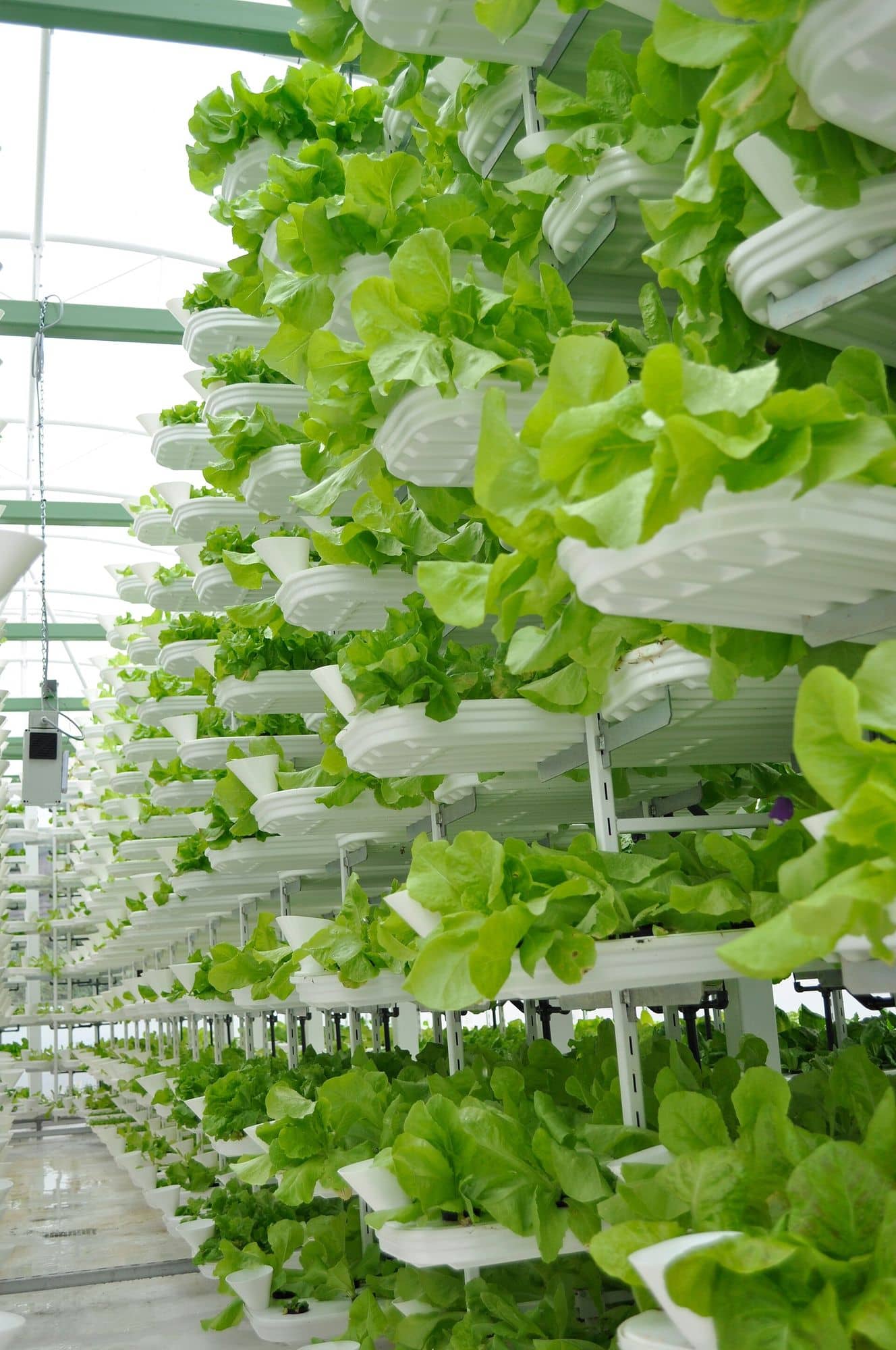
Through the late 2010s, cheaper and more efficient LED lighting, better sensors and plenty of venture capital drew many new companies into indoor farming. Mirai reported that LEDs cut its power use by 40% compared with fluorescent lamps. Start-ups in the United States and Europe raised large rounds to build warehouse farms near big cities and supply supermarkets with leafy greens, herbs and, in a few cases, strawberries.
Bowery Farming in New York raised more than US$700 million and was valued at over US$2 billion in 2021. Gotham Greens raised US$87 million in 2020 and US$310 million in 2022. A 2022 review in Horticulture Research counted more than 500 commercial PFALs in China, Japan, Singapore, the US and the UK. In 2022 a farm in Dubai opened that was described as the largest vertical farm in the world, producing more than a million kilograms of leafy greens a year.
The shake-out of 2022 to 2024
From 2022 the money stopped flowing and energy prices rose sharply, especially in Europe. Several of the best-funded companies failed or shrank. Infarm, once the largest vertical farming company in Europe, announced about 500 job cuts in November 2022 and said in May 2023 that it was leaving Europe for regions with lower energy prices. AeroFarms filed for Chapter 11 bankruptcy protection on 8 June 2023 and emerged in September 2023, concentrating on its farm in Danville, Virginia. AppHarvest also filed for Chapter 11 in 2023.
Bowery Farming told staff on 3 November 2024 that it was closing all its farms. Trade press gave the causes as heavy borrowing when interest rates were low, electricity bills for lighting and cooling, building large farms before the unit economics worked, and selling a narrow range of low-priced leafy greens. The closures continued after 2024. In the UK, Jones Food Company entered administration in April 2025. In December 2025 AeroFarms announced the closure of its Virginia farm and then, three days later, said it would stay open after an existing stakeholder agreed to fund it.
- November 2022: Infarm announces about 500 job cuts.
- May 2023: Infarm says it will leave Europe.
- 8 June 2023: AeroFarms files for Chapter 11; it emerges in September 2023.
- 2023: AppHarvest files for Chapter 11.
- November 2024: Bowery Farming ceases operations.
- April 2025: Jones Food Company (UK) enters administration.
- December 2025: AeroFarms announces closure, then reverses it three days later.
What changed after the shake-out
The farms that remained moved towards smaller, more focused businesses. AeroFarms concentrated on microgreens from one farm. In August 2025 80 Acres Farms merged with Soil Organics. Research also became more specific about what has to improve. A 2026 study in Frontiers in Sustainable Food Systems modelled lettuce production costs of €1.67 to €3.26 per kg in vertical farms against a greenhouse benchmark of €2.35 per kg, and concluded that cost depends mainly on how much light the crop receives and how efficiently it turns that light into leaf.
The lesson most analysts draw is that vertical farming works best for fast, high-value, perishable crops sold close to where they are grown, with power costs known in advance. It is not a replacement for field farming of staples. That view is closer to what Japanese plant factories had learned over three decades than to the skyscraper drawings of the 2000s.
India's vertical farming timeline
In India, soilless growing arrived mainly through hydroponic polyhouses rather than fully indoor, LED-lit farms. The first wave of companies appeared around 2017. CityGreens in Bengaluru and UrbanKisaan in Hyderabad were both founded in 2017. UrbanKisaan was backed by Y Combinator and, in July 2021, by BASF Venture Capital, which said it was the fund's first investment in an early-stage Indian business. NutriFresh Farm Tech in Pune was founded in 2019 and raised US$5 million in May 2023. Rise Hydroponics in Ahmedabad started in 2020.
Government support followed the same path. Krishi Jagran reported in March 2022 that the National Horticulture Board offers a credit-linked, back-ended subsidy of 20% of project cost, capped at ₹25 lakh (₹30 lakh in the North East and hilly areas), for hydroponic and aeroponic projects above 1,000 m² of protected cultivation. Readers should confirm the current terms with NHB or the state horticulture mission before planning on this money. Most Indian farms today grow leafy greens, herbs and exotic vegetables for city restaurants, hotels and online grocers.
Vertical farming timeline at a glance
The table below lists the dates covered in this article. Each entry comes from the sources listed at the end. Where sources disagree on a detail, such as the exact number of towers at Sky Greens, the table gives only the fact that the sources share. Company events after 2023 are given as reported in trade and local press at the time, and some companies named here have since changed owners, names or plans. Check the latest reports before relying on a company's current status.
| Year | Event | Where |
|---|---|---|
| 1915 | Gilbert Ellis Bailey publishes Vertical Farming | United States |
| 1970s–1980s | Plant factory research begins; first commercial plant factories | Japan |
| 1999 | Dickson Despommier's Columbia class starts the vertical farm project | New York |
| 2004 | AeroFarms founded; Mirai set up by Shigeharu Shimamura | US; Japan |
| 2007 | Spread opens Kameoka plant | Japan |
| 2007–2008 | Gordon Graff designs Skyfarm for Toronto | Canada |
| 2010 | Despommier publishes The Vertical Farm; Brooklyn Grange rooftop farm opens | US |
| 2011 | Gotham Greens opens rooftop greenhouse in Brooklyn | US |
| 2012 | Sky Greens opens rotating A-frame farm | Singapore |
| 2016 | AeroFarms opens Newark farm | US |
| 2017 | CityGreens and UrbanKisaan founded | India |
| 2021 | Bowery valued at over US$2 billion; BASF VC invests in UrbanKisaan | US; India |
| 2022 | Infarm cuts about 500 jobs; large vertical farm opens in Dubai | Europe; UAE |
| 2023 | AeroFarms and AppHarvest file for Chapter 11; Infarm leaves Europe | US; Europe |
| 2024 | Bowery Farming ceases operations | US |
| 2025 | Despommier dies; 80 Acres merges with Soil Organics | US |
Planning a vertical farm in India
The history shows that farms fail on power costs, crop choice and borrowing, not on the growing technology itself. Garden & Acre designs and builds commercial and institutional vertical farms on rooftops, in warehouses, on campuses and in hotels, schools and cafés. The work covers feasibility, design, build, commissioning and support through the first crop, and is priced in a written proposal after an initial call. For homes, cafés and schools that want a smaller start, Garden & Acre also installs hydroponic and aeroponic towers from ₹14,000 per tower, including the pump, timer, first seedlings, nutrients and training.
Questions
Who invented vertical farming?
Gilbert Ellis Bailey coined the term in his 1915 book Vertical Farming, but he meant deeper soil cultivation, not stacked crops. The modern concept of growing crops in stacked indoor layers is credited to Dickson Despommier, a Columbia University professor who developed it with his students from 1999 and published The Vertical Farm in 2010.
What was the first commercial vertical farm?
Sky Greens in Singapore, which opened in 2012, is widely described as the first commercial vertical farm. Japan had commercial plant factories under artificial light from the 1980s, and AeroFarms was founded in the United States in 2004, so the answer depends on how narrowly vertical farm is defined.
When did vertical farming start in India?
Commercial hydroponic and vertical farming companies in India appeared from about 2017, when CityGreens in Bengaluru and UrbanKisaan in Hyderabad were founded. NutriFresh in Pune followed in 2019 and Rise Hydroponics in Ahmedabad in 2020. Most Indian farms use hydroponic polyhouses rather than fully indoor LED farms.
Why did so many vertical farms go bankrupt?
The main reasons reported were high electricity costs for lighting and cooling, large debts taken on when interest rates were low, building big farms before costs per kilogram were proven, and selling a narrow range of low-priced leafy greens. Energy prices in Europe from 2022 and the fall in venture funding made these problems fatal for several firms.
Is vertical farming still growing after the closures?
Yes, but more slowly and more selectively. Surviving companies focus on fewer farms and higher-value crops such as microgreens and herbs, and some have merged. Research now concentrates on light use efficiency and cost per kilogram. Japan's plant factory sector, which has operated for decades, continues with more than 150 facilities.
What did Dickson Despommier propose?
Despommier and his Columbia students designed a skyscraper farm that they estimated could feed 50,000 people, with hydroponic crops on its upper floors. The building was never built, but the idea was widely shared and his 2010 book The Vertical Farm made the concept known around the world.
Sources
- Vertical farming — Wikipedia
- Dickson Despommier — Wikipedia
- Is a 60-storey skyscraper the farm of the future? — This Magazine (2009)
- Japan's oldest plant factory company charts a new course — HortiDaily
- Japan Special Report: Plant Factories with Artificial Light — Urban Ag News
- Spread to open larger Techno Farm in Japan — Agritecture
- Farming in the Sky — SINGAPORE Magazine (2015)
- AeroFarms — Wikipedia
- Gotham Greens — Wikipedia
- Brooklyn Grange — Wikipedia
- Bowery Farming is ceasing operations — TechCrunch (2024)
- Infarm abandons Europe for regions better suited for indoor farming — Just Food (2023)
- AeroFarms says it's staying open, 3 days after announcing closure — Cardinal News (2025)
- Plant factory technology lights up urban horticulture in the post-coronavirus world — Horticulture Research (2022)
- Vertical farming economics: crop performance targets for cost-competitive vertical farming — Frontiers in Sustainable Food Systems (2026)
- Hydroponics' coming of age — Forbes India (2023)
- BASF Venture Capital invests in Indian hydroponics pioneer UrbanKisaan — BASF (2021)
- Govt. is providing subsidy for hydroponics & aeroponics farming — Krishi Jagran (2022)