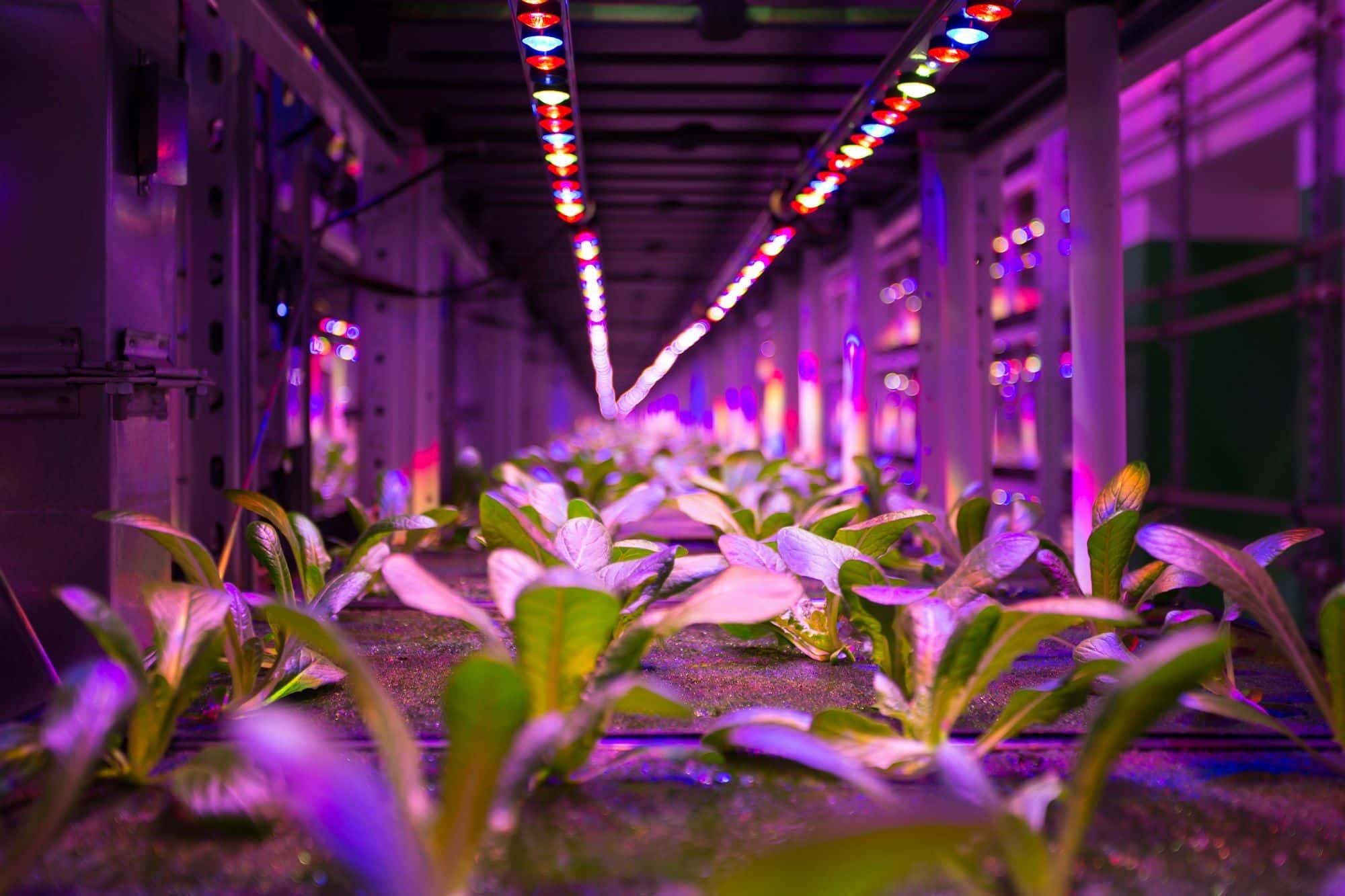
Vertical farming pros and cons at a glance
The table below sets out the main advantages and disadvantages side by side. The figures come from peer-reviewed studies listed at the end of this article. Most research is on lettuce, because it is the crop grown in most vertical farms, so treat numbers for other crops with care. Each row is explained in more detail in the sections that follow.
| Factor | Advantage | Disadvantage |
|---|---|---|
| Water | Hydroponic lettuce used about 20 L/kg against 250 L/kg in the field (Barbosa 2015) | Needs clean water and constant monitoring of pH and EC |
| Land | About 97 kg lettuce per m² a year against 3.3 kg in UK and Spanish fields (Gargaro 2025) | Land saving matters less where farmland is cheap |
| Pesticides | Closed rooms keep most pests out; many farms spray nothing | One pest or disease outbreak can spread through the whole room |
| Year-round output | Same crop every week regardless of monsoon, heat or cold | Output depends entirely on power and equipment staying on |
| Energy | Light and climate are fully controlled | About 10–18 kWh per kg of lettuce, 65–85% of it for lighting |
| Capital cost | Racks, LEDs and controls can be scaled in modules | Much higher cost per m² than a polyhouse or open field |
| Crop range | Leafy greens, herbs, microgreens and some strawberries work well | Staples such as wheat and rice are far too costly to grow this way |
| Labour skills | Work is indoors, clean and less physically hard | Needs staff trained in hydroponics, electrics and food safety |
Advantage: much lower water use per kilogram
Vertical farms grow crops in water or mist instead of soil and recirculate that water. Little is lost to runoff or evaporation from open ground, and in a closed room much of the water that plants transpire can be recovered from the air-conditioning. A study of lettuce in Yuma, Arizona, by Barbosa and colleagues (2015) found that hydroponic production used about 20 litres of water per kilogram, against about 250 litres per kilogram for conventional field production.
A 2022 review in Horticulture Research reported water use efficiency above 96% in plant factories with artificial lighting. Graamans and colleagues (2018) found that moving lettuce from greenhouses to plant factories could cut water use by 28% to 95%, depending on climate. For Indian cities that face summer water shortages, such as Bengaluru and Chennai, this is one of the strongest practical arguments for soilless growing.
Advantage: high yield per square metre of land
Because crops are stacked in layers and grown all year, a vertical farm produces much more food per square metre of floor area than a field. A 2025 life-cycle study by Gargaro and colleagues at the University of Surrey measured about 97 kg of lettuce per m² per year in a commercial vertical farm, against an average of 3.3 kg per m² in the UK and Spanish fields it studied. The 2022 Horticulture Research review gave about 120 kg per m² a year, more than 40 times open-field output.
The saving counts most where land is expensive or unavailable, such as city centres, rooftops, old warehouses and campuses. It counts least where good farmland is cheap. In peri-urban Pune or Bengaluru, the question is not whether a vertical farm saves land, which it always does, but whether that saving is worth more than the extra cost of electricity and equipment.
Advantage: fewer pesticides and cleaner produce
A vertical farm is a closed room with filtered air, controlled entry and no soil. Most insect pests and soil-borne diseases never reach the crop, so many vertical farms grow without spraying pesticides at all. The Horticulture Research review lists contamination-free produce and high quality control among the main benefits. Leaves are also free of soil and grit, which reduces washing for restaurants and packers.
The risk runs the other way once something does get in. Thrips, aphids or a root disease such as Pythium can spread quickly through a warm, humid room of identical plants. Good farms control this with hygiene rules, protective clothing, quarantine of incoming seedlings and regular inspection. Pesticide-free is an operating result that must be earned every day, not a feature of the building.
Advantage: steady, year-round output close to the buyer
Indoor crops do not depend on the monsoon, heat waves or winter cold. A lettuce crop can be planted and harvested every week of the year, with the same weight and quality each time. The Horticulture Research review lists year-round production without geographic restrictions as a core benefit. For a hotel, café chain or quick-service restaurant that needs the same salad leaves every day, that steady supply is often worth more than a lower price.
Farms can also be built inside or near a city, so produce reaches the buyer within hours of harvest. Shorter transport means less wilting and less waste on the way. In Indian cities where imported or hill-grown exotic greens travel long distances by road, a local farm can offer fresher leaves with a longer shelf life at the buyer's end.
Disadvantage: high electricity use
Energy is the main disadvantage. The sun is free in a field or polyhouse; in a vertical farm every photon comes from an LED. Current benchmarks put vertical-farm lettuce at about 10 to 18 kWh of electricity per kilogram, with lighting taking 65% to 85% of the total and most of the rest going to cooling and dehumidifying. Barbosa's 2015 study found hydroponic production needed about 82 times more energy per kilogram than field production.
Graamans and colleagues calculated 247 kWh of electricity per kilogram of lettuce dry weight in a plant factory, against 70 to 211 kWh in greenhouses in the Netherlands, UAE and Sweden. The carbon cost follows the grid. Gargaro's 2025 study put vertical-farm lettuce at about 0.93 kg CO₂-equivalent per kg on renewable power, against 0.57 kg for UK field lettuce, rising to 4.71 kg on the UK grid mix.
What electricity costs per kilogram in India
The arithmetic makes the problem clear. In Maharashtra, MERC's multi-year tariff order of 28 March 2025 lists "Indoor Vertical Farming" under LT IV(C) Agriculture – Others. For FY 2026-27, the MERC order of 25 March 2026 in Case 75 of 2025 sets that category at ₹5.61 energy charge plus ₹1.60 wheeling, or ₹7.21 per kWh. A small non-residential (commercial) connection up to 20 kW, LT-II(A), pays ₹8.51 plus ₹1.60, or ₹10.11 per kWh. At ₹7.21, electricity costs 10 × 7.21 = ₹72.10 to 18 × 7.21 = ₹129.78 per kg of lettuce. At ₹10.11, it costs 10 × 10.11 = ₹101.10 to 18 × 10.11 = ₹181.98 per kg. Fixed charges, electricity duty and fuel adjustment are extra, and so are seeds, nutrients, labour, packaging, rent and loan repayments.
The tariff category a farm falls into depends on the connection and the state, so get it confirmed by your distribution company in writing. MERC's 2025 order also brought in a solar-hours rebate from 9 am to 5 pm and a peak charge from 5 pm to midnight for commercial and industrial users. A farm that runs its lights during solar hours, or pairs the farm with rooftop solar, can bring the per-kilogram cost down.
Disadvantage: high capital cost
A vertical farm needs an insulated room, racks, LED fixtures, pumps, tanks, air-conditioning, dehumidifiers, sensors, controls and backup power. All of this is bought before the first harvest. By comparison, the National Horticulture Board's cost norms put a naturally ventilated tubular polyhouse at ₹844 per m² and a fan-and-pad greenhouse at ₹1,400 per m² in plain areas, and a field needs no structure at all. A vertical farm costs several times more per square metre of floor.
High capital cost also means high loan repayments or investor expectations. This is what brought down several well-funded companies between 2022 and 2024, including Bowery Farming, which raised more than US$700 million before it closed in November 2024. NHB's credit-linked subsidy of 20% of project cost, capped at ₹25 lakh, applies to hydroponic and aeroponic projects over 1,000 m² of protected area, as reported by Krishi Jagran in 2022; confirm the current terms before relying on it.
Disadvantage: a narrow range of crops that pay
Leafy greens, herbs and microgreens dominate vertical farming because they grow quickly, stay short, need modest light, and are eaten almost whole, so little of the energy spent is wasted on roots or stalks. Strawberries and some fruiting crops can be grown, but cost more per kilogram. A 2026 study in Frontiers in Sustainable Food Systems modelled vertical-farm tomato at €2.04 to €5.84 per kg against a greenhouse benchmark of €1.82.
Staple crops are out of reach. A 2020 PNAS study led by Senthold Asseng modelled wheat in a 10-layer indoor farm and estimated yields up to about 1,940 tonnes per hectare of land a year, around 600 times the world average. The authors noted that the energy cost of artificial light makes this uneconomic at present. Rice, pulses and potatoes face the same problem.
Disadvantage: labour and skills
Vertical farms need fewer workers per kilogram than field farms, and the work is indoors and less physically hard. The Horticulture Research review lists reduced labour costs through mechanisation among the benefits. But the staff who remain need different skills: reading nutrient and pH data, keeping pumps and dosing systems working, handling electrical faults, following food-safety rules and planning harvests to match orders.
In India these skills are still scarce outside a few cities, and trained growers are often hired away by larger farms. Budget for training at the start and for at least one person who understands both plants and equipment. A farm that loses its only trained grower can lose a whole crop in days if a pump or chiller fails unnoticed.
When the advantages outweigh the disadvantages
The advantages usually win when four conditions hold together: the crop is fast-growing and high in value, such as lettuce, basil or microgreens; the buyer pays for freshness and consistency, such as a hotel or restaurant group; power is reliable and its price is known; and land near the buyer is scarce or expensive. They usually lose when the crop is a low-priced staple, power is costly or unreliable, and cheap farmland or a polyhouse nearby can supply the same product.
For many Indian growers the practical choice is a hybrid: a naturally lit hydroponic polyhouse for bulk leafy greens and a small indoor room for seedlings, microgreens and herbs that need tighter control. Smaller installations, such as towers for a café or school, let an owner learn the system before investing in a full farm. The same learning applies to staff, buyers and suppliers, and it costs far less to make early mistakes on a few towers than in a full growing room.
Getting a feasibility check before you build
Garden & Acre designs and builds commercial and institutional vertical farms, including rooftop, warehouse, campus, hotel, school and café farms. The work starts with a call, followed by a written proposal that sets out feasibility, crop plan, power budget and cost, and then the site visit and build under an agreement. For a smaller start, Garden & Acre installs hydroponic and aeroponic towers for homes, cafés and schools from ₹14,000 per tower, including the tower, pump, timer, first seedlings, nutrients, training and a refill plan.
Questions
What are the main advantages of vertical farming?
The main advantages are much lower water use (about 20 litres per kg of hydroponic lettuce against 250 in the field in one study), far higher yield per square metre of land, little or no pesticide use, the same output all year regardless of weather, and the ability to grow close to city buyers so produce arrives fresher.
What are the main disadvantages of vertical farming?
The main disadvantages are high electricity use (about 10–18 kWh per kg of lettuce, mostly for lighting), high capital cost for the building and equipment, a narrow range of crops that pay back, the need for skilled staff, and complete dependence on power and machines staying on. These costs caused many closures between 2022 and 2024.
Is vertical farming better for the environment?
It depends on the power source. Vertical farms save water and land and usually avoid pesticides, but they use far more electricity. A 2025 UK study found vertical-farm lettuce produced about 0.93 kg CO₂-equivalent per kg on renewable power against 0.57 kg for field lettuce, and 4.71 kg on the UK grid mix.
Why is vertical farming so expensive?
Every unit of light must be bought as electricity, and the room must be cooled to remove the heat from lights and plants. The farm also needs racks, LEDs, climate control, sensors and backup power before the first harvest. In Maharashtra, 10–18 kWh per kg at ₹7.21 to ₹10.11 per unit means about ₹72 to ₹182 of power per kg of lettuce, before fixed charges.
Can vertical farming grow rice or wheat?
Technically yes, economically no. A 2020 PNAS study modelled wheat in a 10-layer indoor farm at up to about 1,940 tonnes per hectare a year, but the authors noted that the energy cost of artificial light makes it uneconomic. Vertical farms focus on leafy greens, herbs, microgreens and some strawberries.
Does vertical farming use pesticides?
Most vertical farms use no pesticides because the growing room is closed, filtered and free of soil, which keeps most pests and soil diseases out. If a pest such as thrips or aphids does get in, it can spread quickly, so farms rely on strict hygiene, quarantine of seedlings and regular checks rather than spraying.
Sources
- Comparison of land, water, and energy requirements of lettuce grown using hydroponic vs. conventional agricultural methods — Barbosa et al., IJERPH (2015)
- Plant factories versus greenhouses: comparison of resource use efficiency — Graamans et al., Agricultural Systems (2018)
- Plant factory technology lights up urban horticulture in the post-coronavirus world — Zhang et al., Horticulture Research (2022)
- Can vertical farms really feed the UK sustainably? (Gargaro et al., Food and Energy Security 2025) — Phys.org
- Benchmarking energy efficiency in vertical farming — ScienceDirect (2024)
- The yield potential of wheat grown in controlled-environment vertical farms (Asseng et al., PNAS 2020) — Phys.org
- Vertical farming economics: crop performance targets for cost-competitive vertical farming — Frontiers in Sustainable Food Systems (2026)
- MERC MYT order, Case No. 217 of 2024 (28 March 2025), MSEDCL tariff schedule
- MERC order, Case No. 75 of 2025 (25 March 2026), MSEDCL tariffs FY 2026-27
- Cost norms and pattern of assistance — National Horticulture Board
- Govt. is providing subsidy for hydroponics & aeroponics farming — Krishi Jagran (2022)
- Bowery Farming is ceasing operations — TechCrunch (2024)