What broccoli microgreens are
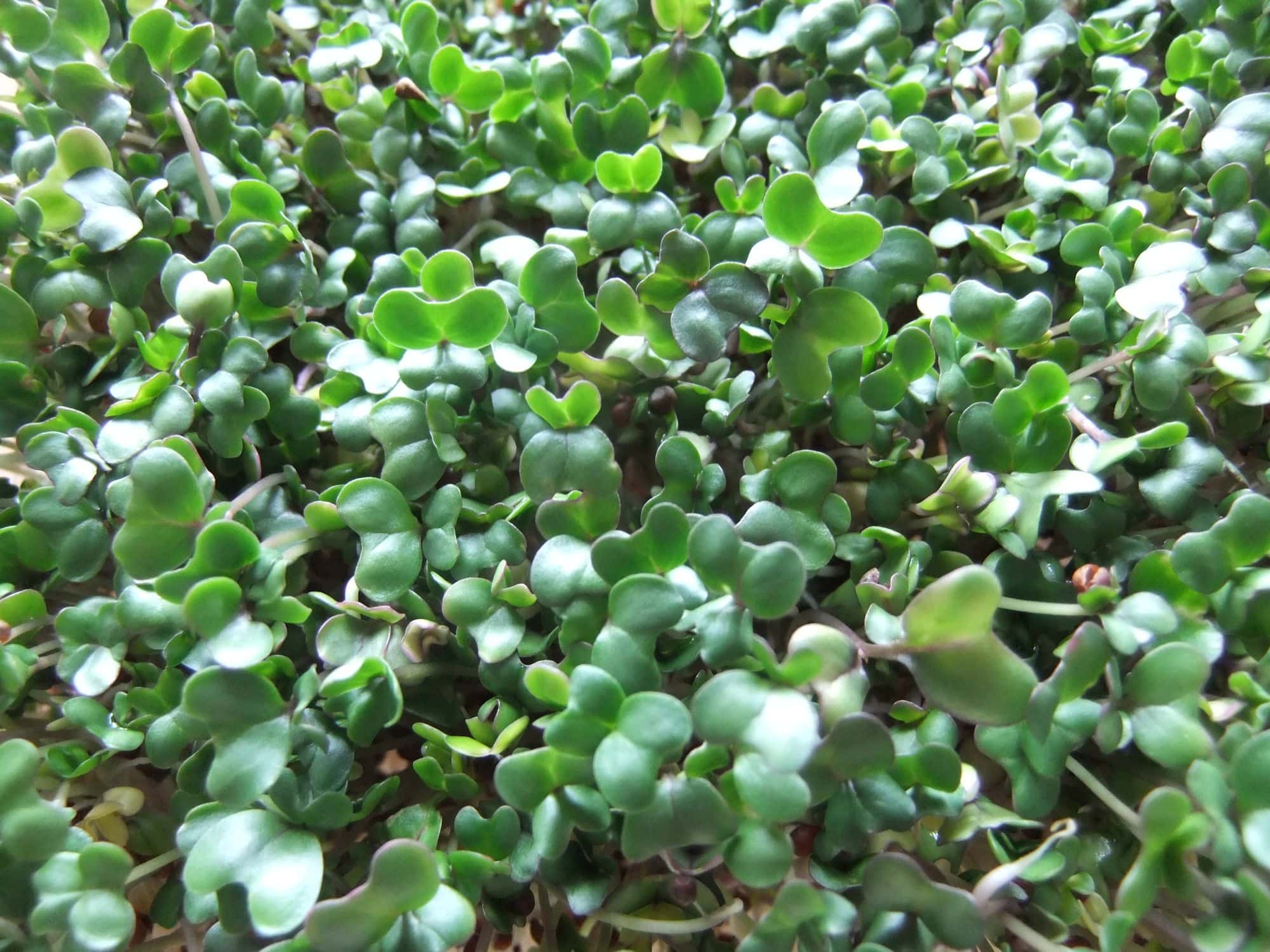
Broccoli microgreens are the same plant as the broccoli head sold in markets, harvested as a seedling. The crop is cut when the two seed leaves (cotyledons) have opened and the first true leaf is appearing, at 5–7.5 cm tall. At that stage the stem is crisp and the leaves are tender. The flavour is milder than radish or mustard microgreens, with a light cabbage note and no heat, which makes broccoli a good first microgreen for people who find mustard too sharp. A 2025 ICAR review of microgreens called broccoli the leading crop in the microgreens industry.
Sulforaphane and glucoraphanin: what the studies measured
Broccoli does not contain much free sulforaphane. It contains glucoraphanin, a glucosinolate, which an enzyme in the plant (myrosinase) converts to sulforaphane when the tissue is cut or chewed. The research on young broccoli began with sprouts. In 1997, Fahey, Zhang and Talalay at Johns Hopkins reported in PNAS that three-day-old sprouts of certain broccoli and cauliflower cultivars contained 10 to 100 times more glucoraphanin than the mature plants. That study measured sprouts, not microgreens, and its tumour findings were in rats.
For microgreens, a USDA Agricultural Research Service team (Lu and colleagues, 2018) compared florets, mature leaves and microgreens of broccoli. The microgreens contained about four times more total aliphatic glucosinolates than mature leaves and florets. In 2023, an Oregon State University team (Bouranis and colleagues) fed eleven healthy adults a single 16 g serving of fresh broccoli microgreens. Glucoraphanin content was similar to published values for broccoli sprouts, and the volunteers' urine showed sulforaphane metabolites in patterns similar to those seen after eating sprouts. The authors concluded that broccoli microgreens are a significant source of sulforaphane and that health effects still need to be studied.
In a 2025 comparison of six microgreens grown under the same conditions in Turkey (Balik and colleagues), broccoli had the highest total phenolic content, at 825.53 mg gallic acid equivalent per 100 g fresh weight, and high iron and manganese. None of these studies shows that eating broccoli microgreens prevents or treats a disease. They show what the plant contains and that the body absorbs sulforaphane from it.
| Study | Material | Finding |
|---|---|---|
| Fahey et al. 1997, PNAS | 3-day broccoli sprouts | 10–100× more glucoraphanin than mature plants |
| Lu et al. 2018, USDA ARS | Microgreens vs florets and leaves | About 4× more total aliphatic glucosinolates |
| Bouranis et al. 2023, Oregon State | One serving of microgreens, 11 adults | Sulforaphane metabolites in urine, similar to sprouts |
| Balik et al. 2025, Sci Rep | Six microgreens compared | Broccoli highest in total phenolics |
How to grow broccoli microgreens
Broccoli seed is small and does not need soaking. Penn State Extension notes that most microgreen seeds need no treatment, and soaking is for larger or hard-coated seeds. In Johnny's Selected Seeds' 2017 yield trial, broccoli was sown at about 13 g per 10×20-inch tray and harvested at an average of 12.5 days. The steps below follow the Penn State and University of Maryland extension guides.
- Fill a tray with drainage holes with 2.5–4 cm of moist soil mix or coco peat, or lay a wet grow mat.
- Scatter about 13 g of seed evenly over a 10×20-inch tray and press it lightly onto the surface. Do not cover it with soil.
- Mist, then cover the tray to keep it dark and humid for about three days.
- Uncover once the seeds have germinated and the stems are 2–3 cm tall. Give bright window light or grow lights for about 16 hours a day.
- Water from below by setting the tray in a shallow pan, so the leaves stay dry.
- Cut just above the medium with clean scissors at 5–7.5 cm, when the first true leaf shows, usually on day 10–13.
Tips specific to broccoli
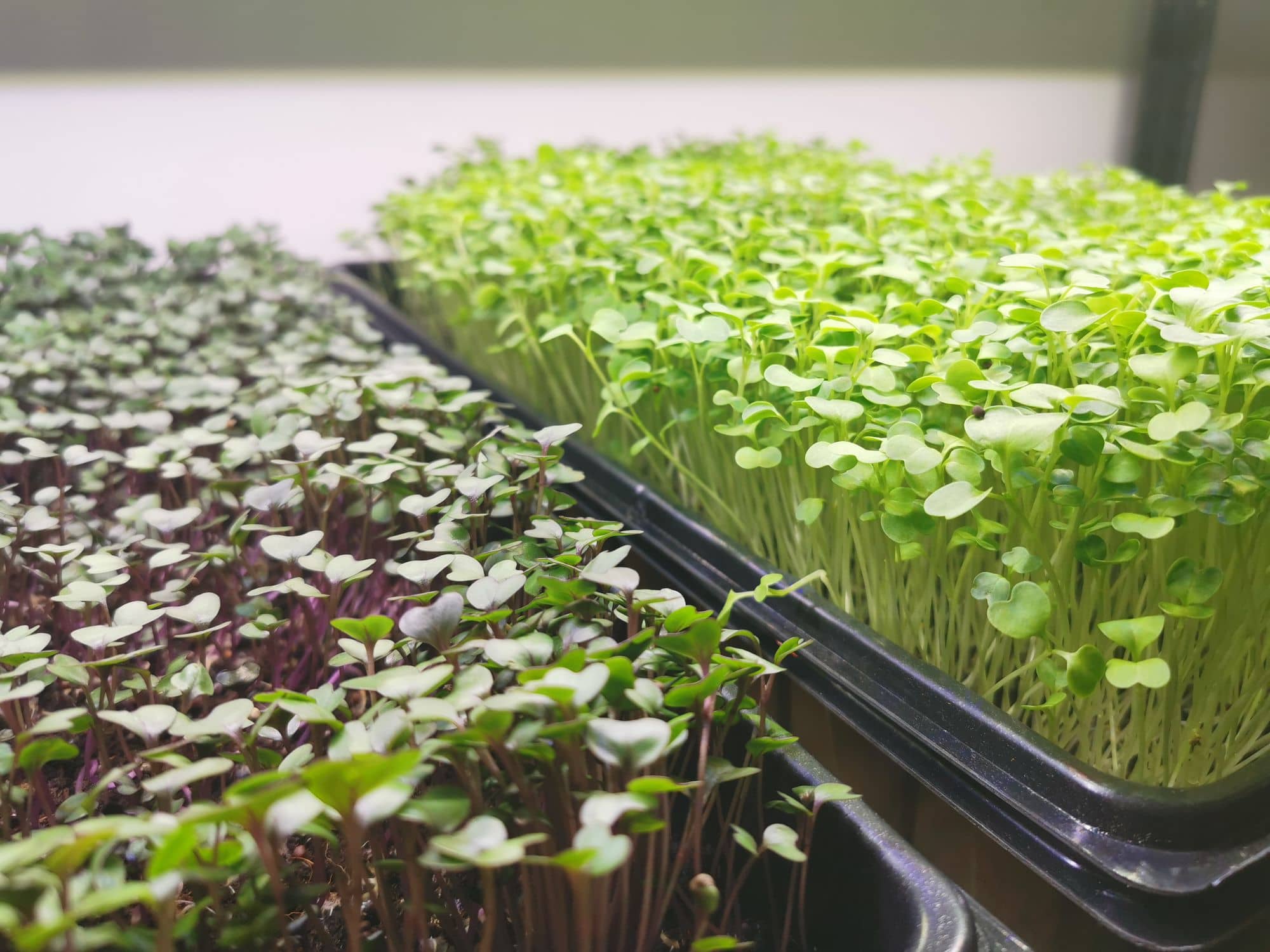
Broccoli germinates fast. The University of Maryland Extension says cabbage-family seeds germinate in about 36 hours at 22 °C, and that 21–24 °C suits most microgreens. In Pune that means most of the year is fine indoors, but in April and May a warm room can push growth too fast and cause leggy, uneven trays. Johnny's noted the same effect in its trial, when a hot week sped up growth but reduced uniformity. Keep trays away from hot windows in summer. Johnny's trial averaged 11.5 oz of harvest per tray from 13 g of seed. That is 11.5 × 28.35 g = about 326 g of microgreens per tray.
Common problems
Most failures come from too much water and too little air. Penn State advises watering only when needed and letting the tray drain, to prevent mould, and suggests opening a window now and then for air. UMD recommends a gentle fan and venting any humidity cover. A tray with grey or musty growth on the seeds and stems should be thrown out, not trimmed, because microgreens are eaten raw. Seedlings are pale yellow when they come out of the blackout; that is normal, and they turn green in light. Stems leaning hard toward the window mean the light is too weak, as Penn State notes. Sow more thinly next time if the stems rot at the base.
How to eat broccoli microgreens, including Indian dishes
Eat them raw or add them at the very end of cooking. Glucoraphanin is converted to sulforaphane by the plant's own enzyme when you chew, so keeping them uncooked keeps that step intact. The mild flavour suits almost anything. Stir a handful into poha or upma after taking it off the heat, fold into curd for a raita, top a dosa or uttapam just before serving, or pile into a vegetable sandwich with green chutney. They also work on dal-chawal, khichdi and chaat as a fresh topping. UMD suggests wraps, omelettes, soups and pesto. Rinse just before eating, not before storing.
Fresh broccoli microgreens in Pune
Garden & Acre delivers fresh microgreens in Pune and Pimpri-Chinchwad from its own supply chain, as a weekly box for homes and as regular supply by weight for restaurants, cafés and hotels. Broccoli is one of the usual core varieties, alongside sunflower, radish, mustard and pea shoots, subject to what is available that week. Ordering is on WhatsApp. Send the varieties and quantity you want, and we reply with this week's availability, the prices and the first delivery date.
Questions
Do broccoli microgreens contain sulforaphane?
They contain glucoraphanin, which the plant's enzyme turns into sulforaphane when the leaves are cut or chewed. A 2023 Oregon State study fed eleven adults one serving of fresh broccoli microgreens and found sulforaphane metabolites in their urine, similar to what earlier studies found after broccoli sprouts.
Are broccoli microgreens better than broccoli sprouts?
They are different products. Sprouts are eaten whole, seed and root included, after a few days. Microgreens grow in light for 10–13 days and are cut above the root. Bouranis and colleagues measured glucoraphanin in broccoli microgreens similar to published values for sprouts. Microgreens have more leaf, colour and texture.
How long do broccoli microgreens take to grow?
About 10 to 13 days from sowing. In Johnny's Selected Seeds' 2017 trial they averaged 12.5 days to harvest at the first true leaf. Warm rooms speed this up and cool rooms slow it down. Johnny's recorded faster but less even growth during a week of unusually hot weather, so in a Pune summer keep trays in the coolest room you have.
Should I cook broccoli microgreens?
No. Add them raw or at the very end, after the pan is off the heat. Cooking wilts them, and the conversion of glucoraphanin to sulforaphane depends on the plant's own enzyme, myrosinase. The Oregon State researchers heated samples to 100 °C for 10 minutes precisely to stop all enzyme activity. Stir them into poha, upma or dal after the pan is off the stove.
How long do broccoli microgreens keep in the fridge?
Keep them dry in a closed box in the refrigerator and use them within a few days. UMD Extension gives up to 10 days refrigerated for rinsed and dried microgreens. An ICAR-IARI study found mustard, a close relative, stayed saleable for about 4 days at 4 °C. Rinse just before eating.
Sources
- Broccoli sprouts: an exceptionally rich source of inducers of enzymes that protect against chemical carcinogens — Fahey, Zhang & Talalay, PNAS, 1997
- Effect of preharvest CaCl2 spray and postharvest UV-B radiation on storage quality of broccoli microgreens, a richer source of glucosinolates — Lu et al., Journal of Food Composition and Analysis, 2018
- Sulforaphane Bioavailability in Healthy Subjects Fed a Single Serving of Fresh Broccoli Microgreens — Bouranis et al., Foods, 2023
- Nutritional quality profiles of six microgreens — Balik et al., Scientific Reports, 2025
- Micro Greens Yield Trial 2017 — Johnny's Selected Seeds
- Microgreens of mungbean, lentil and Indian mustard: yield, shelf life and microbial load — Priti et al., PLoS One, 2022 (ICAR-IARI)
- Growing Microgreens and Baby Greens Indoors — University of Maryland Extension
- A Step-By-Step Guide for Growing Microgreens at Home — Penn State Extension