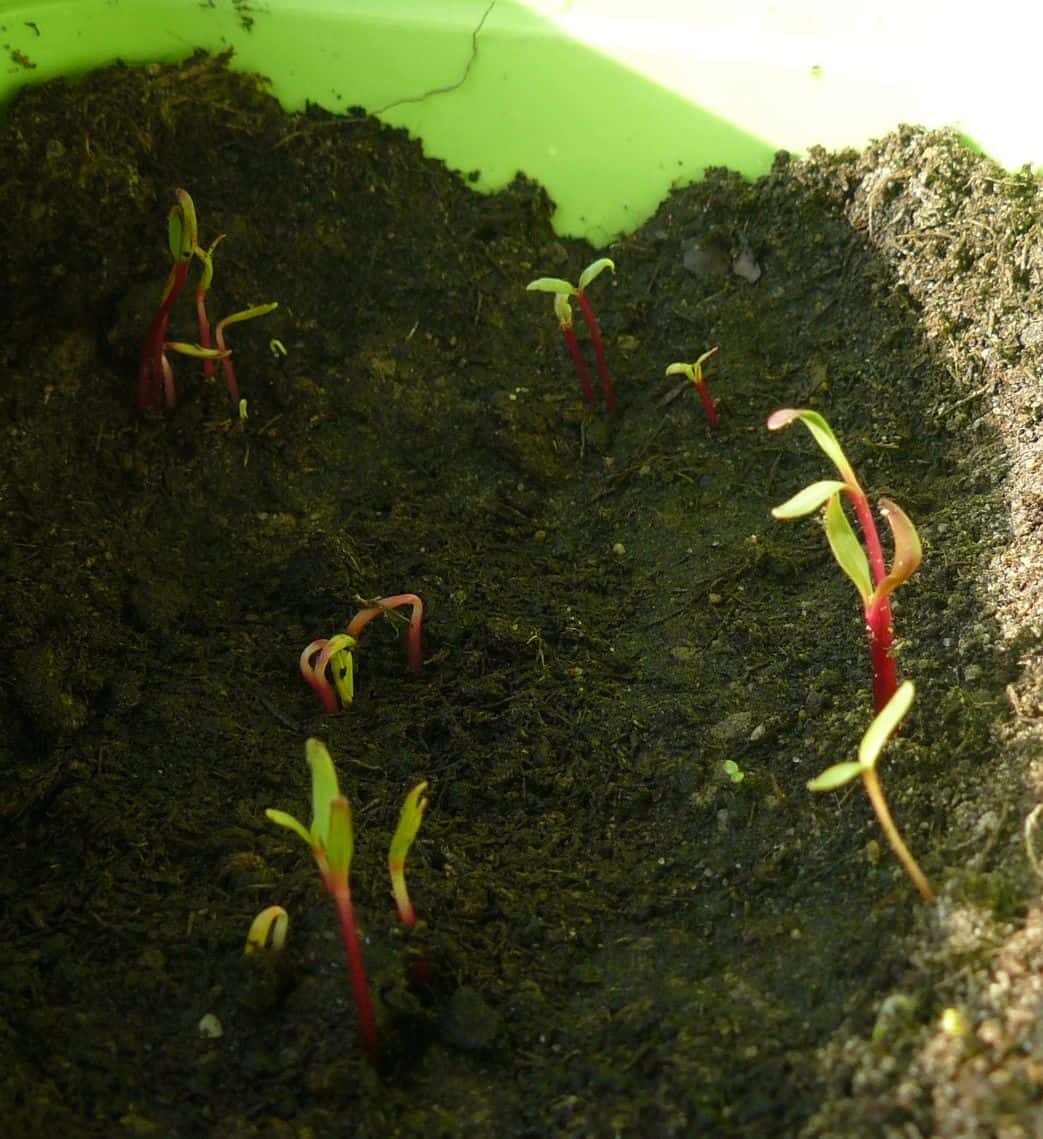
What beetroot microgreens are
They are seedlings of the beet plant, the same species as chukandar, Swiss chard and palak (Beta vulgaris var. bengalensis), harvested at the seed-leaf stage. The stems are bright red and the leaves are green with red veins, or deep red in varieties such as 'Bull's Blood'. They taste of beetroot in a mild form, earthy with a little sweetness. The University of Maryland Extension places beets in the amaranth family (Amaranthaceae) and notes that this family germinates and grows more slowly than the cabbage family. According to the 2025 ICAR review, chefs in San Francisco were already using beet microgreens, along with arugula, basil and kale, in the 1980s.
Nutrition: what studies measured
Beet was among the 25 commercial microgreens in the 2012 study by Xiao and colleagues at the University of Maryland and USDA, which found that microgreens as a group had higher vitamin and carotenoid densities than the mature leaves listed in the USDA database. In a 2025 study of six microgreens grown under the same conditions, red beet had the lowest vitamin C of the six (32.72 mg per 100 g fresh weight, against 80.45 mg in bean), but the most sugar and the most citric acid. At Lovely Professional University in Punjab, beetroot had the highest moisture of seven microgreens grown on burlap, 94.29 g per 100 g, and the lowest chlorophyll a. These figures describe what the greens contain. They do not show any effect on health.
| Study | Compared with | Beet result |
|---|---|---|
| Balik et al. 2025 | Broccoli, black radish, pea, bean, sunflower | Lowest vitamin C; highest sugar and citric acid |
| Gunjal et al. 2024 | Six other microgreens on burlap | Highest moisture; lowest chlorophyll a |
| Xiao et al. 2012 | 24 other commercial microgreens | Included; microgreens denser in vitamins than mature leaves |
How to grow beetroot microgreens
Beet 'seed' is a seed ball, a dry corky cluster, and it benefits from soaking. The University of Maryland lists beet among seeds to soak for 6 to 12 hours before sowing. In Johnny's Selected Seeds' 2017 trial, 'Bull's Blood' beet was sown at about 23 g per 10×20-inch tray and took 17 days on average to reach the first true leaf. A 2025 ICAR review gives 200 to 250 g per m² as the optimum seed rate, which is 200 × 0.129 = 26 g to 250 × 0.129 = 32 g for a 0.129 m² tray.
- Rinse and soak the seed for 6–12 hours in drinking water.
- Fill a drained tray with 2.5–4 cm of moist soil mix or coco peat.
- Spread 23–32 g of soaked seed evenly and press it in.
- Mist, cover and keep dark for about 3 days, until most seeds have sprouted.
- Uncover and give bright light for about 16 hours a day. Water from below and let the surface dry slightly between waterings.
- Harvest at 5–7.5 cm, around day 15–17, when the seed leaves are fully open.
Tips specific to beet
Plan for a longer cycle than radish or broccoli: Johnny's recorded 17 days for beet against 8 for its fastest radishes. Research points to pre-germination as a way to lift yield. The ICAR review cites a 2010 study by Murphy and colleagues in which beet seed balls were first germinated in moist vermiculite and then grown hydroponically in NFT channels; that method gave the highest fresh shoot weight, 10.14 kg per m², harvested 15 days after planting. That is a research figure under controlled conditions, not a home yield. Johnny's trial averaged 7.5 oz per tray, which is 7.5 × 28.35 g = about 213 g.
Common problems: damping-off and mould
Damping-off has been studied specifically in beet microgreens. A 2024 review by Indian researchers explains that Pythium, a water mould, causes seed rot, root rot and the collapse of young seedlings, and that conventional fungicides are of limited use on microgreens because the crop is short and eaten raw. The ICAR review cites trials in which the beneficial fungus Trichoderma, applied to the seed balls or the growing medium, reduced damping-off in beet microgreens. At home the practical defences are clean trays, fresh medium, watering from below only when needed, and good air movement, as Penn State and UMD advise. Discard trays where seedlings fall over at the base.
How to eat beetroot microgreens, including Indian dishes
Use them where colour matters. Scatter them over a beetroot or carrot raita, a kachumber salad or a chaat plate, or on top of dahi puri just before serving. They look striking on white foods: paneer tikka, idli, curd rice or a plain besan chilla. Mix them with green microgreens such as pea shoots or sunflower for a coloured salad, or tuck them into a sandwich with hung curd and mint chutney. Their mild taste means they will not overpower a dish. Add them raw at the end, rinse just before eating, and keep them refrigerated.
Fresh microgreens in Pune
Garden & Acre delivers fresh microgreens in Pune and Pimpri-Chinchwad from its own supply chain, as weekly home boxes, single-variety packs, and regular supply by weight for restaurants, cafés and hotels. The usual core varieties are sunflower, radish, broccoli, mustard and pea shoots, and others such as beetroot depend on what is available that week. Ask on WhatsApp for this week's list. We reply with the varieties, the prices and the first delivery date.
Questions
How long do beetroot microgreens take to grow?
About 15 to 17 days. Johnny's Selected Seeds recorded 17 days on average for 'Bull's Blood' beet, and a research trial cited by ICAR harvested hydroponic beet microgreens at 15 days. Beet belongs to the amaranth family, which UMD Extension notes is slower than the cabbage family.
Do I need to soak beet seeds?
Yes, it helps. The University of Maryland Extension lists beet among the seeds to soak for 6 to 12 hours to speed germination. Beet seed is a corky seed ball rather than a single bare seed. Rinse it during the soak and sow it the same day.
Why do my beet microgreens fall over?
Seedlings that collapse at the soil line are usually damping-off, caused by water moulds such as Pythium. Keep the medium moist but not wet, water from below, sow into clean trays with fresh medium, and keep air moving. Remove and discard affected trays.
Are beetroot microgreens high in vitamin C?
Less than several others. In a 2025 study comparing six microgreens grown the same way, red beet had the lowest vitamin C, 32.72 mg per 100 g fresh weight, while bean microgreens had 80.45 mg. Beet had the most sugar and citric acid of the six.
Can beetroot microgreens be grown hydroponically?
Yes. A 2010 study cited in the 2025 ICAR review pre-germinated beet seed balls in moist vermiculite, then grew them in NFT hydroponic channels, and recorded 10.14 kg of fresh shoots per square metre at 15 days. At home, a grow mat on a tray of water works on the same principle.
Sources
- Micro Greens Yield Trial 2017 — Johnny's Selected Seeds
- Nutritional quality profiles of six microgreens — Balik et al., Scientific Reports, 2025
- Assessment of vitamin and carotenoid concentrations of emerging food products: edible microgreens — Xiao et al., Journal of Agricultural and Food Chemistry, 2012
- Assessment of bioactive compounds, antioxidant properties and morphological parameters in selected microgreens cultivated in soilless media — Gunjal et al., Scientific Reports, 2024
- Microgreens: Functional Food for Nutrition and Dietary Diversification — Seth et al., Plants, 2025 (ICAR)
- Microgreens on the rise: Expanding our horizons from farm to fork — Lone, Pandey & Gayacharan, Heliyon, 2024
- Growing Microgreens and Baby Greens Indoors — University of Maryland Extension
- A Step-By-Step Guide for Growing Microgreens at Home — Penn State Extension