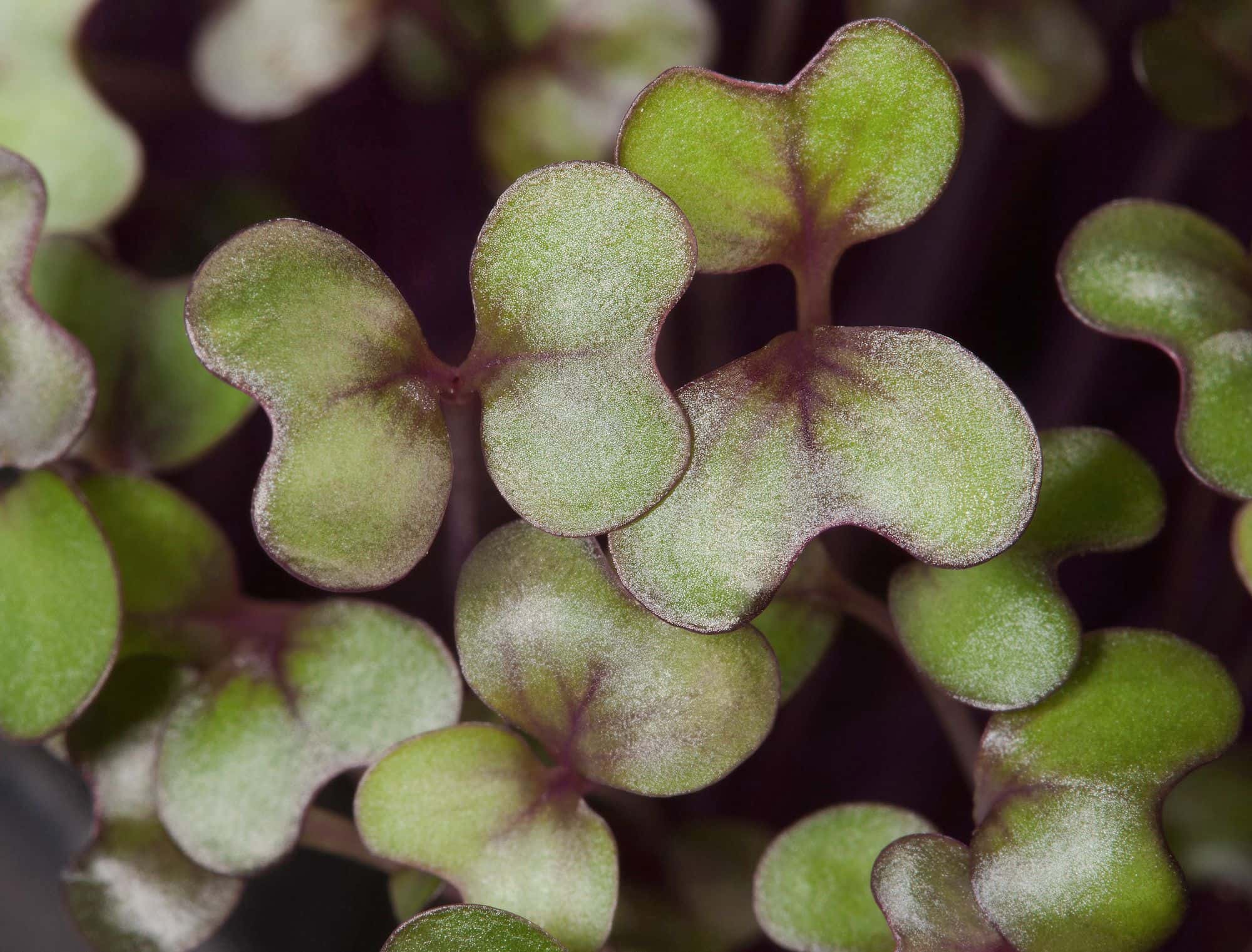
What red cabbage microgreens are
Red cabbage microgreens are the seedlings of the same red cabbage sold as a round purple head, cut when the first two seed leaves have opened. The stems are a strong purple-pink, and the heart-shaped leaves range from green to deep purple, which makes them one of the most colourful microgreens. The purple comes from anthocyanin pigments. The taste is mild and fresh, like a sweeter, softer cabbage, with little of the heat of radish or mustard.
USDA's Agricultural Research Service described red cabbage microgreens as ready to harvest about 10 days after planting. They are one of the most studied microgreens, largely because of the 2012 vitamin findings described below, and they appear in many of the later nutrition, storage and human feeding studies. Penn State Extension included red cabbage in its production trials, and Colorado State University used it in both composition and feeding studies.
The Xiao 2012 vitamin findings
In 2012, Zhenlei Xiao, Gene Lester and colleagues at the University of Maryland and USDA measured vitamin C, carotenoids, vitamin K and vitamin E in 25 commercially available microgreens. Total vitamin C ranged from 20.4 to 147.0 mg per 100 g fresh weight across the 25, and red cabbage had the highest. Cilantro led for carotenoids, garnet amaranth for vitamin K and green daikon radish for vitamin E.
The researchers compared their figures with mature leaves in the USDA nutrient database and found that the microgreens generally had higher nutrient densities. USDA's summary describes the difference as about five times greater, on average, across the vitamins and carotenoids measured. A 2023 Croatian paper, citing Xiao, puts the vitamin C in red cabbage microgreens at about six times that of mature red cabbage. These are concentrations per 100 g, so a small garnish contains correspondingly less.
| Nutrient | Microgreen with the highest level | Range across the 25 |
|---|---|---|
| Vitamin C (ascorbic acid) | Red cabbage | 20.4–147.0 mg per 100 g FW |
| Carotenoids | Cilantro | β-carotene 0.6–12.1 mg per 100 g FW |
| Vitamin K (phylloquinone) | Garnet amaranth | 0.6–4.1 µg per g FW |
| Vitamin E (tocopherols) | Green daikon radish | α-tocopherol 4.9–87.4 mg per 100 g FW |
What a human study found
Lee and colleagues at Colorado State University ran a small crossover trial, published in 2025, in which healthy middle-aged and older adults ate two cups of red cabbage or 'bull's blood' beet microgreens daily for two weeks. Of 26 people enrolled, 24 finished, and they ate 95.6 per cent of the planned portions. Daily eating was feasible and well tolerated. Gastrointestinal inflammation-related symptom scores improved after the red cabbage period.
The same trial found no change in brachial or aortic blood pressure, augmentation index (a measure related to arterial stiffness), bowel movement quality or the diversity of gut bacteria. The authors call for larger studies to test health effects. In short, red cabbage microgreens are rich in vitamin C and easy to eat daily, but have not been shown to treat or prevent any condition.
How to grow red cabbage microgreens
Red cabbage is a reliable, small-seeded brassica. In the Colorado State trial, about 10.5 g of seed was sown per standard 1020 tray (26.7 × 53 cm) on 1.5 cm of coir and covered with black polythene for 24 to 48 hours. In the Croatian trial, seed was sown on perlite at 267 g per square metre, kept under black film at about 20°C and germinated 3 days after sowing. That rate works out to 267 × 0.129 = about 34 g for a 10×20-inch tray, much denser than the Colorado rate.
- Fill a tray with 1.5–3 cm of moist coir or peat-based mix.
- Sow 10–15 g of seed per standard tray evenly over the surface.
- Mist, then cover with black polythene or a second tray for 24–48 hours.
- Uncover once most seeds have germinated and give bright light for 12–16 hours a day.
- Water from below so leaves stay dry.
- Harvest from about day 10, when the seed leaves are open and shoots are 2.5–7.5 cm tall.
Yield and shelf life
Yields vary with the system. Penn State Extension averaged 106.1 g per tray for red cabbage over a two-week cycle in a greenhouse without extra lighting. In floating hydroponics the Croatian trial measured 2.69 kg per square metre, the highest of the four species it grew; on a 10×20-inch tray that would be 2.69 × 0.129 = about 347 g. The gap between the two figures reflects seed rate as much as method: the Croatian rate of about 34 g per tray is two to three times Penn State's 10–15 g.
Red cabbage keeps well for a microgreen. In the storage study cited by ICAR-IARI researchers, it lasted 14 days at 4°C and 7 days at 10°C. Penn State notes that washing before storage shortens shelf life, so store unwashed and rinse just before eating. The same study found day 11 to be the best harvest day for red cabbage under its conditions.
Common problems
Most problems with red cabbage come from moisture and crowding rather than from the crop itself. Penn State Extension reports damping-off, a rot that collapses seedlings at the base, as the one disease it met when growing microgreens, favoured by warm, humid conditions. Watering from below, a fan for airflow and fresh medium for each tray are the main defences.
- Collapsed patches: damping-off; remove the patch, water less and add airflow.
- Pale, weak stems: too little light after uncovering.
- Long, leaning stems: covered too long or light too weak.
- Seed hulls on leaves: brush the tray lightly or rinse just before eating.
Using red cabbage microgreens in food
Red cabbage microgreens add colour as much as flavour. Scatter them over kachumber, koshimbir and raita, fold them into sandwiches, wraps and frankies, or use them to finish poha, upma, dosa, bhel and sprouts salad. Their mild taste suits children's plates. They are usually eaten raw, which is also how the vitamin C in the Xiao study was measured, so add them just before serving rather than cooking them. Keep them chilled in a closed box.
Red cabbage microgreens delivery in Pune
Garden & Acre delivers fresh microgreens in Pune and Pimpri-Chinchwad, as a weekly subscription for homes and as regular supply for restaurants, cafés and hotels. The microgreens come from our own supply chain. Orders are placed on WhatsApp, and prices are given there. Ask which varieties are available that week, including red cabbage, and tell us the quantity and delivery day you need.
Questions
How much vitamin C is in red cabbage microgreens?
In the 2012 USDA-led study by Xiao and colleagues, red cabbage had the highest vitamin C of 25 microgreens tested, at 147 mg per 100 g fresh weight. A 2023 paper citing that study puts it at about six times the level in mature red cabbage. Levels vary with variety, growing conditions and storage.
Are red cabbage microgreens healthier than red cabbage?
They are more concentrated in some vitamins. The Xiao study found microgreens generally had higher vitamin and carotenoid densities than mature leaves, with red cabbage microgreens highest in vitamin C. But you eat far less of them than a serving of cabbage, and no study has shown a health benefit from eating them.
How many days do red cabbage microgreens take?
About 10 days, according to the USDA Agricultural Research Service. A storage study cited by ICAR-IARI researchers found day 11 best under its conditions, and research trials in Colorado and Croatia harvested at 20 days. Cut when the seed leaves are fully open, before true leaves grow large.
Can you eat red cabbage microgreens every day?
In a 2025 Colorado State University trial, healthy middle-aged and older adults ate two cups of red cabbage microgreens daily for two weeks. Almost all finished, and daily eating was feasible and well tolerated. The trial did not show changes in blood pressure or gut bacteria diversity.
How long do red cabbage microgreens last?
In the storage study cited by ICAR-IARI researchers, red cabbage microgreens lasted 14 days at 4°C and 7 days at 10°C, judged by appearance. Home fridges run warmer and are opened often, so expect less. Store them dry and unwashed, and rinse just before eating.
What are red cabbage microgreens called in Hindi?
Red cabbage is called lal patta gobhi in Hindi and lal kobi in Marathi, and it is also sold as purple cabbage. The microgreens are simply the seedlings of this plant, Brassica oleracea var. capitata f. rubra, cut about 10 days after sowing.
Sources
- Xiao et al. 2012, Assessment of vitamin and carotenoid concentrations of emerging food products: edible microgreens (J Agric Food Chem)
- USDA ARS AgResearch Magazine: Specialty Greens Pack a Nutritional Punch (Jan 2014)
- Fabek Uher et al. 2023, Alfalfa, cabbage, beet and fennel microgreens in floating hydroponics (Plants)
- Johnson et al. 2021, Comprehensive evaluation of metabolites and minerals in 6 microgreen species (Curr Dev Nutr)
- Lee et al. 2025, Feasibility and tolerability of daily microgreen consumption in healthy middle-aged/older adults (Nutrients)
- Priti et al. 2022, Yield optimization, microbial load analysis, and sensory evaluation of mungbean, lentil, and Indian mustard microgreens (PLoS One)
- Penn State Extension: Growing Microgreens