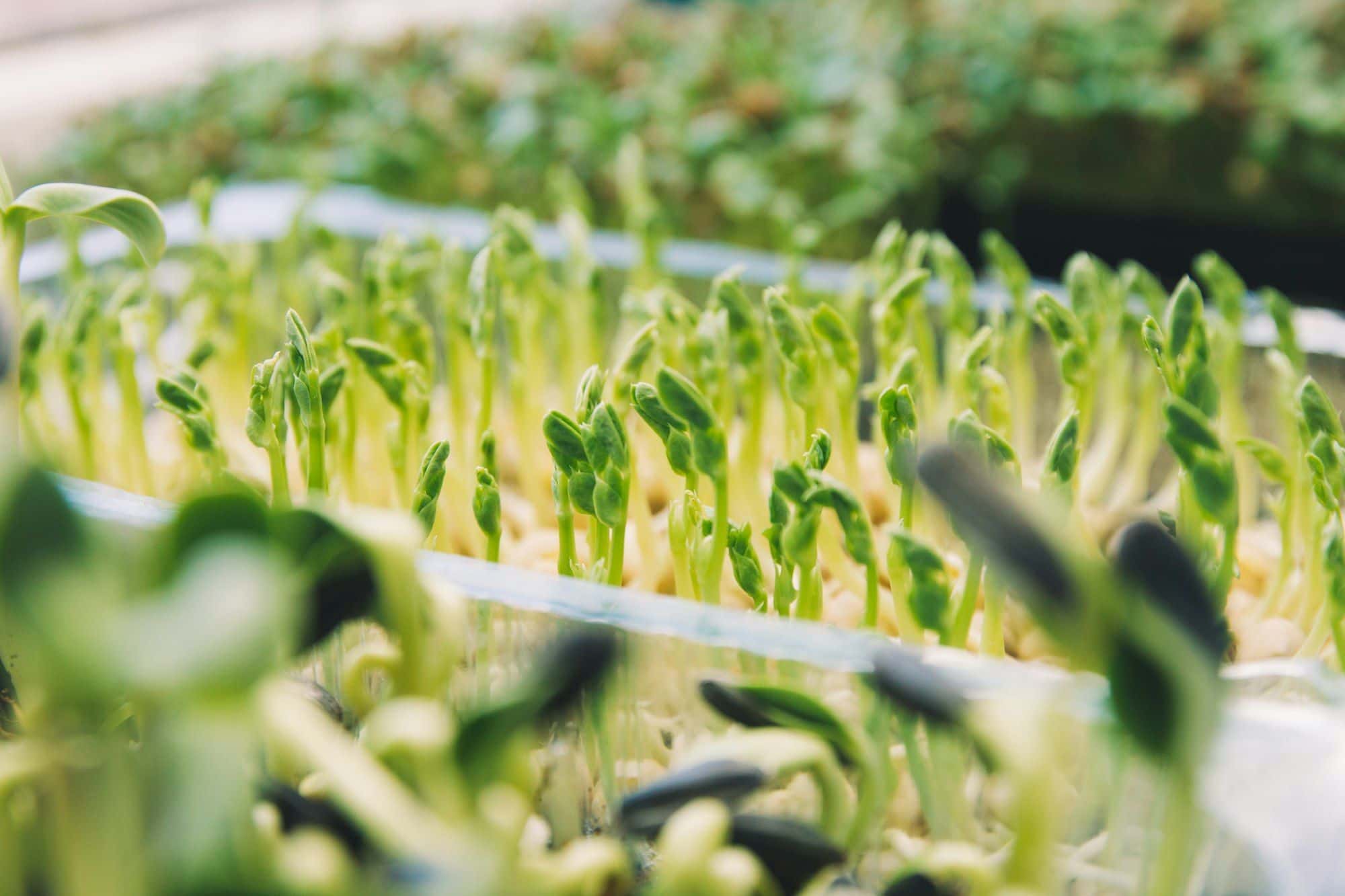
What hydroponic microgreens are
In ordinary microgreen growing, seed is sown on 2.5–4 cm of potting mix or cocopeat. In hydroponic growing, the seed sits on a thin pad or mat, or even on a bare mesh, and the roots take water from below. The Dubey et al. (2024) review describes hydroponics as growing plants without soil using mineral fertiliser solutions and a good supply of oxygen. In practice, many home "hydroponic" trays run on plain water, and a nutrient solution is added only for slower crops.
The term covers several setups. Tilahun and colleagues (2023) grew radish microgreens on soilless mesh trays suspended over water, changed daily, with no medium at all. Moraru, Rusu and Mintas (2022) describe commercial platforms where a substrate membrane sits in a channel and nutrient solution passes over it periodically, draining back to a tank within 30 minutes. A home version is simply a mat in a tray with holes, nested in a tray without holes that holds the water.
How a mat system works at home
The steps are the same as for soil-grown microgreens, with the mat in place of the mix. The main difference is that a thin mat holds far less water than 3 cm of cocopeat, so it dries out faster and needs checking every day, especially in dry summer weather. The sequence below is for a 10 × 20-inch tray, and it works the same way for smaller trays and containers.
- Cut the mat to fit the tray with holes. Soak it in clean water until it is fully wet, then let the excess drain.
- Scatter the seed evenly over the mat. Soak large seeds such as pea and sunflower first, as for soil.
- Mist the seed, cover the tray and keep it dark for about 3 days, misting once or twice a day.
- Once the roots have gripped the mat, uncover the tray and give it about 16 hours of light a day.
- Stand the tray in a tray without holes holding a shallow layer of water or dilute nutrient solution. Keep the mat moist, never swimming.
- Replace the water every day or two rather than topping it up, and rinse the lower tray when you do.
- Harvest by cutting above the mat, then compost the mat and roots and wash both trays.
Mats and pads compared: hemp, jute, coco coir and others
Many materials have been tested. The Dubey review lists coco coir, fleece, glass wool, hemp, jute, paper, perlite, rice husk, rockwool, sawdust, sugar-cane fibre, vermiculite and more. It also cites a study of hemp, jute, wood-fibre and felt mats on broccoli, cabbage, kale, mustard and radish, in which microgreens on hemp had the highest weight, height and potassium, but the lowest nitrogen. Another study it cites found coco coir and a hemp (cannabis) mat could replace peat for mustard microgreens.
Jute has been tested in India. Gunjal and colleagues (2024) at Lovely Professional University grew seven microgreens, including broccoli, radish, beetroot, flax and red amaranth, on pieces of jute bag sterilised in an autoclave, watered with distilled water, and harvested them at 9 days. The MANAGE handbook from Hyderabad also tested wet tissue paper as a growing medium and describes it as quick to set up and less prone to fungus than soil.
| Medium | What it is | What the research shows | Practical notes |
|---|---|---|---|
| Hemp mat | Felted hemp fibre pad | Highest shoot weight and height among four mats in one study cited by Dubey et al. 2024 | Single use; compostable |
| Jute (burlap) | Woven jute cloth or pad | Used for seven microgreens harvested at 9 days (Gunjal et al. 2024, India) | The Indian study sterilised it before use; single use |
| Coco coir mat or cocopeat | Coconut husk fibre, pressed or loose | 1.65 kg/m² fresh yield, against 2.96 kg/m² on peat (Kyriacou et al. 2020) | The most common medium in Indian microgreen studies (Seth et al. 2025) |
| Capillary mat or cellulose sponge | Synthetic pads | 1.18 and 1.31 kg/m² in the same study | Clean and light; lowest yields in that trial |
| Bare mesh over water | No medium at all | Radish at 1.97–3.11 kg/m² in 10 days on water only (Tilahun et al. 2023) | Works for large-seeded, fast crops; roots hang in water |
| Tissue paper | Several layers of wet paper | Tested as a medium by MANAGE (2023) | Cheapest to start; dries fast; for a kitchen batch |
Yield on mats against peat and coco
The clearest comparison is Kyriacou and colleagues (2020), who grew coriander, kohlrabi and pak choi on five media with the same nutrient solution. Fresh yield was 2.96 kg per m² on peat moss, 1.65 on coconut fibre, 1.31 on cellulose sponge and 1.18 on both agave fibre and capillary mat. The authors noted that natural fibres are cheap and sustainable alternatives, and pointed to the environmental cost of peat extraction and the need to watch microbial safety with organic materials.
Other studies show that a well-run substrate-free system can do well. Tilahun and colleagues grew five radish cultivars on mesh over water in a multi-layered unit, at 20°C with 2 days of dark and then 16 hours of light, and recorded 1.97–3.11 kg per m² in 10 days from 10 g of seed per tray. For comparison, the ICAR-IARI study by Priti et al. (2022) measured 0.84–2.65 kg per m² for moong, lentil and Indian mustard grown on a cocopeat blend.
Do hydroponic microgreens need nutrients?
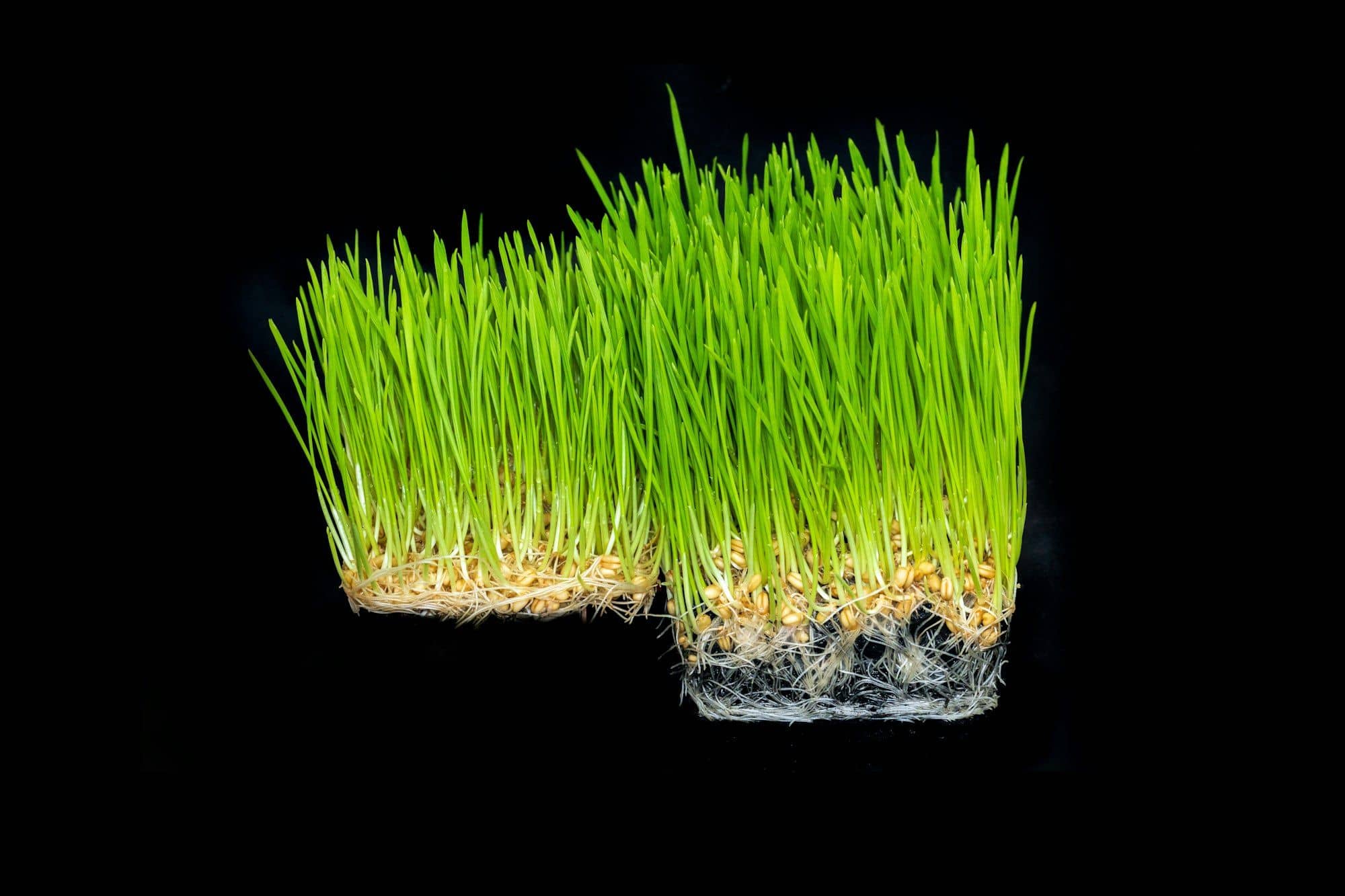
For most home crops, no. The seed holds enough stored food to carry a seedling for the one to two weeks before a brassica or legume is cut. The Tilahun radish trial used only fresh water, changed daily, and the Gunjal jute trial used distilled water. The University of Maryland Extension makes the same point for soilless mix: no fertiliser is needed. Nutrient solution becomes useful for slower crops such as basil and coriander, and for growers chasing weight per tray.
When nutrients are used, research keeps them weak. Kyriacou and colleagues fed a quarter-strength modified Hoagland solution at an electrical conductivity of about 0.4 dS/m. Renna and Paradiso (2020) summarise work by Palmitessa and colleagues in which a half-strength Hoagland-type solution gave good yield and height for broccoli, broccoli raab and cauliflower microgreens. The basil protocol in Moraru et al. (2022) ran at EC 1.2 mS/cm and pH 6.8, with the solution changed every 10 days and held at 20 ± 2°C.
- Radish, mustard, moong, broccoli, sunflower, pea: plain water is usually enough
- Basil, coriander, amaranth and other slow crops: a weak solution helps (quarter to half strength)
- Keep the solution cool, change it regularly, and never reuse it between batches
- If you use a nutrient solution, check its pH and EC with a meter
Nutrition: mats against soil and compost
The growing medium changes what ends up in the leaf, not only how much grows. The Dubey review cites Weber (2017), who found that broccoli microgreens grown on compost had higher concentrations of minerals than those grown hydroponically on pads. It also notes studies in which hydroponic microgreens had a higher concentration of some phytochemicals and a lower concentration of potassium. The Kyriacou trial found that natural-fibre substrates raised nitrate compared with the synthetic pads.
None of this makes one method healthier than another in a simple way. The differences are real but modest, and they vary by crop. Microgreens are eaten in small amounts, and the choice of medium is usually decided by cost, cleanliness and convenience. If mineral content matters for your use, soil or compost-based media have the edge in the studies cited; if cleanliness and light weight matter, mats have it.
Water hygiene and food safety on mats
Hydroponic systems carry one particular risk. The Kaya and Yardimci (2025) review cites Xiao and colleagues (2015), who found that E. coli survived and multiplied in the plant in both soil-substitute and hydroponic growing, with higher levels in the hydroponic system. Moraru and colleagues note that contaminated seed led to contamination of whole plants, that sanitising the harvested product is unlikely to be an effective control, and that seed should get precautionary sanitising treatment.
Regulators treat mat-grown microgreens as ordinary produce, not as sprouts. In the US Produce Safety Rule, the sprout rules in subpart M do not apply to soil- or substrate-grown sprouts harvested without their roots, and the FDA states that hydroponic systems growing produce other than sprouts are outside subpart M. It adds that hydroponic operations whose risks resemble those of sprouts are encouraged to adopt those standards voluntarily. At home, that means clean seed, clean water changed often, and washed trays.
Pros and cons against soil or coco
Mats suit a kitchen or a stacked indoor rack, where soil is messy and heavy. Soil and cocopeat suit growers who want the most weight from each tray, or who grow slower crops that benefit from the extra water and food a deeper medium holds. The table sets the two side by side, using the research above. Many growers use both: mats for radish and pea, a cocopeat blend for basil and coriander.
| Mats or water (hydroponic) | Soil mix or cocopeat | |
|---|---|---|
| Yield per tray | Usually lower: 1.18–1.65 kg/m² on fibre pads against 2.96 on peat (Kyriacou et al. 2020) | Usually higher |
| Mess and weight | Clean and light; nothing to spill | Heavier; loose medium can end up on the greens |
| Water | Thin mat dries fast; check daily | Holds water longer; easier to leave for a day |
| Nutrients | Plain water for fast crops; weak solution for slow ones | No fertiliser needed in a good mix (UMD) |
| Minerals in the crop | Lower mineral levels in one broccoli study (Weber 2017) | Higher in the same study |
| Food-safety risk | Water can spread contamination; higher E. coli levels in one study (Xiao et al. 2015) | Lower in that study, but soil particles must be kept off the harvest |
| Waste | Single-use mat, compostable if natural fibre | Used medium, compostable |
| Best for | Kitchens, racks, radish, mustard, pea, sunflower | Beginners, slow crops, maximum yield |
Growing on a larger scale
Commercial indoor farms often use channels or trays with a thin pad and a recirculating nutrient solution, because this makes stacking, cleaning and harvesting faster than soil. The trade-off is a pump, a tank, and a water-hygiene routine that has to be followed every day. Moraru and colleagues describe systems in which the solution is recirculated through the root zone at intervals, with tank temperature and dissolved oxygen monitored, which is closer to a lettuce farm than to a kitchen tray.
For a business, the choice between mats, cocopeat and a flood-and-drain rack depends on the crops, the market and the labour available. The article on microgreens in vertical farming, at /vertical-farming/microgreens-vertical-farming, covers racks, lighting and selling in more detail. Garden & Acre's Vertical Farm Consulting covers feasibility, system design, crop plans, SOPs and troubleshooting for indoor farms, including farms built by others, and Vertical Farm Setup builds commercial and institutional indoor farms. Both are priced in a written proposal.
Questions
Can microgreens be grown in water only?
Yes, for fast, large-seeded crops. Tilahun and colleagues (2023) grew radish microgreens on mesh trays over plain water, changed daily, and harvested 1.97–3.11 kg per m² in 10 days. The seed supplies most of what the seedling needs over that short time. Slower crops such as basil do better with a weak nutrient solution.
Which is better for microgreens, a hemp mat or a jute mat?
In a study cited by Dubey et al. (2024), microgreens on hemp mats had the highest weight and height among four mats tested, including jute. Jute is cheaper and easier to find in India, and Gunjal and colleagues grew seven microgreens on it successfully. Both work for fast crops such as radish and mustard.
Do hydroponic microgreens need fertiliser?
Fast crops such as radish, mustard and moong do not; they are cut before they use up the food stored in the seed. For slower crops, research uses weak solutions: a quarter-strength Hoagland solution at about 0.4 dS/m (Kyriacou et al. 2020) or half-strength (Palmitessa et al.). Stronger solutions are not needed.
Are hydroponic microgreens safe to eat?
Yes, when grown cleanly, but water can spread contamination. One study (Xiao et al. 2015) found higher E. coli levels in hydroponic than soil-substitute systems after contaminated seed was used. Use clean seed, change the water every day or two, wash trays between batches, and wash the greens before eating.
Do hydroponic microgreens yield less than soil?
Usually, in the studies available. Kyriacou and colleagues (2020) measured 2.96 kg per m² on peat moss against 1.65 on coconut fibre and 1.18–1.31 on synthetic pads, with the same nutrients. A well-managed substrate-free system can still do well: radish on water reached 1.97–3.11 kg per m² in 10 days.
Can I reuse a hemp or jute mat?
It is better not to. After harvest the mat is full of roots, which are hard to remove and can carry mould or disease into the next tray. Natural-fibre mats are cheap and compostable, so most growers use a fresh one for each tray and put the old one on the compost heap.
Sources
- Phenolic Constitution, Phytochemical and Macronutrient Content in Three Species of Microgreens as Modulated by Natural Fiber and Synthetic Substrates — Kyriacou et al., Antioxidants, 2020
- Microgreens Production: Exploiting Environmental and Cultural Factors for Enhanced Agronomical Benefits — Dubey et al., Plants, 2024
- Radish microgreens produced without substrate in a vertical multi-layered growing unit are rich in nutritional metabolites — Tilahun et al., Frontiers in Plant Science, 2023
- Assessment of bioactive compounds, antioxidant properties and morphological parameters in selected microgreens cultivated in soilless media — Gunjal et al., Scientific Reports, 2024
- Trial Protocol for Evaluating Platforms for Growing Microgreens in Hydroponic Conditions — Moraru, Rusu and Mintas, Foods, 2022
- Ongoing Research on Microgreens: Nutritional Properties, Shelf-Life, Sustainable Production, Innovative Growing and Processing Approaches — Renna and Paradiso, Foods, 2020
- Microgreens: nutritional properties, health benefits, production techniques, and food safety risks — Kaya and Yardimci, PeerJ, 2025
- Standards for the Growing, Harvesting, Packing, and Holding of Produce for Human Consumption (final rule), 80 FR 74353 — US FDA, 2015
- Yield optimization, microbial load analysis, and sensory evaluation of mungbean, lentil, and Indian mustard microgreens — Priti et al., PLoS One, 2022 (ICAR-IARI)
- Microgreens for Nutritional Security — Kumari, Junuthula and Mandapaka, MANAGE Hyderabad, 2023
- Growing Microgreens and Baby Greens Indoors — University of Maryland Extension