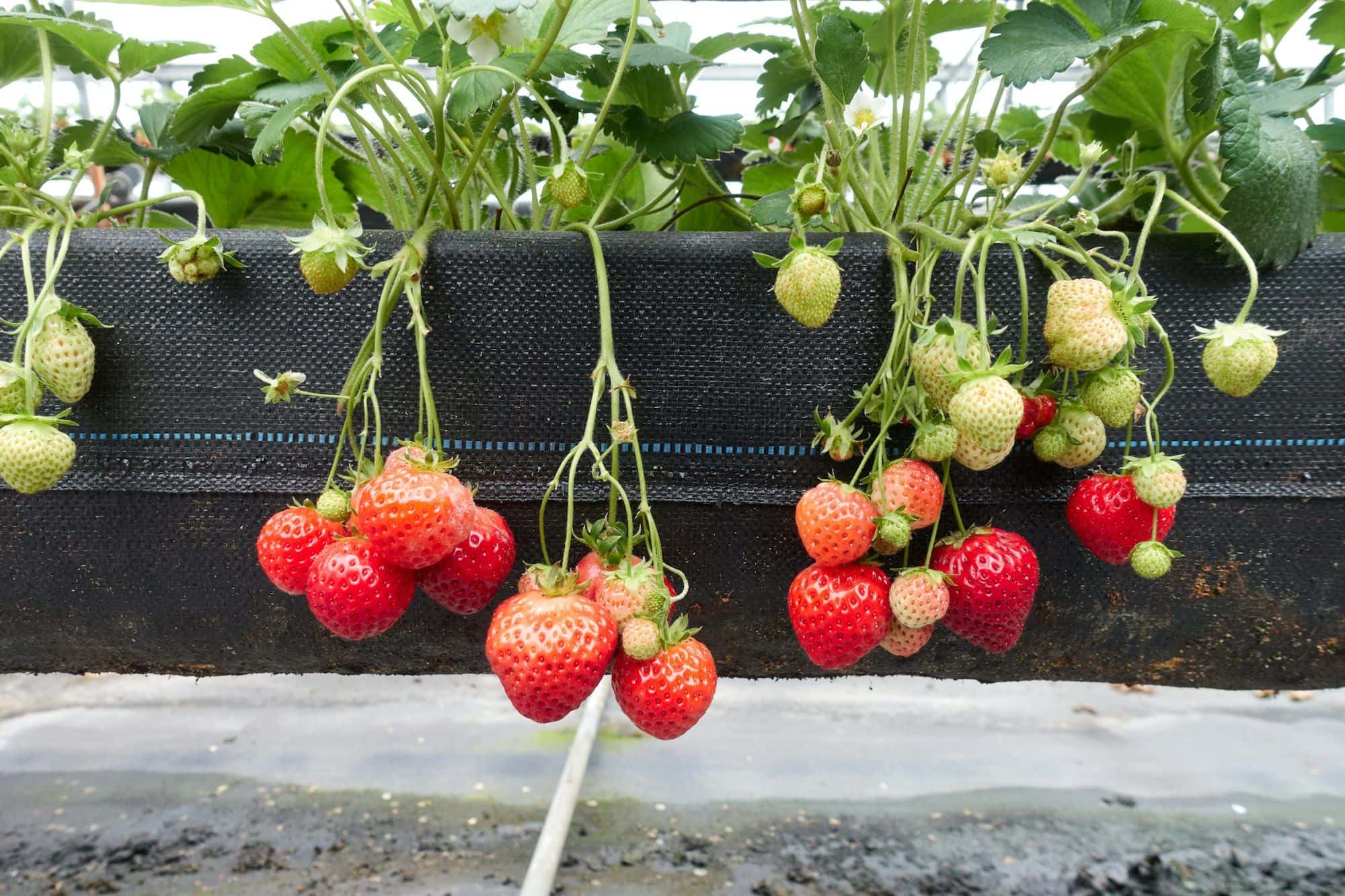
Why strawberries are the hardest vertical farm crop
Lettuce and herbs are harvested as leaves, so a vertical farm only has to grow foliage. A strawberry has to grow leaves, form flower buds, open flowers, be pollinated and then ripen fruit, and each stage has its own needs for light, temperature and humidity. Oishii's founder Hiroki Koga told AgFunderNews that strawberries are the hardest crop to grow in a vertical system, with a very large number of combinations of growing factors to tune across the plant's life.
The payoff is price. Strawberries sell for far more per kilogram than lettuce, they bruise easily in transport, and fruit picked ripe tastes better than fruit picked early for long supply chains. That is the case every indoor strawberry farm makes: grow close to the buyer, pick ripe, and sell into the premium end. It also means the business rests on yield per plant, and the research below shows that yield depends heavily on pollination and temperature.
Day-neutral and short-day strawberries
Strawberry varieties fall into two broad groups. Short-day, or June-bearing, varieties form flower buds only when the day is shorter than a critical length. The Ohio State University controlled-environment berry programme reports critical photoperiods of 13–14 hours for cultivars such as Chandler and Radiance. Once induced, flowers show in 4–5 weeks, open 3–4 weeks later and give fruit 4–5 weeks after that. The National Horticulture Board describes the same need: a day of 12 hours or less with moderate temperature for flower-bud formation.
Day-neutral, or everbearing, varieties are facultative long-day plants. They flower whatever the day length, and form more flowers when the day is longer. That makes them the standard choice for vertical farms, which run the same light schedule all year. A 2023 study in the journal Plants grew the day-neutral variety Albion in a vertical farm at 21 °C. Lengthening the day from 12 to 16 hours brought flowering forward by 17–21 days at 300 µmol per square metre per second or more, and raised fruit production by 372–989%.
Best day-neutral strawberry varieties for vertical farming
Many of the most widely planted day-neutral varieties come from the University of California, Davis breeding programme. Lassen Canyon Nursery, a large propagator, describes Albion as the flavour benchmark with good disease resistance, and San Andreas as similar to Albion in flavour and production pattern with a slightly lighter colour. Seascape is an older standard that needs fewer chill hours, which suits warmer climates. Newer UC releases such as Royal Royce and Valiant are selected for higher yield. In India, strawberry mother plants are largely imported, as Mahabaleshwar growers do each year from California, so check availability of a variety before designing around it.
| Variety | Origin | Stated traits |
|---|---|---|
| Albion | UC Davis | Industry standard for flavour, good disease resistance |
| San Andreas | UC Davis | Flavour similar to Albion, strong appearance, slightly lighter colour |
| Seascape | UC Davis | Dependable older standard, flexible on chill hours |
| Monterey | UC Davis | Sweet flavour with a distinct aftertaste |
| Portola | UC Davis | Broad adaptability across planting systems |
| Cabrillo | UC Davis | Flavour comparable to Albion, higher yield per plant |
| Royal Royce | UC Davis | Reported 77% higher yield than comparable San Andreas, fewer runners |
Temperature and light for indoor strawberries
Temperature controls both flowering and fruit set. A study reported in Acta Horticulturae compared everbearing strawberries in a glasshouse averaging 26 °C by day and 21 °C by night with a plastic house at 25/18 °C. The warmer house reduced pollen viability and germination, lowered the share of flowers that became fruit and increased malformed fruit. An earlier study found that strawberry pollen lost germination fastest when held at 30 °C and 75–85% relative humidity. Warm nights and humid air are therefore the two conditions to avoid.
Light is the second control. The 2023 Albion study found that longer days mattered more than brighter light for flowering and early yield, although raising light from 200 to 450 µmol per square metre per second increased crown diameter by 18–64% and shoot mass by 38–80%. Together, these results give a working envelope for an indoor farm. The table summarises what the studies used or found, and should be tuned for each variety.
| Factor | What the research used or found | Source |
|---|---|---|
| Air temperature | 21 °C constant gave good flowering and fruit in a vertical farm | Park et al. 2023 |
| Day/night | 25/18 °C outperformed 26/21 °C for pollen and fruit set | Winardiantika et al. |
| Photoperiod | 16 hours beat 12 hours for flowering time and yield | Park et al. 2023 |
| Light intensity | 200–450 µmol m⁻² s⁻¹ tested; higher gave bigger plants | Park et al. 2023 |
| Humidity at flowering | Pollen germination fell most at 30 °C with 75–85% RH | Leech et al. 2002 |
Pollinating strawberries indoors: bumblebees, brushes and vibration
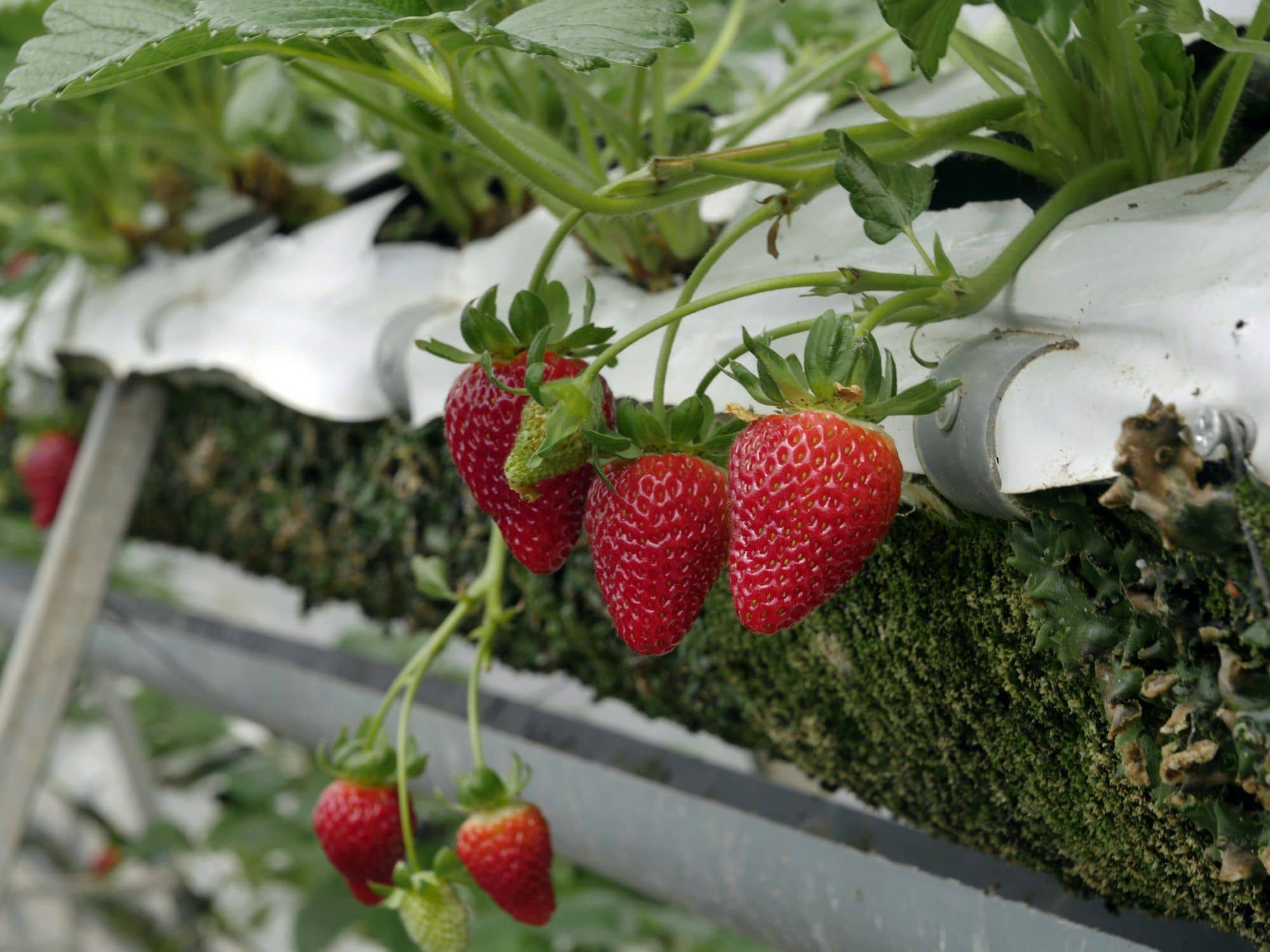
Strawberry flowers need pollen spread evenly across every pistil. Uneven pollination gives misshapen fruit, because only the fertilised seeds on the surface make the flesh swell around them. In a field, wind and insects do this. In a closed room, the grower must supply it. The Ohio State berry programme describes three routes: honeybees, bumblebees and mechanical methods. Oishii, the best-known indoor strawberry farm in the United States, uses bees and keeps its method proprietary.
Each route has limits. Honeybees need ultraviolet light to navigate, so they struggle under many LED fixtures, and they need careful handling of any pesticide. Bumblebees are more active and need far fewer insects, but too many for the number of flowers can damage blooms and cause malformed fruit. Mechanical pollination needs flowers to be dry and must be repeated daily or every other day, which becomes heavy labour above roughly 1,000 square feet.
- Honeybees: 6,000–8,000 bees per 1,000 m² are recommended for greenhouse strawberries; they need UV light and work best when outside forage is scarce.
- Bumblebees: about 20 bees per 1,000 square feet; restrict hive openings or add pollen if there are too few flowers.
- Electric vibrators or brushes: a few seconds of vibration per flower truss, daily or every other day; practical for small rooms.
- Air movement: a blower or fan to shake flower trusses; cheap, but less even than bees or hand work.
Towers vs gutters vs substrate for vertical strawberries
Strawberries can grow in vertical towers, stacked gutters, NFT channels or substrate bags on shelves. A University of Georgia trial published in Frontiers in Plant Science in 2025 compared four systems over 129 days with the varieties Florida Brilliance and Florida Beauty. Substrate culture was clearly best. For Florida Brilliance, it yielded 144% more than the three water-culture systems. The vertical tower came second, and its yield was 71% higher than NFT. For Florida Beauty, substrate yielded 613% more than NFT.
The authors linked the gap to plant stress. Plants in substrate had 38–71% higher shoot water content than those in water culture. The practical reading is that gutters or troughs filled with coco peat, fed by drip, are the safest choice for a commercial strawberry farm, whether stacked indoors or in a polyhouse. Towers are a reasonable second, especially where space is tight. NFT channels, which work well for lettuce, are the weakest choice for strawberries.
| System | How it works | Result in the trial |
|---|---|---|
| Substrate (coco or similar, drip-fed) | Roots in soilless media, fed by drip | Highest yield and efficiency |
| Vertical tower | Plants in a stacked column, solution flows down | Second; 71% above NFT for Florida Brilliance |
| Aeroponic | Roots misted with solution | Lower than substrate |
| NFT gutter | Thin film of solution in a channel | Lowest; substrate yielded 613% more for Florida Beauty |
Strawberries in India: Mahabaleshwar and beyond
Mahabaleshwar, in the Mahabaleshwar–Panchgani belt of Satara district, Maharashtra, is India's main strawberry region and is often said to supply about 85% of the country's crop. Mahabaleshwar strawberry received a Geographical Indication in 2010. Estimates reported in the press put the area at about 3,000 acres and output near 30,000 tonnes a year around 2015. Sweet Charlie makes up nearly half the crop, with Camarosa and Winter Dawn the other main varieties. Sweet Charlie and Camarosa are short-day (June-bearing) varieties, suited to the region's winter season.
The Mahabaleshwar season runs from October–November to April–May. Mother plants are imported from California around June, runners are planted out in September after the monsoon, and fruit follows through winter. The NHB also lists Himachal Pradesh, Uttar Pradesh, West Bengal, Delhi, Haryana, Punjab and Rajasthan as growing states. Its model project assumes 22,000 plants per acre at 30 × 30 cm and 8 tonnes an acre with good management, which works out to 8,000 kg ÷ 22,000 plants = about 360 g per plant per season.
Polyhouse vs indoor vertical strawberry farming in India
Where Indian growers protect strawberries, they use polyhouses or shade-net houses, often with coco-peat grow bags or raised gutters. A polyhouse uses sunlight, so it has no lighting bill, and in the cooler months it can hold temperatures close to the range the research favours. Its limits are the hot months. With outside air above 30 °C and high monsoon humidity, a polyhouse cannot hold the 18–21 °C nights that the research favours, so pollination and fruit set fall away.
A fully indoor vertical farm can hold the right climate all year and fruit through summer and monsoon, outside the Mahabaleshwar season, when little local fruit is on the market. The costs are lighting, cooling and pollination labour, and the lighting load is heavy because strawberries need long days at high intensity. For most Indian growers, the realistic order is a well-run polyhouse first, then a small climate-controlled room for off-season fruit once the grower can sell at a price that covers power.
- Choose a polyhouse if you have land, a cool-season market and want lower running costs.
- Choose an indoor room if you need fruit in April–September, sell to premium buyers and can pay for cooling and light.
- Either way, use substrate gutters or bags rather than NFT, and plan pollination before planting.
Planning a strawberry vertical farm with Garden & Acre
Garden & Acre designs and builds vertical farms for rooftops, warehouses, hotels, campuses and cafés, including climate-controlled rooms for fruiting crops such as strawberries. A project starts with a call about the site and the market, followed by a written proposal priced for that site, then the site visit and build as part of the agreement, and first-crop support. For open land, the Farm Development service covers polyhouse and field layouts. For a home, café or school that wants to try a few plants first, a hydroponic tower from ₹14,000 installed is a small starting point.
Questions
Can strawberries be grown in a vertical farm?
Yes. Day-neutral varieties such as Albion and San Andreas fruit under a fixed 16-hour light schedule in vertical farms. They are harder than leafy greens because every flower must be pollinated and fruit set falls when nights are warm or the air is humid. Substrate gutters or towers work better than NFT channels.
Which strawberry variety is best for hydroponics indoors?
Day-neutral varieties are the standard indoors because they flower regardless of day length. Albion is the most widely used and is known for flavour and disease resistance. San Andreas, Monterey, Portola and Seascape are also common. Short-day varieties such as Sweet Charlie and Camarosa, grown in Mahabaleshwar, need short days to flower.
How are strawberries pollinated in an indoor farm?
By bees or by hand. Bumblebees need about 20 bees per 1,000 square feet, while honeybees need 6,000–8,000 per 1,000 m² and ultraviolet light to navigate. Small rooms often use an electric vibrator or brush on each flower truss daily or every other day. Poor pollination produces misshapen fruit.
What temperature do strawberries need indoors?
Research points to days around 21–25 °C with nights near 18 °C. A study found 26/21 °C day/night reduced pollen viability and fruit set compared with 25/18 °C, and strawberry pollen lost viability fastest at 30 °C with 75–85% humidity. Warm nights and humid air are the conditions to avoid.
Can strawberries be grown year-round in India?
In open fields and most polyhouses, no. The Mahabaleshwar season runs from October–November to April–May. Year-round fruit needs a climate-controlled room with cooling, grow lights and planned pollination, which adds running cost. Polyhouses with cooling can extend the season, but holding cool nights in peak summer is difficult without a closed, air-conditioned room.
Are vertical towers good for strawberries?
They work, but substrate systems did better. A 2025 University of Georgia trial found drip-fed substrate gave the highest yield. The vertical tower came second, with 71% more yield than NFT for Florida Brilliance. NFT channels, which suit lettuce, gave the lowest strawberry yields in that trial.
Sources
- Growth, Flowering, and Fruit Production of Strawberry 'Albion' in Response to Photoperiod and PPFD of Sole-Source Lighting — Park, Sethi & Temnyk, Plants, 2023
- Flowering basics — Controlled Environment Berry Production Information, The Ohio State University
- Pollination — Controlled Environment Berry Production Information, The Ohio State University
- Effects of high temperature on pollen performance in ever-bearing strawberry cultivars — Winardiantika et al., Acta Horticulturae 1117
- Effect of temperature and relative humidity on pollen germination in four strawberry cultivars — Leech, Simpson & Whitehouse, Acta Horticulturae 567, 2002
- Substrate system outperforms water-culture systems for hydroponic strawberry production — Hutchinson et al., Frontiers in Plant Science, 2025
- Strawberry varieties: day-neutral — Lassen Canyon Nursery
- Strawberry model project — National Horticulture Board
- Mahabaleshwar strawberry — Wikipedia (citing Business Standard, 14 May 2010)
- Oishii sees itself as the 'Tesla of vertical farming' — AgFunderNews