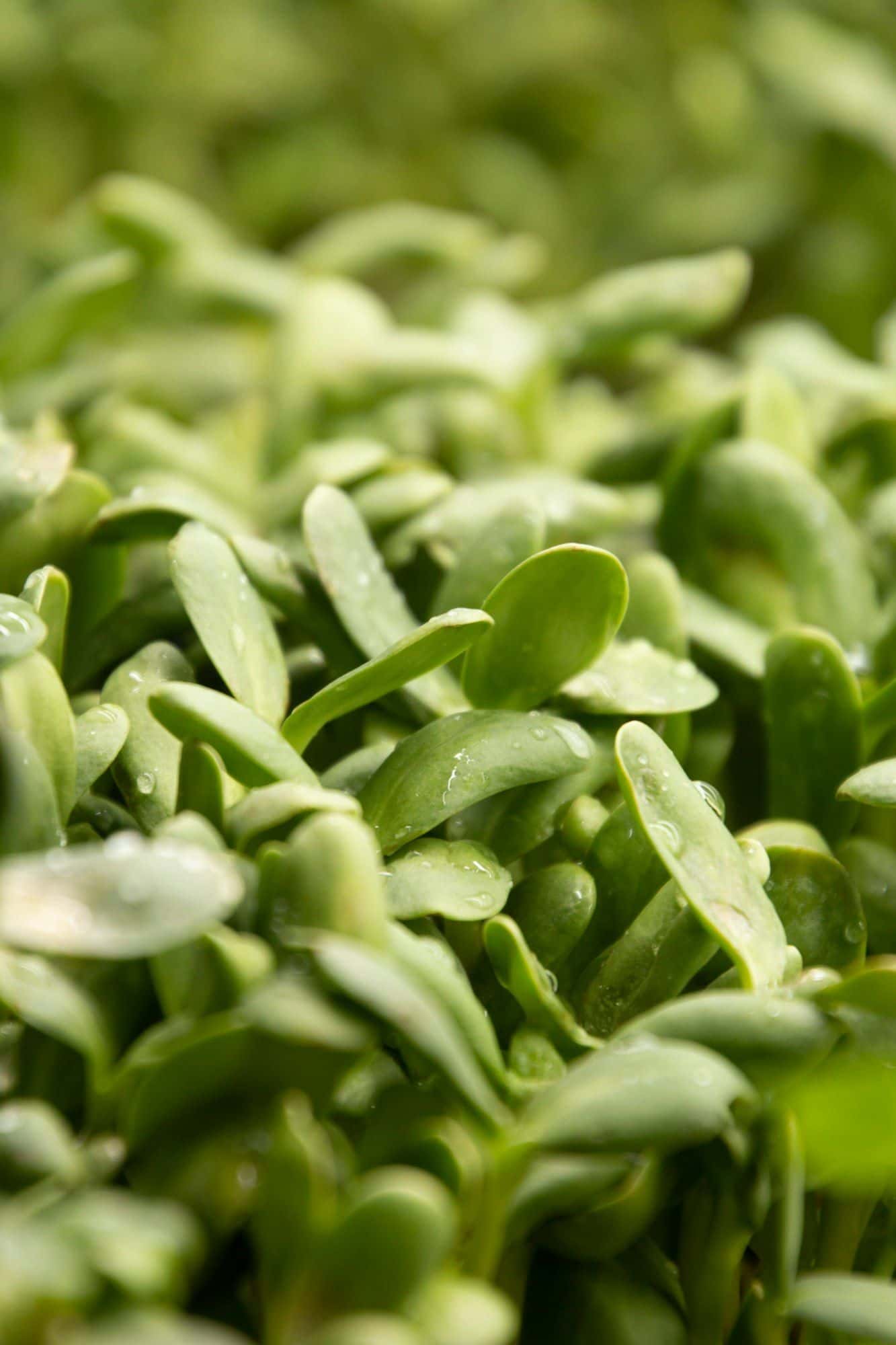
What sunflower microgreens are
They are young sunflower plants, the same species grown for oil and for the seeds sold as a snack. The harvest is the stem and the two fleshy cotyledons, cut before the first true leaves grow large. Sunflower shoots are thicker and juicier than brassica microgreens, so they hold up in a salad or sandwich instead of wilting. The taste is nutty with a fresh green finish. Researchers at Penn State used the 'Black oil' sunflower type in their 2023 microgreen trials, a small black-seeded type. In Hindi the plant is surajmukhi and in Marathi suryaphool.
Nutrition: what studies measured
In a 2025 study that grew six microgreens under identical conditions (broccoli, black radish, red beet, pea, bean and sunflower), Balik and colleagues found sunflower had the highest calcium of the six, and the highest fumaric acid. Sunflower was also one of ten culinary microgreens analysed by Ghoora and colleagues at the Sri Sathya Sai Institute of Higher Learning in India in 2020. Across those ten, the authors reported that the microgreens met 28–116% of the reference daily intake of vitamin C, 28–332% of vitamin E and 24–72% of vitamin A (as beta-carotene), depending on the species.
A 2023 Penn State study (Poudel and colleagues) tested soaking sunflower seed in zinc solutions before sowing. Seed soaked in a 200 ppm zinc sulphate solution produced microgreens with 3.32 times the zinc of the water-soaked control. That is a research method for biofortification, not something to try at home. These studies describe what the greens contain. They do not show that eating them treats any condition.
How to grow sunflower microgreens
Sunflower is one of the large seeds that benefits from soaking. Penn State Extension shows sunflower soaked for about 10 hours, and the University of Maryland lists it among seeds to soak for 6–12 hours. In the Penn State research trial, seed was soaked for 12 hours, sown at one seed per square centimetre in a peat and perlite mix, pressed with a weight, covered with black plastic, and harvested 9 days after sowing at about 25 °C.
- Rinse the seed, then soak it for 8–12 hours in drinking water. Rinse again once or twice during the soak.
- Fill a drained tray with 2.5–4 cm of moist soil mix or coco peat.
- Spread the soaked seed in a single, even layer, about 45 g for a 10×20-inch tray, so seeds touch but do not pile up.
- Mist, cover, and place a second tray or a light weight on top. Keep it dark.
- When the seeds have germinated and push against the weight, usually after 2–3 days, remove the weight and cover and give full light.
- Water from below. Harvest around day 9, when the seed leaves are open and before true leaves grow.
| Source | Soak | Seed rate | Harvest |
|---|---|---|---|
| Penn State research trial, 2023 | 12 hours | 1 seed per cm² | 9 days after sowing |
| Penn State Extension guide | About 10 hours | Not given | Not given |
| UMD Extension | 6–12 hours | Not given | 7–21 days (all microgreens) |
| Ghoora et al., cited in ICAR review | Not given | About 350 g/m² | Not given |
Tips specific to sunflower: hulls and weight

The black seed hull is the main nuisance. Penn State Extension recommends a weight on the tray during germination for sunflower and pea, both to keep seeds in contact with the medium and because keeping pressure on the shoots helps the hulls come off the cotyledons. A tray set on top with a brick or a few books works. For the seed rate, the ICAR review cites about 350 g of sunflower seed per square metre. The tray arithmetic: a 10×20-inch tray is 25.4 cm × 50.8 cm = 0.129 m², so 350 g/m² × 0.129 m² = about 45 g of seed. Brush off any hulls still attached before cutting, or rinse after harvest.
Common problems
Soaked seed sown thickly in a warm, still room can go mouldy before it sprouts. Penn State advises watering only when needed, letting trays drain and opening a window for air; UMD adds a small fan. Use drinking water for soaking and rinse the seed during the soak. A tray with musty grey growth should be discarded, not trimmed. Patchy germination can come from a medium that dried out on one side, so check moisture daily during the blackout. Stems that lean hard toward a window are short of light, as Penn State notes. Tall, thin, yellow stems mean the blackout ran too long.
How to eat sunflower microgreens, including Indian dishes
Because they are sturdy, sunflower shoots work where softer microgreens would collapse. Toss them with sprouted moong, onion, tomato, lemon and chaat masala for a quick chaat, or add them to a kachumber salad. Fold a handful into a vegetable sandwich or a frankie roll, top bhel just before serving, or scatter them over poha and upma once off the heat. They also stand up to a light toss in a hot pan for a few seconds at the end of a stir-fry. For a snack, eat them plain with a squeeze of lime and a pinch of salt. Rinse just before eating.
Fresh sunflower microgreens in Pune
Garden & Acre delivers fresh microgreens across Pune and Pimpri-Chinchwad from its own supply chain. Homes can take a weekly box or single-variety packs, and restaurants, cafés and hotels can take regular supply by weight on fixed delivery days. Sunflower is one of the usual core varieties, subject to what is available that week. Order on WhatsApp: tell us the varieties, quantity and delivery day, and we reply with availability, prices and the first delivery date.
Questions
Do I need to soak sunflower seeds for microgreens?
Yes. Sunflower is one of the larger seeds that germinates faster after soaking. Penn State Extension shows seed soaked for about 10 hours, UMD gives 6–12 hours, and the Penn State research trial used 12 hours. Rinse the seed during the soak so it gets some oxygen.
How do I get the hulls off sunflower microgreens?
Put a weight on the tray while the seeds germinate. Penn State Extension says the pressure keeps seeds in contact with the medium and helps the hulls detach from the seed leaves. Sow densely so the seedlings push against each other, and brush or rinse off any hulls left at harvest.
How many days do sunflower microgreens take?
About 9 days. In the 2023 Penn State trial, sunflower microgreens were harvested 9 days after sowing at an average greenhouse temperature of about 25 °C. Harvest when the two seed leaves are open and before the true leaves grow large. UMD Extension gives 7–21 days and 5–7.5 cm as the general microgreen stage, and sunflower sits at the fast end.
Can I use sunflower seeds from the grocery shop?
Roasted or salted kernels will not grow. Raw, whole seed may germinate, but its germination rate is unknown. Seed sold for microgreens or sprouting usually states a germination figure on the pack. The Penn State trial used seed with 90% germination, bought from a seed company. Do a small test tray first if you try shop seed.
Are sunflower microgreens good for you?
They are a nutritious vegetable. In a 2025 comparison of six microgreens, sunflower had the highest calcium. Studies measure what the greens contain; none shows that sunflower microgreens treat or prevent a disease. Eat them as part of a varied diet.
Sources
- Zinc biofortification through seed nutri-priming using alternative zinc sources and concentration levels in pea and sunflower microgreens — Poudel et al., Frontiers in Plant Science, 2023
- Nutritional quality profiles of six microgreens — Balik et al., Scientific Reports, 2025
- Nutrient composition, oxalate content and nutritional ranking of ten culinary microgreens — Ghoora, Babu & Srividya, Journal of Food Composition and Analysis, 2020
- Microgreens: Functional Food for Nutrition and Dietary Diversification — Seth et al., Plants, 2025 (ICAR)
- A Step-By-Step Guide for Growing Microgreens at Home — Penn State Extension
- Growing Microgreens and Baby Greens Indoors — University of Maryland Extension