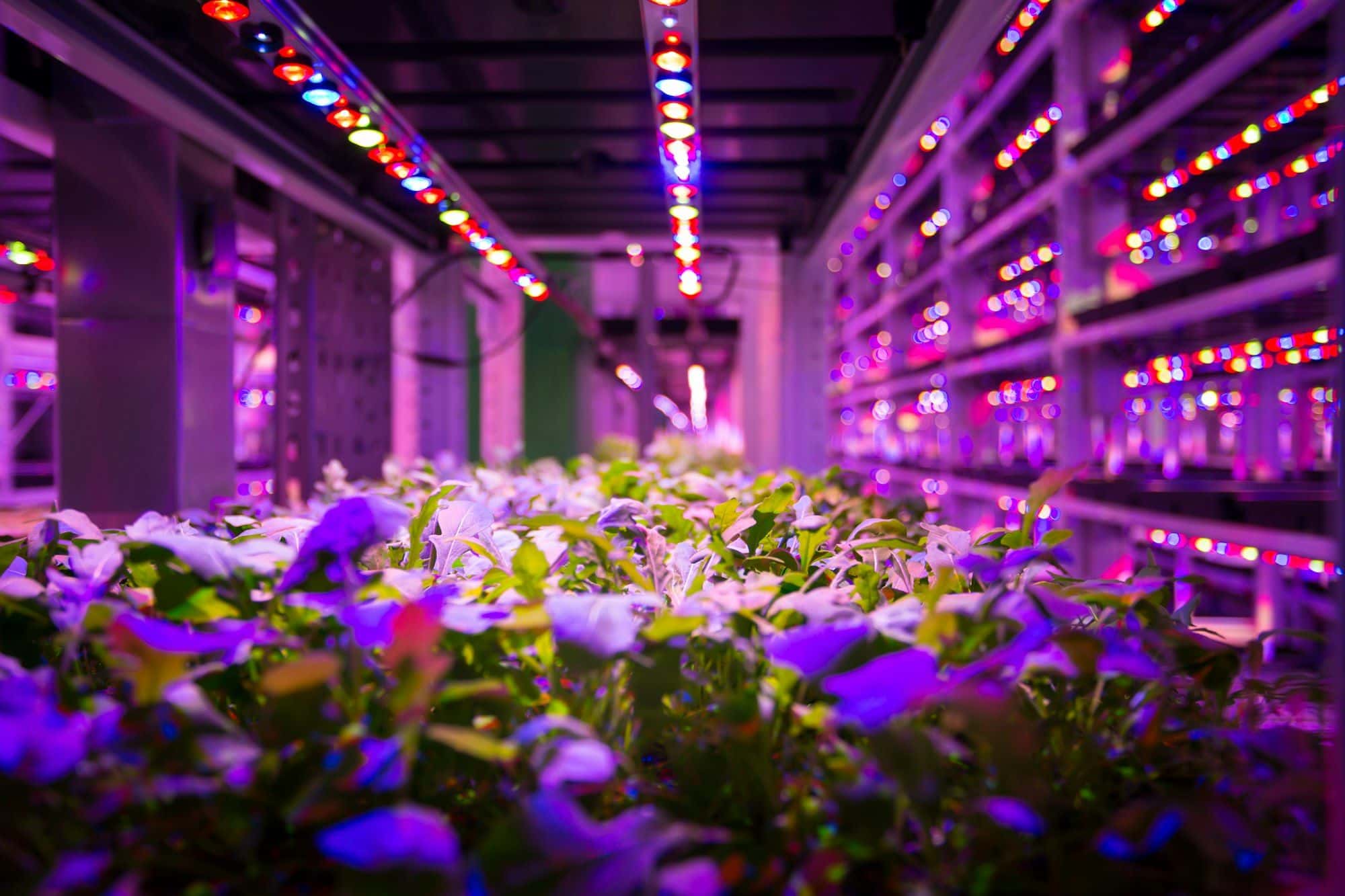
Why lighting decides the economics of a vertical farm
Indoors, every photon a plant uses comes from a lamp, and every lamp runs on bought electricity. A 2024 benchmarking study of vertical farms found that lettuce takes about 10 to 18 kWh of electricity per kg in current farms, with lighting taking 65 to 85 percent of the total. Most of the rest goes to cooling and dehumidification, and a large part of that cooling load is the heat from the lights themselves, because every watt a fixture draws ends up as heat in the room.
That makes the grow light the single most important equipment choice. A more efficient fixture cuts the lighting bill and the cooling bill together. A fixture that delivers light where the plants are, rather than onto aisles and walls, cuts it again. And setting the light dose to what the crop actually needs, rather than running lights at full power for long hours, avoids paying for light the plant cannot use.
PAR: the light plants use
Photosynthetically active radiation (PAR) is the waveband plants use for photosynthesis. The standard definition, ASABE S640, sets it at 400 to 700 nanometres (nm), from violet-blue to deep red. The DesignLights Consortium (DLC), which runs a widely used qualified products list for horticultural fixtures, uses this range for all its measurements. Wavelengths outside it, such as far-red (700 to 800 nm) and ultraviolet (280 to 400 nm), are not counted in its photon figures.
PAR is measured as a count of photons, not as brightness to the human eye. Lux and lumens weight light by how bright it looks to people, who see green best, so a lux meter or a lumen rating says little about how useful a lamp is to plants. Two lamps with the same lumen rating can deliver very different amounts of plant light. For grow lights, ask for photon figures in micromoles (µmol), measured with a quantum sensor or an integrating sphere.
PPF, PPFD and DLI explained
Three linked measures describe plant light. Photosynthetic photon flux (PPF) is the total PAR a fixture emits, in µmol per second. Photosynthetic photon flux density (PPFD) is how much of that arrives on each square metre of canopy per second, in µmol/m²/s; it is what a quantum sensor reads at plant height. Daily light integral (DLI) is the total PAR a square metre of canopy receives in a day, in mol/m²/day.
DLI links intensity to hours. The formula, as given by Hort Americas and Cornell University's Controlled Environment Agriculture group, is DLI = PPFD × hours of light × 3,600 ÷ 1,000,000, or more simply PPFD × hours × 0.0036. For example, 250 µmol/m²/s for 16 hours gives 250 × 16 × 0.0036 = 14.4 mol/m²/day. The same DLI can be reached with a lower PPFD over more hours, which lets a farm use fewer or smaller fixtures running longer.
- PPF: total plant light from a fixture, µmol/s
- PPFD: plant light arriving at the canopy, µmol/m²/s
- DLI: plant light per day, mol/m²/day = PPFD × hours × 0.0036
- PPE (photon efficacy): plant light per unit of electricity, µmol/J
Lettuce DLI and PPFD targets
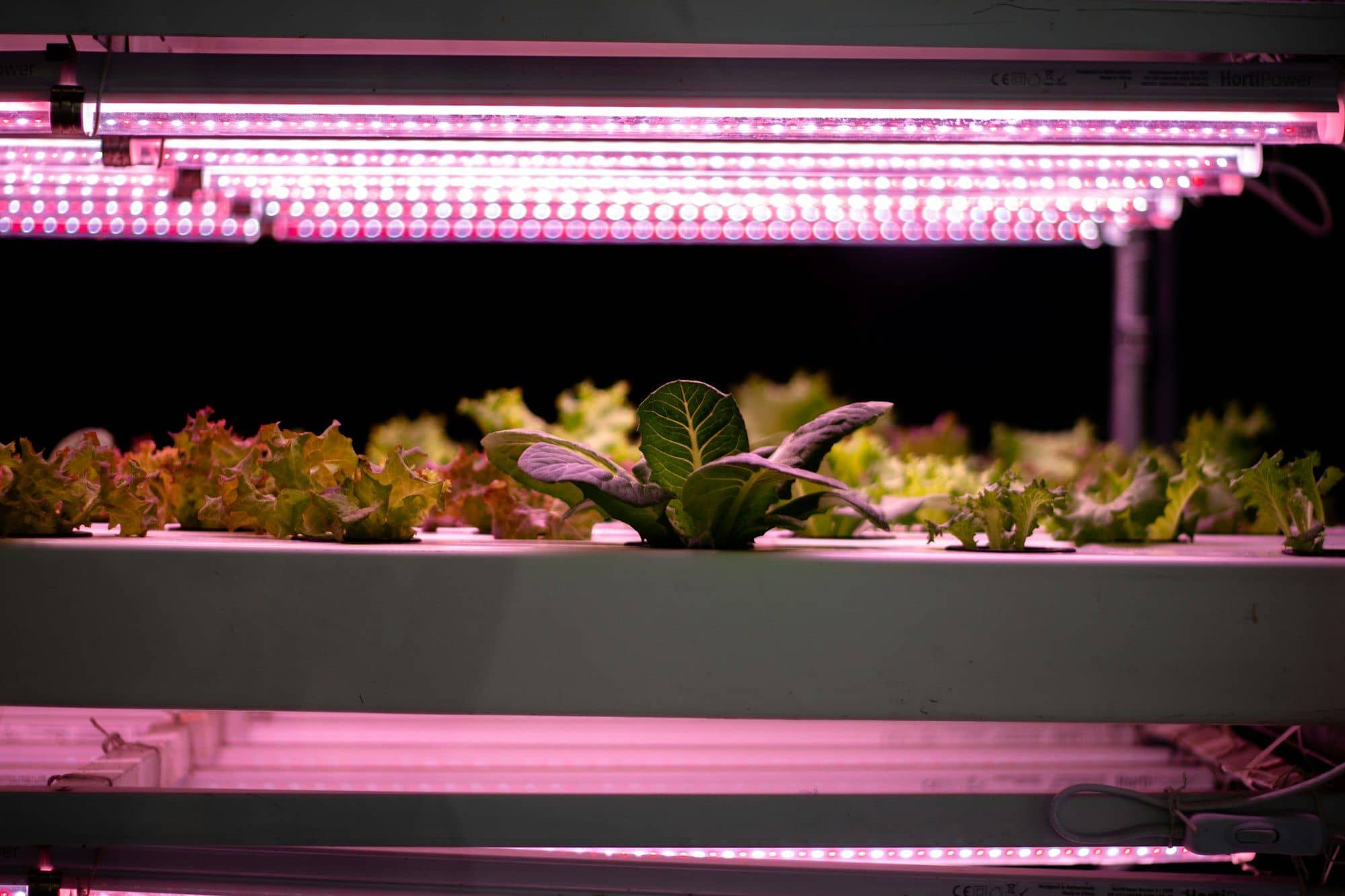
Cornell University's Controlled Environment Agriculture group, led by Neil Mattson, gives 12 mol/m²/day as the minimum DLI for lettuce and 17 mol/m²/day as the optimum for head lettuce, as summarised by Hort Americas. It also warns that a continuous DLI above 17 mol/m²/day for more than three days in a row can cause tipburn, the browning of young leaf edges. Going above the target costs more electricity and can lower quality.
The table converts those DLI targets into the PPFD needed at common photoperiods, using PPFD = DLI ÷ (hours × 0.0036). The table uses 16, 18 and 20 hours as examples of long indoor photoperiods. Longer photoperiods at lower PPFD need fewer photons per second, which lets you use fewer fixtures for the same daily dose. The trade-off is more hours of running time for pumps, fans and cooling, so the cheapest photoperiod depends on your tariff and the cost of the fixtures.
| Photoperiod | For DLI 12 (minimum) | For DLI 17 (optimum) |
|---|---|---|
| 16 hours | 12 ÷ 0.0576 = 208 µmol/m²/s | 17 ÷ 0.0576 = 295 µmol/m²/s |
| 18 hours | 12 ÷ 0.0648 = 185 µmol/m²/s | 17 ÷ 0.0648 = 262 µmol/m²/s |
| 20 hours | 12 ÷ 0.0720 = 167 µmol/m²/s | 17 ÷ 0.0720 = 236 µmol/m²/s |
Photon efficacy: µmol per joule
Photosynthetic photon efficacy (PPE) is the number of PAR photons a fixture produces for each joule of electricity, in µmol/J. Since one watt is one joule per second, a fixture's PPF divided by its wattage gives its PPE. It is the most useful single number for comparing grow lights, because it tells you how much plant light you get for your electricity bill.
In their 2020 review in Horticulture Research, Kusuma, Pattison and Bugbee reported that the best horticultural LED fixtures reached 2.5 to 3.0 µmol/J for blue and red designs and 2.6 to 2.8 µmol/J for white plus red designs, against 1.72 µmol/J for a 1,000 W double-ended high-pressure sodium (HPS) lamp. They estimated the practical ceiling at about 3.4 µmol/J for white plus red and 4.1 µmol/J for blue plus red. The DLC raised its minimum for qualified fixtures to 2.5 µmol/J under its Horticultural Technical Requirements V4.0, which took effect on 18 April 2025, an 8.7 percent increase over V3.0.
| Light source | Photon efficacy (µmol/J) | Source |
|---|---|---|
| 1,000 W double-ended HPS | 1.72 | Kusuma et al. 2020 |
| DLC V4.0 minimum for qualified LEDs | 2.5 | DLC, effective 18 April 2025 |
| Best white + red LED fixtures (2020) | 2.6–2.8 | Kusuma et al. 2020 |
| Best blue + red LED fixtures (2020) | 2.5–3.0 | Kusuma et al. 2020 |
| Estimated ceiling, white + red | 3.4 | Kusuma et al. 2020 |
| Estimated ceiling, blue + red | 4.1 | Kusuma et al. 2020 |
Spectrum: blue, red, white and far-red
Red LEDs are the most efficient photon source. Kusuma and colleagues measured red LED packages at 4.5 µmol/J, blue at 3.5 and white at 2.9 under test conditions, which is why many fixtures are built mainly from red with some blue. Blue light (400 to 500 nm) matters beyond photosynthesis: Park and Runkle of Michigan State University report that blue suppresses stem extension and raises leaf chlorophyll, so plants grow more compact and darker green.
White LEDs make the room look normal, which helps workers spot pests, disease and nutrient problems. In a 2018 PLOS ONE study, Park and Runkle found seedlings under white LEDs grew much like those under blue plus red at the same PPFD, with far better colour rendering; the blue plus red fixtures in that study were more efficient (2.25 µmol/J against 1.51 to 2.13), but growth per unit of electricity was comparable. Far-red light (700 to 800 nm) promotes leaf expansion and stem elongation, so leaves catch more light; the same researchers found it can also make leaves slightly paler. DLC excludes far-red from its efficacy figures, so a fixture with far-red can look less efficient on paper than it performs.
- Red (600–700 nm): the most efficient LEDs; drives photosynthesis
- Blue (400–500 nm): compact plants, darker leaves; less efficient than red
- White (broad spectrum): easier crop inspection and a natural look; slightly less efficient
- Far-red (700–800 nm): larger leaves, more elongation; not counted in PPF or PPE
Worked example: electricity cost per shelf per day
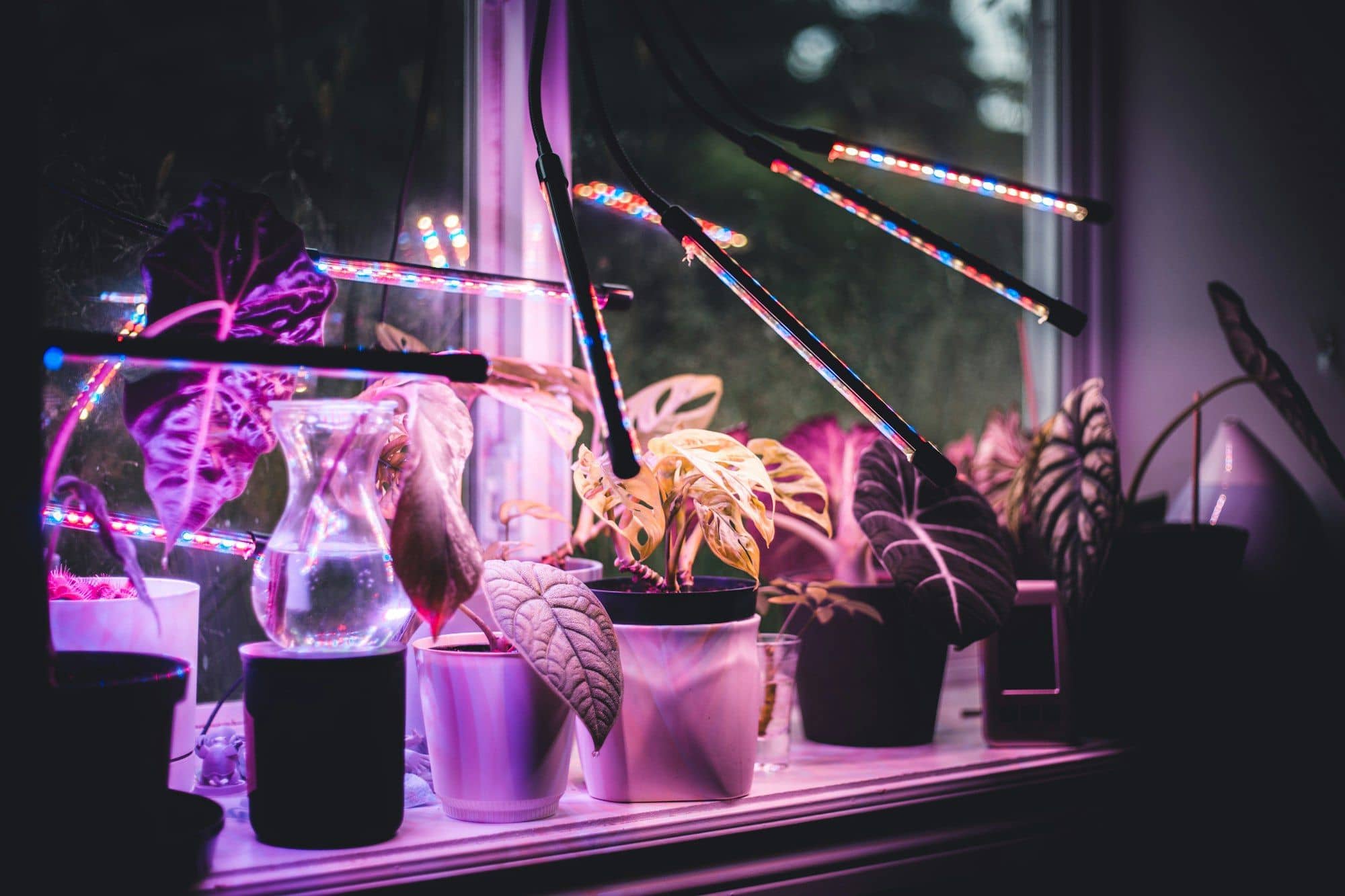
Take one shelf of 2.4 m × 1.2 m = 2.88 m² of lettuce, lit for 16 hours a day to the optimum DLI of 17 mol/m²/day. The PPFD needed is 17 ÷ (16 × 0.0036) = 295 µmol/m²/s. Photons needed on the shelf each second: 295 × 2.88 = 850 µmol/s. With LED fixtures at the DLC minimum of 2.5 µmol/J, electrical power = 850 ÷ 2.5 = 340 W. Energy per day = 340 W × 16 hours = 5,440 Wh = 5.44 kWh.
At the Maharashtra small commercial tariff approved by MERC for 2026-27, ₹8.51 energy + ₹1.60 wheeling = ₹10.11 per kWh, the lighting cost is 5.44 kWh × ₹10.11 = ₹55.0 per shelf per day, or ₹55.0 × 30 = ₹1,650 per 30-day month. This assumes every photon lands on the canopy; in practice some light falls on aisles and walls, so real wattage is higher. Fixed charges, electricity duty and fuel adjustment charges are extra.
Lighting is only part of the bill. If lighting is 65 to 85 percent of total electricity, as the 2024 benchmarking study found, the shelf's total share is 5.44 ÷ 0.85 = 6.4 kWh to 5.44 ÷ 0.65 = 8.4 kWh a day, or 6.4 × ₹10.11 = ₹64.7 to 8.4 × ₹10.11 = ₹84.9 per day including cooling and fans.
| Case | PPFD | Fixture watts | kWh per day | ₹ per day |
|---|---|---|---|---|
| DLI 17, LED at 2.5 µmol/J | 295 | 850 ÷ 2.5 = 340 W | 340 × 16 = 5.44 | 5.44 × 10.11 = ₹55.0 |
| DLI 12, LED at 2.5 µmol/J | 208 | 600 ÷ 2.5 = 240 W | 240 × 16 = 3.84 | 3.84 × 10.11 = ₹38.8 |
| DLI 17, HPS at 1.72 µmol/J | 295 | 850 ÷ 1.72 = 494 W | 494 × 16 = 7.90 | 7.90 × 10.11 = ₹79.9 |
How to buy LED grow lights for a vertical farm
Ask every supplier for a test report that gives the fixture's PPF in µmol/s, its input wattage and its PPE in µmol/J, and the spectrum. Be wary of lights sold only on wattage, lux, lumens or LED count, none of which tells you how much plant light you get. A DLC-listed fixture has been independently tested against these measures, which is a useful check even outside North America.
Then match the fixture to the shelf. In a multi-tier rack the lights sit close to the plants, so bar-style fixtures with even spread across the shelf work better than a few high-power points. Plan the driver location and heat path too: LEDs lose efficiency and life when they run hot, and Kusuma and colleagues list thermal management as one of the main gaps between tested packages and real fixtures.
- PPE of 2.5 µmol/J or better (DLC V4.0 minimum)
- PPF and PPFD map for your shelf size and hanging height
- Spectrum suited to the crop, with enough blue for compact leafy greens
- Dimmable drivers, so you can set PPFD to the DLI target
- Heat sinking and a warranty that covers Indian room temperatures
- IP-rated (water-resistant) housings for humid grow rooms
Running LED grow lights in Indian conditions
In India, cooling is the hidden cost of lighting. Every watt of LED power becomes heat that the air conditioner must remove, and outside temperatures in summer make that harder. Running the photoperiod at night, when outside air is cooler, reduces the load on cooling. Dimming to the DLI the crop needs, rather than running lights at full output, saves power twice: once at the fixture and again at the air conditioner.
Tariffs differ by state, category and sanctioned load, so repeat the shelf arithmetic with your own rate. Larger farms with loads above 20 kW move into higher slabs; in Maharashtra, MERC's 2026-27 energy charge for the next non-residential slab (above 20 kW and up to 50 kW) is ₹12.40 plus ₹1.52 wheeling per unit, billed in kVAh. At that rate, the example shelf's lighting cost rises to 5.44 × ₹13.92 = ₹75.7 per day.
Lighting design for vertical farms by Garden & Acre
Garden & Acre designs and builds indoor vertical farms for rooftops, warehouses, campuses, hotels, schools and cafés, including the lighting plan: crop DLI targets, fixture selection by photon efficacy, shelf layout and the matching cooling load. The same arithmetic shown on this page is done for each project with the site's own tariff and crop plan. Projects are priced in a written proposal after an initial call, and include commissioning and first-crop support.
Questions
What PPFD does lettuce need in a vertical farm?
Lettuce needs a daily light integral of at least 12 mol/m²/day, with 17 mol/m²/day the optimum for head lettuce according to Cornell. At a 16-hour photoperiod that is about 208 to 295 µmol/m²/s; at 20 hours it is about 167 to 236 µmol/m²/s. Staying above 17 mol/m²/day for more than three days can cause tipburn.
What is DLI and how do I calculate it?
Daily light integral (DLI) is the total photosynthetic light a square metre of canopy receives in a day, in mol/m²/day. Calculate it as PPFD × hours of light × 0.0036. For example, 250 µmol/m²/s for 16 hours gives 250 × 16 × 0.0036 = 14.4 mol/m²/day. Plants respond to the daily total, so intensity and hours can be traded.
What does µmol/J mean on a grow light?
µmol/J is photosynthetic photon efficacy: how many micromoles of plant-usable photons (400 to 700 nm) a fixture produces per joule of electricity. Higher is better. The DesignLights Consortium requires at least 2.5 µmol/J for qualified fixtures from April 2025, and the best LED fixtures reported in 2020 reached 2.5 to 3.0 µmol/J, against 1.72 for a 1,000 W HPS lamp.
Are red and blue LEDs better than white LEDs for growing?
Red and blue LEDs are usually slightly more efficient because red LEDs are the most efficient photon source. White LEDs grow plants about as well at the same light level and make it much easier to see pests and disease. A 2018 Michigan State study found similar seedling growth under both, with better colour rendering under white. Many modern fixtures combine white with extra red.
How much electricity does a grow light shelf use per day?
A 2.4 m × 1.2 m lettuce shelf lit to 17 mol/m²/day over 16 hours needs about 850 µmol/s of light. At 2.5 µmol/J that is 340 W, and 340 W × 16 hours = 5.44 kWh a day. At ₹10.11 per kWh, 5.44 × ₹10.11 = ₹55 a day for lighting alone, before cooling, fixed charges and duties.
Does far-red light help vertical farm crops?
Far-red light (700 to 800 nm) promotes leaf expansion and stem elongation, so plants catch more light and can grow larger. It can also make leaves slightly paler. It is not counted in PAR-based measures such as PPF and PPE, so fixtures with far-red may look less efficient on paper. Blue light counteracts some of the stretching effect.
Sources
- Kusuma, Pattison and Bugbee (2020), From physics to fixtures to food: current and potential LED efficacy, Horticulture Research
- DesignLights Consortium: Horticultural Technical Requirements V4.0
- DesignLights Consortium (2021): Limitations of Predicting Far-Red's Effect on Photosynthesis
- Hort Americas: Daily Light Integral, are your plants receiving the right amount of light?
- Park and Runkle (2018), Spectral effects of light-emitting diodes on plant growth, visual color quality, and photosynthetic photon efficacy, PLOS ONE
- Park and Runkle (2019), LEDs: Blue and Far-Red Light, GrowerTalks
- Benchmarking energy efficiency in vertical farming: status and prospects (2024)
- MERC tariff order, Case No. 75 of 2025 (25 March 2026), MSEDCL