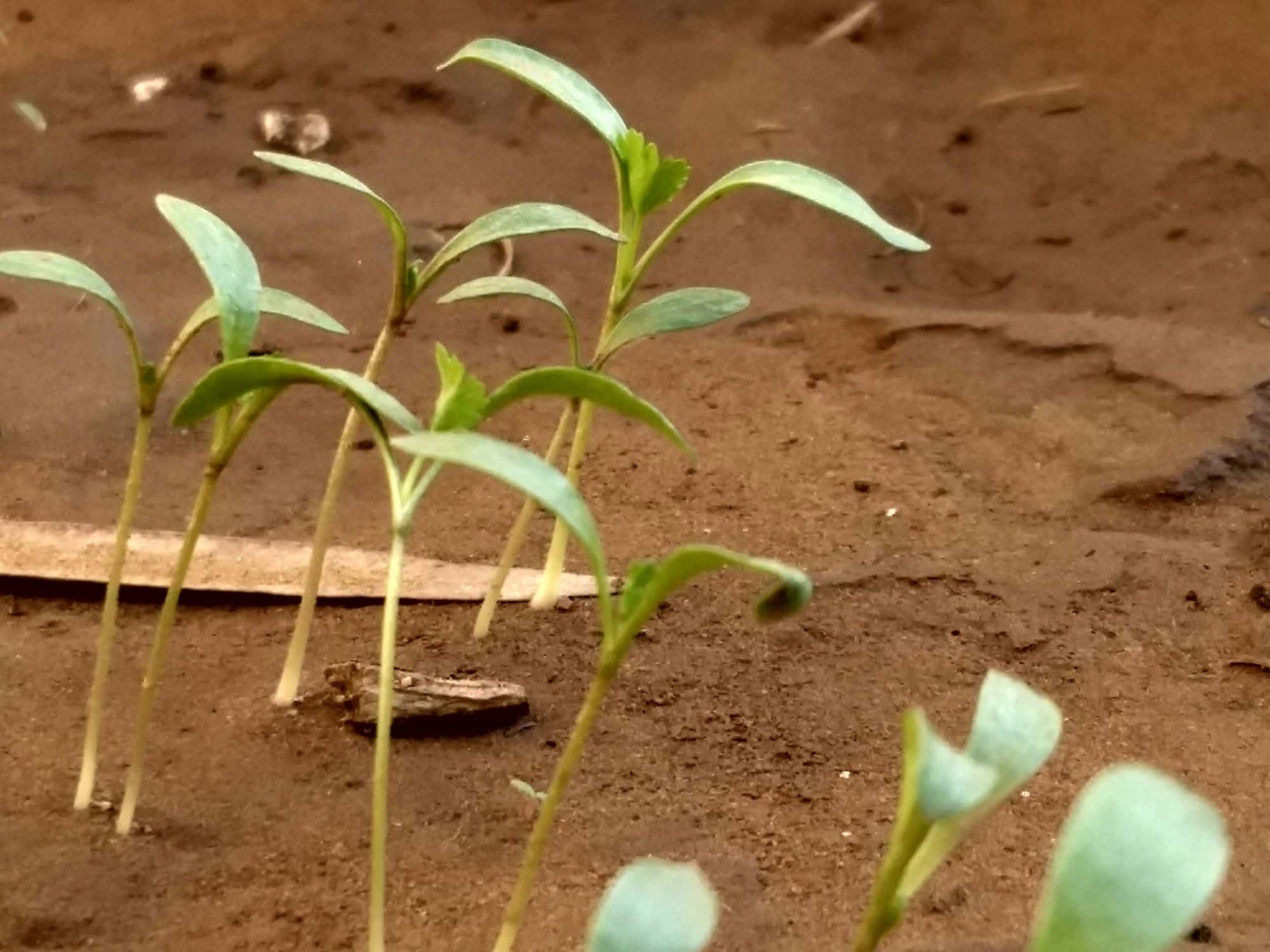
What coriander microgreens are
Coriander microgreens are the first seedling stage of the herb Indians call dhania or kothimbir. They are cut when the two narrow seed leaves have opened and the first true leaf, with its familiar lobed shape, is just appearing. The taste is recognisably coriander, fresh and citrusy, but softer than the mature leaf. The stems are thin and tender, so the whole microgreen is eaten.
They are one of the slowest common microgreens. The Seth et al. 2025 review of microgreen research lists coriander among crops harvested 16 to 18 days after sowing, while radish, mustard and mung bean appear among crops cut at 6 to 12 days. Penn State Extension recorded the lowest yield of 18 microgreens for cilantro: 46.8 g per tray, against 147.6 g for arugula grown the same way.
What studies have measured
Xiao and colleagues, working with the USDA Agricultural Research Service, measured vitamins and carotenoids in 25 commercial microgreens in 2012. Cilantro had the highest carotenoid concentrations of the 25. As summarised in the 2025 Seth et al. review, it contained 10.1 mg of lutein and zeaxanthin and 7.7 mg of violaxanthin per 100 g fresh weight. The same study found that microgreens as a group had higher vitamin and carotenoid densities than the mature leaves listed in the USDA nutrient database.
A Cypriot study published in Antioxidants in 2020 grew coriander microgreens on five substrates and measured minerals, nitrate and phenolic compounds. A 2019 paper by the same group notes that coriander's phenolic profile, dominated by flavonol glycosides, stays broadly similar from the microgreen stage to the mature plant. These are measurements of composition. They do not show that eating coriander microgreens prevents or treats any condition.
| Measure | Coriander | Arugula | Source |
|---|---|---|---|
| Days to harvest in studies | 16–18 | 6–21 | Seth et al. 2025 |
| Yield per tray, same method | 46.8 g | 147.6 g | Penn State Extension |
| Carotenoids among 25 microgreens | Highest | Not highest | Xiao et al. 2012 |
Why coriander is slow, and splitting the seed
What is sold as coriander seed is a dry fruit called a schizocarp, made of two halves, or mericarps, each holding one seed. A review of the species in Molecules describes the seeds as dry schizocarps with two mericarps. Whole fruits have a hard shell and take up water slowly. In the Cypriot trial, coriander germinated more slowly than pak choi and kohlrabi on every substrate, although once up, it grew faster than both over the next few days.
Many growers split the fruits before sowing so each half can take up water directly. Place the seed on a board and press gently with a rolling pin or the flat of a bowl until most fruits break into two half-moons. Press lightly; the aim is to separate the halves, not crush the seed inside. Then soak the split seed briefly in clean water and drain.
How to grow coriander microgreens
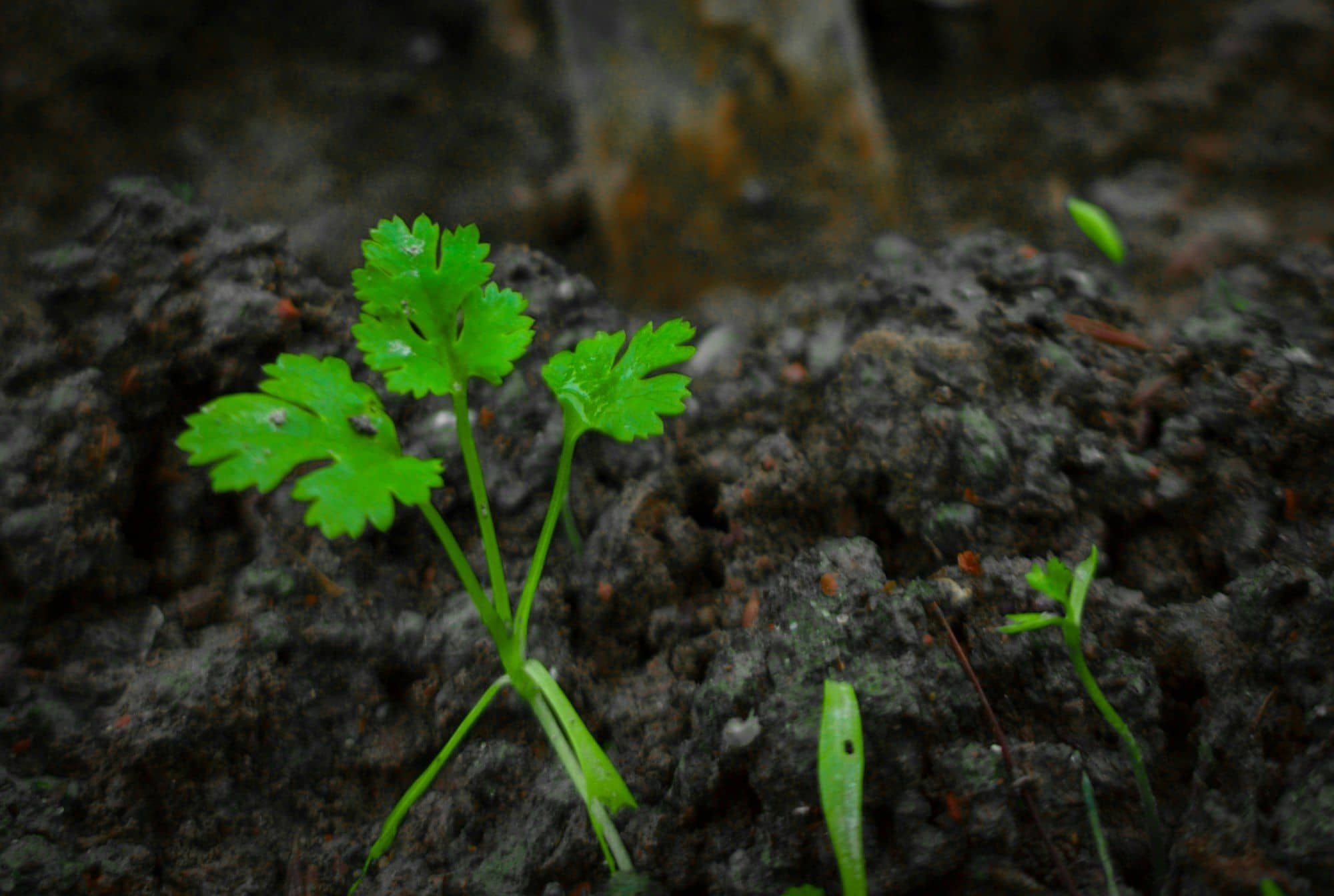
Coriander needs patience more than skill. The Cypriot researchers sowed about 46,000 seeds per square metre and germinated them in darkness at 24°C and high humidity, then grew them under a 12-hour light period. With a hundred-seed weight of 0.684 g, 46,000 seeds weigh 46,000 × 0.00684 g = about 315 g. A 10×20-inch tray covers 0.129 m², so 315 × 0.129 = about 41 g of seed per tray.
- Split the fruits gently, then soak them briefly and drain.
- Fill a tray with 3–4 cm of moist peat-based mix or fine soil.
- Sow about 41 g per 10×20-inch tray and cover with a thin layer of mix.
- Keep dark and evenly moist until most seeds have germinated.
- Move to bright light for 12–16 hours a day and water from below.
- Harvest at 16–18 days, when the first true leaves appear.
Common problems
The long cycle is what causes most trouble with coriander. Seed that sits damp in the dark for a week or more gives mould and damping-off more time to start, and Penn State notes that warm, humid conditions favour damping-off. Keep the medium moist rather than wet, use fresh mix for each tray, and uncover as soon as germination is general rather than waiting for every seed.
- Very patchy germination: whole, unsplit fruits or old seed; split the seed and buy fresh stock.
- Mould before emergence: medium too wet or too warm; water less and improve airflow.
- Thin, floppy stems: not enough light after uncovering.
- Low weight per tray: normal for coriander; it yields far less than pulses or brassicas.
Using coriander microgreens in food
Use coriander microgreens anywhere you would use chopped coriander, but add them whole and at the last minute. They suit poha, upma, misal, pav bhaji, dal, sambar and khichdi as a finishing garnish, and they lift chaat, bhel and sev puri. Blend them into green chutney with mint, green chilli and lime, or scatter them over raita, dosa and uttapam. The flavour is gentler than mature coriander, so they can be used more generously. Store them cold and dry, and wash just before use.
Coriander microgreens delivery in Pune
Garden & Acre delivers fresh microgreens in Pune and Pimpri-Chinchwad, as a weekly subscription for homes and as regular supply for restaurants, cafés and hotels. The microgreens come from our own supply chain. Orders are placed on WhatsApp, and prices are given there. Because coriander takes more than two weeks to grow, ask on WhatsApp which weeks it is available and we will tell you what we can supply.
Questions
Why are coriander microgreens so slow to grow?
Each coriander 'seed' is a hard dry fruit with two seeds inside, so it takes up water slowly. In a 2020 trial it germinated more slowly than pak choi and kohlrabi on every growing medium tested. Research reviews list coriander among microgreens harvested 16 to 18 days after sowing, about twice as long as mustard or radish.
Should I split coriander seed for microgreens?
Most growers do. The fruit is made of two halves, each with one seed. Pressing the fruits gently with a rolling pin separates the halves so each can absorb water directly. Press lightly so you separate the halves without crushing the seed. Then soak briefly, drain and sow.
Are coriander microgreens nutritious?
In the USDA-led study of 25 microgreens by Xiao and colleagues in 2012, cilantro had the highest carotenoid concentrations, including 10.1 mg of lutein and zeaxanthin per 100 g fresh weight. That is a measured concentration. How much you get depends on how much you eat, and a garnish is a small amount.
How much coriander seed do I need per tray?
One trial sowed about 46,000 seeds per square metre. At 0.684 g per hundred seeds, that is about 315 g per m², or 315 × 0.129 = about 41 g for a 10×20-inch tray. Split seed covers more surface than whole fruits, so spread it evenly in one layer.
What is coriander called in Marathi?
Coriander leaf is kothimbir in Marathi and dhania or dhaniya in Hindi. In American English the fresh leaf is called cilantro, which is why the USDA study lists 'cilantro' microgreens. All of these names refer to the same plant, Coriandrum sativum.
Can I grow coriander microgreens from kitchen dhania seeds?
Often, yes, if the seed is whole, fresh and untreated. Kitchen dhania may be old or stored warm, which lowers germination. Test a small batch first by splitting, soaking and keeping it moist for a week. Penn State advises avoiding pesticide-treated seed for any microgreen.
Sources
- Xiao et al. 2012, Assessment of vitamin and carotenoid concentrations of emerging food products: edible microgreens (J Agric Food Chem)
- USDA ARS: Specialty Greens Pack a Nutritional Punch (2014)
- Seth et al. 2025, Microgreens: functional food for nutrition and dietary diversification (Plants)
- Kyriacou et al. 2020, Phenolic constitution, phytochemical and macronutrient content in three species of microgreens as modulated by natural fiber and synthetic substrates (Antioxidants)
- Kyriacou et al. 2019, Genotype-specific modulatory effects of select spectral bandwidths on the nutritive and phytochemical composition of microgreens (Front Plant Sci)
- Mahleyuddin et al. 2021, Coriandrum sativum L.: a review on ethnopharmacology, phytochemistry, and cardiovascular benefits (Molecules)
- Penn State Extension: Growing Microgreens