Plant library · Office
Rubber plant
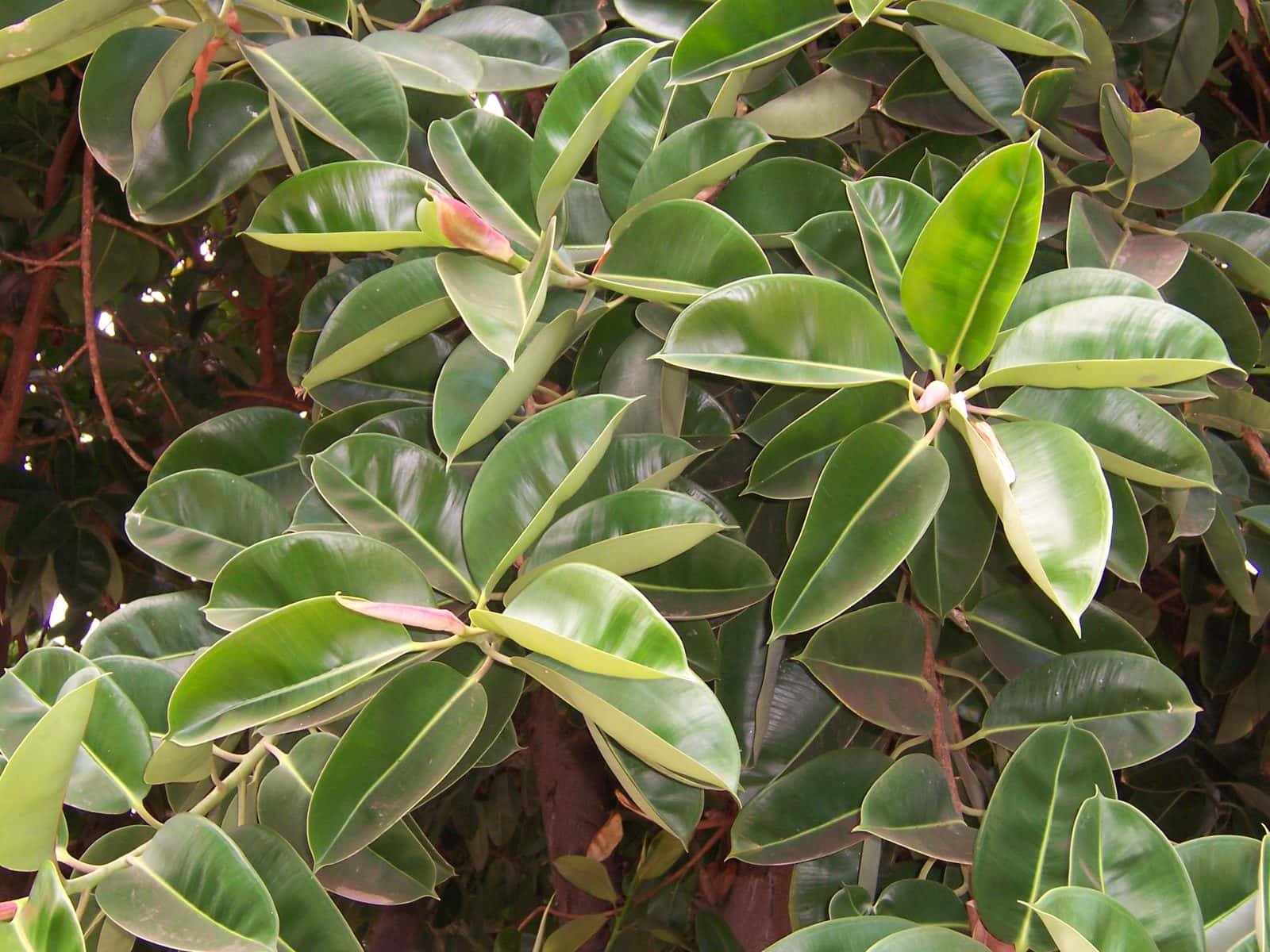
The rubber plant is a fig native to north-east India and South-East Asia, where it grows into a large tree. Indoors it is kept as a single upright stem or a small branched tree with large, thick, glossy leaves. It needs more light than the low-light plants and drops leaves if moved suddenly or kept too wet.
Ficus elastica · Rubber tree · Indian rubber tree · Rubber fig · Ficus elastica Burgundy · Ficus elastica Tineke
Size
1–2.5 m indoors
Growth
Moderate
Leaf
Evergreen
Light
Bright indirect light, within 1–2 m of a window. It tolerates medium light but then grows slowly with widely spaced leaves. Variegated and burgundy forms need the brightest spots to keep their colour.
Water
Water when the top 4–5 cm of mix is dry: about every 7–10 days in an AC office, every 2–3 weeks in winter. Overwatering causes yellowing and leaf drop.
Potting mix
Well-drained potting mix with cocopeat, compost and some coarse sand or perlite, in a heavy pot with a drainage hole to keep a tall plant stable.
01
How to recognise Rubber plant
Family Moraceae
- aLeaves are large, 15–30 cm, thick, leathery and glossy, oval with a short pointed tip, arranged alternately along the stem.
- bNew leaves unfurl from a red or pink sheath at the growing tip, which falls off as the leaf opens.
- cColour varies by variety: dark green, deep burgundy-black ('Burgundy', 'Black Prince'), or green with cream and pink variegation ('Tineke', 'Ruby').
- dCut or broken stems and leaves leak white, sticky milky sap (latex).
- eOften confused with the fiddle-leaf fig (Ficus lyrata), which has wavy, violin-shaped leaves with prominent veins, and with ficus 'Audrey' (Ficus benghalensis), which has velvety leaves with pale veins.
02
Rubber plant in your city
Indoor conditions differ from city to city: dry air, long air-conditioning seasons, humidity and dust.
Grows steadily in bright offices all year. Reduce watering during the monsoon, when the mix dries slowly.
Handles dry air better than thinner-leaved plants, but dust builds up fast on the large leaves, so they are wiped every week or two. Keep it away from heaters in winter.
Does well in bright offices. Avoid placing it directly under AC outlets.
Cold drafts near entrances in winter cause leaf drop. Keep it in a warm, bright interior spot and water sparingly from December to February.
Humidity suits it. Take care not to overwater in the monsoon, when the mix stays wet for a long time.
Mild indoor conditions give steady growth; it may need pruning to keep its height in check.
Handles the dry heat indoors if kept in bright indirect light and away from hot glass.
Its thick leaves cope with dry summer air. Dust settles quickly, so wipe leaves often and keep it out of direct AC airflow.
Humid air suits it. Water less often than in dry cities and make sure pots drain freely during the monsoon.
03
Where it fits
- Reception areas and lobbies near large windows, as a bold single floor plant.
- Corners of cabins and meeting rooms that get good daylight.
- Beside glass facades along workstation rows, as a tall green accent.
- Breakout and cafeteria areas with good natural light.
04
Care
- Water thoroughly when the top few centimetres are dry and empty any water left in the outer pot.
- Wipe each leaf with a damp cloth every one to two weeks; clean leaves look better and take in more light.
- Rotate the pot every few weeks to keep the stem straight.
- Prune the tip in spring to make it branch or to control height; wear gloves, as the sap irritates skin.
- Feed monthly with a balanced fertiliser from March to September.
05
Common problems
- Leaf drop after moving — sudden changes in light or temperature make it shed lower leaves; place it well and avoid moving it again, and it usually settles within a few weeks.
- Yellow lower leaves — usually overwatering or poor drainage; let the mix dry further between waterings.
- Brown patches or crisp edges — dry mix, cold drafts or heat from sunny glass; move it and keep watering even.
- Scale and mealybug — brown bumps or white cotton on stems and leaf undersides, often with sticky leaves; wipe off with alcohol on a cotton bud and treat with neem oil weekly.
06
Questions
Is the rubber plant toxic to pets or people?
Its milky sap irritates skin and eyes and can cause mouth irritation and stomach upset in pets or children if chewed. People with latex allergy may react to the sap. Wear gloves when pruning and keep it away from pets that chew leaves.
How much light does a rubber plant need indoors?
Bright indirect light, ideally within one or two metres of a window. In dim corners it survives but stretches, with small leaves spaced far apart, and variegated forms lose their colour.
Why is my rubber plant dropping leaves?
The common causes are a recent move, cold air from an AC vent or open door, overwatering, or a sudden fall in light. Find the cause, fix it and avoid moving the plant again while it recovers.
How tall does a rubber plant get in an office?
Usually one to two and a half metres. It can reach the ceiling in a few years in good light, but pruning the growing tip keeps it at the height wanted and makes it bushier.
Begin with a visit
Request a proposal
Tell us about the space, or send photos on WhatsApp. We send a written proposal with a fixed price.
hi@gardenandacre.com