Plant library · Hedges · Terrace
Duranta
Duranta is a fast-growing evergreen shrub from the Americas that has become one of the most widely planted hedge plants in India, especially its lime-yellow form sold as golden duranta. It takes clipping well and fills in quickly. It is not native, and its orange berries are poisonous to people and pets, so we clip it before berries form where children or animals play. It also grows well in containers on terraces.
Duranta erecta · Duranta · Golden duranta · Golden dewdrop · Sky flower · Pigeon berry
Size
Kept at 0.6–1.5 m as a hedge; 2–4 m if left unpruned
Growth
Fast
Leaf
Evergreen
Sun
Full sun for the best colour on golden forms; tolerates partial shade but grows leggy
Water
Moderate; regular watering in summer, less in winter
Soil
Most well-drained garden soils; in containers a free-draining mix with compost
01
How to recognise Duranta
Family Verbenaceae
- aLeaves are small, oval and opposite, often lightly toothed near the tip; golden forms have lime-yellow leaves and variegated forms have cream edges.
- bStems are slender and arching, and some plants carry small sharp spines.
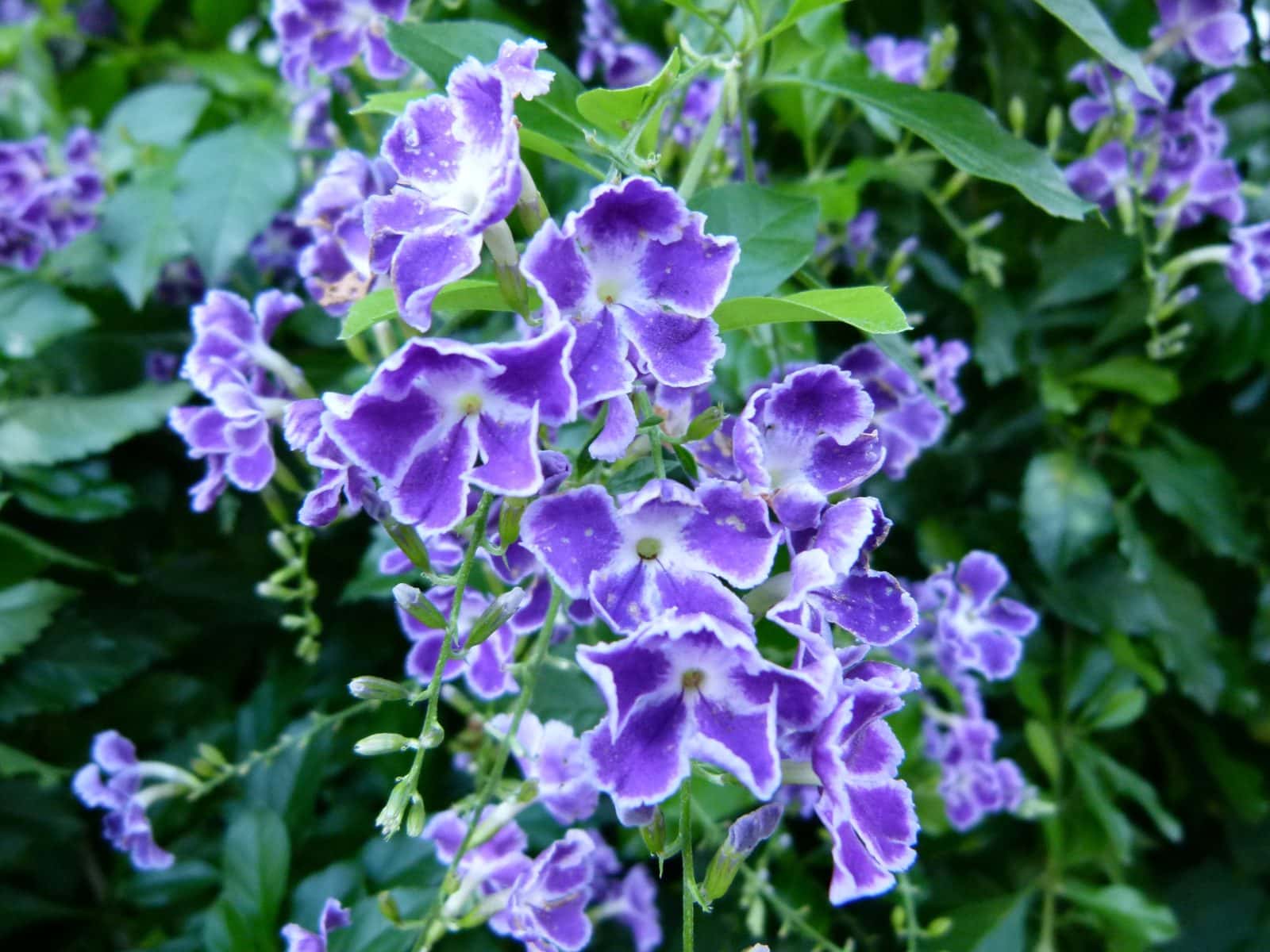
- cFlowers are small, lilac-blue to purple or white, in hanging clusters, seen mainly on unclipped plants.
- dBerries are small, round and orange-yellow, in drooping bunches, following the flowers.
- eClipped hedges show dense, bright foliage with few or no flowers.
- fOften confused with golden privet or lantana in hedges; lantana has rough, strongly scented leaves and flat-topped multicoloured flower heads.
02
Duranta in your city
How it grows in each city we work in, and what we do differently there.
Grows easily in Pune and is widely used in society hedges. Needs clipping every three to four weeks through the monsoon.
Grows well through the warm months, but frost in December–January can scorch the leaves of golden forms. It recovers after a spring trim; water well in the 45°C heat.
Grows well in the region. On black cotton soil we improve drainage in the hedge trench so roots do not stay wet.
Frost can brown the foliage in December–January. Plant in a sunny, sheltered line and trim off damaged growth in February–March.
Grows well in Mumbai and handles some salt air, though leaves on sea-facing hedges can scorch. Needs frequent clipping in the monsoon.
Grows well year-round in the mild climate. Common in apartment and campus hedges.
Handles the hot Deccan summer with regular watering. Golden forms colour best in full sun.
Survives the 45°C summers with regular irrigation, but leaves can scorch in hot winds. Mulch the hedge line and water deeply.
Grows fast in the warm, humid climate. Keep the hedge line well drained to avoid root rot in heavy rain.
03
Where it fits
- Clipped low to medium hedges along paths, lawns and driveways.
- Colour hedges and edging with golden or variegated forms.
- Containers and planters on terraces and balconies, clipped to shape.
- Informal screens where the plant can be left to flower, away from play areas.
04
Care
- Clip every three to four weeks in the growing season and every six to eight weeks in winter; keep the base slightly wider than the top so light reaches the lower leaves.
- Clip regularly where children or pets play, so the plant does not flower and set poisonous berries.
- Water regularly in summer and allow the topsoil to dry between waterings in winter.
- Feed with compost or a balanced fertiliser before the monsoon and again after winter.
- Wear gloves when clipping forms with spines, and clear the clippings.
05
Common problems
- Poisonous berries — orange berries on unclipped plants are toxic to people and pets if eaten; clip off flowers and berries near play areas, or choose a different hedge plant there.
- Mealybugs and whitefly — white cottony clusters or tiny white flies, often with sooty mould; wash with water and use neem oil or insecticidal soap.
- Bare base — lower stems lose leaves when the hedge is clipped wider at the top; trim with a slight taper and cut back hard in spring if needed.
- Frost scorch — browned leaves after cold nights in north India; wait for new growth in spring and trim off damaged parts.
06
Questions
Is duranta poisonous?
Yes. The berries, and to a lesser extent the leaves, are poisonous to people, dogs and cats if eaten. Keep hedges clipped so they do not set berries where children or pets play.
How often should a duranta hedge be clipped?
Every three to four weeks in the monsoon and summer growing season, and every six to eight weeks in winter.
Is duranta native to India?
No. Duranta erecta is native to the Americas and is grown in India as an ornamental. For native hedges we suggest species such as kamini (Murraya paniculata).
Why is my golden duranta turning green?
Golden forms lose colour in shade. Move future plantings into full sun; clipping also brings out new growth, which is the brightest.
Also used for hedges
Guides that mention Duranta
Begin with a visit
Request a proposal
Tell us about the space, or send photos on WhatsApp. We send a written proposal with a fixed price.
hi@gardenandacre.com