Plant library · Green belt · Hedges
Bamboo (Male bamboo)
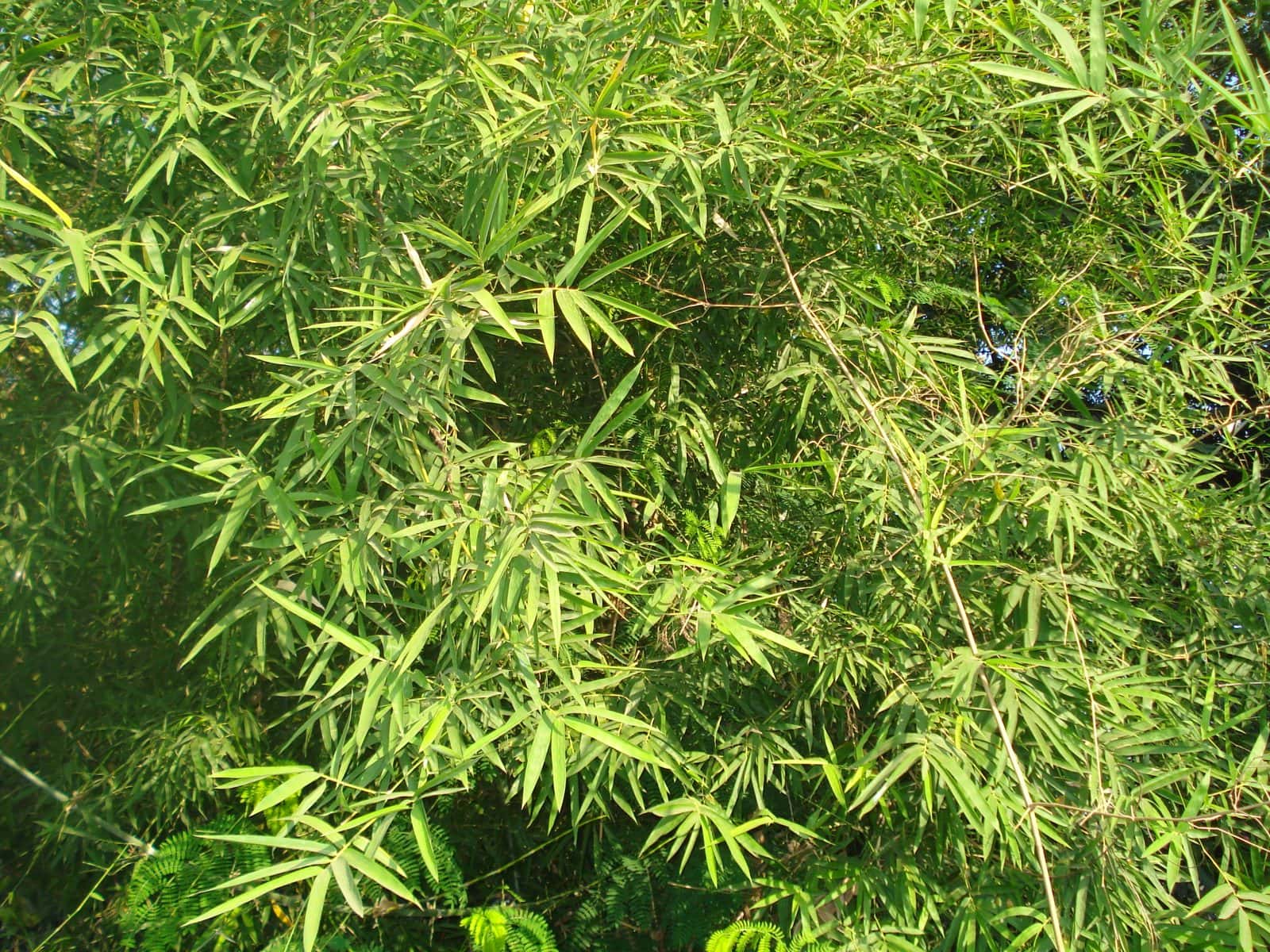
Dendrocalamus strictus, called male bamboo or lathi bans, is the most widely grown bamboo of India's dry deciduous forests. It is a clumping bamboo: new culms come up close to the existing clump instead of running far underground, so it stays where it is planted. It is drought hardy, thick-walled and often nearly solid, which is why it is used for poles and fencing. We use it for tall boundary screens on farms and industrial sites.
Dendrocalamus strictus · Bans · Lathi bans · Kal moongil (Tamil) · Male bamboo · Solid bamboo · Calcutta bamboo
Size
8–15 m tall, clumps 3–6 m across when mature
Growth
Fast
Leaf
Deciduous
Sun
Full sun to light shade
Water
Regular watering for the first two years; established clumps are drought tolerant
Soil
Most well-drained soils, including gravelly and poor soils; does badly in waterlogged or heavy, poorly drained clay
01
How to recognise Bamboo
Family Poaceae
- aCulms grow in dense clumps, 8–15 m tall and about 2.5–8 cm thick, with thick walls that are often nearly solid in drier areas.
- bCulms are pale green when young, turning dull green to yellowish-brown, with closely spaced nodes lower down.
- cLeaves are narrow and lance-shaped, rough to the touch, and much of the foliage is shed in the hot dry season.
- dNew shoots come up in the monsoon, covered in stiff sheaths with fine hairs.
- eFlowers are rare, borne in dense spiky clusters along leafless branches when a clump flowers.
- fOften confused with running bamboos, which spread by long underground rhizomes, and with Bambusa species, which have hollow culms and are often thorny at the base.
02
Bamboo (Male bamboo) in your city
How it grows in each city we work in, and what we do differently there.
Suits the Deccan climate around Pune, where it occurs naturally in dry forests. Good for farm boundaries on the city's outskirts.
Handles the dry heat once established. Young clumps may show leaf scorch after frosty nights in December–January and recover in spring.
Native to the dry forests of central India. On black cotton soil we raise the planting spot and add murrum so the rhizomes do not sit wet in the monsoon.
Grows, but frost can scorch leaves and new culms on young clumps. Plant in a sunny, sheltered spot and mulch heavily for the first winters.
Grows, but needs well-drained ground to avoid rot in the long monsoon. Not suited to spots with direct salt spray.
The mild climate suits it. Useful as a screen on farm and farmhouse boundaries around the city.
Well adapted to the hot, dry Deccan. Deep watering in the first two summers helps clumps establish faster.
One of the more drought-hardy bamboos for Gujarat's heat. Needs irrigation in the first two summers when temperatures reach 45°C.
Grows, but it prefers drier ground than much of Kolkata offers. Plant on raised bunds where water drains away after heavy rain.
03
Bamboo (Male bamboo) for industrial green belts
Where it goes in a three-row belt
Boundary side ← → factory side. This plant: outer tall row.
Male bamboo grows fast, forms a dense screen and tolerates dry, poor soils, and it is commonly used in green-belt plans along boundaries alongside native trees. Because it clumps, it stays in its planted line and does not spread across the site.
We place it on the outer boundary, clumps spaced about 4–5 m apart, often with trees in the same row so that the screen does not depend on one species. Bamboo sheds much of its foliage in the hot dry season, and a clump that flowers dies back, so we never make it the only species in a row.
The species mix, belt width and planting density that apply to a site are the ones set out in the unit's own consent to establish, consent to operate or environmental clearance.
04
Where it fits
- Tall boundary screen on farms, farmhouses and industrial plots.
- Outer tall row of a green belt where a dense visual and dust screen is wanted.
- Windbreak on the exposed side of a farm or orchard.
- Stabilising bunds and slopes where a clump's dense roots help hold soil.
05
Care
- Water weekly in the first dry season; established clumps survive on rainfall in most of the country but look better with a few deep waterings in summer.
- Mulch the clump base with leaves and compost; the fallen bamboo leaves can be left as mulch.
- From the third or fourth year, remove old, dead and congested culms each winter so new shoots have space and light.
- Protect new shoots from grazing animals during the monsoon, when they are soft.
- Apply compost or manure around the clump before the monsoon to support new shoot growth.
06
Common problems
- Gregarious flowering — the whole clump, and often all clumps from the same seed source, flower together after many years and the flowered culms die; replant from seedlings, and mix sources and species so a screen is not lost at once.
- Congested clumps — thin, weak new culms when old culms are never removed; thin the oldest and dead culms every winter.
- Termites on young plants — wilting and hollowed bases in dry soil; keep the soil moist while establishing and treat the planting pit if termites are active on the site.
- Rot in waterlogged soil — yellowing and decay of shoots after long wet spells; raise the planting spot and improve drainage.
07
Questions
Will this bamboo spread across my garden?
Dendrocalamus strictus is a clumping bamboo. The clump widens slowly each year, but it does not send runners far out the way running bamboos do.
Is it true bamboo dies after flowering?
This species flowers at long intervals, often decades apart, and the culms that flower die. Clumps from the same seed batch tend to flower together, which is why we mix planting stock and species in a screen.
How far apart should bamboo be planted for a screen?
For male bamboo on a boundary we usually plant clumps about 4–5 m apart. Closer spacing closes the gap faster but the clumps compete as they mature.
Do I need permission to cut bamboo on my land?
The Indian Forest Act was amended in 2017 so that bamboo grown outside forest areas is not treated as a tree. Transit rules for selling harvested culms can still vary by state, so check with the local forest office before transporting a harvest.
Also used for green belt
Guides that mention Bamboo (Male bamboo)
Begin with a visit
Request a proposal
Tell us about the space, or send photos on WhatsApp. We send a written proposal with a fixed price.
hi@gardenandacre.com