Plant library · Hedges · Green belt · Terrace
Clerodendrum (Wild jasmine hedge)
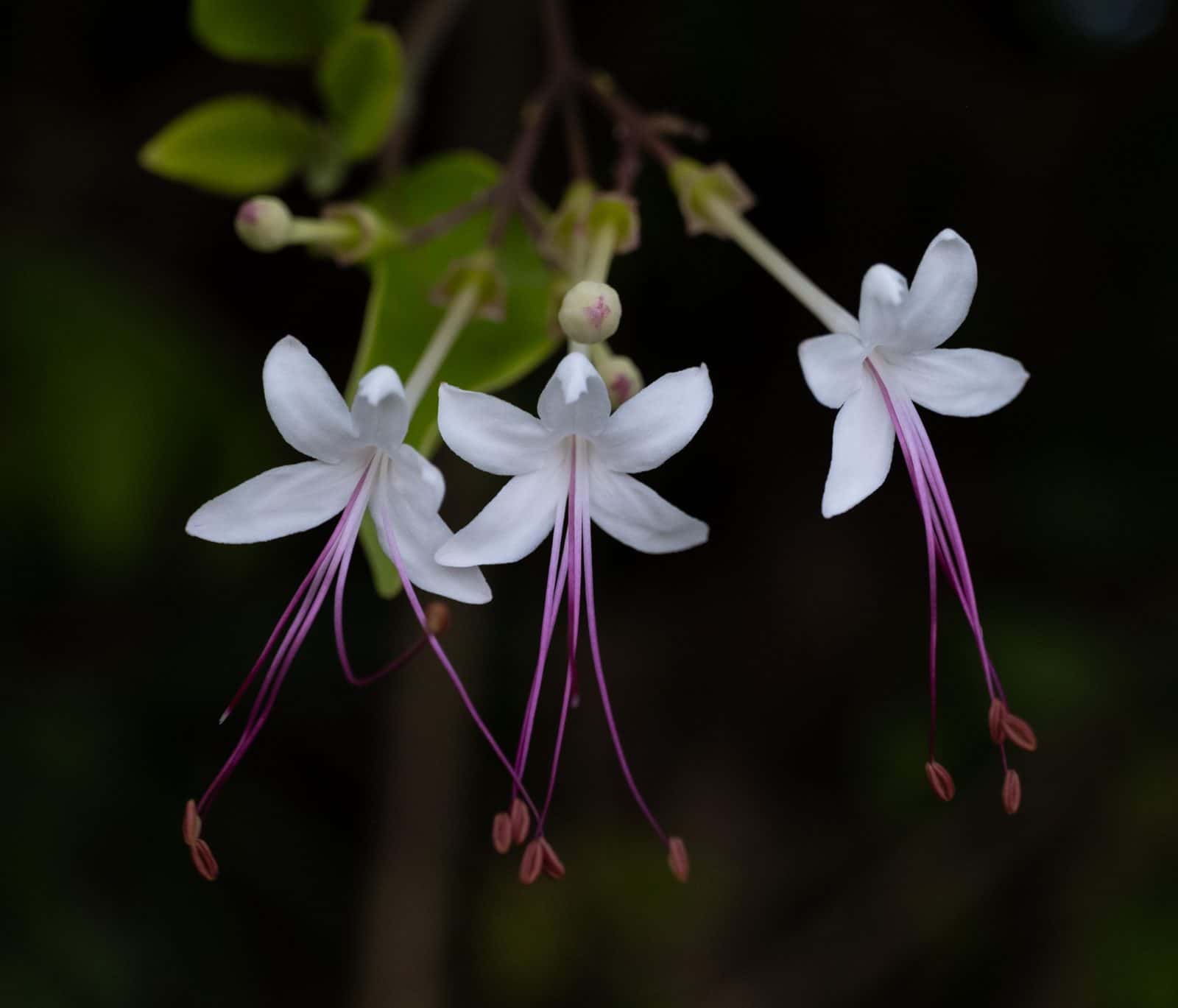
Clerodendrum inerme, now placed in the genus Volkameria, is one of the most common clipped hedges in Indian cities. It has glossy, slightly fleshy leaves, takes hard trimming well and tolerates salt air, poor soil and heat. Small white flowers with long purple stamens appear on unclipped growth and carry a light scent in the evening.
Volkameria inermis (syn. Clerodendrum inerme) · Lanjai · Vanajai · Sangankuppi
Size
1–2 m as a clipped hedge; up to 3 m and sprawling if left unpruned
Growth
Fast
Leaf
Evergreen
Sun
Full sun to light shade; hedges thin out at the base in heavy shade
Water
Moderate. Water young hedges two or three times a week in summer; established hedges in the ground tolerate dry spells.
Soil
Adapts to most soils, including sandy coastal soil and poor fill, as long as water does not stand around the roots
01
How to recognise Clerodendrum
Family Lamiaceae
- aLeaves are opposite, elliptic, 4–8 cm long, dark glossy green and slightly thick and leathery to the touch.
- bFlowers are white and tubular, in small clusters, with long purple-red stamens that stick well out of the petals.
- cFruit is a small round drupe that turns from green to dark brown or black when ripe.
- dHabit is a scrambling, many-stemmed shrub that becomes sprawling and loose if it is not clipped.
- eA variegated form with cream-edged leaves is also sold in nurseries.
- fOften confused with Duranta and Murraya (Kamini) hedges; Clerodendrum leaves are thicker and glossier and have no citrus smell when crushed.
02
Clerodendrum (Wild jasmine hedge) in your city
How it grows in each city we work in, and what we do differently there.
The mild climate suits it through the year. Clip after the monsoon flush and again before summer to keep the hedge dense.
Widely planted as a hedge in Delhi. Frost in late December and January can burn the tips, which recover once trimmed in February; water well through the May–June heat.
Handles black cotton soil if the trench is mixed with sand and compost so water drains after heavy rain.
Frost in December and January can scorch the outer growth and thin the hedge. Delay the main trim until the cold has passed and new shoots appear.
One of the better hedges for sea-facing sites because it tolerates salt air. Ensure beds drain in the monsoon, and clip after the rains end.
Steady growth through the year in the mild climate. Needs regular trimming, roughly every six to eight weeks in the growing season.
Tolerates the hot, dry summer once established. Mulch the base and water deeply rather than daily.
Handles heat up to 45°C in the ground; hedges on terraces or next to paving need extra water in April and May.
Grows fast in the humid climate. Watch for fungal leaf spot in the monsoon and keep the base open to air.
03
Clerodendrum (Wild jasmine hedge) for industrial green belts
Where it goes in a three-row belt
Boundary side ← → factory side. This plant: inner low row.
Clerodendrum is useful in the inner low row of an industrial green belt, on the side facing the plant or the road. It fills the gap between the ground and the lower branches of the trees behind it, which helps trap dust close to the source and gives the belt a finished edge.
It tolerates poor fill soil, heat and salt, and it recovers from hard cutting, so it suits factory sites where soil is rough and maintenance visits are spaced out. Planted about 45–60 cm apart in a single or staggered line, it closes into a continuous hedge within a year or two in most of our cities.
The species list, number of rows and planting density for a green belt are set by the unit's consent to establish, consent to operate or environmental clearance. Those conditions govern what is planted; shrub rows like this one are added where the conditions allow and do not replace the tree count they ask for.
04
Where it fits
- A clipped boundary or divider hedge for housing societies, campuses and farmhouses.
- A salt-tolerant hedge for coastal and sea-facing properties.
- The inner low row of an industrial green belt, under taller trees.
- A low screen in large terrace planters where wind and sun rule out softer shrubs.
- Topiary and shaped forms, since it responds well to frequent clipping.
05
Care
- Pruning: clip three to five times a year to keep a hedge dense. Cut a new hedge back by a third after planting to make it branch from the base, and keep the top slightly narrower than the bottom so light reaches the lower leaves.
- Feeding: apply compost or well-rotted manure before the monsoon and a balanced NPK fertiliser after each major trim during the growing season.
- Watering in the ground: water new hedges regularly for the first year; after that, deep watering once or twice a week in summer is usually enough.
- Watering in pots: on terraces, grow it in planters at least 45 cm deep and 45 cm wide; water when the top 3–4 cm of mix is dry, which may be daily in peak summer.
- Terrace wind: it copes with wind better than most flowering shrubs, but tie young plants to a stake until they root in, and use heavy planters that will not tip.
06
Common problems
- Mealybug — white cottony clusters on stems and leaf joints. Prune out badly affected shoots and spray neem oil or an insecticidal soap, repeating after a week.
- Leaf-eating caterpillars — ragged holes and chewed shoot tips. Pick off by hand on small hedges; use a Bt-based spray if the damage spreads.
- Bare base — the lower part of the hedge thins out. Usually caused by shade or a hedge clipped wider at the top; cut back hard in spring and reshape with a wider base.
- Root rot — yellowing and sudden wilting in the monsoon. Improve drainage around the bed and avoid watering during wet spells.
07
Questions
How far apart should Clerodendrum hedge plants be planted?
About 30–45 cm apart for a dense boundary hedge, or 45–60 cm for a looser green-belt row. Closer spacing gives a solid hedge sooner.
Does Clerodendrum inerme grow near the sea?
Yes. It tolerates salt air and sandy soil, which is why it is common along coastal roads and sea-facing buildings.
Why is my Clerodendrum hedge bare at the bottom?
Usually because the top is clipped wider than the base, so the lower leaves are shaded. Cut back hard in spring and shape the hedge so it tapers slightly towards the top.
Can Clerodendrum be grown in a pot?
Yes, in a planter at least 45 cm deep with a well-drained mix. It needs more frequent watering than a hedge in the ground and a feed after each trim.
Also used for hedges
Guides that mention Clerodendrum (Wild jasmine hedge)
Begin with a visit
Request a proposal
Tell us about the space, or send photos on WhatsApp. We send a written proposal with a fixed price.
hi@gardenandacre.com