Plant library · Hedges · Green belt · Terrace
Hamelia (Firebush)
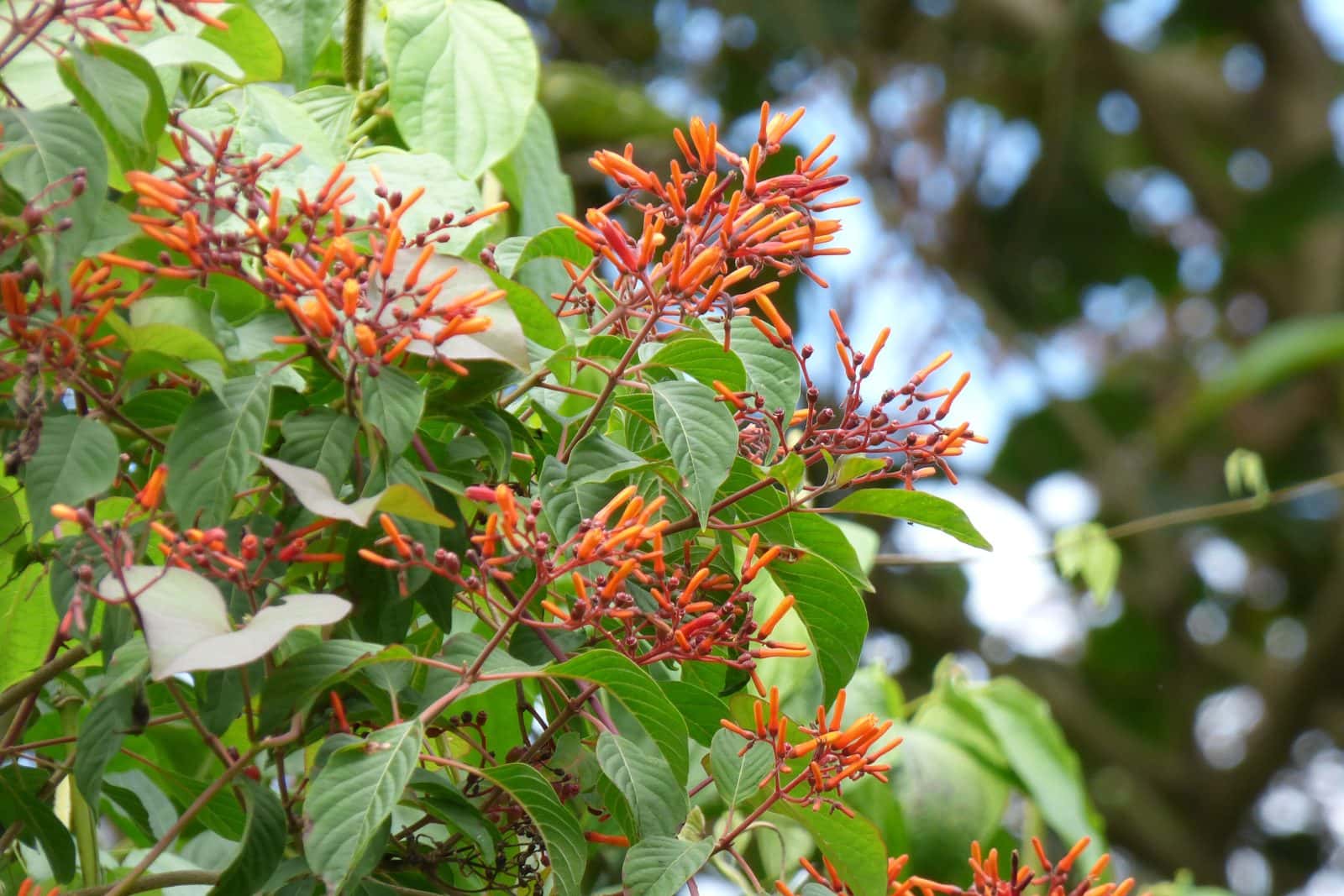
Hamelia patens, sold in Indian nurseries as Hamelia or Firebush, is a fast shrub from tropical America with orange-red tubular flowers for most of the year. It handles heat, dry spells and poor soil better than most flowering shrubs, which has made it common in road medians, industrial sites and society gardens. Sunbirds and butterflies visit the flowers.
Hamelia patens · Hamelia · Scarlet bush · Hummingbird bush
Size
1–2.5 m as a maintained shrub; up to 3–4 m if left unpruned
Growth
Fast
Leaf
Evergreen
Sun
Full sun for best flowering; tolerates part shade with fewer flowers
Water
Low to moderate once established. Water new plants regularly for the first few months; in pots, water when the top few centimetres of mix are dry.
Soil
Most well-drained soils, including sandy, rocky and mildly alkaline soil
01
How to recognise Hamelia
Family Rubiaceae
- aLeaves are elliptic, 8–15 cm long, usually in whorls of three around the stem, with red leaf stalks and veins; they often take on a reddish tinge in cool weather or full sun.
- bFlowers are narrow orange-red tubes about 2 cm long, held in branched clusters at the ends of the shoots.
- cFruit is a small berry that ripens from green through red to glossy black.
- dStems are reddish and slightly hairy on new growth, becoming woody at the base.
- eHabit is an upright, rounded shrub that can reach small-tree size if never cut back.
- fOften confused with Ixora from a distance; Ixora has flat four-petalled flower heads, while Hamelia has loose clusters of slender tubes.
02
Hamelia (Firebush) in your city
How it grows in each city we work in, and what we do differently there.
Flowers for most of the year in Pune's mild climate. Cut back once after the monsoon to keep it compact.
Handles the 45°C summer well, but frost in December and January can kill the top growth. Leave the damaged shoots until February, then cut back to live wood.
Copes with heat and dry spells. On black cotton soil, plant in a raised bed or a pit backfilled with sand and compost for drainage.
Frost in December and January often cuts it back to the base. Established plants usually regrow in spring; plant in a sheltered spot near walls.
Grows fast in the warm, humid climate. Needs good drainage through the monsoon and a hard trim afterwards.
Flowers through most of the year. Growth is steady, so two or three prunings a year keep it in shape.
One of the more reliable flowering shrubs for Hyderabad's hot, dry summer once roots are established.
Tolerates the 45°C heat in the ground. Terrace planters heat up more, so mulch the surface and water daily in May.
Grows vigorously in the humid climate. Prune after the monsoon so it does not become leggy.
03
Hamelia (Firebush) for industrial green belts
Where it goes in a three-row belt
Boundary side ← → factory side. This plant: inner low row.
Hamelia works in the inner low row of an industrial green belt. It grows quickly, fills in within a season or two and flowers through most of the year, which gives the front of the belt a maintained look without needing much attention.
It tolerates heat, reflected light from paving and dry spells, so it holds up along factory roads and boundary walls. Plant about 60–90 cm apart; in Delhi and Chandigarh, expect frost to cut back the top growth in some winters and plan a spring trim to bring it back.
The species, number of rows and spacing in a green belt are set by the unit's consent to establish, consent to operate or environmental clearance. Those conditions govern the planting; a shrub row like this is added where allowed and does not stand in for the trees they require.
04
Where it fits
- A flowering boundary or informal hedge for societies, campuses and farmhouses.
- The inner low row of an industrial green belt, where it adds colour under taller trees.
- Road medians and parking-lot islands where heat and reflected light are high.
- Large terrace planters and butterfly gardens.
05
Care
- Pruning: cut back by a third to a half once a year, after the monsoon or at the end of winter in the north, to keep it bushy. Light tip pruning during the year encourages more flowering shoots.
- Feeding: compost at the start of the monsoon and a balanced fertiliser two or three times in the growing season. Excess nitrogen gives leaves at the cost of flowers.
- Watering in the ground: water weekly for the first summer; established plants need water only in long dry spells.
- Watering in pots: use a container at least 40–45 cm wide and deep with drainage holes. Water when the top 3 cm is dry, daily in peak summer on a terrace.
- Terrace wind: the brittle young shoots can snap in strong wind, so place it where a parapet or taller plants give some shelter and tie tall plants to a stake.
06
Common problems
- Mealybug and scale — white or brown bumps on stems and under leaves, often with sticky honeydew and black sooty mould. Spray neem oil or insecticidal soap and cut out heavy infestations.
- Spider mite — fine speckling and dull, bronzed leaves in hot, dry weather. Hose the underside of the leaves and spray neem oil if it persists.
- Frost damage — blackened shoots after cold nights in north India. Leave them on as protection until the frost season is over, then prune back to healthy wood.
- Few flowers — usually too much shade or too much nitrogen. Move to full sun and cut back on high-nitrogen feed.
07
Questions
Does Hamelia need full sun?
It flowers best in full sun. In part shade it stays green but produces fewer flowers and grows more open.
Will Hamelia survive the winter in Delhi?
Established plants usually survive, although frost can kill the top growth. Cut it back to live wood in February and it regrows in the warm months.
How fast does Hamelia grow?
Fast. In warm cities a young plant can reach 1 m or more within a year, which is why it needs regular pruning to stay compact.
Can Hamelia be grown in a pot on a terrace?
Yes, in a container at least 40–45 cm wide and deep. Keep it in full sun, water often in summer and prune it once a year to keep the size manageable.
Begin with a visit
Request a proposal
Tell us about the space, or send photos on WhatsApp. We send a written proposal with a fixed price.
hi@gardenandacre.com