Plant library · Avenue & campus
Gulmohar
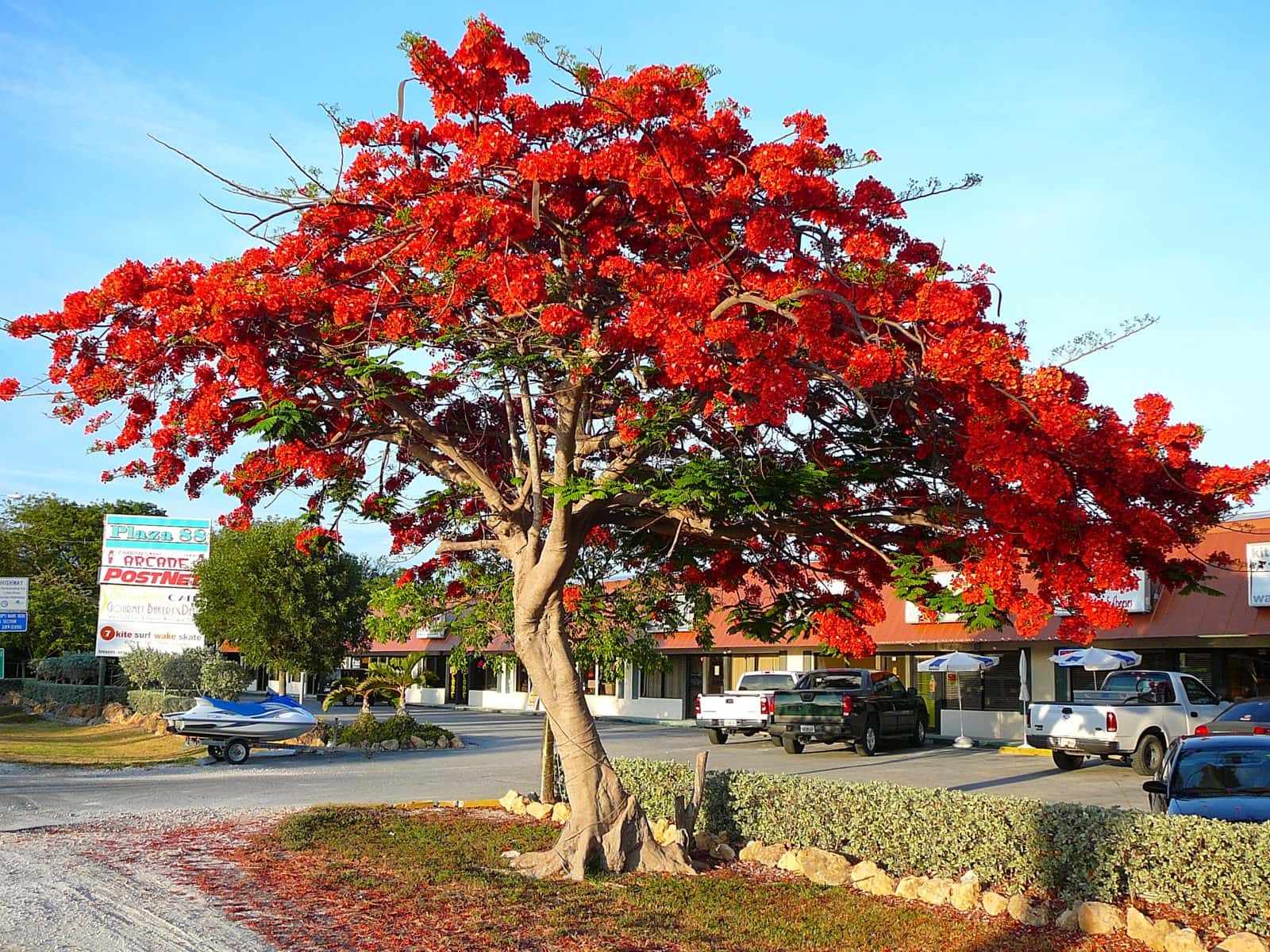
Gulmohar is the umbrella-shaped tree that turns red across Indian cities in April and May. It is native to Madagascar and has been planted in India for well over a century, mostly along roads, in campuses and in large gardens. It grows fast and gives wide, light shade, but its wood is brittle and its roots run close to the surface, so where you plant it matters.
Delonix regia · Gulmohar · Gulmohur · Krishnachura · Mayfair · Gulmohor · Kattu Theku · Royal poinciana · Flame tree
Size
8–12 m tall, 10–15 m spread
Growth
Fast
Leaf
Deciduous
Sun
Full sun. It flowers poorly in shade.
Water
Regular watering for the first two years; established trees need little beyond the monsoon, and a dry spell before summer helps flowering.
Soil
Well-drained soil of almost any type; it does not tolerate standing water around the roots.
01
How to recognise Gulmohar
Family Fabaceae
- aLeaves are feathery and fern-like, twice divided into many small leaflets, light green and soft to the touch.
- bFlowers are scarlet to orange-red, about 8–10 cm across, in large clusters at the branch tips from April to June; one of the five petals is larger, upright and streaked with white or yellow.
- cFruit is a long, flat, woody pod, dark brown when ripe and often 30–50 cm long, that hangs on the tree for months.
- dHabit is a low, wide umbrella crown, usually wider than the tree is tall, on a short trunk with smooth grey bark.
- eOften confused with Copper Pod (Peltophorum), which has similar feathery leaves but yellow flowers and short flat copper-coloured pods.
02
Gulmohar in your city
How it grows in each city we work in, and what we do differently there.
Pune's mild winters and dry pre-monsoon months suit it, and it flowers heavily in April and May. We plant it away from compound walls and paving because of its surface roots.
Mature trees handle Delhi's 45°C summers, but young plants can be scorched by frost in December and January. We plant after the monsoon has settled and cover saplings on cold nights for the first two winters.
It does well in Indore's hot summers and flowers reliably. On black cotton soil we open a large pit and mix in murum and compost so water drains away from the roots.
Winter frost in Chandigarh can kill back young shoots. We use well-grown saplings, plant in a sheltered spot and protect them through December and January until they are above head height.
It grows fast in Mumbai's warmth, but heavy monsoon winds snap its brittle branches. We plant on raised, well-drained ground and thin the crown before June.
Bangalore's mild climate suits it well and it is common on older roads. We keep it clear of building foundations and drains because the roots spread wide near the surface.
It handles the hot, dry Deccan summer and flowers well on red soils. Young trees need weekly watering through March to May for the first two years.
Established trees take Ahmedabad's 45°C heat without trouble. Saplings need regular deep watering in their first two summers and a mulch ring to keep the root zone cool.
Krishnachura is a familiar tree in Kolkata and grows fast in the humid heat. We plant on raised mounds where the ground floods in the monsoon, and prune weak limbs before storm season.
03
Where it fits
- A single shade tree in a large lawn, farmhouse or campus open space.
- Wide internal roads and boulevards with enough verge width for the roots.
- Parking areas where light, filtered shade is wanted and paving is set well back.
- Colour planting alongside Amaltas and Jacaranda for a summer flowering sequence.
04
Care
- Plant at least 6–8 m from buildings, compound walls and underground pipes; the roots lift paving close to the trunk.
- Prune young trees to a single strong leader and remove narrow-angled branches, which are the ones that split in storms.
- Thin the crown and remove dead wood each year before the monsoon to reduce wind damage.
- Water deeply and less often once established; frequent shallow watering encourages even more surface roots.
- Rake up fallen pods and flowers from paths, as they make paving slippery and messy in summer.
05
Common problems
- Looper caterpillars — the tree is stripped of leaves within days, usually in the monsoon. Mature trees recover on their own; on young trees we hand-pick or spray a biological insecticide such as Bt.
- Branch breakage — limbs split at weak forks in wind or after heavy rain. Prune to a strong structure when young and thin the crown yearly.
- Root rot — leaves yellow and the tree declines where water stands around the trunk. Improve drainage and avoid planting in low spots.
- Termites — mud tunnels on the trunk of young trees. Clear the tunnels and treat the soil around the base.
06
Questions
When does Gulmohar flower in India?
Mostly from April to June, often while the tree is partly bare. The exact timing shifts by a few weeks with the city and the year. In the south and on the coast it can start in March.
Is Gulmohar native to India?
No. It comes from Madagascar and was brought to India during the colonial period. It is now so widely planted that many people take it for a native tree.
Can I plant Gulmohar near my house?
Keep it at least 6–8 m from the building and away from pipes and paving. Its roots run near the surface and can lift floors and walls, and its branches break in storms.
How fast does Gulmohar grow?
In good conditions it can put on 1–1.5 m a year when young and usually starts flowering in 4–6 years from a nursery sapling.
Also used for avenue & campus
Begin with a visit
Request a proposal
Tell us about the space, or send photos on WhatsApp. We send a written proposal with a fixed price.
hi@gardenandacre.com