Plant library · Green belt · Avenue & campus
Banyan
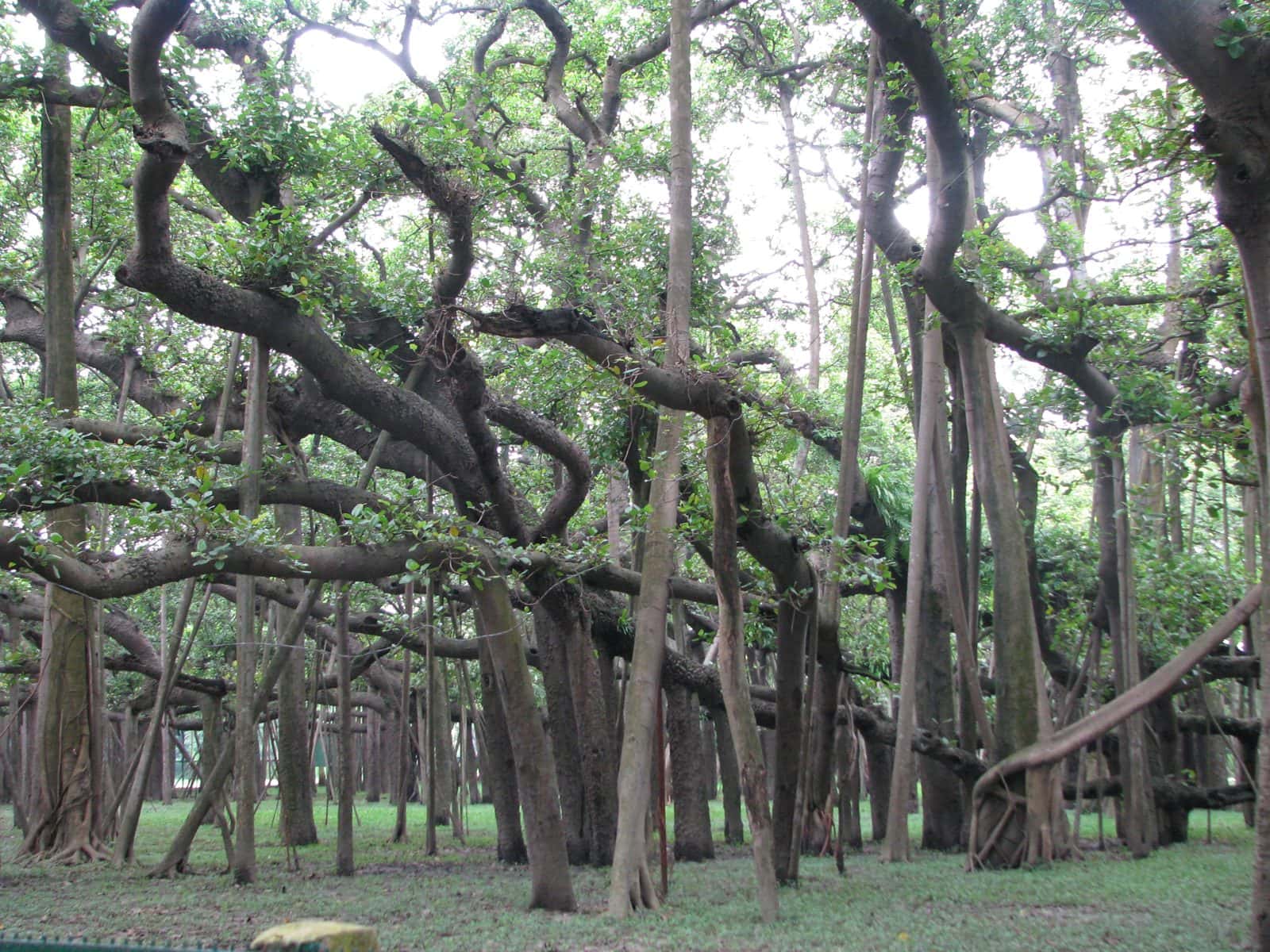
Banyan is India's national tree and one of the largest-spreading trees in the country. Its aerial roots drop from the branches, thicken into new trunks and let a single tree cover a very large area over time. It suits open land, large campuses and wide green belts.
Ficus benghalensis · Bargad · Bad · Vat · Vad · Vadlo · Aalamaram · Marri · Aala · Bot
Size
15–25 m tall, spread 20 m or more and increasing with age
Growth
Moderate
Leaf
Evergreen
Sun
Full sun
Water
Moderate when young; low once established
Soil
Deep soils of most types; tolerates clay and stony ground
01
How to recognise Banyan
Family Moraceae
- aLeaves are large, thick and leathery, oval, 10–20 cm long, with pale, clearly raised veins.
- bAerial roots hang from the branches and, where they reach the ground, grow into pillar-like trunks.
- cFruit are paired round figs about 1–2 cm across, turning red when ripe and eaten by many birds.
- dYoung shoots and leaf buds are covered with a soft down, and the leaf bud is wrapped in a sheath.
- eBark is smooth and grey-white; the crown is broad and dome-shaped, often wider than the tree is tall.
02
Banyan in your city
How it grows in each city we work in, and what we do differently there.
Banyan grows well in Pune and is a common roadside and temple tree. We plant it only where there is open ground for its spread.
Established banyans handle Delhi's heat and cold, but young plants can be frost-damaged in December–January. We plant in the monsoon and protect saplings through the first winter.
Banyan grows in Indore's black cotton soils. We keep it away from walls on this soil, since both the soil and the roots move structures.
Banyan grows in Chandigarh but young trees are sensitive to the region's winter frost. We shelter saplings for two winters and plant in July–August.
Banyan grows strongly in Mumbai's heavy rain and humidity. On urban plots we plan for its roots and spread from the start.
Bangalore's mild climate suits banyan well. It is best kept to large campuses, parks and open land.
Banyan tolerates the hot, dry Deccan once established. We water weekly through the first two summers.
Established banyans handle Ahmedabad's summer heat. Young trees need regular water and mulch from April to June.
Banyan grows vigorously in Kolkata's humid climate. We plant it only on open ground well away from buildings and drains.
03
Banyan for industrial green belts
Where it goes in a three-row belt
Boundary side ← → factory side. This plant: outer tall row.
Banyan is native, evergreen and very long-lived, and its broad canopy of large leathery leaves catches a good deal of dust. It is commonly used in green-belt plans where there is enough width, and it provides food for birds through the year.
We place banyan in the outer tall row, usually at corners or on the widest stretches of the belt, at much wider spacing than the trees around it. Its spread means it can shade out neighbours over time, so we plan the surrounding planting with that in mind and keep it clear of walls, drains and cables.
The species mix, belt width and planting density that apply are the ones written into the unit's own consent to establish or environmental clearance. Clearances commonly ask for about 2,500 trees per hectare, and we plan the rows to match whatever the document says.
04
Where it fits
- Corners and wide stretches of the outer row in a large green belt.
- Single specimen shade tree on campuses, farms and parks.
- Wide roads and highways with deep verges.
- Farmhouses and farms where a large shade tree is wanted near a gathering area or well.
05
Care
- Water weekly for the first two dry seasons.
- Give young trees a stake and a tree guard; banyan saplings are browsed by cattle and goats.
- Guide aerial roots onto open ground where you want new supporting trunks, and remove those that drop onto paths.
- Lift low branches over roads and paths as the tree grows.
06
Common problems
- Root and trunk spread — lifted paving and cracked walls near the tree. Plant at least 15 m from structures and allow for the crown to widen over the years.
- Leaf-eating caterpillars — holes and chewed edges on young leaves. Mature trees recover on their own; treat young trees only if damage is heavy.
- Scale insects and mealybugs — white or brown crusts on twigs with sticky leaves. Prune out heavy patches and treat young trees early.
- Fig drop — fallen fruit stain paving and bring birds. Keep banyans away from parking and entrances.
07
Questions
How much space does a banyan tree need?
A banyan needs a lot of room. Keep it at least 15 m from buildings and allow for a crown that can spread 20 m or more over the decades.
How fast does banyan grow?
Banyan grows at a moderate pace. It takes several years to give real shade, and the crown keeps widening for decades.
When should banyan be planted?
Plant at the start of the monsoon, June to August. In north India this gives young trees time to settle before winter frost.
Is banyan good for an industrial green belt?
It suits wide belts, placed at corners or in the outer row with extra spacing. For narrow belts, neem, arjun or jamun fit the space better.
Also used for green belt
Guides that mention Banyan
Begin with a visit
Request a proposal
Tell us about the space, or send photos on WhatsApp. We send a written proposal with a fixed price.
hi@gardenandacre.com