Plant library · Green belt · Avenue & campus · Miyawaki forest
Neem
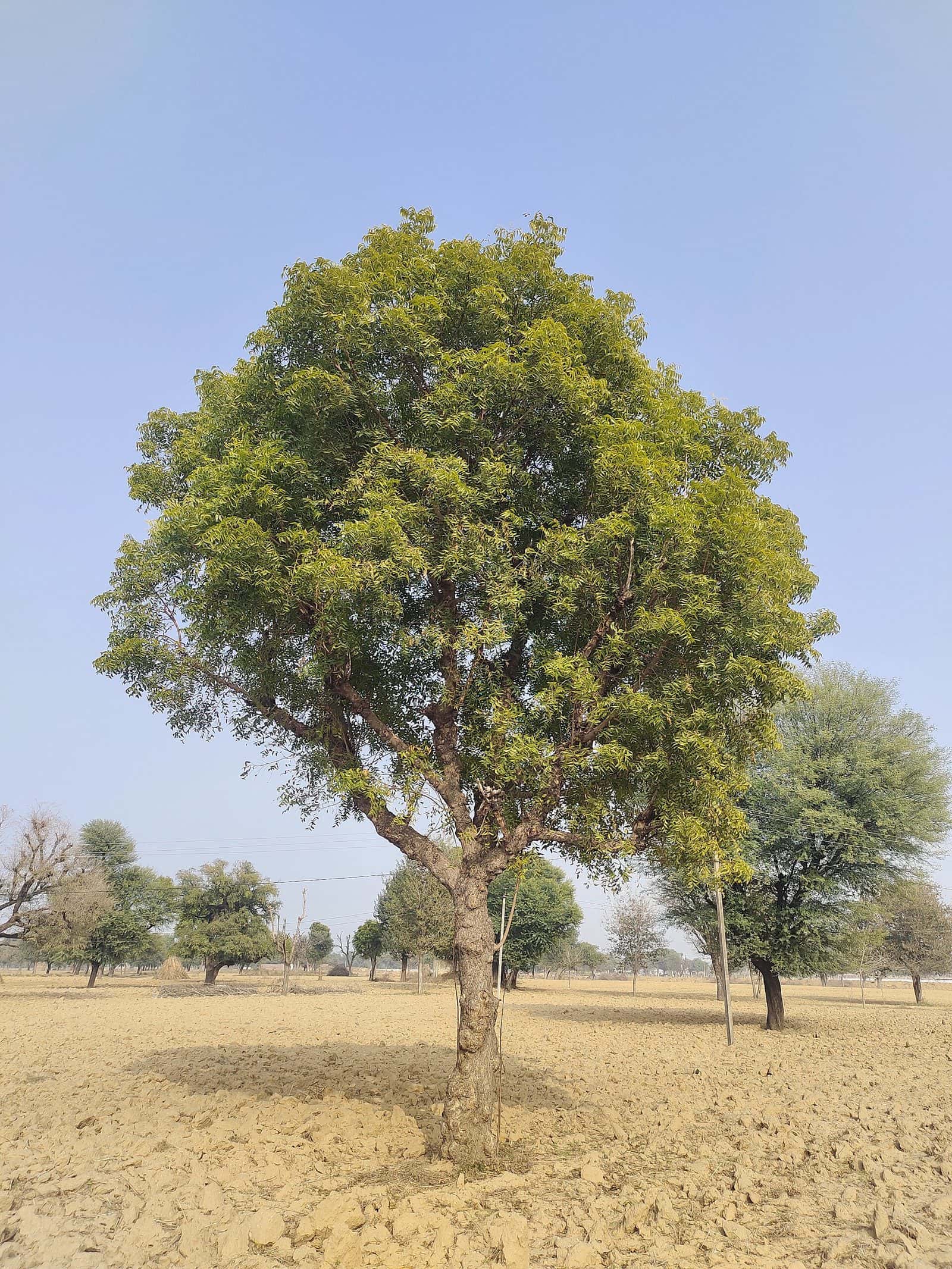
Neem is one of the most dependable native trees for hot, dry parts of India. It takes poor soil, long dry seasons and dusty roadsides, and keeps a dense, mostly evergreen canopy through the year. That is why it appears in so many green-belt plans, avenues and campus boundaries.
Azadirachta indica · Nimb · Nimba · Vepa · Vembu · Limdo · Kadunimb · Bevu · Nim
Size
12–18 m tall, 8–12 m spread
Growth
Moderate
Leaf
Evergreen
Sun
Full sun
Water
Low once established; weekly watering in the first two dry seasons
Soil
Most soils including sandy, stony and black cotton soil; needs drainage and does not like standing water
01
How to recognise Neem
Family Meliaceae
- aLeaves are pinnate, 20–40 cm long, with 9–15 narrow, curved leaflets that have sawtooth edges and a pointed tip.
- bFlowers are small, white and honey-scented, carried in loose drooping clusters from about March to May.
- cFruit is an olive-like drupe, green at first and yellow when ripe, usually from June to August.
- dBark is grey to dark brown, rough and furrowed on older trunks; the crown is rounded and dense.
- eOften confused with Bakain (Melia azedarach), which has twice-divided leaves, lilac flowers and round yellow berries that stay on bare branches.
02
Neem in your city
How it grows in each city we work in, and what we do differently there.
Neem does well on Pune's murrum and shallow soils. We plant at the start of the monsoon and water through the first two summers.
Mature trees handle Delhi's 45°C summers well, but young plants can be scorched by frost in late December and January. We plant after the monsoon arrives and cover saplings on the coldest nights of the first winter.
Neem is one of the best choices for Indore's black cotton and stony soils. On heavy black soil we dig wider pits and add murrum or sand so water does not sit around the roots.
Chandigarh's winter frost can burn the leaves of young neem and sometimes kill saplings. We plant in July–August so the tree has a full season of growth before its first winter, and shelter it for the first two winters.
Neem grows in Mumbai but dislikes waterlogged ground during the heavy monsoon. We plant on raised or well-drained spots and avoid low corners where water collects.
Bangalore's mild climate and red soils suit neem. Growth is steady and trees need little attention after the second year.
Neem is at home in the hot, dry Deccan around Hyderabad. We water weekly through the first two summers, after which rainfall is usually enough.
Neem handles Ahmedabad's 45°C heat and dry winds better than most shade trees. We mulch the basin and water young plants through April–June.
Neem grows in Kolkata but slows down on heavy, wet clay. We choose higher ground and improve drainage before planting.
03
Neem for industrial green belts
Where it goes in a three-row belt
Boundary side ← → factory side. This plant: outer tall row.
Neem is native, grows in almost any well-drained soil and survives long dry spells once established. Its dense, mostly evergreen canopy holds dust through the year, and it tolerates roadside and industrial conditions well. It is commonly used in green-belt plans across central, western and southern India.
We place neem in the outer tall row on the boundary side, spaced so the crowns close over a few years. On dry or rocky sites it often forms the backbone of the belt, with faster or broader trees mixed in between. It needs watering only for the first two dry seasons, which keeps upkeep low on large belts.
The species mix, belt width and planting density that apply are the ones written into the unit's own consent to establish or environmental clearance. Clearances commonly ask for about 2,500 trees per hectare, and we plan the rows to match whatever the document says.
04
Where it fits
- Outer tall row of an industrial green belt, especially on dry or stony land.
- Avenue tree along internal roads and boundary walls.
- Shade tree for campus parking and open grounds.
- Pioneer species in a Miyawaki forest on poor soil.
- Boundary tree on farmhouses and farms in dry districts.
05
Care
- Water weekly in the first two dry seasons, then only in long droughts.
- Keep the basin mulched and weed-free for the first two years.
- Formative pruning in the first three years gives a clean trunk for avenues and belts.
- Remove dead twigs after the monsoon, when dieback is most visible.
- Avoid planting in spots where rainwater stands for days.
06
Common problems
- Tea mosquito bug — young shoots and twigs dry out and blacken from the tip, often after the monsoon. Prune out affected twigs and spray only if damage spreads across the crown.
- Twig dieback — branches die back from the tips in patches. Cut back to healthy wood, clear fallen twigs and check that the roots are not waterlogged.
- Scale insects — small raised bumps on stems with sticky leaves and sooty mould. Prune heavy patches and treat young trees early.
- Frost scorch — leaves turn brown after cold nights in north India. Leave the damage until spring, then prune back to live buds.
07
Questions
How fast does neem grow?
Neem grows at a moderate pace, often about a metre a year when young with regular water. Most trees give useful shade in five to seven years.
How far from a building should I plant a neem tree?
Keep neem at least 5–6 m from walls and foundations. Its roots are less aggressive than those of peepal or banyan, but the crown needs room to spread.
When is the best time to plant neem?
Plant at the start of the monsoon, June to August, so the roots settle before the dry season. In north India, avoid late autumn planting because young plants may not survive the first frost.
Is neem suitable for an industrial green belt?
Yes. Neem is one of the species most commonly used in green-belt plans because it is native, hardy, mostly evergreen and needs little water once established.
Also used for green belt
Begin with a visit
Request a proposal
Tell us about the space, or send photos on WhatsApp. We send a written proposal with a fixed price.
hi@gardenandacre.com