Plant library · Green belt · Avenue & campus
Peepal
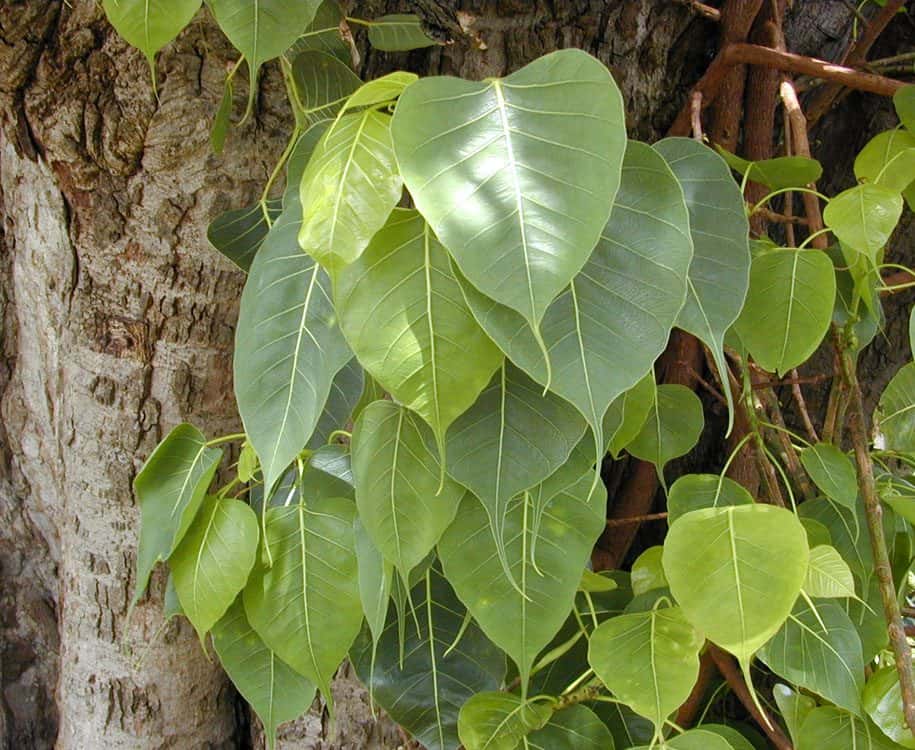
Peepal is a large native fig with a broad crown and long-tailed, heart-shaped leaves that flutter in the lightest breeze. It is long-lived, very hardy and gives heavy shade, but its roots are strong enough to crack walls and paving. It needs open ground and a site where it can stay for decades.
Ficus religiosa · Pipal · Ashvattha · Pimpal · Piplo · Raavi · Arasamaram · Arali
Size
15–25 m tall, 15–20 m spread
Growth
Fast
Leaf
Semi-evergreen
Sun
Full sun
Water
Low to moderate once established
Soil
Almost any soil, from sandy to clay; tolerates rocky ground
01
How to recognise Peepal
Family Moraceae
- aLeaves are heart-shaped with a long, narrow tail at the tip, 10–17 cm long, on a slender stalk that lets them tremble in wind.
- bNew leaves are copper-pink to reddish, usually appearing in spring after a short leafless spell.
- cFruit are small paired figs without stalks, green at first and purple-black when ripe; birds eat them in large numbers.
- dBark is smooth and grey on young trees, becoming patchy and uneven with age.
- eOften seen as a seedling growing out of walls, roofs and cracks, where birds have dropped the seeds.
02
Peepal in your city
How it grows in each city we work in, and what we do differently there.
Peepal grows fast in Pune's climate. We only plant it where there is at least 15 m of open ground around it.
Mature peepal handles Delhi's heat and winter well; very young plants can be touched by frost in January. We plant in July and protect saplings through their first winter.
Peepal takes Indore's black cotton and stony soils without difficulty. We keep it well clear of boundary walls, which black soil movement already stresses.
Peepal is widely grown around Chandigarh. Saplings need cover from frost in December–January for the first year or two.
Peepal grows vigorously in Mumbai's heavy rain. On tight urban plots we generally advise against it because of root damage to compound walls and drains.
Bangalore's mild climate suits peepal. It is best kept to large campuses, parks and belts where roots will not meet foundations.
Peepal tolerates the hot, dry Deccan summer once established. We water young trees through the first two summers.
Peepal takes Ahmedabad's 45°C summers well after establishment. We mulch and water weekly in the first two hot seasons.
Peepal grows fast in Kolkata's humid climate and wet soils. Its main risk here is root damage to old buildings, so we plant it only in open ground.
03
Peepal for industrial green belts
Where it goes in a three-row belt
Boundary side ← → factory side. This plant: outer tall row.
Peepal is native, fast-growing and very hardy, with a broad, dense canopy that traps dust for most of the year. It sheds its leaves only briefly in spring and grows back quickly. It is commonly used in green-belt plans where the belt is wide enough to hold a large tree.
We place peepal in the outer tall row, on the boundary side, at wider spacing than neem or jamun because each tree eventually covers a large area. We keep it away from boundary walls, drains, pipelines and underground cables. Many people are also reluctant to cut or lop a peepal later because of its cultural significance, so we plant it only where it can stay.
The species mix, belt width and planting density that apply are the ones written into the unit's own consent to establish or environmental clearance. Clearances commonly ask for about 2,500 trees per hectare, and we plan the rows to match whatever the document says.
04
Where it fits
- Outer tall row of a wide green belt, well away from structures.
- Specimen shade tree in large campuses and parks.
- Wide avenues and open village-style roads with deep verges.
- Farmhouse boundaries where a long-lived, large tree is wanted.
05
Care
- Water weekly for the first two dry seasons; after that it needs little.
- Stake young trees in windy sites until the trunk firms up.
- Remove seedlings from walls and roofs while they are small, before roots enter the masonry.
- Lift low branches over paths and roads as the tree grows.
- Sweep fallen figs from paved areas in the fruiting season, as they stain and attract birds.
06
Common problems
- Root damage — cracked walls, lifted paving or blocked drains near the tree. Prevent it by planting at least 12–15 m from structures; on existing trees, get advice before cutting large roots.
- Leaf galls — small raised bumps on leaves caused by sap-sucking insects. They look untidy but rarely harm a healthy tree, and usually need no treatment.
- Leaf-eating caterpillars — ragged holes and partly eaten young leaves in spring. Mature trees recover on their own; spray young trees only if damage is heavy.
07
Questions
How far from a house should a peepal tree be planted?
Keep peepal at least 12–15 m from buildings, compound walls, septic tanks and pipelines. Its roots spread widely and can crack masonry.
How fast does peepal grow?
Peepal grows fast, and a well-watered young tree can add 1–2 m a year. It gives useful shade within five or six years.
Is peepal evergreen?
Nearly. Peepal drops most of its leaves for a short spell in spring and quickly puts out new pinkish-copper leaves.
Can peepal be planted in an industrial green belt?
Yes, if the belt is wide enough. It is commonly used in green-belt plans for its large, dense canopy, but it should be planted well away from structures and underground services.
Also used for green belt
Guides that mention Peepal
Begin with a visit
Request a proposal
Tell us about the space, or send photos on WhatsApp. We send a written proposal with a fixed price.
hi@gardenandacre.com