Plant library · Green belt · Avenue & campus · Miyawaki forest
Arjun
Arjun is a tall native tree of riverbanks and stream sides, recognised by its smooth, pale bark that peels off in flakes. It tolerates seasonal flooding and heavy soils better than most large trees, which makes it useful on low-lying and wet sites. It is a common choice for avenues and green belts.
Terminalia arjuna · Arjuna · Kahua · Sadada · Sadad · Marudhu · Tella Maddi · Holematti
Size
18–25 m tall, 10–15 m spread
Growth
Moderate
Leaf
Semi-evergreen
Sun
Full sun
Water
Moderate; tolerates seasonal waterlogging
Soil
Deep alluvial, clay and black soils; tolerates heavy and periodically wet ground
01
How to recognise Arjun
Family Combretaceae
- aBark is smooth, grey-white to pinkish, and peels off in thin, irregular flakes, leaving a mottled trunk.
- bLeaves are oblong, 10–15 cm long, in near-opposite pairs, often with two small glands near the base of the leaf.
- cFlowers are tiny, creamy yellow, in short spikes, usually from about April to June.
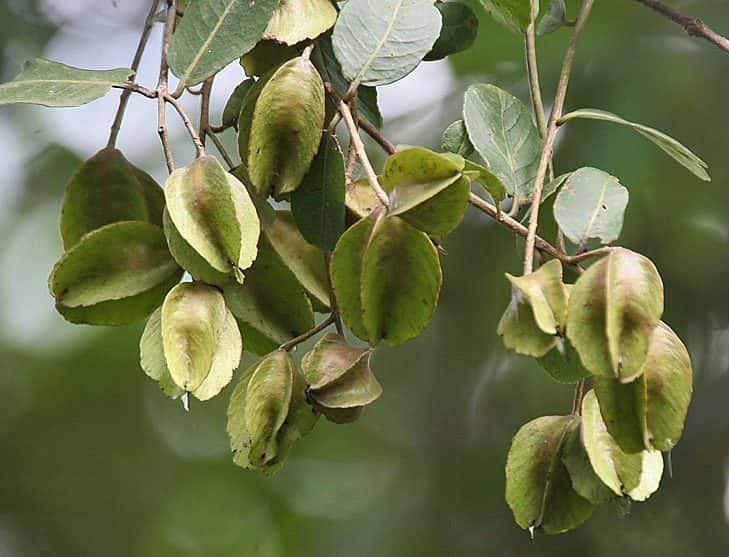
- dFruit is woody, 2–5 cm long, with five hard, papery wings, turning brown as it ripens in the cooler months.
- eTrunk is straight and often buttressed at the base in older trees, with a spreading crown.
02
Arjun in your city
How it grows in each city we work in, and what we do differently there.
Arjun does well in Pune, especially near nallahs and on deeper soils. On shallow murrum we give it bigger pits and more water in the first two summers.
Arjun is widely planted in Delhi. Young plants can be damaged by frost in January and scorched by 45°C heat in May, so we water and shelter them for the first two years.
Arjun suits Indore's deep black cotton soils, which hold moisture it likes. On stony patches we improve the pit with soil and compost.
Arjun grows in Chandigarh but saplings are frost-tender in December–January. We plant in the monsoon and protect young trees for two winters.
Arjun copes with Mumbai's heavy monsoon and wet ground better than most large trees. It is a good choice for low-lying plots that flood briefly.
Arjun grows steadily in Bangalore's mild climate. We use it on campuses and along lakes and storm-water drains.
Arjun needs more water than neem in the hot, dry Deccan. We plant it where soil is deeper or near water, and water weekly through the first three summers.
Ahmedabad's dry heat stresses young arjun trees. We mulch heavily, water through April–June and favour deeper, moisture-holding soil.
Arjun is well suited to Kolkata's wet, alluvial soils and waterlogging during the monsoon.
03
Arjun for industrial green belts
Where it goes in a three-row belt
Boundary side ← → factory side. This plant: outer tall row.
Arjun is native, tall and long-lived, with a broad crown that stays in leaf for most of the year and sheds only briefly in dry places. It takes heavy clay and periodic waterlogging, which many green-belt trees do not, and it is commonly used in green-belt plans in the plains.
We place arjun in the outer tall row, and we favour it on the wetter side of a site, along drains or in low patches where neem would struggle. It needs more water than neem in its first few years in dry cities, so we plan irrigation for it accordingly.
The species mix, belt width and planting density that apply are the ones written into the unit's own consent to establish or environmental clearance. Clearances commonly ask for about 2,500 trees per hectare, and we plan the rows to match whatever the document says.
04
Where it fits
- Outer tall row of a green belt, especially on low-lying or wet land.
- Avenue tree for internal roads, with a straight trunk and high crown.
- Along storm-water drains, ponds and lake edges on campuses.
- Tall layer species in a Miyawaki forest.
05
Care
- Water weekly in dry months for the first two to three years.
- Mulch the basin to hold moisture, especially in dry cities.
- Prune to a single straight leader for avenues and belts in the first few years.
- Use tree guards against termites and cattle on open sites.
06
Common problems
- Leaf-eating caterpillars — chewed leaves and bare shoots in the monsoon. Mature trees usually recover; spray young trees only if they are badly stripped.
- Termites — wilting saplings with mud tunnels on the stem, mainly on dry sites. Keep the basin weed-free and treat the pit soil where termites are known to be a problem.
- Powdery mildew — white powdery patches on young leaves in humid spells. Improve airflow and treat if it spreads on young trees.
- Drought stress — leaf drop and slow growth on shallow, dry soil. Water more deeply and mulch the basin.
07
Questions
How fast does arjun grow?
Arjun grows at a moderate pace, faster on deep, moist soil. With regular water, young trees can add around a metre a year.
Can arjun grow in waterlogged soil?
Yes. Arjun is a riverbank tree and tolerates seasonal waterlogging better than most large trees, which is why we use it on low-lying sites.
How far from a building should arjun be planted?
Keep arjun about 6–8 m from buildings so the crown and roots have room. It is a large tree when mature.
Is arjun used in industrial green belts?
Yes. Arjun is commonly used in green-belt plans, especially in the outer row and on wetter parts of a site.
Begin with a visit
Request a proposal
Tell us about the space, or send photos on WhatsApp. We send a written proposal with a fixed price.
hi@gardenandacre.com