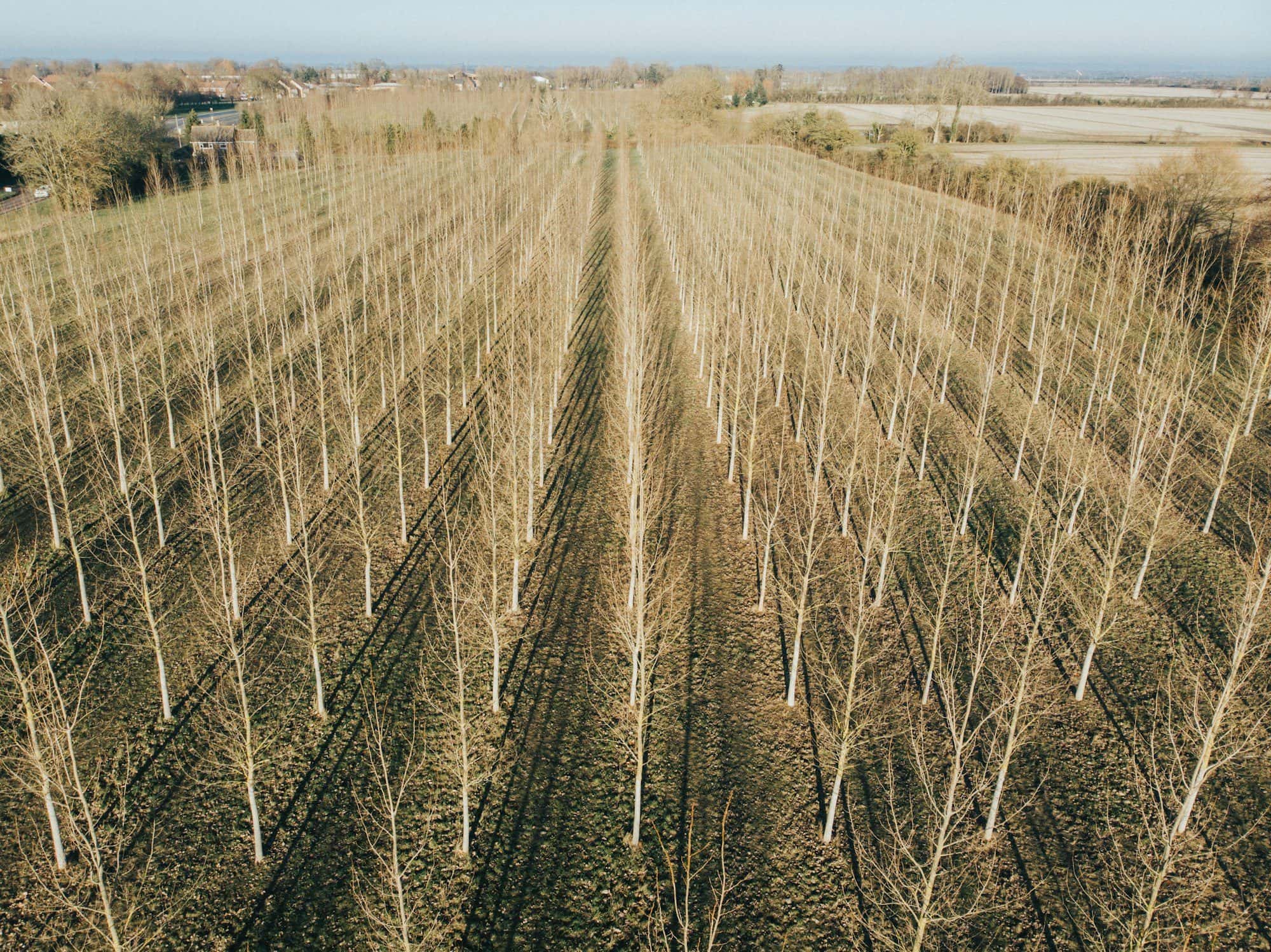
How a three-row industrial green belt is laid out, how far apart the trees go, how the 2,500-trees-per-hectare figure works out on the ground, and how survival is kept up.
Part 1
The three-row layout
A green belt is planted in bands that rise from the inside to the boundary: shrubs on the factory side, medium trees in the middle and tall trees on the outside. Seen from the side it forms a slope that catches dust and breaks noise at every height.
Where the plot allows, the rows are staggered so each tree sits opposite a gap in the next row. This closes the belt faster than trees planted in straight lines.
Part 2
Spacing
Planting 2,500 trees per hectare works out to one tree every 2 m × 2 m, or 4 sq m per tree. That is closer than an avenue, on purpose: the trees shade out weeds and grow into a continuous canopy within a few years.
Tall trees in the outer row are often spaced wider, 3–4 m apart, with medium trees and shrubs filling between them. The average across the belt is what counts towards the density in your order.
Part 3
Width
Many clearances specify a belt of a set width along the boundary, and some ask for wider belts on the side facing residential areas or the prevailing wind. A narrow belt of two rows is better than none, but three rows of at least 10–15 m in total give the screening the condition intends.
Where the boundary is too narrow, the remaining area is often met with dense planting elsewhere on the site, such as around the admin block or along internal roads. Check with your consent whether that counts.
Part 4
Pits, planting and water
Each sapling goes into a pit about 60 cm cube filled with soil, compost and, where termites are common, a treatment at the base. Planting is done at the start of the monsoon so roots grow before the dry season.
Drip lines along each row are the most reliable way to water through the first two summers. After that, most native green-belt trees need water only in long dry spells.
Part 5
Survival and gap filling
Some saplings always fail in the first year. Gap filling in the next monsoon replaces them so the density in the register stays true. We count survival row by row every quarter and record it with photos, which is what inspectors ask to see.