Plant library · Terrace · Miyawaki forest
Harsingar (Parijat)
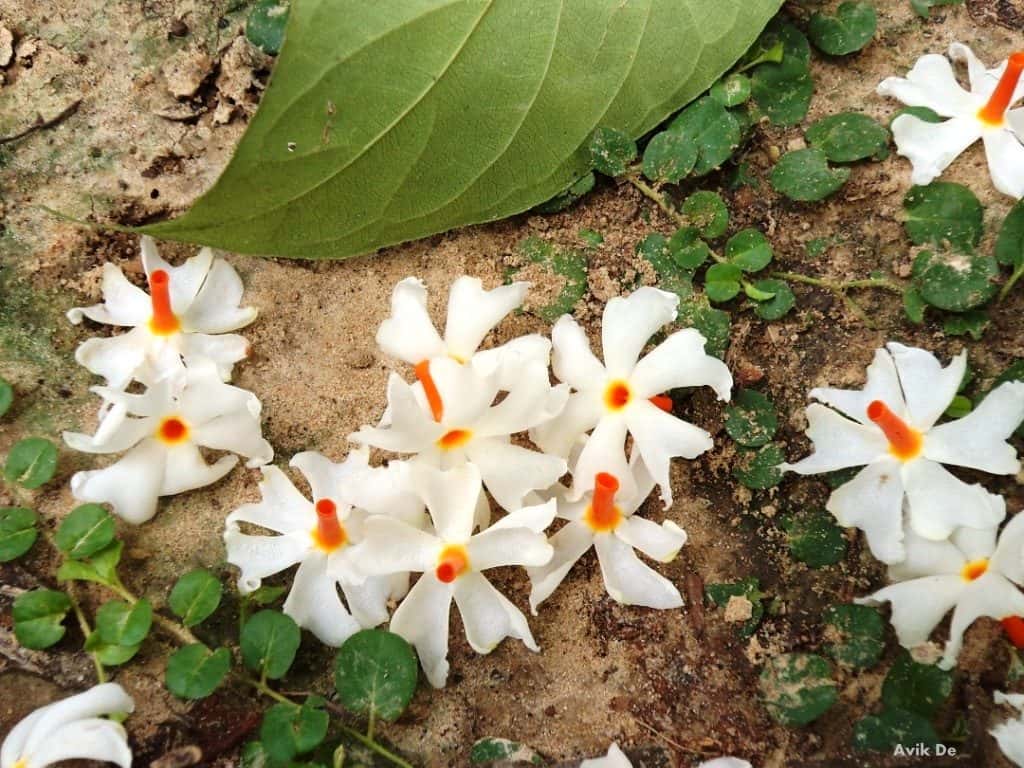
Harsingar is a native shrub or small tree whose small white flowers with orange tubes open at night and fall by morning, covering the ground below. It flowers mainly from about August to December and is valued for its fragrance and cultural significance; it is the state flower of West Bengal, where it is called shiuli. It grows in the ground or in a large container on a terrace, and in a Miyawaki forest it fits the shrub layer. The flowers and leaves are used in Ayurveda and in traditional practice.
Nyctanthes arbor-tristis · Harsingar · Parijat · Shiuli (Bengali) · Parijatak (Marathi) · Pavazhamalli (Tamil) · Parijatham (Telugu) · Night-flowering jasmine · Coral jasmine
Size
3–5 m tall and 2–3 m wide in gardens; 1.5–2.5 m in large containers
Growth
Moderate
Leaf
Deciduous
Sun
Full sun to partial shade; at least four to five hours of direct sun for good flowering
Water
Moderate; water when the top few centimetres of soil are dry, less in winter
Soil
Well-drained loam or sandy loam; in containers a free-draining mix with compost
01
How to recognise Harsingar
Family Oleaceae
- aLeaves are opposite, oval and pointed, with a rough, sandpaper-like surface on both sides.
- bFlowers are small and white with five to eight lobes and a bright orange tube at the centre, strongly fragrant at night.
- cFlowers open after dusk and drop by early morning, leaving a carpet of white and orange under the plant.
- dStems are four-angled when young and slightly rough.
- eFruit is a flat, rounded to heart-shaped capsule that splits into two halves, each with one seed.
- fOften confused with jasmines (Jasminum species), which have smooth leaves and flowers that usually stay on the plant, without the orange tube.
02
Harsingar (Parijat) in your city
How it grows in each city we work in, and what we do differently there.
Suits Pune's mild climate and flowers well from the end of the monsoon into winter. Grows well on terraces in large containers.
Common in Delhi gardens and flowers through autumn. It may drop leaves or get tip damage in frosty spells in December–January; give it a sheltered spot and water well in the 45°C heat.
Grows well in the region. In black cotton soil we add sand and compost to the pit so it drains after rain.
Grows, but frost can damage shoots in December–January. Plant against a south- or west-facing wall, or move containers to shelter on cold nights.
Grows, but needs a sunny, well-drained spot to avoid root rot in the long monsoon. On sea-facing terraces, shield it from direct salt wind.
The mild climate suits it well. Flowers best in a sunny spot.
Handles the dry Deccan heat with regular watering in summer. Afternoon shade helps terrace plants in April–May.
Grows, but terrace plants need shade netting or afternoon shade and daily watering when temperatures reach 45°C.
Shiuli is a familiar garden plant in Bengal and flowers around the autumn festival season. Keep the base above standing water in the monsoon.
03
Where it fits
- Terrace gardens in a large container of at least 45–60 cm depth.
- Shrub layer of a Miyawaki forest, beneath the tree and sub-canopy species.
- Near seating, windows or entrances where the evening fragrance can be enjoyed.
- Temple gardens, courtyards and farmhouse gardens where flowers are collected in the morning.
04
Care
- Water regularly in summer and during flowering, and cut back in winter; never let containers stand in water.
- Prune after flowering ends, in late winter, to shape the plant and encourage bushy new growth.
- Feed with compost or well-rotted manure before the monsoon to support the flowering season that follows.
- Repot or top-dress container plants every two to three years with fresh mix.
- Keep the ground below clear and mulched so fallen flowers can be collected cleanly.
05
Common problems
- Leaf-eating caterpillars — chewed or rolled leaves in the monsoon; pick them off by hand or use a biological spray such as Bt.
- Sucking insects and sooty mould — black film on leaves from aphids, mealybugs or scale; wash off with water and use neem oil or insecticidal soap.
- Root rot — sudden wilting and yellowing in pots or wet soil; improve drainage and water less often.
- Sparse flowering — usually too much shade or heavy pruning late in the season; move to a sunnier spot and prune only after flowering.
06
Questions
When does harsingar flower?
Mainly from about August to December, with flowers opening at night and dropping by morning. Timing shifts a little by region.
Can harsingar be grown in a pot?
Yes. Use a container at least 45–60 cm deep with drainage holes and a free-draining mix, and place it where it gets at least four to five hours of sun.
Why is my parijat plant not flowering?
The usual causes are too much shade, a young plant, or pruning too late in the year. Give it more sun, feed before the monsoon, and prune only after the flowering season ends.
Is harsingar the same as jasmine?
No. It is in the same family as jasmines but a different plant. Its rough leaves and white flowers with an orange tube that fall by morning set it apart.
Begin with a visit
Request a proposal
Tell us about the space, or send photos on WhatsApp. We send a written proposal with a fixed price.
hi@gardenandacre.com